Image source: wikiart.org
Introduction to Hercules Fighting the Erymanthian Boar
Francisco de Zurbaran’s “Hercules Fighting the Erymanthian Boar” reveals a side of the Spanish Baroque master that many viewers do not immediately associate with his name. Better known for solemn monks, virgins and martyrs, Zurbaran was also commissioned to paint a series of the Labors of Hercules for a royal setting. In this scene he turns from monasteries to mountains, from friars to a near naked demigod locked in a primal struggle with a ferocious beast.
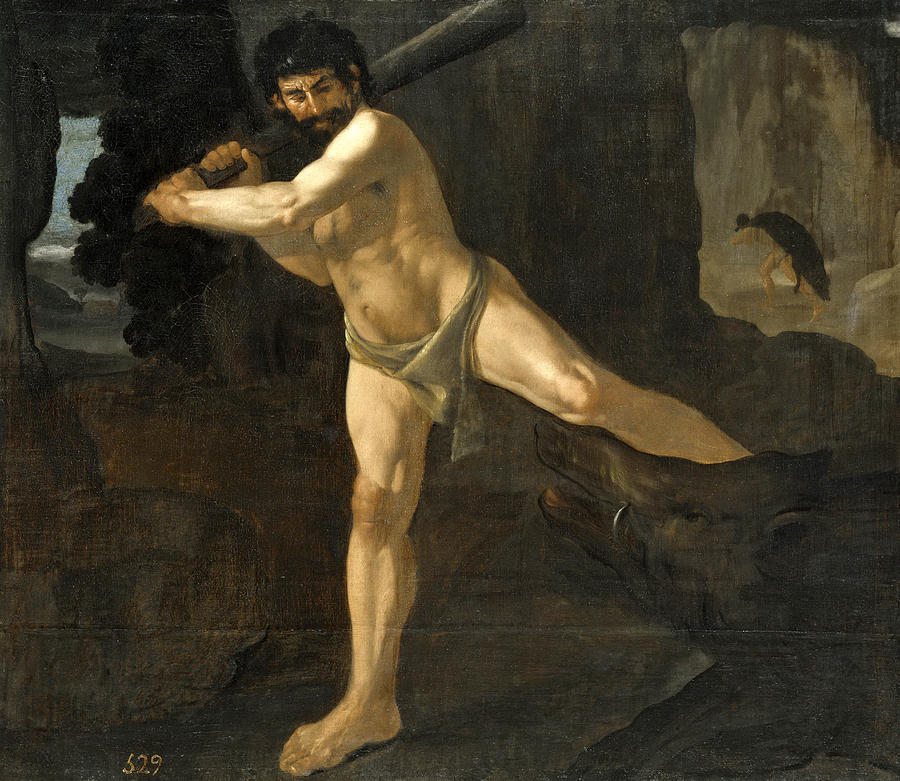
The painting captures Hercules at the peak of exertion. His body twists in a powerful arc as he raises his club for a decisive blow. Beneath his forward leg the dark mass of the Erymanthian Boar writhes in the shadows, its head emerging just enough for the viewer to grasp the danger. The surrounding rocky landscape, lit only by a faint sky in the distance, closes in like a stone amphitheater. Zurbaran transforms an episode from Greek mythology into an almost sculptural study of muscle, force and human determination.
The Myth of the Erymanthian Boar
The Erymanthian Boar appears in the cycle of twelve labors imposed on Hercules as a penance. This fearsome creature, said to live on the slopes of Mount Erymanthos, ravaged the surrounding countryside, destroying crops and terrifying villagers. Hercules received the task of capturing the boar alive and bringing it back to King Eurystheus. Ancient sources often describe the labor as a test of tenacity and strategy, since the hero had to chase the animal through the snow, drive it into a trap and subdue it without killing it.
Zurbaran chooses not to illustrate the full pursuit or the eventual presentation of the captured beast. Instead he focuses on the climactic confrontation inside a rocky region. The story is compressed into the instant before a crushing blow. Historically the myth emphasizes capture rather than slaughter, but Baroque painters frequently allowed themselves freedom in selecting the most dramatic angle. Zurbaran’s version is less concerned with strict narrative details than with the visual drama of a man pitted against wild nature.
Composition and Pictorial Structure
The composition is built around the diagonal sweep of Hercules’ body. He stands in the foreground, almost filling the height of the canvas. His torso twists to the left, shoulders rotating as he swings the club behind his back. The forward leg braces against a rock, extended over the boar’s body, while the rear leg recedes slightly into shadow. This contrapposto pose creates a dynamic equilibrium, suggesting both movement and stability.
The club itself extends horizontally along the top of the painting, an extension of Hercules’ shoulders and arms. It leads the viewer’s gaze from the hero’s tense face toward the left edge, where a sliver of pale sky opens between the rocks. The boar’s bulk occupies the lower right, its snout and tusks emerging from dark paint. This triangular arrangement of hero, weapon and beast forms a tight knot of action at the center of the image.
In the background a secondary figure appears within a cave entrance. Bent under a heavy object, perhaps the carcass of another animal, this small silhouette echoes Hercules’ struggle in reduced scale. It reinforces the sense of a harsh, work filled landscape where survival depends on strength and endurance. The rocky surroundings frame the central drama, leaving little empty space and intensifying the sense of confinement and danger.
The Heroic Body and the Language of Muscle
Zurbaran’s treatment of Hercules’ body is deliberately monumental. The painter models the torso, arms and legs with careful attention to anatomical detail, yet he avoids excessive refinement. The forms are robust and somewhat blocky, closer to carved stone than to idealized marble smoothness. This fits his broader style, which often emphasizes solidity and weight over graceful elegance.
Hercules wears only a simple loincloth tied at the hip, exposing the full architecture of his muscles. The tension of his pose is visible in the swelling of his biceps, the stretch of his shoulders and the flexing of his thigh as it presses against the rock. The viewer senses the transfer of energy from planted foot through rotating hips and shoulders into the raised club. Zurbaran thus turns the human body into a kind of living mechanism of force.
The hero’s face, framed by dark curly hair and beard, is almost as intense as his body. Brows knit, eyes narrowed, he looks toward the viewer rather than at the beast. This frontal gaze pulls us into the scene, as if we have stumbled into his path at the very moment of attack. The expression combines concentration and aggression, but there is also a hint of calculated control. Hercules appears fully aware of his strength and the exact instant at which he will release it.
The Erymanthian Boar and the Representation of the Beast
While Hercules dominates the foreground, the boar is deliberately obscured. Only its head and upper back stand out from the shadows, rendered in dark browns that blend with the rocky terrain. The animal’s small, glinting eye and white tusk provide sharp accents. Zurbaran does not dwell on anatomical detail here. The boar is more a mass of danger than a carefully drawn creature.
This choice makes visual sense. If the animal were rendered with the same clarity as the hero, it might compete for the viewer’s attention. Instead, the boar functions almost like an extension of the rocks, a wild force emerging from nature itself. Hercules’ foot rests firmly on its neck, suggesting domination, yet the beast’s head still twists upward, implying struggle. The powerful downward slant of the hero’s leg and the upward thrust of the animal create a momentary clash of directions that intensifies the drama.
Symbolically, the boar represents destructive chaos, the irrational violence of the natural world. Hercules, in contrast, personifies ordered strength and heroic virtue. In subduing the animal he does more than secure safety for nearby villagers. He demonstrates the capacity of disciplined human effort to confront raw instinct and bring it under control. Zurbaran visualizes this moral struggle through the interplay of light human flesh and shadowy animal mass.
Light, Shadow and Baroque Drama
Light plays a crucial role in “Hercules Fighting the Erymanthian Boar.” A strong illumination falls from the left, bathing the hero’s chest, arms and forward leg. The brightness of his skin contrasts sharply with the gloom around him, giving his figure sculptural relief against the dark rocks. This chiaroscuro technique is typical of Baroque painting, derived from Caravaggio and adapted to Spanish sensibilities.
The background remains mostly in shadow. Only small areas of sky and distant landscape are lit, appearing in cool blue and grey tones that contrast with the warmer flesh colors of Hercules. The boar almost dissolves into the dark foreground, emerging only where touches of lighter paint suggest bristling fur and tusks. The deep shadows not only frame the hero but also heighten the sense of peril, as if unknown threats lurk beyond the immediate scene.
By isolating Hercules in this spotlight of illumination, Zurbaran emphasizes his role as protagonist and moral focus. The light can be read symbolically as divine favor or heroic clarity. It falls not only on his muscles but also on his determined face, suggesting that his strength is guided by conscious will rather than blind fury. The darkness that envelops the animal and the rocks symbolizes the untamed world he is taming through his labor.
Landscape, Space and Atmosphere
The setting of the painting is a rugged mountainous region. Rocks fill the majority of the frame, forming irregular planes that catch and block the light. A narrow opening in the upper left reveals a distant valley and a strip of cloudy sky. This small vista serves as a visual relief from the otherwise heavy environment, hinting at the wider world beyond the immediate struggle.
The cave in the right background adds depth and narrative suggestion. Within it, the small figure who bends under a load indicates that this is an active hunting ground, not an isolated mythical stage. Perhaps this figure represents Hercules in another part of the story or a shepherd dealing with daily work. Either way, it anchors the scene in a more realistic sense of place. The viewer can imagine a harsh frontier where men and animals wrestle with one another for survival.
Zurbaran does not lavish attention on botanical detail. A few dark masses may suggest trees or thorny bushes, but they remain sketchy. The focus stays firmly on rock, flesh and the play of light. This minimalistic landscape suits the moral starkness of the subject. The world here is reduced to essentials: a man, a beast, and the unforgiving terrain on which they fight.
Zurbaran’s Interpretation of Classical Heroism
Painting Hercules allowed Zurbaran to engage with classical themes that were popular across Europe. Italian and Flemish artists had long depicted the hero with polished bodies and elaborate narratives. Zurbaran adopts some of this tradition, especially the emphasis on muscular anatomy, yet he adapts it to his own austere style.
Unlike some highly idealized Renaissance Hercules figures, this hero feels tangible, almost rough. His muscles are impressive yet not exaggerated beyond all credibility. The loincloth is simple and slightly frayed. Instead of mythic armor or fluttering draperies, we see the body almost bare, as if he were a laborer rather than a prince of demigods. This down to earth treatment aligns with the realism of Spanish Baroque, which often presented saints and biblical figures as people drawn from daily life.
At the same time, Zurbaran respects the larger symbolic dimension of Hercules. In seventeenth century Spain, the hero could be interpreted as a political emblem of royal strength or a moral emblem of virtue triumphing over vice. The Erymanthian Boar, as a destructive force, could stand for unruly passions or external threats to order. By depicting the hero at the exact moment of poised action, Zurbaran suggests that such threats are being decisively confronted.
The Human Body as Spiritual Metaphor
Although “Hercules Fighting the Erymanthian Boar” is not a religious painting in a strict sense, it reflects ideas that run through Zurbaran’s sacred works. The artist often used the human body, especially in his depictions of monks and martyrs, as a vessel for spiritual meaning. Here, the hero’s disciplined physique and focused gaze can be interpreted as metaphors for inner moral strength.
Hercules’ struggle with the boar parallels the internal struggle believers face when confronting temptations or destructive habits. The hero’s raised club and firm stance evoke the effort required to resist such forces. Viewers familiar with Zurbaran’s many images of saints wrestling with sin and the devil might easily perceive this mythological battle as an allegory for similar spiritual combat.
The near nudity of Hercules also contributes to this reading. In Christian symbolism, stripped figures frequently represent the soul laid bare before judgment or the vulnerability of humans relying on grace rather than worldly possessions. Although the context here is classical rather than biblical, the visual language resonates with those themes. The hero’s exposed flesh can be seen as the raw human condition confronted by the wildness of the world.
Emotional Impact and Viewer Experience
Standing before this painting, a viewer is likely to feel both admiration and tension. Admiration arises from the sheer physical presence of Hercules. His muscles, stance and commanding gaze project an image of strength that is both attractive and intimidating. Tension emerges from the recognition that the battle is not yet complete. The club has not yet fallen, the boar still struggles under his leg, and the outcome is frozen in suspense.
Zurbaran deliberately chooses this unstable moment, inviting the viewer’s imagination to complete the action. We anticipate the crack of wood against bone, the animal’s last thrash, the hero’s heavy breathing after the exertion. The painting thus activates the senses rather than remaining a static tableau. It is not difficult to imagine the sounds and smells of this rocky wilderness, the clash of man and beast echoing off the cliffs.
For modern audiences, the painting may also prompt reflection on how power is used. Hercules is clearly stronger than the boar and stands on the threshold of victory. The viewer might ask whether such dominance is always justified, or whether it can be abused. Zurbaran does not answer these questions explicitly, but the intensity of the scene invites contemplation of the responsibilities that accompany physical power.
Conclusion
“Hercules Fighting the Erymanthian Boar” is a compelling example of Francisco de Zurbaran’s ability to adapt his somber, sculptural style to mythological subject matter. Through strong composition, dramatic light and a powerful central figure, he transforms a classical legend into a vivid meditation on strength, struggle and the taming of destructive forces.
The painting celebrates the hero’s muscular body yet also underscores the vulnerability and effort that such heroism requires. The dark landscape, shadowy boar and distant figure all contribute to a sense of a harsh world where victory is never effortless. In the poised swing of Hercules’ club and the straining twist of his torso, Zurbaran captures the perpetual human drama of confronting danger, whether external or internal, and struggling to bring it under control.