Image source: wikiart.org
Historical Context and Mythological Background
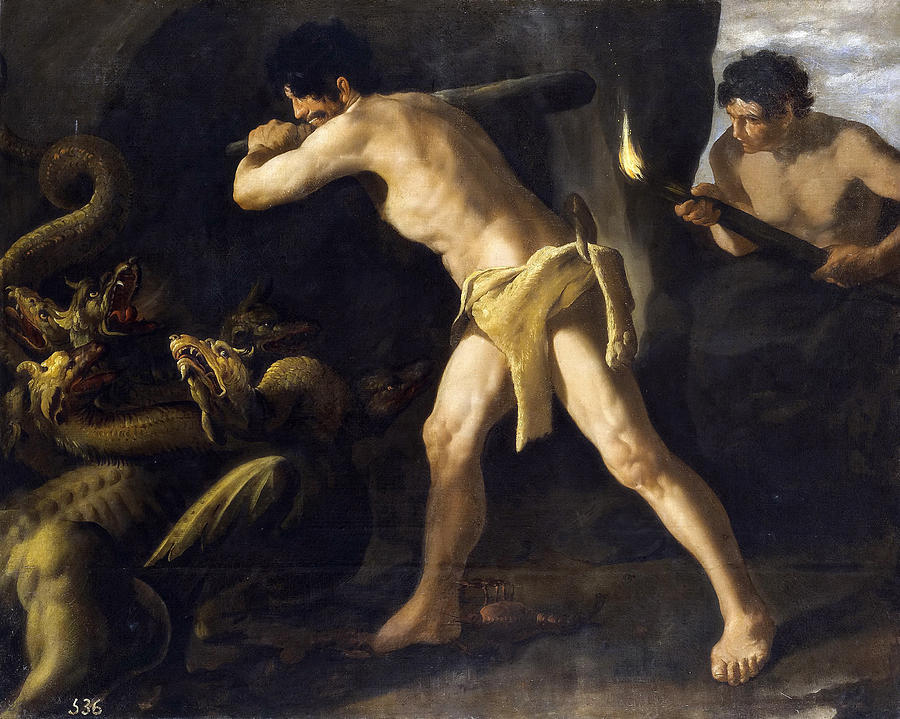
“Hercules Fighting with the Lernaean Hydra” by Francisco de Zurbaran is part of the celebrated series of paintings dedicated to the labors of Hercules. These works were probably intended for a royal or aristocratic interior, where the ancient hero functioned as a symbol of power, virtue and endurance. In seventeenth century Spain Hercules was often interpreted as a political emblem of strong and just rule, and Zurbaran’s cycle visually aligned the Spanish monarchy with this classical figure of heroic strength.
The chosen subject is the second of Hercules’ twelve labors. The Lernaean Hydra was a monstrous water serpent that lived in the marshes of Lerna. It possessed multiple heads, and every time one was cut off, two more would grow in its place. Some versions of the myth describe one immortal head that could not be killed at all. Hercules at first tried to hack off the heads with his club and sword, only to see them multiply. With the help of his nephew Iolaus, he devised a new strategy: after severing each head, Iolaus used a burning brand to cauterize the stump, preventing regeneration. Finally Hercules cut off the immortal head and buried it under a rock.
Zurbaran selects the most dramatic moment of this story. Hercules is in mid stride, body twisted toward the many headed monster as he lifts his club for another crushing blow. Beside him, Iolaus holds a blazing torch ready to seal the wound. The hydra lunges from the left side of the canvas, a writhing mass of necks and gnashing jaws. The entire scene becomes a powerful allegory of human courage and ingenuity when faced with seemingly impossible evil.
Composition and Staging of the Battle
The composition of “Hercules Fighting with the Lernaean Hydra” is built around a strong diagonal that runs from the lower left, where the hydra rears up, to the upper right, where Iolaus’ torch flares. This diagonal is echoed in the line of Hercules’ spine and the raised club that extends behind his shoulder. The result is a dynamic, sweeping movement that guides the viewer’s eye across the scene and reinforces the sense of violent action.
Hercules occupies the central position, his almost nude body forming a solid bridge between monster and companion. The stance is wide and grounded, with his right leg bent and his left leg stretched back in a powerful lunge. This positioning makes him appear both rooted and flexible, able to shift weight and direction as he fights. The twist of his torso reveals the back and shoulders in full tension, while his head is bent slightly forward in concentrated effort.
The hydra is confined mainly to the lower left quadrant of the canvas. Zurbaran does not show the entire body of the creature. Instead he focuses on a mass of serpent necks, each ending in a snarling head with open jaws and sharp teeth. The repetition of arched necks creates a visual rhythm, like a cluster of whips frozen in motion. This partial view makes the hydra seem endless and unstoppable, as if more heads are hidden in the darkness beyond the frame.
Iolaus on the right provides a counterbalance. He stands partly in shadow, leaning forward with the flaming torch and another club or staff. His presence deepens the narrative and demonstrates that this labor is not a solitary feat. Hercules relies on intelligent assistance to defeat a foe whose power lies in regeneration. The triangular relationship between Hercules, Iolaus and the hydra anchors the composition and keeps the viewer’s eye circulating among the three key actors in the drama.
The Heroic Anatomy of Hercules
Zurbaran clearly relished the opportunity to depict Hercules’ muscular body in motion. The hero is almost completely nude, wearing only a small, rough loincloth. This garment emphasizes rather than conceals the anatomy. The figure is seen from the back, allowing Zurbaran to display the broad shoulders, powerful back muscles, and strong legs.
The modeling of the flesh is robust and sculptural. Light falls across the planes of the back, picking out the scapulae, the curve of the spine, and the swell of the gluteal muscles. The arms are shown in full contraction as Hercules swings the club. The tension in the forearms and the twist of the wrist convey the kinetic energy of the impending blow.
Despite the heroic exaggeration of the muscles, there is still a sense of grounded realism. This is not an idealized marble statue but a working body, sweaty and straining under the effort. Small details such as the weight distribution in the feet and the slight bend of the knee help anchor Hercules firmly on the ground. His stance communicates not only power but also stability, essential when facing a monster that strikes from multiple directions at once.
The nearly nude figure also underscores the vulnerability of the hero. Hercules confronts the hydra without protective armor. His only defenses are his strength, his weapon and his wits. This exposure increases the tension of the scene and turns the battle into a contest of raw human courage against monstrous threat.
The Terrible Beauty of the Hydra
Zurbaran’s hydra is a chilling creation. Rather than a single dragon with many heads, it appears as a tangle of serpentine necks, each ending in a distinct head that snarls or shrieks in a different direction. The heads are grotesquely expressive. Some lunge forward with tongues extended, others gape wide as if screeching, and still others retreat slightly, ready to strike again.
The artist paints the creature’s skin in sickly green and ocher tones. Scales and ridges suggest a rough texture, and the nostrils and gums are tinged with red, enhancing its ferocity. Glints of light accentuate the eyes and teeth, making them gleam against the surrounding darkness. The hydra’s body coils in the lower left corner, providing a base from which the writhing necks arise.
By showing several heads at once, Zurbaran visually communicates the core challenge of this labor. No single blow can end the threat. Even if one head is smashed, others remain ready to attack. For a viewer familiar with the myth, these multiple heads hint at the problem of exponential regeneration. The more one fights the hydra with straightforward strikes, the more it grows.
In symbolic terms, the hydra embodies foes that multiply when confronted directly. These might be moral vices, political revolts or personal anxieties. The multi headed monster becomes a metaphor for problems that seem to worsen with each attempt to solve them, calling for creative and strategic approaches rather than brute repetition.
Iolaus and the Power of Cooperation
The figure of Iolaus on the right side of the painting plays a crucial role in both narrative and interpretation. Bare chested and strong, yet clearly less massive than Hercules, he holds a flaming torch and appears ready to assist the hero by cauterizing the necks of the hydra. His presence transforms the scene from a simple solo battle into a partnership.
Zurbaran positions Iolaus slightly behind Hercules and partially in shadow, which suggests that he is a supporting character rather than the main focus. Nevertheless, the torch he carries is a key visual and symbolic element. The bright flame introduces a warm, golden light that contrasts with the cooler tones of the rocky cavern. This fire is both literal and metaphorical. In the myth it physically burns the stumps of the hydra’s heads, preventing regeneration. Allegorically it represents insight, reason and the illuminating power of thought.
By including Iolaus, Zurbaran emphasizes that some adversaries cannot be overcome by individual strength alone. Cooperation, counsel and shared effort are necessary. Hercules still performs the physically demanding task, but without Iolaus’ burning brand his labor would remain futile. This detail adds depth to the heroic ideal, suggesting that true greatness involves the humility to accept help and to recognize the value of others’ contributions.
Chiaroscuro and the Atmosphere of the Cavern
Like many of Zurbaran’s works, “Hercules Fighting with the Lernaean Hydra” relies heavily on dramatic lighting. The background is composed of shadowy rock formations that create a cave like environment. Parts of the cavern open onto a dim landscape, but most of the space around the figures is dark and mysterious.
Two main light sources operate within the painting. The first is an unseen general light that falls from the upper left, illuminating Hercules’ back and the nearest heads of the hydra. This light sculpts the bodies with clarity, giving them volume and solidity. The second source is the torch held by Iolaus. Its flame glows with intense yellow and orange, casting a localized brilliance on the right side of Hercules and on the rocks nearby.
The interaction between these lights creates complex patterns of shadow. Parts of the hydra disappear into darkness, adding to its fearsome mystery. Hercules’ face is mostly hidden from the viewer, intensifying the impression that he is focused entirely on the battle in front of him. The dark setting also symbolizes the moral or psychological darkness in which such confrontations often occur. The heroes descend into a murky, dangerous world to confront evil at its source.
The strong contrasts of light and dark, or chiaroscuro, heighten the emotional drama. The illuminated flesh glows against the dark rock and shadowy monster, drawing attention to the fragile yet resilient human presence in a hostile environment.
Symbolic and Moral Interpretations
As with other paintings in Zurbaran’s Hercules cycle, this work invites allegorical readings. The hydra stands for a kind of evil that cannot be defeated by straightforward force because it constantly regenerates. This might signify addictive behaviors, systemic corruption, persistent heresy or any repeating cycle of wrongdoing. Every attempt to simply cut it off without addressing its root causes leads to renewed and multiplied problems.
Hercules’ repeated blows with the club represent the initial, perhaps naive, attempts to defeat such issues by sheer willpower or punishment. These efforts, while brave, are not enough on their own. Only when he works in tandem with Iolaus, whose fiery torch cauterizes the stumps, does he achieve lasting results. The torch suggests reasoned strategy, moral insight or spiritual purification. Fire in religious symbolism often stands for the Holy Spirit or the purifying truth that burns away falsehood.
From this perspective, the painting becomes a visual sermon about the need to confront evil intelligently and cooperatively. Strength must be combined with wisdom. Temporary victories that fail to prevent regeneration are not sufficient. Real transformation requires addressing the underlying sources of destructive behaviors or conditions.
The scene also reflects on the human capacity to confront fearsome challenges. The hydra is huge, venomous and many headed, yet Hercules moves toward it without hesitation. His naked vulnerability underscores the magnitude of his courage. For viewers, the image can function as an encouragement to face their own multi headed problems not with despair, but with strategic persistence and support from others.
Zurbaran’s Fusion of Myth and Spiritual Intensity
Although the subject is pagan myth, Zurbaran approaches it with the same concentrated seriousness that marks his religious paintings of saints and monks. The stark setting, the focus on a few monumental figures, and the intense lighting all recall his famous depictions of penitent friars. Hercules, with his rough loincloth and bare feet, resembles a spiritual athlete as much as a classical hero.
In this way Zurbaran bridges the gap between classical legend and Christian spirituality. Hercules’ labors can be seen as metaphors for the moral struggles of believers, and the hydra becomes a personification of sins or temptations. The painting thus functions as both a courtly celebration of heroic myth and a moral image aligned with Counter Reformation ideals.
At the same time, the canvas showcases Zurbaran’s technical versatility. He demonstrates mastery of the male nude, complex group composition, and atmospheric chiaroscuro. The mythological series offered him the chance to experiment with dynamic poses and violent movement that rarely appear in his more contemplative religious works. “Hercules Fighting with the Lernaean Hydra” stands out as one of the most energetic and theatrical paintings in his entire oeuvre.
Conclusion A Battle Against Multiplying Darkness
“Hercules Fighting with the Lernaean Hydra” by Francisco de Zurbaran crystallizes a moment of intense struggle where courage, strategy and cooperation come together. The muscular figure of Hercules, poised to strike with his club, and the writhing hydra with its many snarling heads create a scene charged with tension and danger. Iolaus’ torch glows like a symbol of focused intelligence amid the surrounding darkness.
Through composition, anatomy and lighting, Zurbaran transforms this mythological episode into a powerful meditation on the nature of evil and the conditions required to overcome it. Force alone cannot defeat a monster whose power lies in constant renewal. Only when strength is allied with insight and aided by trusted companions can the hydra be truly subdued.
The painting remains compelling for contemporary viewers because it resonates with modern experiences of complex, recurring problems. Whether interpreted politically, psychologically or spiritually, the hydra still stalks the marshes of human life. Zurbaran’s Hercules reminds us that even the most terrifying adversaries can be faced and defeated when we combine determination with wisdom and refuse to fight alone.