Image source: wikiart.org
Introduction to Saint Jacob by Francisco de Zurbaran
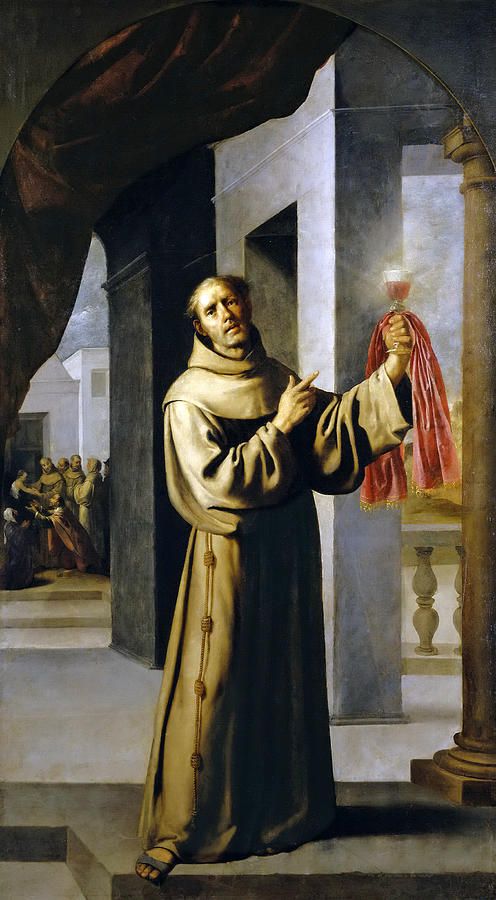
“Saint Jacob” by Francisco de Zurbaran presents a striking vision of a solitary friar poised between earthly architecture and heavenly mystery. The Spanish Baroque master was famous for his austere saints and monks, and in this painting he once again turns a quiet religious moment into a powerful image of spiritual authority. The figure stands in a vaulted interior, robed in the simple habit of a mendicant order, and holds a chalice wrapped in a rich red veil. With one hand he presents the sacred vessel to the viewer while with the other he points toward it, as if teaching, warning and blessing at the same time.
The combination of humble clothing and luminous light creates an unforgettable portrait. “Saint Jacob” is more than an isolated devotional image. Zurbaran weaves together architecture, narrative background scenes and symbolic objects to show how a single life of holiness touches the wider community of believers.
Visual Description of the Scene
At first glance, the viewer meets the full length figure of Saint Jacob standing barefoot on a stone floor. He occupies the foreground, slightly off center, beneath a dark arch that frames him against a lighter wall behind. The saint wears a tan or grayish habit tied with a rope girdle whose knots mark the traditional vows. The voluminous folds of fabric fall in heavy verticals, giving his body the weight and dignity of a stone column.
In his right hand he raises a crystal chalice filled with red wine and covered by a scarlet liturgical veil lined with gold. His left hand points toward the vessel with an insistent gesture that cuts diagonally across his body. The saint’s face is turned slightly toward us, mouth parted, eyes lifted as if in mid speech. Behind him, in the shadowed distance to the left, a group of men gather in tense conversation. Architectural forms stretch back in perspective, with doorways, columns and walls guiding the eye deep into the interior.
Historical and Spiritual Context
Zurbaran worked in seventeenth century Spain, a period when religious imagery served as a central tool for teaching the faith. Monasteries and churches commissioned paintings that would instruct monks, clergy and lay people about doctrine and proper devotion. Saintly figures who held the chalice of the Eucharist or pointed to it played an important role in reinforcing belief in the real presence of Christ in the sacrament.
“Saint Jacob” belongs to this spiritual climate. Although the exact identity of the saint is debated, the Franciscan habit and the clear emphasis on the chalice suggest a friar renowned for reverence toward the Eucharist. Zurbaran does not focus on miraculous events or dramatic martyrdom here. Instead, he presents the saint as a preacher of sacramental mystery, someone who stands on the threshold between the liturgical space of the altar and the everyday world of the people gathered in the background.
Composition and Use of Space
The composition of “Saint Jacob” is carefully structured to highlight both the figure and the architectural environment. The dark arch on the left creates a natural frame, like a stage curtain drawn to reveal the saint. This curved form is echoed on the right by a tall column that rises out of the lower edge of the canvas. Between arch and column the saint stands, aligning his body with the vertical lines of the architecture.
The space recedes in two directions. Behind the saint, a corridor leads to a group of small figures, their gestures animated. Further back, bright light spills into the interior from unseen windows. The strong linear perspective guides the viewer’s gaze into depth while the figure of the saint anchors the foreground. This dual focus suggests that his message about the chalice is relevant both to the immediate viewer and to the community behind him. Zurbaran balances intimacy with public significance.
The Figure of Saint Jacob
Zurbaran’s portraits of monks are celebrated for their psychological depth, and Saint Jacob is no exception. The friar’s face is weathered and earnest. He is neither idealized as a youthful hero nor portrayed as a remote icon. Instead, he appears as a middle aged man whose experience of prayer and pastoral work has carved subtle lines around his eyes and mouth. There is a touch of vulnerability in the way his lips are parted and his eyebrows raised, as though he is urgently appealing to the viewer.
His posture, however, is firm. The slightly forward lean of his body and the planted position of his bare feet express determination. He inhabits the space with quiet authority. The habit that wraps his figure is painted with Zurbaran’s usual mastery of cloth. Folds catch the light in broad, simplified planes, reducing the garment to a kind of sculptural mass. This treatment of drapery gives the saint an almost monumental presence, even though his expression remains gentle and human.
Symbolism of the Chalice and Veil
The most prominent object in the painting is the chalice. It glows like a small beacon, catching the light at the level of the saint’s shoulder. The red wine inside echoes the crimson veil that drapes elegantly from his hand. In Christian symbolism, the chalice represents the blood of Christ offered in the Eucharist. The liturgical veil indicates reverence and hints that the vessel is used in formal worship.
By raising the chalice and pointing to it, Saint Jacob effectively turns his entire body into a living sermon on the mystery of the Mass. The red color of the veil contrasts sharply with the neutral tones of his habit and the surrounding architecture, so that the viewer’s eye is irresistibly drawn to it. Zurbaran thus uses color not merely for decoration but to direct attention to the theological heart of the painting. The saint’s gesture reinforces the message. He is saying, visually, “Here is the source of grace and life.”
Narrative Background and Community
In the left background, a group of figures gathers in what appears to be a cloister or large hallway. They are in shadow, yet their gestures are animated. Some seem to be listening, others debating. One man raises his arm as if speaking emphatically. This small narrative vignette opens a window into the role of Saint Jacob in the broader life of the Church.
The group may represent fellow friars, townspeople, or a mixture of both. Their presence reminds the viewer that saints do not live in isolation. Their devotion and teaching affect communities, shaping discussions and decisions. The contrast between the quiet focus of the foreground and the busy background also suggests the difference between contemplation and action. Saint Jacob, standing alone with the chalice, embodies contemplation directed toward God, while the distant group embodies the noisy affairs of ordinary life. Yet both belong to the same architectural space, implying that true spirituality must engage the real world.
Light, Color and Baroque Drama
Zurbaran’s use of light in “Saint Jacob” is deliberately dramatic yet controlled. A strong beam, apparently coming from the upper left, illuminates the saint’s face, hands and the front of his habit. This light also hits the chalice and veil, causing the red fabric to glow like a jewel. The arch, the back of the corridor and much of the column on the right remain in deep shadow, creating a strong contrast that heightens the three dimensional effect of the scene.
The palette is dominated by earth tones. Browns, grays and muted whites define the architecture and clothing. The only intense hue is the red of the veil, with a subtle echo in the garments of some background figures. This restricted range gives the painting a sober, contemplative mood. It reflects the humility associated with Franciscan spirituality while allowing the chalice to stand out as the visual and symbolic center. The glowing light on the saint’s face suggests inner illumination, as if his understanding of the sacrament enlightens not only his mind but his physical appearance.
Architecture and Sacred Space
The architectural setting in “Saint Jacob” is more than a neutral backdrop. The arches, columns and receding corridors create a sense of sacred architecture, reminiscent of a monastery or church complex. The solid geometry of the space communicates stability and order. Lines converge to a vanishing point, reinforcing the idea of direction and purpose.
The column in the right foreground echoes the standing figure of the saint. Both are vertical axes that support the composition. The arch above functions like a spiritual threshold. The viewer sees the saint from within a shadowed area, almost as if we are stepping through a doorway to encounter him. This use of architecture deepens the sense that the painting invites us to cross from everyday distraction into a place of encounter with divine mystery. The carefully painted floor tiles underline this transition, leading our gaze from the dark foreground toward the illuminated area around the chalice.
Zurbaran’s Artistic Language
“Saint Jacob” shows many hallmarks of Zurbaran’s mature style. His figures are solid and sculptural, modeled by strong light rather than intricate detail. The handling of paint on the habit is broad and economical, with a focus on the main planes of light and shadow rather than on tiny folds. This approach gives the painting an almost classical restraint despite its Baroque use of contrast.
Zurbaran is also known for his ability to endow everyday objects with intense presence. Here the chalice, veil and even the rope girdle of the saint have a tactile reality. They seem to exist in the same space as the viewer, not merely on a flat surface. This physical realism serves spiritual ends. By making the sacred objects so tangible, Zurbaran encourages the viewer to feel the nearness of the sacred realities they represent.
Emotional and Devotional Reading
On an emotional level, “Saint Jacob” communicates calm urgency. The saint does not appear overwhelmed by ecstatic vision, yet his gaze is earnest and his gesture insistent. He seems to be addressing someone directly in front of him, perhaps a congregation, perhaps the individual viewer standing before the painting. The sense of dialogue is strong.
For a devotional viewer, the image invites reflection on the centrality of the Eucharist. The friar’s bare feet and simple robe remind us of humility and poverty. Yet in his hands he holds a treasure of infinite value. The juxtaposition of simplicity and grandeur suggests that the divine chooses modest vessels in order to reveal itself. The painting can thus function as a reminder of the dignity granted to every believer who approaches the sacrament with faith.
Relevance for Contemporary Viewers
Although created centuries ago, “Saint Jacob” still speaks to contemporary viewers. The painting explores themes that remain meaningful today, such as the relationship between personal conviction and public life, and the tension between inner contemplation and outer action. The saint’s solitary stance suggests the importance of individual conscience, while the background group reminds us that faith has social consequences.
The work also offers a visual antidote to distraction. In a world full of noise and competing images, Zurbaran presents a single figure who points unswervingly to a single object. The clarity of his gesture and the economy of the composition encourage viewers to ask what, in their own lives, deserves this kind of focused attention. Whether one shares the specific religious belief depicted or not, the painting can inspire a search for what is truly central and life giving.
Conclusion
“Saint Jacob” by Francisco de Zurbaran is a masterful fusion of portraiture, architecture and symbolic still life. Through the figure of a humble friar raising a chalice, the artist communicates a rich theology of presence and devotion. The careful composition, strong contrast of light and shadow, restrained color palette and expressive gesture all serve to draw the viewer into a moment of encounter.
Zurbaran’s painting stands as a testament to the power of visual art to convey complex spiritual ideas through simple forms. The saint’s pointing hand and lifted chalice invite each viewer to consider the meaning of sacrifice, grace and the sacred in everyday life. Even after centuries, the quiet authority of Saint Jacob continues to resonate, inviting contemplation within the vaulted spaces of Zurbaran’s imagined monastery and within the interior space of the viewer’s own heart.