Image source: wikiart.org
Introduction to “Hercules Separates the Mountains Calpe and Abyla”
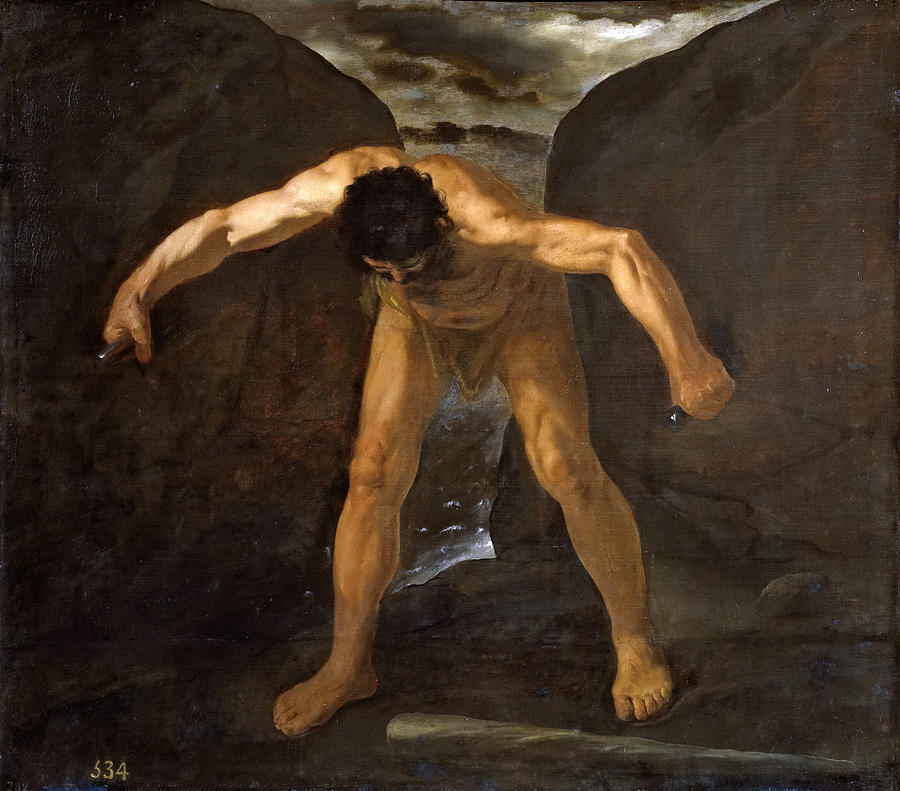
Francisco de Zurbaran’s painting “Hercules Separates the Mountains Calpe and Abyla” presents one of the most dramatic moments from the legendary life of the Greek hero. Instead of showing Hercules in the familiar act of slaying lions or hydras, Zurbaran captures him at the instant he performs a superhuman feat of pure strength, wrenching apart two enormous mountain masses to open what will become the Strait of Gibraltar. The composition is stark. A single monumental figure dominates the canvas, bent forward with arms extended, body straining between two dark rocky walls. The surrounding space is almost entirely filled with stone and cloud, which throws even more emphasis on the laboring hero.
Painted as part of a series devoted to the Labors of Hercules, this canvas shows how deeply Zurbaran embraced mythological subjects alongside his more famous religious works. He treats the pagan hero with the same seriousness and sculptural clarity that he lavishes on saints and monks. The result is an image that feels both ancient and intensely Baroque, uniting classical legend with seventeenth century Spanish taste for muscular spiritual drama.
Mythological Background And The Pillars Of Hercules
The story behind “Hercules Separates the Mountains Calpe and Abyla” comes from the legendary exploits of Heracles, known in the Roman world as Hercules. On his journey to steal the cattle of the monster Geryon, Hercules had to reach the far west, beyond the Mediterranean. According to later tradition, he either broke through an existing mountain range or moved two mountains apart, creating the narrow passage between the Mediterranean Sea and the Atlantic Ocean. The two promontories that flank this strait, the Rock of Gibraltar (Calpe) in Europe and Jebel Musa or Monte Hacho (Abyla) in North Africa, became known as the Pillars of Hercules.
In classical geography the Pillars of Hercules marked the boundary of the known world. They symbolized the outer limit of human exploration and the threshold beyond which lay the mysterious ocean. For a seventeenth century audience living in an age of Spanish global expansion, this story was particularly resonant. The Strait of Gibraltar had strategic value, and Spain’s maritime empire stretched across the Atlantic once guarded by those mythic pillars.
By choosing to paint Hercules at the moment he forces Calpe and Abyla apart, Zurbaran touches on a myth about boundaries, conquest, and the opening of new routes. His Hercules is not simply a strong man, but a figure whose action alters the shape of the earth and the destiny of nations.
A Composition Built On Tension And Compression
The composition of the painting is very simple yet extremely powerful. Hercules occupies the center of the canvas, positioned frontally but bent sharply forward, so his head and torso thrust toward the viewer while his arms extend outward to either side. Each hand presses or pulls against a dark rocky mass that rises up like a wall. We do not see the full mountains of Calpe and Abyla, only these vertical cliffs that close in on the hero. This tight framing creates an overwhelming sense of compression.
The rocks on the left and right converge slightly inward, making the central space narrower at the top than at the level of Hercules’ legs. The result is visual pressure. The landscape seems to squeeze the figure, and his task becomes immediately apparent. He must force these titanic masses away from each other. Zurbaran turns the entire rectangle into a kind of vise around the hero’s body, so that everything in the painting, including the frame itself, seems to resist his effort.
At the top a patch of sky opens between the rock walls, filled with clouds that echo the turmoil below. The vertical gap of light draws the eye upward along the line of Hercules’ spine and suggests the space he is trying to create. At the bottom, the rocky ground supports his planted feet, one forward, one back, in a stance that anchors his strain. The composition is thus a carefully balanced system of forces in which every line and mass helps convey the idea of monumental effort.
The Heroic Body And Zurbaran’s Study Of Anatomy
“Hercules Separates the Mountains Calpe and Abyla” is among the most muscular figures in Zurbaran’s oeuvre. The hero is nearly nude, wearing only a small piece of cloth that leaves the entire torso and limbs exposed. This gives the painter a vast field on which to display his understanding of human anatomy.
Hercules’ arms are extended almost horizontally, with the muscles of the shoulders, biceps, and forearms standing out in strong relief. The broad back, arched and tense, shows the play of the trapezius and latissimus as they stretch toward each arm. The legs are planted wide apart, thighs and calves swollen with effort. The entire body forms an inverted V, its apex at the head that bows low between the shoulders. This posture is at once powerful and vulnerable, suggesting that even a demigod must bow under the weight of such a labor.
The modeling of the flesh is rich and tactile. Warm tones of ocher and reddish brown describe the skin, with highlights catching on the shoulders, upper back, and thighs where the light strikes most strongly. Deeper shadows carve out the hollow of the spine, the underarms, and the inner legs, giving the figure sculptural volume. Hercules appears almost like a bronze or marble statue come to life, which is fitting given the classical origin of his story.
Zurbaran was famous for his capacity to make solid forms emerge out of darkness, and here he uses that skill to push the heroic body forward from a murky rocky setting. The contrast between the glowing flesh and the dark mountains enhances the sense that Hercules stands apart from the natural world, a force that can reshape it.
Light And Color In A Landscape Of Stone
The color palette of “Hercules Separates the Mountains Calpe and Abyla” is restrained and earthy. Browns, grays, and muted greens dominate the rocks and sky, while the body of Hercules glows with warm golden tones. This limited palette reinforces the ruggedness of the setting. We feel we are in a harsh, primal landscape where stone and sky are the main actors.
Light enters from above and slightly to the left, illuminating the upper surfaces of Hercules’ arms and back. However, Zurbaran does not flood the scene with brightness. Much of the canvas remains in deep shadow, especially the lower rocks and parts of the hero’s legs. This controlled chiaroscuro heightens the drama. The hero seems to emerge from a world of primordial darkness, his effort literally bringing light into the narrow space between the mountains.
The sky at the top is painted in turbulent strokes of gray, white, and brown, suggesting heavy clouds and perhaps the remnants of a storm. It mirrors the tension of the earth below. Yet between those clouds a silvery glimmer appears, hinting at light beyond. The separation of the mountains opens not only a passage in the rock but also a channel for this light, an image of new possibilities emerging from struggle.
A Sense Of Movement Caught In A Single Instant
Although Hercules is frozen in one position, the painting conveys a strong sensation of movement. The diagonal thrust of his body, the outward push of his arms, and the planted steps of his feet all imply a dynamic process. We can imagine the rocks grinding and sliding under his pressure, even though Zurbaran shows them still.
The downward tilt of Hercules’ head, with the dark hair falling forward, suggests intense concentration. He appears to be straining every fiber of his being, yet the moment captured is not one of collapse but of ongoing effort. This gives the painting a suspended energy. It is as if we are witnessing the exact point at which the impossible is becoming possible.
The tension between stasis and movement is a hallmark of Baroque art, and Zurbaran manages it here with great economy. There are no swirling draperies or groups of figures to convey motion. Instead, the movement is entirely contained within the muscular body and its relation to the rigid environment. This focus makes the physical drama all the more compelling.
Symbolism Of The Mountains And The Heroic Task
On a literal level, the mountains represent Calpe and Abyla, the two rocky pillars that will mark the entrance to the Mediterranean. Symbolically, they stand for any barrier that separates one realm from another. By pushing them apart, Hercules becomes a figure of transition and transformation.
For viewers in Zurbaran’s time, this image could echo Spain’s own history of exploration and conquest. The Strait of Gibraltar was the gateway through which ships passed to reach the Atlantic and the New World. Hercules’ action thus anticipates the journeys of explorers and colonizers who expanded the boundaries of the known world.
On a more personal level, the mountains can be read as obstacles in the human soul. In this interpretation, Hercules becomes an emblem of inner strength and determination, breaking through the rocks of ignorance, fear, or sin to reach spiritual freedom. Such a reading would not have been alien to a Spanish audience accustomed to allegorical religious imagery. Although the subject is classical, the moral message aligns with Christian themes of perseverance and grace.
Hercules In Zurbaran’s Oeuvre
Francisco de Zurbaran is renowned primarily for his devotional images of saints, monks, and scenes from the life of Christ. However, commissioned to decorate royal spaces, he also produced a series of paintings on the Labors of Hercules. These works allowed him to explore male anatomy, classical themes, and worldly heroism.
In “Hercules Separates the Mountains Calpe and Abyla,” we can see how the artist’s experience with religious subjects informs his treatment of myth. The isolated figure, set against a dark background, recalls his single figure saints who stand alone in contemplation or ecstasy. The monumental scale and sculptural modeling also echo his depictions of penitents and martyrs. The difference here is that the spiritual anguish is translated into physical strain, and the miraculous act relates to the natural world rather than divine intervention.
This crossover underscores Zurbaran’s versatility. He shows that heroism, whether spiritual or mythological, can be conveyed through the same visual language of solid forms, strong light, and concentrated poses. The Hercules cycle demonstrates that the Baroque fascination with drama and intensity could be applied just as effectively to pagan subjects as to Christian ones.
Emotional And Psychological Dimensions
Despite the focus on the heroic body, the painting also invites psychological interpretation. We do not see Hercules’ face clearly, since it is turned downward and partly obscured by hair. This anonymity allows viewers to project themselves into his position. The hero becomes a kind of everyman figure, representing the weight of tasks that seem beyond human capacity.
The bowed head also indicates humility. Although he is performing a cosmic feat, Hercules is not arrogantly displaying his strength. Instead, he appears inwardly focused, almost in a state of exertive prayer. This nuance may reflect Zurbaran’s own inclination toward spiritual introspection. Even in a mythological work, he imbues his protagonist with a certain internal seriousness.
The rocky environment contributes to the psychological mood. Its dark tones and rough textures create a sense of isolation and hardship. Hercules’ nude body stands alone in this harsh world, without allies or comforts. The separation of the mountains becomes a metaphor for facing one’s challenges in solitude, relying solely on inner strength.
Relevance For Contemporary Viewers
Today, “Hercules Separates the Mountains Calpe and Abyla” continues to speak to modern audiences. At a time when people confront global and personal barriers, the image of a solitary figure straining between two immovable masses feels intensely relatable. Whether we think of scientific frontiers, social injustices, or private struggles, the act of opening a passage where none seems possible is a powerful metaphor.
The painting also encourages reflection on the relationship between humanity and nature. Hercules physically reshapes the earth, a mythic representation of humankind’s capacity to alter the environment. Contemporary viewers, mindful of ecological consequences, might read the scene with mixed feelings, admiring the strength yet pondering the responsibility that comes with such power.
Finally, the artwork invites an appreciation of the human body as an instrument of will and endurance. In an era where digital images often detach us from physical reality, Zurbaran’s Hercules reminds us of the raw, embodied dimension of effort. The hero’s muscles, tendons, and stance all proclaim that real change, whether outer or inner, often demands wholehearted physical and mental engagement.
Conclusion
“Hercules Separates the Mountains Calpe and Abyla” by Francisco de Zurbaran is a compact masterpiece of Baroque mythological painting. Through a single monumental figure locked in combat with stone, the artist conveys themes of strength, boundary breaking, and transformation. The compressed composition, sculptural anatomy, earthy color palette, and dramatic light all work together to express the titanic nature of Hercules’ labor.
At the same time, the painting transcends its ancient story. It becomes an image of human perseverance in the face of seemingly impossible obstacles, a visual meditation on the effort required to open new paths in the world and in the self. By treating the classical hero with the solemn intensity he reserved for saints, Zurbaran bridges pagan myth and Christian moral reflection, offering a work that is both historically rooted and timelessly evocative.