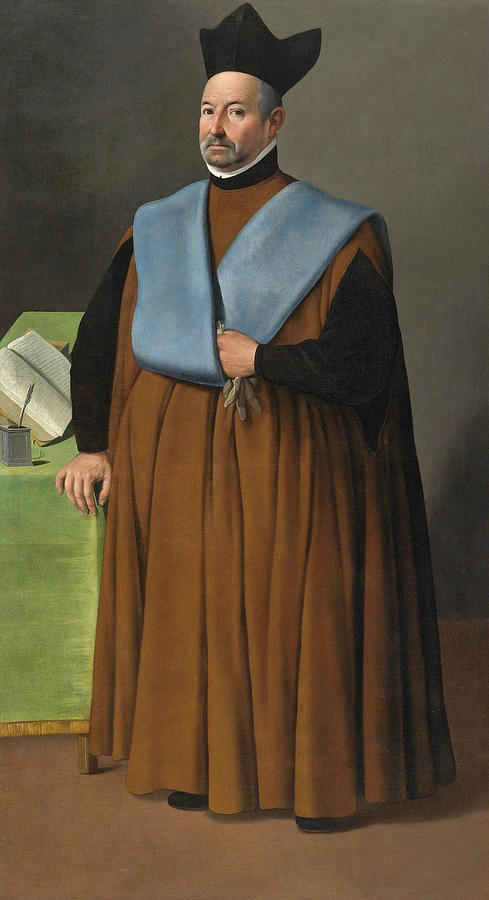
Image source: wikiart.org
Introducing the “Portrait of Doctor Juan Martinez Serrano, Full Length”
Francisco de Zurbaran’s “Portrait of Doctor Juan Martinez Serrano, Full Length” is a striking example of how the Spanish Baroque painter could invest a seemingly simple standing portrait with quiet grandeur and psychological depth. The work presents an academic figure in full-length format, dressed in formal robes and placed beside a modest writing table. There is no elaborate landscape, no architectural column, and no cascade of decorative detail. Instead, Zurbaran builds his composition around the gravity of one man, his profession, and the intellectual vocation he embodies.
Doctor Juan Martinez Serrano stands facing the viewer, body turned slightly to the side, with his left hand resting on a green-covered table and his right hand holding a pair of gloves or folded cloth against his chest. He wears a long brown gown with a black undergarment and a soft blue academic stole that falls over his shoulders. A black cap marks his rank and learning. The background is an austere gradation of gray and brown, creating a neutral stage that pushes the figure forward.
The entire painting speaks of steadiness, restraint, and respect. Zurbaran distills the essence of academic dignity into this single, commanding figure.
The Spanish Golden Age and the Portrait of a Learned Man
In seventeenth-century Spain, portraits of learned professionals occupied a special place. Jurists, physicians, university professors, and church doctors were not merely skilled workers. They were guardians of knowledge, mediators between royal power and the law of God, and advisors whose opinions shaped both civic and religious life.
Zurbaran is better known for his powerful saints, monks, and still lifes, but he also painted portraits of important figures in Seville and beyond. In “Portrait of Doctor Juan Martinez Serrano, Full Length,” he brings the same seriousness he reserved for martyrs and mystics to a man whose sanctity lies in his intellect and integrity. The honor of a full-length portrait, usually reserved for nobility or high-ranking clergy, signals the high esteem in which the sitter was held.
The painting thus celebrates a social ideal of the Spanish Golden Age: the learned Christian gentleman, whose authority derives not from weapons or wealth, but from study, judgment, and the disciplined life of the mind.
Composition Focused on Presence and Authority
The composition is remarkably controlled. Doctor Martinez Serrano occupies the center-right of the canvas, his tall figure dominating the vertical space. His pose is stable and symmetrical, with only a gentle turn of the torso and a slight shift of weight adding naturalness. The vertical folds of his brown gown reinforce the sense of groundedness, making him appear like a column or pillar.
The table to the left, draped in bright green, counters his mass and extends the space outward. It also introduces diagonal and horizontal lines that prevent the composition from feeling stiff. The open book, inkwell, and quill placed upon it allude to his daily work and form a secondary focal point that balances the figure’s head and shoulders.
The sitter’s gaze is directed slightly to the viewer’s right, not straight at us, which contributes to a sense of dignity. He is aware of being observed but does not pose theatrically. Instead he appears caught in a moment of composed stillness, as if he has paused his work to receive the painter and then will return to his studies as soon as the session is finished.
Costume and Academic Identity
Doctor Juan Martinez Serrano’s clothing is essential to the portrait’s meaning. The long brown gown falls in heavy, unbroken folds from his shoulders to the floor, suggesting weight and seriousness. The gown’s color, a warm earth tone, evokes solidity and modesty rather than display.
Over this garment lies a pale blue stole or academic mozzetta, broad across the chest and resting on the shoulders. Its soft sky-blue hue stands out against the darker tones of the gown and background, drawing attention to the upper body, where the intellect resides. Blue traditionally connotes wisdom, faith, and loyalty. Here it signals his affiliation with a particular university or faculty and hints at the clarity of thought expected from a doctor of law, medicine, or theology.
The black undergarment visible at the sleeves and collar gives the outfit structure and connects visually with the black cap on his head. The cap, with its angular form, identifies him as a scholar and doctor. On the surface, this hat is a simple piece of clothing. Symbolically, it is a crown of learning, the sign of years of study and examination.
In his right hand he holds what appears to be a pair of gloves or a folded cloth. Gloves were often associated with social rank and gentlemanly conduct. Holding them rather than wearing them suggests refinement and signals that the sitter is indoors, in an environment of study, not out in public or on official business. This detail underscores that his primary arena is the world of books and ideas.
The Writing Table and its Symbolic Still Life
To the viewer’s left, a sturdy table covered with a vivid green cloth adds an important narrative note to the painting. On it rests an open book, angled toward us so that we can see its pages, though the text is not legible. Beside it sits an inkwell with a quill. Together, these objects transform the portrait from a simple likeness into a story of vocation.
The open book suggests ongoing study or the act of writing a learned treatise, legal opinion, or medical observation. Its openness implies a mind that is still active, still engaged in weighing arguments and exploring new questions. The inkwell and quill underline the doctor’s role as author and authority. He is not just a passive reader but someone whose words carry weight in his field.
The green tablecloth introduces a fresh, almost luminous color field. Green is associated with life, growth, and hope. In the context of the painting, it may hint at the living, growing body of knowledge that Doctor Martinez Serrano tends through his work. It also breaks the otherwise restrained palette, energizing the left side of the composition.
Zurbaran’s careful depiction of this small still life reflects his mastery of texture and detail. The folds of the cloth, the shiny surface of the inkwell, and the crisp edges of the pages are painted with precision, yet they do not distract from the figure. They act as an extension of his identity, a portrait of his working environment.
Light, Shadow, and the Atmosphere of Serious Reflection
The lighting in “Portrait of Doctor Juan Martinez Serrano, Full Length” is subtle but deliberate. A clear, cool light seems to fall from the left, illuminating the sitter’s face, the blue stole, and the objects on the table. The right side of his gown fades gradually into deeper shadow, which merges with the muted background.
This arrangement of light not only gives volume to the figure but also guides the viewer’s eye. We are first drawn to the face, then to the blue stole, and finally to the hands and the table. The progression mirrors the structure of the sitter’s life from inner character, to institutional role, to daily practice.
The background is composed of two large planes of gray and brown, gently shifting in tone but free of any detail. This lack of distraction creates a contemplative atmosphere. The doctor appears to stand in a quiet, undefined space that could be a study, a hall, or an abstract zone of thought. The focus is entirely on him and the intellectual world he inhabits.
Zurbaran avoids dramatic contrasts of tenebrism here. Instead he uses a measured chiaroscuro that suits the subject’s rational character. The overall effect is one of calm seriousness rather than emotional intensity.
Psychological Insight and Character
One of the strengths of the painting lies in its psychological portrayal of Doctor Martinez Serrano. His face, turned slightly toward the viewer, shows a mix of mild reserve, self possession, and attentive intelligence. The short graying beard and carefully groomed mustache, the slight lines around the eyes, and the firm set of the lips all suggest a man of middle age who has spent many years in responsible work.
His gaze is steady and open but not seeking flattery. There is a hint of scrutiny, as if he is used to assessing the arguments or statements of others. At the same time, his expression avoids severity. There is a trace of calm kindness and measured patience that befits someone entrusted with teaching or guiding.
The pose contributes to this impression. The left hand resting on the table appears relaxed yet firm, implying reliability. The right hand holding the gloves or cloth near his chest introduces a more intimate note. It hints at a private sense of modesty or reservation, an awareness that beneath the external dignities he remains a man responsible before God and conscience.
Zurbaran’s portrait does not idealize his sitter beyond recognition. Instead it combines realism and respect, presenting a man whose authority arises from both intellect and moral character.
Zurbaran’s Approach to Secular Portraiture
Although many of Zurbaran’s best known works are religious, this portrait reveals his skill in secular subject matter. The solemnity and frontality familiar from his saints and monks are adapted to a lay figure, yet the spiritual seriousness remains. The painter does not turn the doctor into a saint, but he does treat his professional life as a kind of vocation.
The composition recalls court portraits in its full-length format and the presence of a table with objects. However, it avoids ostentation. There are no silks, jewels, or emblems of worldly power. Instead, the focus lies on the sober garments of office and the tools of learning. This restraint suits the Spanish taste for dignified austerity and reflects the Counter Reformation ideal of Christian professionalism.
Zurbaran’s restrained palette and uncluttered setting set his approach apart from more decorative Baroque portraitists. He prefers concise statements over complex narratives. In this painting, everything serves a single purpose: to show Doctor Juan Martinez Serrano as a man completely identified with his intellectual and ethical role.
Reading the Portrait Today
For modern viewers, “Portrait of Doctor Juan Martinez Serrano, Full Length” offers more than a glimpse of seventeenth-century academic fashion. It speaks to enduring questions about the place of knowledge, responsibility, and personal integrity in public life.
The doctor stands alone, without assistants or students, emphasizing that the final responsibility for judgment rests with the individual conscience. The open book and quill remind us that learning is an ongoing task rather than a finished achievement. The gloves in his hand hint at the balance between public function and private humanity.
In an age when expertise is both highly valued and frequently questioned, Zurbaran’s portrait invites reflection on what it means to be a true professional. The painting suggests that knowledge must be joined to modesty, that authority should be grounded in faithful work rather than self display, and that the quiet discipline of study can be as noble as more spectacular forms of heroism.
At the same time, the painting can be appreciated as a beautiful object in its own right. The harmony of brown, black, blue, and green, the sensitive modeling of light, and the serene architecture of the composition make it a pleasure to contemplate. Its calm presence has a meditative quality, as if the viewer were granted a pause in a busy world to consider the value of thoughtfulness and duty.
Conclusion
Francisco de Zurbaran’s “Portrait of Doctor Juan Martinez Serrano, Full Length” stands as a dignified celebration of the learned vocation. Through a carefully controlled composition, austere background, and precise depiction of clothing and accessories, Zurbaran presents his sitter as a man whose life is entirely devoted to knowledge and responsibility.
The brown academic gown, pale blue stole, black cap, and simple gloves all speak of modest authority. The green table with its open book and writing tools situates him within the world of study and authorship. Soft light models his features and garments, highlighting a face marked by thoughtful composure.
More than a mere likeness, the painting embodies an ideal. Doctor Juan Martinez Serrano appears as a figure of steady integrity, a pillar of learning within his community. In his silent stance, Zurbaran elevates the intellectual life, showing that in the Spain of the Golden Age, the work of the mind was worthy of the same respect usually granted to warriors and princes.
Seen today, this portrait continues to inspire respect for scholarly dedication and ethical professionalism. Its quiet grandeur reminds us that true authority often resides in those who serve quietly, think deeply, and carry the weight of their vocation with humility.