Image source: wikiart.org
Introduction to Tears of Saint Peter
Francisco de Zurbaran’s painting “Tears of Saint Peter” is one of the most powerful images of repentance in Spanish Baroque art. The work presents the apostle Peter not as triumphant leader of the Church, but as a broken man who has just realized that he denied Christ. This intensely emotional portrait captures a critical spiritual moment, when guilt and grace collide inside a human heart.
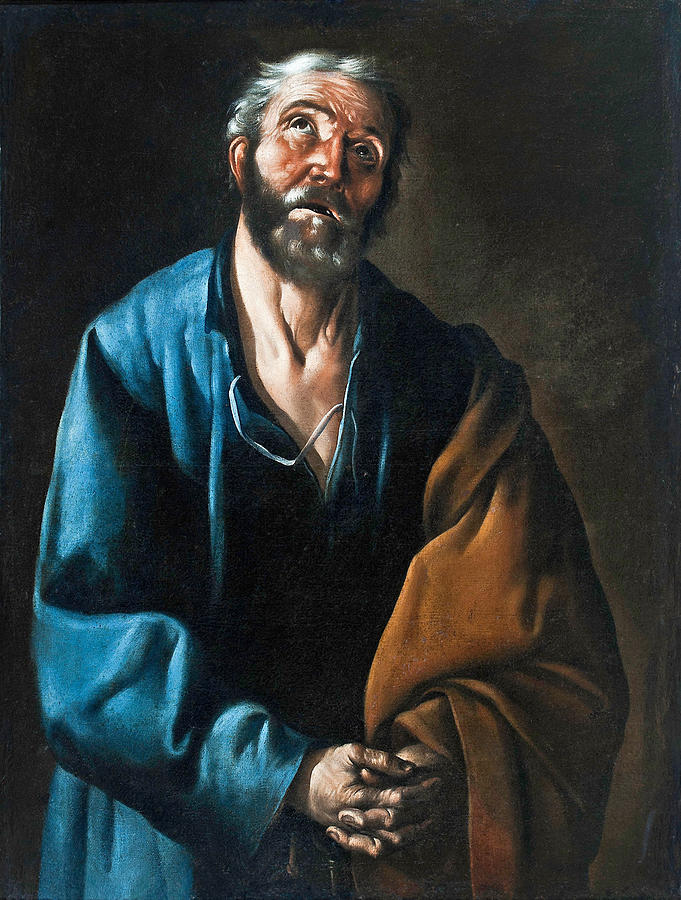
The painting shows Peter half length, wrapped in a blue cloak with a warm brown mantle over one shoulder. His hands are clasped tightly at his chest, his eyes lifted upward toward an unseen source of light. Tears glisten in his eyes and his face is furrowed with anguish, yet there is also a fragile hope in his expression. In a single figure, Zurbaran condenses the drama of betrayal, remorse and forgiveness that lies at the core of Christian spirituality.
Biblical and Religious Context
The subject of the weeping Peter comes from the Passion narratives of the Gospels. After promising that he would never abandon Jesus, Peter nevertheless denies knowing him three times during the night of the arrest. When a rooster crows, Peter remembers Christ’s prediction and is overwhelmed with sorrow. Scripture states that he went outside and “wept bitterly.”
Artists across Europe returned again and again to this moment, using it to explore the psychology of guilt and the possibility of conversion. In Counter Reformation Spain, where penitence and confession were central themes in preaching and devotion, the image of a repentant Peter carried special force. It reminded believers that even the chief apostle had fallen and yet been restored through tears and mercy.
Zurbaran’s painting does not show the rooster, the soldiers or the courtyard. Instead, he isolates Peter from all narrative accessories. The emphasis falls entirely on the inner transformation that begins at the moment of recognition. The composition becomes a visual meditation on contrition and divine compassion.
Composition and Overall Structure
The composition is simple and tightly focused. Peter occupies nearly the entire canvas. The viewer encounters him almost life size, placed close to the picture plane. There is no distracting architecture or landscape, only a dark, neutral background that recedes into shadow. This stark setting pushes Peter’s figure forward and heightens the sense of immediacy.
Zurbaran arranges the body in a slightly diagonal pose. Peter turns his upper torso toward the right, while his face lifts toward the left and upward, creating a subtle twist that energizes the composition. His hands are positioned in front of his chest, fingers interlaced in a tight, almost painful grip. The garments fall in broad planes of blue and brown that cross his body, emphasizing the movements of his shoulders and arms.
The strong vertical of the figure is countered by the angle of the head and hands, which lead the eye in a circular route from the clasped fingers up through the bent neck to the uplifted eyes. This circular motion suggests the turning of the heart, away from betrayal and toward the source of forgiveness.
The Expressive Face of the Apostle
The emotional center of the painting is Peter’s face. Zurbaran portrays him as a man of advanced age, with graying hair and beard. Deep lines crease his forehead and the corners of his mouth, testifying to a hard life of labor and recent anguish. Yet the skin is rendered with warmth and vitality, suggesting that spiritual rebirth is still possible.
Peter’s mouth is half open, as if he has just gasped in horror at his own weakness or is about to utter a prayer for mercy. The muscles around the eyes are tightened, and the eyebrows draw together in a mixture of pain and pleading. Most striking are the eyes themselves. They are turned sharply upward, away from the viewer, toward an unseen presence above the frame. Tiny highlights of light on the lower lids suggest that his eyes are wet with tears.
This upward gaze is crucial. It shows that Peter’s sorrow is not a closed loop of self hatred, but a movement toward God. The direction of his sight invites the viewer to imagine the compassionate face of Christ or the distant glow of heaven beyond the painting. His expression holds a paradoxical combination of despair and trust. He knows he has failed, yet he believes that the one he betrayed is still ready to forgive.
The Language of the Hands
Just below the face, Peter’s clasped hands provide a second focal point. Zurbaran paints them with extraordinary detail. The knuckles are pronounced, veins stand out beneath the skin, and the fingers press together tightly. These are the hands of a fisherman, rough and strong, accustomed to work and struggle.
The gesture is ambiguous in a rich way. Clasped hands can signify prayer, but here they are not simply folded in pious calm. The tension in the fingers hints at inner turmoil. They may suggest a man wringing his hands in shame, or gripping them together to resist despair. At the same time, their position near the heart indicates that the struggle taking place is not external but deeply emotional and spiritual.
By placing the hands in such a prominent position, Zurbaran translates theological concepts into physical language. Contrition becomes visible as strain in the muscles, as the instinctive response of a body grappling with guilt and need.
Color and Light
Zurbaran’s use of color in “Tears of Saint Peter” is both restrained and eloquent. The dominant hues are the blue of Peter’s cloak and the warm ocher of the mantle draped over his shoulder. The blue, rich yet somewhat worn, suggests humanity and frailty, while the brown evokes earthiness and humility. Together they create a harmonious balance between emotional intensity and grounded realism.
The background remains dark and largely undefined. This allows the colors of the garments and the flesh tones to stand out powerfully. Light falls from the upper left, illuminating Peter’s face, neck, and the upper parts of his clothing. The highlights along the folds of the blue cloak and the edges of the mantle give the figure sculptural solidity. Meanwhile, deep shadows carve out the contours of his arms and torso, intensifying the sense of volume.
This concentrated play of light and dark owes much to the influence of Caravaggio and his followers, whose dramatic chiaroscuro had spread throughout Europe. Yet Zurbaran’s approach is more meditative than theatrical. The illumination does not burst in as sudden revelation, but rather bathes Peter in a steady, searching light that seems to probe his conscience. It is as if the very light represents the gaze of Christ, exposing his failure yet at the same time surrounding him with mercy.
Background, Space and Focus
The background in this painting is reduced to a simple dark field, possibly a shadowed wall or night sky. There are no symbols such as keys, the rooster, or the cross, which often appear in depictions of Peter. By stripping away these narrative markers, Zurbaran heightens the psychological intensity of the image.
The undefined space has an important spiritual function. It places Peter in a kind of interior chamber, a symbolic space of conscience where the drama of repentance unfolds. The lack of architectural or landscape context makes the scene timeless and universal. This could be the moment just after the rooster has crowed, or it could represent later contemplations of that event. It could also stand for any believer’s moment of recognition and conversion.
The compressed space between Peter and the viewer makes the encounter intimate. We are drawn close to his anguish. His almost life size presence can create the impression that he stands just in front of us, caught in a beam of light, about to whisper his prayer.
Emotional and Spiritual Interpretation
“Tears of Saint Peter” is more than a psychological study. It is a profound spiritual statement about the nature of sin and grace. Peter’s posture and expression suggest a man who has hit the deepest point of his own failure. He has denied the one he loves most and cannot escape the knowledge of his betrayal. Yet the painting does not end in despair.
The upward gaze and the light on his face imply that the moment of recognition is also the beginning of restoration. His sorrow is real and deep, but it is not hopeless. The title itself emphasizes tears, a traditional sign of genuine repentance. Tears cleanse and open the heart to transformation. In Christian tradition, Peter’s tears lead to forgiveness and renewed mission as leader of the apostles.
Zurbaran invites viewers to identify with Peter. Every person, the painting suggests, has some experience of denying what they know is true, of failing their deepest commitments. By contemplating Peter’s anguish and his turning toward mercy, viewers are encouraged to bring their own failures into the light of grace. The painting becomes a mirror of conscience and an invitation to conversion.
Zurbaran’s Style and Influences
This work showcases the characteristics that made Francisco de Zurbaran one of the most important painters of the Spanish Baroque. His figures are robust and naturalistic, grounded in close observation of real models. At the same time, his compositions are stripped of unnecessary detail, focusing on what is essential for spiritual contemplation.
The influence of Caravaggist tenebrism is clear in the strong light that isolates Peter against a dark background. However, Zurbaran’s handling of light is softer, more enveloping. He uses it not only to dramatize but also to model the form with quiet sensitivity. The textures of skin and fabric are rendered with a tactile realism that invites almost physical empathy.
The choice of a close up half length figure aligns with Zurbaran’s many portrayals of saints and monks, where he often avoided elaborate narrative scenes in favor of intense portraits of contemplation. His artistic aim is not to show action but to reveal states of soul. In this sense, “Tears of Saint Peter” stands alongside his depictions of Saint Francis, Saint Serapion and other penitents as a key example of his spiritual portraiture.
Devotional Function and Viewer Experience
For devout viewers in seventeenth century Spain, this painting would have served as a powerful aid to prayer. Placed perhaps in a chapel, sacristy or monastic cell, it invited meditation on personal sin and the need for reconciliation. Peter’s broken yet hopeful demeanor could guide the faithful in examining their conscience and approaching the sacrament of confession.
The painting also teaches through example. Peter is not portrayed as a distant, idealized figure without weakness. Instead, he is achingly human. By seeing such vulnerability in a great apostle, viewers learned that failure is not the end of the story. What matters is the response, the willingness to turn back to God with humility.
Even for contemporary audiences who may not share the same religious framework, the painting has resonance. It captures a universal moment of moral crisis and self knowledge, when a person faces the gap between who they wanted to be and who they have become. The honesty and depth of emotion in Peter’s face transcend doctrinal boundaries and speak to the fundamental human experience of regret and the longing for a second chance.
Modern Relevance of Tears of Saint Peter
In a culture that often masks vulnerability behind confidence and distraction, Zurbaran’s Peter stands as a counter image. He shows the dignity of acknowledging failure openly. His tears are not signs of weakness but of courage and truthfulness. The painting suggests that the path to healing begins not with self justification but with honest sorrow.
The focus on a single figure in a bare space also resonates with contemporary concerns about solitude and interior life. In a world filled with noise, screens and constant communication, the quiet darkness around Peter feels almost refreshing. It is a space where one can hear the voice of conscience and the whisper of grace.
Moreover, the painting encourages empathy. When viewers meet Peter’s anguished yet hopeful gaze, they are invited to respond not with judgment but with understanding and compassion. This can inspire a more merciful attitude both toward oneself and toward others who struggle with their own failures.
Conclusion
“Tears of Saint Peter” by Francisco de Zurbaran is an intense visual meditation on human weakness and divine mercy. Through a simple but powerful composition, the artist captures the exact moment when the apostle realizes his denial of Christ and turns toward forgiveness. The expressive face, tightly clasped hands, rich blue and brown garments and dramatic play of light and shadow all work together to reveal the inner drama of repentance.
Zurbaran avoids external narrative details in order to focus on the spiritual core of the event. The result is a painting that transcends its historical context and speaks directly to the conscience of anyone who contemplates it. It stands as a testament to the Baroque conviction that art can lead viewers not only to aesthetic pleasure but also to moral and spiritual transformation.
