Image source: wikiart.org
Introducing Zurbaran’s “The Prayer of St Bonaventura About the Selection”
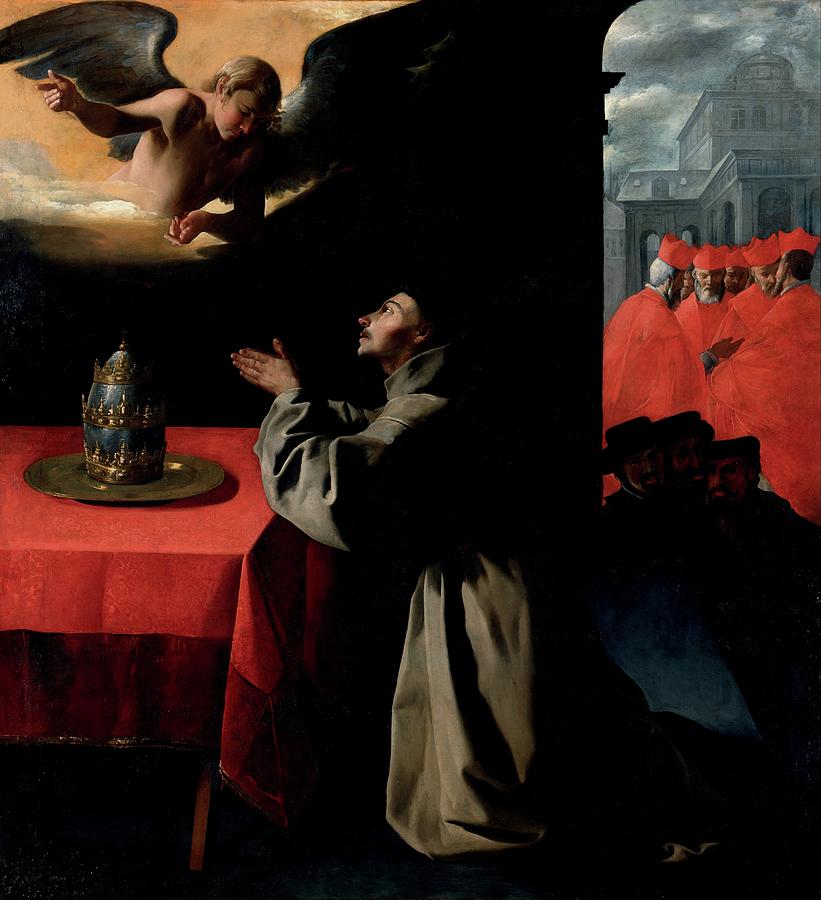
Francisco de Zurbaran’s painting “The Prayer of St Bonaventura About the Selection” is a powerful meditation on humility, spiritual discernment and the weight of ecclesiastical power. At first sight the composition seems almost theatrical. A Franciscan friar kneels in the foreground, hands joined in intense prayer, while a luminous angel breaks through the dark sky above him. To his left, a richly embroidered red cloth covers a table on which rests the papal tiara. To the right, a group of cardinals dressed in vivid scarlet confer in front of monumental church architecture.
Although the overall subject is the selection of a pope, Zurbaran chooses to focus on a single decisive moment. St Bonaventure, renowned theologian and Franciscan minister general, is caught between heaven and earth, between the claims of the cardinals and the call of God. The painting turns a complex historical episode into a spiritual drama that unfolds in light and shadow.
Historical And Spiritual Context
St Bonaventure lived in the thirteenth century and became one of the greatest minds of the medieval Church. A member of the Franciscan order, he combined mystical spirituality with clear theological reasoning. Tradition recounts that he was offered high office, including the papal dignity, but preferred poverty and contemplation.
Zurbaran’s painting refers to one of these episodes, when the Church was searching for a new pope and Bonaventure was consulted about the choice. The cardinals, symbolically represented at the right, look to human discussions and political alliances. Bonaventure, by contrast, withdraws in prayer, seeking heavenly guidance. The angel who appears at the left represents that guidance, while the tiara on the table stands for the power and responsibility at stake.
For a seventeenth century Spanish audience living in a deeply Catholic society, this subject would have had strong resonance. It presented a model of church leadership based on prayerful discernment rather than ambition. In an age of political intrigue and confessional conflict, Bonaventure’s stance represented the ideal of a holy scholar who places God’s will above personal advancement.
Composition And The Dramatic Division Of Space
Zurbaran organizes the canvas using a striking division of space. The painting is essentially split vertically into two zones. On the left, a warm golden sky opens to reveal the angel, while a red tablecloth and blue tiara occupy the earthly foreground. On the right, deep shadow dominates the lower part, while the upper section reveals a cool, bluish architectural background and the cluster of cardinals in bright scarlet.
This division sets up a dialogue between two realms. The left side evokes a more interior and spiritual space, marked by the hovering angel and the devotional posture of Bonaventure. The right side suggests the external world of ecclesiastical politics. The artist thus makes visible the tension between contemplation and action, between the quiet voice of God and the noisy debates of men.
The vertical column or wall that separates these two halves functions almost like a moral barrier. Bonaventure is physically located at the boundary, with his body facing the angelic light and his back turned to the cardinals. The viewer sees his profile illuminated as he looks upward, a clear statement that true discernment occurs when one turns away from human expectations and seeks divine guidance.
Chiaroscuro And Color Symbolism
Light and shadow are central tools in Zurbaran’s storytelling. The strongest light falls on three key elements: the face and hands of Bonaventure, the winged figure of the angel and the papal tiara on the table. These areas stand out sharply against the surrounding darkness, compelling the viewer to connect them conceptually.
The red tablecloth introduces an intense field of color into the left foreground. Its folds are carefully painted, and its hue links symbolically with the cardinals’ robes on the right. Red suggests the blood of martyrs and the fire of the Holy Spirit, but it also hints at power and passion. By placing the tiara upon this cloth, Zurbaran surrounds the symbol of the papacy with both sacred and worldly connotations.
The cool blue of the tiara itself contrasts with the warmth of the red cloth. It offers a note of distance and serenity, as if to remind viewers that the papal office should be oriented toward heavenly truth rather than earthly ambition. The glowing gold that crowns the tiara further suggests divine authority.
The cloud on which the angel rests is suffused with golden light that blends into the upper left sky. This luminous area balances the cooler tones of the building and stormy sky to the right. The cardinals’ crimson garments blaze against this bluish background, underscoring their prominence in the visible church, yet they remain somewhat detached from the central beam of light that falls on Bonaventure.
The Figure Of St Bonaventure
St Bonaventure is the spiritual center of the composition. Clad in the simple grayish brown habit of a Franciscan, he kneels at the table with his hands joined in prayer. The folds of his habit are rendered with great realism, demonstrating Zurbaran’s unmatched ability to give weight and volume to cloth. The coarse material of the robe contrasts sharply with the rich textiles and precious metals that accompany the papal tiara.
Bonaventure’s face is turned upward, his expression intense yet peaceful. The strong light that falls on his forehead and cheek emphasizes his role as thinker and contemplative. His lips are slightly parted, suggesting silent dialogue with the heavenly messenger above.
The posture of his body reveals both humility and strength. Kneeling, he acknowledges his dependence on God, yet his upright back and firm clasped hands convey resolve. He is not surrendering to pressure but actively choosing to seek God’s will. For viewers, he becomes an example of how to face decisions that involve personal sacrifice or the needs of the wider community.
The fact that Bonaventure remains physically close to the tiara, yet does not touch it, deepens the narrative tension. The object is within reach, but his gaze is directed elsewhere. Zurbaran thereby portrays the saint’s refusal to grasp power for himself, even when it is offered.
The Angel And The Papal Tiara
The angel who leans out of the clouds at the upper left is a key figure in the story. With one arm extended in a gesture of indication, he seems to be pointing either toward Bonaventure or toward some invisible choice that the friar must make. His expression is earnest and compassionate. Although he possesses the strength symbolized by his dark wings, his demeanor is gentle.
This angel is not a distant apparition. He leans forward, almost entering the earthly space, as if eager to communicate. The proximity of the angel to Bonaventure’s uplifted face underscores the intimacy between divine guidance and human response. The clouds on which he rests glow with the same light that illuminates Bonaventure’s face, visually uniting them.
The papal tiara, elaborately decorated and surmounted by crosses, rests solidly on a golden tray. It is placed on the red table almost like a liturgical object, ready to be claimed or set aside. The composition positions it directly between Bonaventure and the angel, forming a triangle of meaning. The question implicit in the painting is whether this object is meant for the praying friar, for someone else, or whether the true message is that spiritual authority should never be separated from humble dependence on God.
For seventeenth century viewers in Spain, the tiara would have represented not only spiritual leadership but also influence in global politics. Zurbaran’s careful depiction of its splendor invites contemplation of the responsibilities attached to such power.
The Gathering Of Cardinals
On the right side of the painting, a group of cardinals occupies the middle ground. Their bright scarlet robes and caps stand out vividly against the gray architecture and blue sky. Some are turned toward each other, engaged in discussion. Others look downward as if reflecting on ballots or documents.
Closer to the viewer, in the lower right foreground, three men in dark hats stand in partial shadow. Their faces are more heavily shaded than those of the cardinals, indicating some distance from the decision making circle. They may represent lower clergy or envoys observers who witness but do not control the selection process.
By clustering these figures together, Zurbaran communicates the collective aspect of papal elections. Decisions are made through consultation and political maneuvering. Yet the fact that they occupy a different half of the painting and lack the heavenly illumination surrounding Bonaventure subtly critiques any selection that relies solely on human negotiation.
The cardinals are not portrayed as villains. They are dignified in posture, their garments painted with respect. However, the emphasis placed on their scarlet robes against a somewhat cold and cloudy sky contrasts with the warm golden light that bathes Bonaventure and the angel, suggesting two different atmospheres, one of human deliberation and one of divine inspiration.
Architectural Background And Political Dimension
The architecture rising behind the cardinals evokes the grandeur of Rome. Massive columns and a multi storied church or palace suggest the seat of papal authority. The building’s scale dwarfs the human figures, reminding viewers of the weight of tradition and institutional power.
The sky above this architecture is overcast, with gray clouds that hint at tension or uncertainty. This weather contrasts with the more serene golden tones above the angel. The visual opposition between stormy and clear skies reinforces the thematic contrast between ecclesiastical politics and divine clarity.
By including such an imposing building, Zurbaran situates the drama of Bonaventure’s prayer within the broader history of the Church. The decision that is being discerned will affect not only the individuals pictured but the entire Christian world. The painting therefore becomes a reflection on governance and conscience, asking how spiritual leaders can remain true to the Gospel while navigating the realities of institutional life.
Zurbaran’s Style And Spanish Baroque Spirituality
“The Prayer of St Bonaventura About the Selection” bears many hallmarks of Zurbaran’s style. His use of deep blacks and strong directional light creates a sense of sacred mystery. Figures emerge from darkness into illumination, echoing the spiritual journey from ignorance to understanding.
The careful rendering of textiles, especially the red tablecloth and the cardinals’ robes, showcases his talent for depicting different surfaces. At the same time, the simple, almost geometric forms of the table and the architectural elements provide a stable framework for the drama.
The painting reflects the spiritual ideals of Spanish Baroque culture, which valued intense personal devotion, the example of the saints and the constant interplay between inner prayer and outward action. Zurbaran does not fill the canvas with distracting details. Every object, from the tiara to the table corner, contributes to the central theme of discernment.
Contemporary Resonance And Meditative Power
For contemporary viewers, this painting remains surprisingly relevant. Many people today face decisions that involve career advancement, public responsibility or the tension between personal ambition and deeper values. Bonaventure’s posture offers a countercultural model. Instead of seizing opportunities solely because they are available, he first turns to prayer, seeking alignment with a higher purpose.
The contrast between the solitary figure in contemplation and the group engaged in discussion also invites reflection on how choices are made within institutions, whether religious, political or corporate. Zurbaran suggests that authentic leadership requires both communal deliberation and the silent listening of the heart.
The painting can serve as a visual aid for meditation. Viewers can imagine themselves in Bonaventure’s place, kneeling before the symbols of power in their own lives and asking for clarity. The angel becomes an image of the inner voice that calls one to fidelity and humility.
Conclusion
“The Prayer of St Bonaventura About the Selection” is far more than a historical anecdote rendered in paint. Francisco de Zurbaran transforms the scene into a profound exploration of the relationship between divine guidance and human responsibility. Through a bold division of space, dramatic chiaroscuro and carefully chosen symbols, he invites viewers to ponder what it means to discern God’s will amid the pressures of public life.
Bonaventure’s humble yet resolute posture, the luminous presence of the angel, the rich yet weighty papal tiara and the distant circle of cardinals together create a narrative that speaks across centuries. The painting honors the saint’s fidelity while gently questioning any pursuit of power that is not rooted in prayer.
In this way, Zurbaran offers a timeless reminder that the most important decisions are not made in council chambers alone, but in the quiet moments when a person kneels before God and listens.