Image source: wikiart.org
Introducing Zurbaran’s “The Archangel Michael”
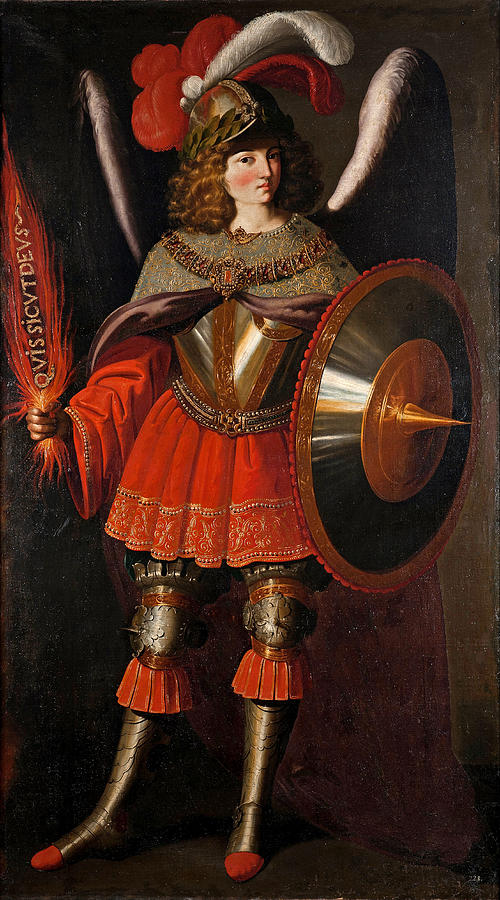
Francisco de Zurbaran’s “The Archangel Michael” presents one of the most striking warrior angels of the Spanish Baroque. The painting shows the archangel standing full length in glorious armor, dressed in a short crimson tunic richly embroidered with gold, great wings rising behind him, a plumed helmet on his curly hair, a blazing sword in one hand and a gleaming shield in the other.
The composition is simple yet monumental. Michael stands alone in a dark, undefined space, his figure powerfully illuminated so that he seems to step forward out of shadow. This isolation emphasizes his role as commander of the heavenly hosts and defender of the Church. At the same time the refined details of his costume, the careful modeling of his youthful face and the delicate feathers of his wings reveal Zurbaran’s sensitivity to both spiritual and material beauty.
In this painting, the archangel is not only a terrifying military figure but also an image of noble virtue and celestial dignity. Zurbaran invites viewers to contemplate Michael as protector, judge and model of courage in the struggle against evil.
The Archangel as Heavenly Warrior
From the Book of Revelation to centuries of Christian devotion, Michael is known as the leader of the angels who cast down the dragon and defend God’s people. Zurbaran captures this martial aspect directly. Michael stands in a firm contrapposto stance, weight resting on one leg, the other slightly forward as if braced for battle. His armor covers him from shoulders to feet and his weapons are held with calm assurance.
Yet there is no visible enemy in the painting. No dragon writhes under his feet, no demons lurk in the shadows. Instead, Michael seems to stand guard at the edge of an unseen battlefield. This absence of an explicit adversary shifts attention to the inner qualities of the angel. He represents continual vigilance rather than a single dramatic victory. The viewer is reminded that the struggle between good and evil is ongoing, fought not only in distant realms but in the human heart.
Michael’s solemn expression reinforces this idea. His lips are closed, his gaze directed forward or slightly to the side, as if he is watching and weighing. He is not a frenzied fighter but a disciplined commander, prepared to act when justice demands.
Composition and Stance of Authority
The painting’s vertical format accentuates the archangel’s towering presence. Zurbaran places Michael centrally, filling almost the entire height of the canvas. The figure is slightly turned, giving a sense of three dimensionality, but the frontal presentation conveys direct confrontation.
The dark background creates a powerful contrast with the luminous armor and bright red garments. There are no architectural elements or landscapes to distract the eye. Instead, an almost theatrical spotlight falls on Michael, modeling his body and equipment with strong highlights and deep shadows. This dramatic lighting, characteristic of Baroque art, makes him appear both real and otherworldly.
Michael’s body forms a stable triangle, with the broad wings at the top and the firmly planted feet at the base. The shield and sword create two opposing diagonals. The rounded shield projects outward, catching the light and drawing attention to the center of the figure, while the sword rises at an angle, topped by a flaming plume. These diagonals give energy and rhythm to the composition, while the overall triangular structure keeps it balanced and calm.
Armor, Costume and Material Splendor
One of the great pleasures of this painting is the wealth of detail in the armor and clothing. Zurbaran, renowned for his still life works and for his attention to texture in monastic habits, brings the same care to Michael’s martial finery.
The archangel’s breastplate is polished metal that reflects light with sharp highlights. Over it lies a richly embroidered collar and a short cape that falls elegantly over his shoulders. The short red tunic, adorned with gold edging and delicate patterns, recalls the uniforms of elite soldiers and at the same time the ceremonial dress of the Spanish court. Beneath the tunic hang pleated tassets, protecting the upper legs yet echoing the ornamental quality of a skirt.
The greaves and boots are masterpieces of metalwork painting. Their curved plates, hinges and rivets catch light on every ridge, suggesting weight and solidity. The red leather or fabric underlayers at the knees and ankles link visually with the tunic and create a harmonious rhythm of color down the figure.
This blend of armor and luxurious textile reflects the Baroque fascination with visual opulence. Michael is not simply ready for battle. He appears as a prince of heaven, clothed with honor and glory. The rich costume also connects the celestial realm with the earthly world of seventeenth century Spain, where armor and court dress were symbols of noble rank and duty.
Color, Light and Baroque Drama
Zurbaran’s color choices heighten the painting’s sense of drama and sacred power. The dominant hue is a saturated red that appears in the tunic, the pleated elements of the leg armor and the feathers of the helmet. Red, associated with blood, fire and divine love, suits an angel who fights with burning zeal for God’s justice. The golden embroidery and metallic surfaces add brilliance and suggest the radiance of heaven.
The background remains a deep, nearly black brown. This creates a strong silhouette for the figure and allows the colors of the costume to glow. Light appears to fall from the upper left, striking Michael’s face, chest and shield. Highlights on the shield form a bright radial pattern, as if the surface were not only reflecting light but emitting it. This shimmering effect turns the shield into an emblem of divine protection, a barrier that reflects and deflects the forces of darkness.
The wings, mostly white with touches of rose, are painted with softer transitions of light and shade. They frame the figure and provide a gentle counterbalance to the hardness of the armor. Their pale color also enhances the visual impact of the red tunic and the golden shield.
Overall, light in this painting is not merely natural. It behaves almost symbolically, concentrating on the face, weapons and central torso, leaving the surrounding space in shadow. This focus guides the viewer’s contemplation toward the archangel’s role as spiritual protector and instrument of divine light.
Symbolism of Sword, Shield and Inscription
Michael’s sword is one of the key symbolic elements. It is no ordinary weapon. The hilt and guard are ornate and from its blade rises a stylized flame of red and orange, representing holy fire or the burning power of the word of God. The sword is not raised in a striking gesture, but held upright, close to his body, suggesting readiness and contained strength.
An inscription runs along the sword. Although the letters are stylized, they likely echo the traditional phrase linked to Michael, “Quis ut Deus,” Latin for “Who is like God.” This question, which plays on the meaning of Michael’s name, proclaims that no creature can rival God. The flaming sword therefore becomes a visual proclamation of divine supremacy and a reminder that Michael’s authority derives entirely from God.
The shield is equally meaningful. Its circular form and radiant center give it the appearance of a sun. In Christian symbolism, the shield often represents faith that protects believers from spiritual assault. The pointed boss in the middle adds a sense of offense as well as defense, suggesting that faith not only withstands evil but also overcomes it.
Together, sword and shield turn the archangel into a complete image of spiritual warfare. The believer who contemplates this painting is invited to imagine being under Michael’s protection, armed with faith and the word of God.
The Angelic Face and Inner Character
Despite the heavy armor and fierce weapons, Michael’s face is youthful and almost gentle. Zurbaran portrays him with soft features, slightly parted lips and large eyes that gaze with measured intensity. His hair falls in golden curls around his shoulders, giving him an almost courtly elegance.
This contrast between delicate face and powerful body expresses a key idea. True spiritual strength is not brutal or coarse. It is joined to purity, beauty and obedience. Michael’s youth suggests eternal freshness and unwavering fidelity. There is no hint of cruelty in his expression. Instead, one sees calm determination and a certain sadness, as if he is fully aware of the gravity of the battle he fights.
The halo around his head, though subtle, confirms his sanctity. Unlike more ecstatic depictions of angels, this Michael does not appear swept up in overpowering emotion. His spirituality is expressed through steadiness, self control and the quiet acceptance of duty. Zurbaran thus offers him as a model for Christians who must practice virtue in the midst of their own struggles.
Wings, Plumes and Courtly Splendor
The wings behind Michael are not merely functional signs of his angelic nature. Their grand sweep and soft feathering contribute significantly to the painting’s visual impact. Rising from his shoulders, they arc outward and upward, framing his head like a monumental backdrop. Their whiteness speaks of purity, while hints of rosy tones tie them to the warmer palette of the rest of the painting.
On his helmet, a cluster of plumes echoes the wings on a smaller scale. Red and white feathers curve elegantly, crowning the archangel with a flourish that recalls the ceremonial attire of officers and nobles. This detail again bridges the realms of heaven and earth, presenting Michael as a commander who could stand alongside the greatest captains of Zurbaran’s Spain, yet belongs to a higher army.
Such courtly details would have resonated strongly with seventeenth century viewers, especially in religious orders or confraternities devoted to the archangel. The painting communicates that heavenly service is a form of noble chivalry and that virtues like courage, loyalty and honor have their highest expression in the spiritual realm.
The Painting in the Context of Spanish Devotion
In Catholic Spain, devotion to St Michael was widespread. He was invoked as patron of soldiers, protector against heresy and plague, and defender against the snares of the devil. Many monasteries, churches and confraternities commissioned images of the archangel to decorate altars and meeting halls.
Zurbaran, whose career was deeply intertwined with monastic patrons, would have been well suited to translate this devotion into paint. His tendency toward strong, solitary figures, often placed against dark backgrounds, matched the desire to present saints and angels as powerful intercessors standing close to the viewer.
“The Archangel Michael” likely functioned as a devotional image that encouraged believers to trust in heavenly protection and to imitate Michael’s steadfast courage. In an age marked by religious conflict and political tension, the figure of a vigilant, victorious angel would have been both comforting and inspiring.
Stylistically, the painting fits with Zurbaran’s broader interest in combining realism with idealization. The armor and textiles are rendered with almost tangible precision, while the halo, wings and glowing light emphasize the supernatural identity of the figure. This blend allowed viewers to feel that Michael was both close to their world and yet gloriously beyond it.
Contemporary Resonance of Zurbaran’s Archangel
For modern viewers, “The Archangel Michael” continues to hold strong appeal. Even apart from its religious meaning, the painting is a powerful study in heroic stance, luxurious costume and dramatic lighting. It stands as a fine example of Baroque portraiture applied to a celestial subject.
At a deeper level, the image speaks to ongoing human concerns about justice, protection and moral struggle. Michael’s calm readiness and luminous armor can be interpreted as symbols of integrity in the face of hostility, or of the courage needed to confront personal and societal forms of evil.
The flaming sword and radiant shield suggest that true defense requires both clarity of truth and steadfast faith, however one defines those values. His youthful, uncorrupted face reminds viewers that strength need not be harsh.
In a world where conflicts often feel overwhelming, Zurbaran’s archangel offers a vision of ordered, purposeful power directed entirely toward the defense of what is good. That message, painted with such visual splendor, explains why this image remains compelling centuries after its creation.