Image source: wikiart.org
Introduction to Still Life with Dish of Quince
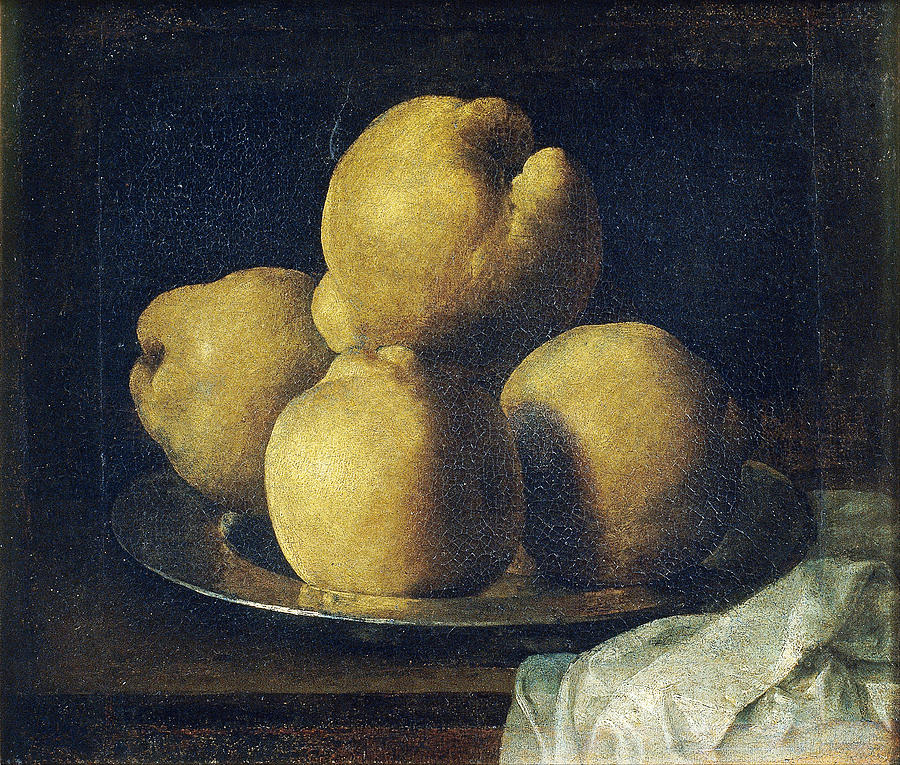
“Still Life with Dish of Quince,” painted by Francisco de Zurbaran in 1664, is a quiet yet powerful example of Spanish Baroque still life. At first sight the subject appears disarmingly simple. Five quinces sit on a reflective plate against a dark background, accompanied only by a folded white cloth at the right edge of the table. There are no decorative vases, no elaborate table settings, no dramatic spills of fruit across the surface.
Yet the more you look, the more this restrained composition reveals its depth. Zurbaran transforms ordinary fruit into monumental forms that feel almost sculptural. Light touches the quinces with a soft golden glow, while the surrounding darkness gives them a solemn presence. What might have been a humble kitchen scene becomes an intense meditation on matter, light, and the quiet mystery of everyday objects.
Zurbaran and the Spanish Bodegón Tradition
In seventeenth century Spain the still life genre was known as the bodegón, a term that originally referred to taverns or pantry spaces. Painters of bodegones focused on food, vessels, and utensils, often arranged with a stark simplicity that reflected both Spanish austerity and Counter Reformation spirituality.
Zurbaran is most famous for his religious canvases and monastic portraits, yet he also produced a small but striking group of still lifes. These works share many qualities with his devotional paintings. They feature strong contrasts of light and shadow, carefully observed textures, and an atmosphere of contemplative silence.
“Still Life with Dish of Quince” belongs to the later period of his career, when his brushwork had become more relaxed and atmospheric. However, the compact clarity of the composition shows that he remained deeply interested in how simple things could carry spiritual weight.
A Carefully Balanced Composition
The structure of the painting is deceptively straightforward. A pewter dish occupies the center of the table, slightly tilted toward the viewer. On it Zurbaran arranges five quinces in a pyramidal cluster. Two fruits sit at the front, two more behind them, and one rises at the back to form the apex.
This arrangement is not accidental. The pyramid has long been associated with stability and harmony. Here it gives the still life a monumental solidity, as if the quinces were carved forms rather than soft fruit. The subtle asymmetries in their positions keep the group from feeling mechanical. Each quince leans slightly in a different direction, creating a lively interplay of overlapping curves.
The plate is placed a little below center, leaving enough space above the fruit for the dark background to frame them. At the lower right corner, the white cloth spills over the edge of the table, breaking the otherwise rigid horizontals with a flowing diagonal. The cloth not only balances the composition visually but also introduces a contrasting texture that enriches the scene.
The Drama of Light and Shadow
One of the most striking aspects of the painting is its use of light. It appears that a single, focused light source shines from the upper left, striking the quinces and the rim of the plate. The front surfaces of the fruit are bathed in warm illumination, while their sides and the area behind them dissolve into deep shadow.
This interplay of light and dark is characteristic of the Baroque era. In Zurbaran’s hands it serves not only to describe volume but also to create a sense of spiritual intensity. The quinces emerge from darkness as if called into presence by the light itself. Their golden surfaces seem to glow with an inner life, while the surrounding gloom hints at the mystery that lies beyond what we can see.
The reflections on the metal dish are rendered with restrained precision. Rather than dazzling highlights, Zurbaran uses soft, blurred reflections that reinforce the roundness of the form. The plate subtly mirrors the tones of the quinces above it, binding the elements together in a unified field of light.
Texture and Material Presence
Zurbaran demonstrates an extraordinary sensitivity to texture in this still life. The skin of the quinces is slightly rough, with tiny speckles and subtle shifts of color. Some areas appear smoother and shinier, others duller or more matte, suggesting variations in ripeness. Fine cracks in the paint surface, visible from age, now interact with these textures and make the fruit appear even more tangible.
The pewter dish has a different quality. Its surface is cool, smooth, and slightly reflective. Zurbaran captures the way it catches highlights along the rim and under the fruit, giving it a solid metal presence that contrasts with the organic softness of the quinces.
The white cloth introduces yet another material. Its folds are painted with loose but confident strokes, creating an impression of light, flexible fabric that has just been set down. The cloth appears almost casual, yet its placement is deliberate. Its brightness ensures that the viewer’s eye moves from the golden fruit to the pale textile and back again, exploring the full range of surfaces.
Color Harmony and Subtle Modulation
While many still lifes from northern Europe feature a wide array of vivid fruits and flowers, Zurbaran restricts his palette. The dominant color is a muted golden yellow, tempered with greenish and brownish shadows. This unified tone gives the quinces a sense of quiet harmony, like variations on a single theme.
The background is a deep blue black, almost velvety in its darkness. This cool tone sets off the warm hues of the fruit, making them appear more luminous. The plate picks up both warm and cool tones, acting as a transition between the objects and their surroundings.
The white cloth, tinged with soft grays, blues, and beige highlights, provides a crucial contrast. Without it, the painting might risk monotony. With it, the eye experiences a rhythm between warm yellow, cool dark, and bright neutral. This restrained yet sophisticated color scheme reinforces the contemplative mood of the work.
Symbolic Resonances of the Quince
In addition to their visual appeal, the quinces may carry symbolic meanings. In Mediterranean cultures, quinces have long been associated with love, fertility, and prosperity. In Christian symbolism, fruit can also refer to the fruits of the Spirit or the virtues cultivated in a life of faith.
The choice of five quinces may not be accidental. The number five can recall the five senses, suggesting that the painting invites both physical and spiritual perception. It can also allude to the five wounds of Christ, linking this apparently secular still life to religious themes that permeate Zurbaran’s work.
At the same time, the heavy, almost weighty presence of the quinces hints at the passage of time. Fruit ripens, bruises, and eventually decays. Even though these quinces appear fresh, the viewer knows that their perfection is temporary. In this sense the painting participates in the vanitas tradition, where still lifes remind viewers of the fleeting nature of earthly pleasures and the need to orient life toward enduring values.
The Plate and Cloth Between Sacred and Everyday
The pewter plate and white cloth contribute to the symbolic resonance of the painting. The plate has a humble, domestic quality. It might easily belong to a monastery refectory or a simple household table. Its metallic sheen, however, and its central placement on the table give it a faint echo of liturgical vessels used for bread and wine.
The white cloth strengthens this association. It resembles the linen used on altars during the celebration of the Eucharist. Seen in this light, the still life takes on a subtle sacramental aura. The quinces on the plate can be read not only as fruit ready for eating but also as an offering that hints at spiritual nourishment.
Zurbaran’s ability to allow both readings at once is part of the painting’s power. Viewers can appreciate the objects as simple food and domestic utensils, yet the quiet solemnity of the composition suggests that everyday realities are never far from the sacred.
A Meditation on Silence and Space
Unlike some still lifes that crowd the table with numerous objects, “Still Life with Dish of Quince” revels in emptiness. The dark background offers no distraction. There is no window, no drapery, no secondary fruit overflowing the plate. The negative space around the quinces is as important as the objects themselves.
This emptiness has a meditative quality. It gives the viewer room to pause and attend. The stillness of the scene feels almost like the silence of a chapel or cloister. The quinces become focal points for contemplation, much like candles or devotional statues, yet they remain purely natural objects.
Such an approach reflects the spiritual climate of Zurbaran’s Spain, where many religious orders emphasized withdrawal from worldly noise in order to seek God in simplicity. In this still life, silence is not a lack but a presence, a quiet field in which the humble beauty of creation can be fully perceived.
Technical Mastery and Painterly Subtlety
On a technical level the painting demonstrates Zurbaran’s mastery of oil paint. The transitions from light to shadow on the quinces are handled with delicacy, without abrupt edges. The modeling of form is achieved through thin glazes and soft blending, giving the fruit a rounded solidity.
The surface of the painting, when viewed closely, reveals a fine craquelure that testifies to its age. Rather than detracting from the image, these tiny cracks interact with the textures that Zurbaran painted, adding a sense of patina and history.
The brushwork on the cloth is more visible and free. Broad strokes suggest folds and creases rather than delineating every detail. This contrast between the carefully modeled fruit and the more loosely rendered textile enriches the visual experience. It shows that Zurbaran was not simply copying reality but interpreting it through varied painterly approaches.
Comparison with Other Still Lifes by Zurbaran
When compared to other still lifes by Zurbaran, such as compositions featuring oranges, lemons, or earthenware vessels, “Still Life with Dish of Quince” stands out for its extreme economy. Some of his earlier works include more elaborate arrangements with multiple tiers of objects and stronger contrasts. Here he pares everything down to essentials.
This late work feels like the distilled essence of his still life vision. The choice of a single type of fruit, the quiet colors, and the sparse setting suggest an artist who has grown more interested in contemplation than in display. The painting becomes less about showing virtuosity and more about capturing presence.
Lasting Appeal for Modern Viewers
Although created in the seventeenth century, “Still Life with Dish of Quince” has a strikingly modern feel. Contemporary viewers, accustomed to minimalist design and photographic close ups of food, can readily appreciate its focus on a small set of objects and its dramatic lighting. The painting’s restrained palette and strong geometry would not look out of place in a modern gallery devoted to abstraction.
At the same time, the still life offers a counterpoint to the speed and distraction of modern life. It encourages viewers to slow down, to notice the weight of fruit on a plate, the way light grazes a rough surface, the quiet beauty of a folded cloth. In an age of constant visual overload, Zurbaran’s disciplined focus on a few things invites a different way of seeing.
Conclusion A Monument to Ordinary Fruit
“Still Life with Dish of Quince” is a small painting with a monumental presence. Francisco de Zurbaran elevates five quinces, a pewter plate, and a simple cloth into a visual poem about light, matter, and silence. Through careful composition, subtle color harmonies, and sensitive handling of texture, he reveals the hidden dignity of everyday objects.
The painting belongs firmly to the Spanish bodegón tradition, yet it also transcends its genre. The quinces are both fruit ready for the table and symbols that hint at spiritual themes such as the passage of time, the fruits of virtue, and the sacramental character of creation. The emptiness around them becomes an arena of contemplation, where viewers can encounter the extraordinary within the ordinary.
More than three centuries after its creation, this still life continues to draw viewers into its quiet world. It reminds us that great art does not always depend on grand narratives or complex scenes. Sometimes a few pieces of fruit on a plate, painted with love and attention, are enough to open a window onto mystery.