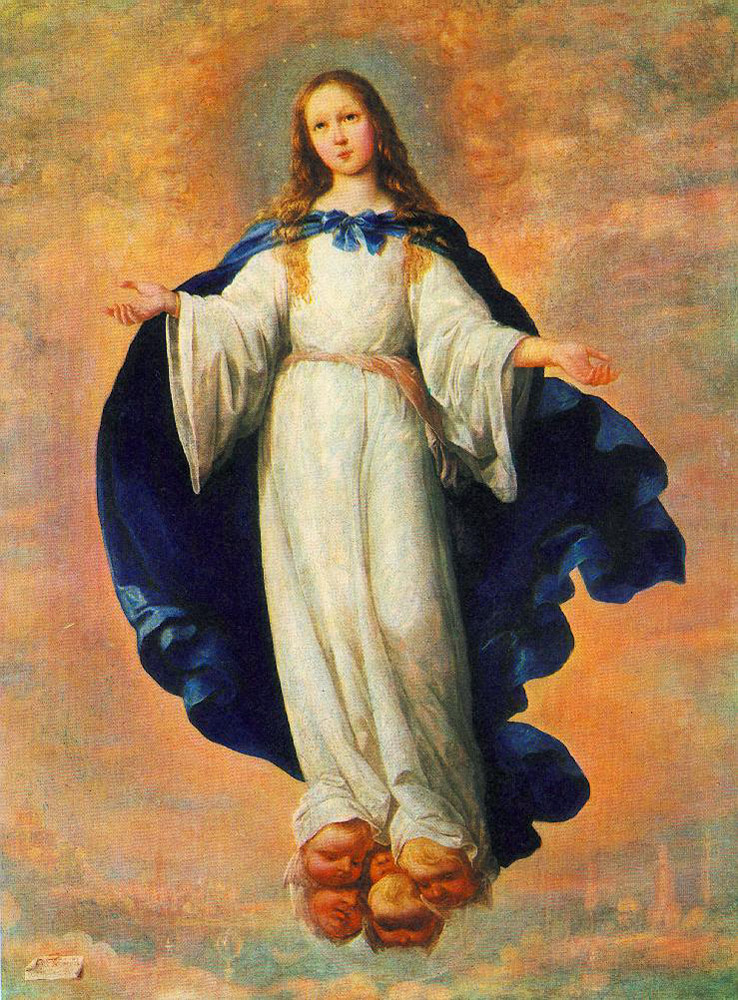
Image source: wikiart.org
Historical Context of The Immaculate Conception
Francisco de Zurbaran painted “The Immaculate Conception” in 1661, at a time when Spain was passionately devoted to the doctrine of Mary conceived without original sin. Although the dogma would not be officially defined until the nineteenth century, seventeenth century Spain already treated it as a cherished truth. Cities held processions in honor of the Immaculate Conception, religious orders adopted it as their special cause, and artists were commissioned to produce images that captured Mary’s purity and heavenly election.
Zurbaran, a leading figure of the Spanish Baroque, had spent decades painting saints, monks and mystical visions with a distinctive blend of austerity and radiance. In this late work he responds to the theme of the Immaculate Conception with remarkable clarity. Instead of filling the canvas with complex theological symbols, he centers everything on a youthful Virgin who appears almost like a living apparition in the sky. The result is a painting that feels both doctrinal and deeply personal, a vision of Mary as the perfect, grace filled woman close to the hearts of ordinary believers.
Composition and Overall Design
The composition of “The Immaculate Conception” is strikingly vertical. Mary’s figure occupies nearly the entire height of the canvas, rising from a bed of cherub heads to the upper edge of the painting. She is placed centrally, and her long white robe accentuates the sense of upward movement. Around her, clouds shift from warm golds to cooler blues, suggesting the glowing atmosphere of heaven as dawn light breaks.
Zurbaran uses a symmetrical arrangement that gives the composition a sense of balance and calm. Mary’s arms open gently to either side, her palms facing outward in a gesture that combines prayer, acceptance and blessing. Her head tilts slightly, breaking the strict symmetry just enough to keep the image alive and natural. The deep blue mantle that frames her body spreads outward in a soft triangular shape, echoing the traditional Marian color and also stabilizing the vertical thrust of the figure.
Unlike some earlier images of the Immaculate Conception that include numerous symbolic objects, Zurbaran’s version is almost minimalist. There is no crescent moon, no lilies in a vase, no elaborate garden. The main elements are Mary herself, the floating cherub heads beneath her feet, and the luminous sky. This reduction intensifies the impact of her presence and allows viewers to concentrate on her purity and grace without distraction.
The Figure of the Virgin Mary
Mary appears as a very young woman, almost adolescent, which underlines the theme of untouched innocence. Her face is delicate, with smooth, pale skin and soft pink cheeks. The eyes are large and slightly raised toward heaven, their expression a mixture of humility and gentle wonder. Her lips are closed in a serene, almost shy smile that conveys trust rather than triumph.
Her hair is loose, a golden brown cascade that falls freely over her shoulders. This detail adds to the sense of youth and natural beauty, yet Zurbaran treats it with modest simplicity rather than sensuality. The loose hair also contributes to the impression that Mary is untouched by strict conventions of courtly fashion. She stands as the new Eve, fresh from the creator’s hand, unmarked by sin.
The pose is both simple and eloquent. Mary’s weight appears evenly distributed, yet her robes suggest a subtle upward drift, as if she is being gently lifted by the cloud of angels. The open arms resemble the stance of the orant, an ancient gesture of prayer in Christian art. At the same time, the hands extended outward recall the pose of Christ in many depictions of blessing. In this way, Zurbaran visually expresses Mary’s unique role. She is a human being praying to God, yet she is also a channel through which divine grace pours upon the world.
The White Robe and Blue Mantle
Color is essential in conveying the meaning of this painting. Mary is dressed in a long white robe tied at the waist with a soft, rose tinted sash. White evokes purity, innocence and light. It suggests that Mary’s soul is untouched by the stain of original sin, transparent to God’s presence. Zurbaran paints the fabric with a subtle range of tones, from creamy highlights where the light hits to cooler shadows in the folds. This nuanced handling gives the robe a tangible, almost heavy quality, yet the overall effect remains luminous.
Over the white robe Mary wears a deep blue mantle that wraps around her shoulders and falls behind her. Blue had long been associated with Mary in Western art, partly because of its connection with the sky and with costly ultramarine pigments reserved for special subjects. Here the mantle functions like a protective aura around the white figure. The intense blue sets off the brightness of the robe and helps the figure stand out clearly against the golden clouds.
The combination of white and blue also refers to Marian titles such as “Mirror of Justice” and “Seat of Wisdom,” suggesting that Mary reflects the light of God rather than generating it on her own. Zurbaran’s careful balance of these colors turns the painting into a kind of visual hymn, praising the harmony of humility and glory in the person of the Virgin.
The Cherubs Beneath Her Feet
At the bottom of the figure, Mary’s feet rest not on solid ground but on a cluster of cherub heads. These rosy faces, with their golden hair and tiny wings, emerge from the swirling cloud like living jewels. The cherubs support her and also conceal any direct contact with the earth. In iconography of the Immaculate Conception, this separation from the soil symbolizes Mary’s exemption from the fallen condition of humanity. She belongs already to the heavenly realm, though she shares our human nature.
Zurbaran’s cherubs are individualized yet harmonized. Some gaze up toward Mary with adoration, others peer out toward the viewer. Their infant features recall the innocence of baptismal grace, suggesting that through Mary the same purity can be offered to all believers. Their warm colors, rich pinks and golds, form a visual base that balances the cooler tones of Mary’s robe and the surrounding sky.
The fact that the cherubs form a kind of living pedestal also alludes to images of the apocalyptic woman in the Book of Revelation, who is described as standing on the moon and clothed with the sun. While Zurbaran does not include the crescent moon explicitly, the floating cherub cloud serves a similar function of elevating Mary above the ordinary world and connecting her directly with symbolic light.
Light, Atmosphere and the Heavenly Space
One of the most beautiful aspects of this painting is its treatment of light and atmosphere. The entire background consists of clouds bathed in a warm, diffused glow. Soft oranges, pinks and golden yellows blend seamlessly with pale blues and violets. The effect is reminiscent of sunrise or sunset, a transitional moment when earth and heaven seem to touch. This luminous environment reinforces the idea that Mary belongs to a realm of grace that bridges divine and human reality.
The lighting on Mary is consistent with the background but slightly intensified. Her white robe catches more direct illumination than the clouds around her, making her appear like the brightest point in the sky. The blue mantle, though darker, shows subtle reflections of the surrounding light along its edges. This harmonious interplay of figure and background avoids any sense of artificial spotlighting; instead, it suggests that Mary is naturally radiant within the environment of divine glory.
Zurbaran is known for his use of tenebrism, the sharp contrasts of light and shadow inspired by Caravaggio. In “The Immaculate Conception” he softens that technique. The transitions between light and dark are gentle, and there are no harsh shadows. This softness suits the theme of Immaculate grace. The painting feels like a vision seen through contemplative eyes rather than a dramatic scene lit by theatrical lamps.
Theological Symbolism and Doctrinal Meaning
Although Zurbaran keeps the visual elements relatively simple, the painting is rich in theological significance. The doctrine of the Immaculate Conception teaches that Mary, from the first moment of her existence, was preserved from original sin in view of the merits of Christ. Artists were challenged to express this invisible state of grace in visible form.
Zurbaran’s answer is to present Mary as untouched by anything heavy, dark or earthbound. Her garments are light and flowing, her feet never touch the ground, and her surroundings are filled with luminous clouds rather than material structures. The choice of a youthful, almost childlike face underscores that this purity characterizes her entire being, not simply a later conversion. She appears as the embodiment of God’s original intention for humanity, fulfilled in one person.
Her open hands and upward gaze also carry doctrinal weight. They show her as the perfect responder to God’s initiative, the one who says “yes” completely. In Catholic theology Mary’s Immaculate Conception is not a privilege that distances her from us, but a sign of what grace can do when it meets perfect cooperation. Zurbaran’s painting conveys this idea without relying on textual explanation. The viewer sees in her posture a model of surrendered freedom.
Zurbaran’s Style and the Spanish Baroque
“The Immaculate Conception” demonstrates how Zurbaran’s style had evolved by the 1660s. Earlier in his career he often painted saints in stark interiors, surrounded by deep shadows and minimal color. Here he embraces a brighter palette and a more atmospheric setting. Yet he retains his characteristic sense of calm and structural clarity. Unlike some Baroque artists who favored swirling movement and crowded compositions, Zurbaran prefers stillness and centeredness.
Spanish Baroque art often combined intense piety with a certain sobriety that distinguished it from the exuberant decoration of Italian or Flemish works. In this painting, we see that balance clearly. There is emotional warmth in Mary’s expression and in the glowing colors, but there is no theatrical gesture or dramatic narrative. The painting invites quiet contemplation rather than excitement.
The Immaculate Conception was a favored subject of other Spanish painters as well, notably Murillo. Compared to Murillo’s more sentimental and soft edged versions, Zurbaran’s Mary appears slightly more reserved and solid. Her features are less sugary, her body more firmly drawn. This difference reflects Zurbaran’s training and personality, which leaned toward monastic austerity. Yet the warmth of the background and the gentle luminance of the figure show that he too could create images of tender devotion.
Devotional Function and Viewer Experience
For seventeenth century viewers, this painting would have been more than an aesthetic object. It would have served as a focus for prayer, processions and liturgical celebrations dedicated to the Immaculate Conception. Believers might kneel before it, reciting litanies or simply gazing at Mary’s face in silence. The open hands of the Virgin could be read as an invitation to entrust one’s life to her intercession.
The upward thrust of the composition naturally lifts the viewer’s gaze. The eye moves from the warm cherub heads at the bottom up along the white robe, then to the face, and finally to the softly glowing clouds above. This visual ascent mirrors the spiritual movement of prayer, in which the soul rises from earthly concerns to contemplation of the divine.
At the same time, the youthful sweetness of Mary’s expression offers a sense of closeness and compassion. She is not remote or stern. Her slightly tilted head and gentle features make her appear ready to listen. In a culture marked by political turmoil and plague, such an image would have provided comfort and reassurance that heaven remained attentive.
Legacy and Contemporary Appreciation
Today, “The Immaculate Conception” by Francisco de Zurbaran continues to captivate viewers for both religious and artistic reasons. Art historians admire its harmonious composition, luminous color and successful fusion of doctrinal clarity with human warmth. Devotional viewers find in it a powerful representation of Mary as a pure, approachable mother who stands in solidarity with those seeking grace.
The painting also resonates with contemporary interests in the portrayal of feminine holiness and dignity. Mary appears confident and serene, not passive or overshadowed. Her stance communicates strength rooted in trust. She embodies a form of beauty that is neither eroticized nor rigid, but simply radiant with inner integrity.
Even for those who do not share the specific theological beliefs behind the image, the painting offers an invitation to consider the ideals of purity, harmony and self giving love. Zurbaran’s Mary stands as a luminous symbol of what human life might look like when fully aligned with goodness. Her presence in the sky suggests that such a vision, though transcendent, is still intimately connected with our world.
Conclusion
“The Immaculate Conception” of 1661 reveals Francisco de Zurbaran at the height of his powers as a painter of spiritual realities. Through a central standing figure bathed in light, wrapped in a white robe and blue mantle, and supported by cherubs among glowing clouds, he expresses the Catholic conviction that Mary was preserved from sin and filled with grace from the first moment of her existence. The painting’s simplicity of design, gentle yet radiant color and serene expression of the Virgin create an image that is both theologically rich and emotionally accessible.
More than three centuries after its creation, the work continues to speak. It draws the eye upward, invites the heart to trust, and offers a vision of humanity restored to innocence and beauty. In “The Immaculate Conception,” Zurbaran gives the world not only a masterpiece of Spanish Baroque art but a lasting visual hymn to the mystery of grace.