Image source: wikiart.org
Introduction to The Virgin of the Carthusians
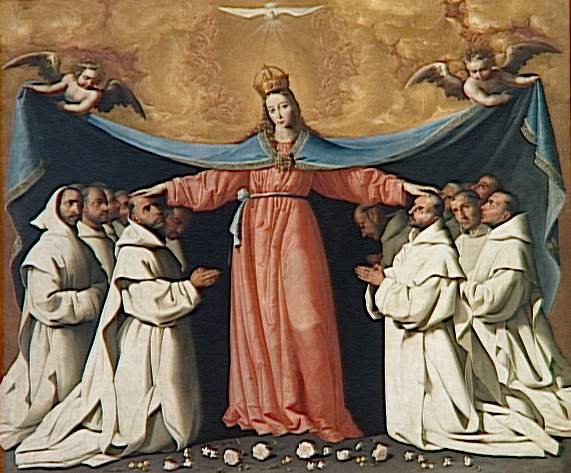
Francisco de Zurbaran’s “The Virgin of the Carthusians,” painted around 1655, is one of the most serene and monumental Marian images of the Spanish Baroque. At first glance, the composition feels almost architectural. The Virgin Mary stands in the center, towering above a group of kneeling Carthusian monks. With her arms extended, she holds open a vast blue mantle that shelters the religious community beneath it. Above her, the sky glows with warm clouds, cherubs hover at the edges of her cloak, and a white dove symbolizing the Holy Spirit radiates light over the scene.
The painting presents Mary as both queen and protective mother. At the same time, it expresses the ideals of the Carthusian Order, known for its strict silence, solitude, and focus on contemplation. Zurbaran, who often worked for monastic patrons, brings these themes together in a unified vision of communal prayer gathered under the gentle protection of the Virgin.
Historical and Spiritual Context
The Carthusian Order, founded in the eleventh century by Saint Bruno, is one of the most austere contemplative communities in the Catholic Church. Carthusians follow a life of solitude, silence, manual work, and liturgical prayer. Even though they live in a monastery, each monk spends most of his time alone in a small cell, coming together only for specific communal prayers.
By the seventeenth century, devotion to the Virgin Mary was deeply ingrained in Carthusian spirituality. Mary was honored as a model of contemplation and as a figure who gathers the faithful under her care. An image of the Virgin spreading her mantle to shelter believers is known as the “Virgin of Mercy” or “Madonna of the Protective Mantle.” Zurbaran adapts this iconography specifically to the Carthusian context.
Painted late in his career, “The Virgin of the Carthusians” shows Zurbaran at a stage when he had mastered the calm, monumental style that suited monastic commissions. The painting likely served as an altarpiece or devotional focus in a Carthusian church, reminding the monks that all their solitary efforts are embraced by Mary’s maternal solicitude.
Overall Composition and Architectural Balance
The composition is carefully organized around strong horizontal and vertical lines. The Virgin stands at the exact center of the canvas, forming a vertical axis that reaches from the row of flowers at her feet up to the dove of the Holy Spirit above her head. Her extended arms create a broad horizontal that divides the painting into upper and lower zones.
In the lower zone, the Carthusian monks kneel in two symmetrical groups, one on each side of the Virgin. Their white habits form parallel diagonals that slope gently upward toward her. This arrangement draws the eye toward Mary and reinforces her role as the focal point of the composition.
The upper zone is filled with warm golden clouds that envelop the dove and two small angels who hold the upper corners of the mantle. These angels echo the form of the monks below, creating a vertical resonance between heaven and earth. The overall effect is one of harmonious order, befitting an image intended for a community that values disciplined silence and liturgical structure.
The Virgin Mary as Queen and Mother
Zurbaran’s depiction of Mary combines regal dignity with maternal tenderness. She wears a long rose colored dress that falls in simple vertical folds, emphasizing her height and centrality. Over this she carries the wide blue mantle that has been opened to form a shelter for the monks. Around her waist a narrow belt gathers the fabric gracefully, and delicate jewelry at her neckline confirms her status as queen.
On her head rests a golden crown. Unlike some crowned Madonnas where jewels glitter extravagantly, Zurbaran keeps the crown relatively simple, almost like a natural extension of her head. It signals her queenship without overshadowing her gentle face.
Mary’s expression is calm, almost introspective. She does not look directly at the monks or at the viewer. Instead, her gaze is slightly softened and distant, as if she contemplates both the earthly community before her and the divine presence above. Her head tilts gently to one side, adding a touch of humanity and humility to her formal stance.
Her extended arms, palms turned downward, evoke the gesture of a priest or mediator interceding for others. At the same time, this gesture is deeply maternal, like a mother spreading out her cloak to protect her children from the sun or the rain. In this dual symbolism, Mary appears as both queenly intercessor and everyday mother of the Carthusian family.
The Mantle as Symbol of Protection and Unity
The deep blue mantle is perhaps the most striking visual element in the painting. It stretches almost from one edge of the canvas to the other, forming a vast canopy. Two small angels at the upper corners hold it up, while Mary’s arms support it at the center. The mantle curves gently downward, enclosing the monks in a sheltered space.
This image of the protective mantle has a long tradition in Christian art. It suggests that Mary’s intercession covers the faithful, guarding them from spiritual dangers and bringing them under the gentle shadow of God’s mercy. In the case of the Carthusians, the mantle also evokes their common life. Although each monk lives in solitude, they are not isolated individuals. They are gathered under one rule, one spirit, and, as Zurbaran suggests, one maternal protection.
The inside of the mantle, turned toward the monks, is lighter and cooler in tone, almost like the interior of a tent or the shade of a tree. This subtle change in color helps convey a sense of shelter and intimacy. The outside of the mantle blends with the glowing clouds, linking Mary’s protection with the surrounding heavenly light.
The Carthusian Monks Portraits of Contemplative Devotion
The kneeling monks are rendered with careful individuality, yet they form a unified group. Each face has distinct features, suggesting that Zurbaran may have based them on real Carthusians or on a variety of models from his workshop. Despite their differences, they all share a calm, concentrated demeanor.
Their white habits, the traditional Carthusian garment, are painted with the precision that made Zurbaran famous. Thick woolen folds catch the light in broad planes, creating a sense of weight and warmth. The whiteness of the habits has a symbolic character as well, reflecting the purity and simplicity of their life.
Some monks kneel with hands joined in prayer, others with hands open or folded on their chests. Several look up at the Virgin, while others bow their heads in meditative recollection. None show dramatic emotion. Instead, Zurbaran emphasizes quiet attentiveness and interior devotion.
Placed so close to Mary, the monks appear like a living foundation that supports her majestic figure. At the same time, they are clearly gathered under her protection. Their posture and placement affirm that the Carthusian vocation is lived in the light of Mary’s intercession and under the guidance of the Holy Spirit who hovers above.
The Presence of the Holy Spirit and Angels
At the apex of the painting, just above Mary’s crown, the Holy Spirit appears in the form of a white dove. Rays of light emanate from it, illuminating the central axis of the composition. This small but powerful symbol reminds viewers that Mary’s role is always related to the action of the Spirit. She is the one in whom the Spirit first brought forth Christ, and she continues to be the vessel through which grace flows into the Church.
The two cherubic angels who grasp the corners of the mantle bridge the realms of heaven and earth. Their small bodies and fluttering wings echo the innocence and joy associated with heavenly worship. They seem almost playful, yet their task is serious: to help hold open the mantle of mercy that shelters the monks.
These angelic figures create a visual link between the luminous clouds and the solid forms of Mary and the monks. They underscore the idea that the Carthusian community on earth participates in the praise of heaven and that angels are close companions in contemplative life.
Symbolism of Flowers and Ground
At the very bottom of the painting, beneath Mary’s feet, a row of flowers stretches from one side to the other. These blossoms introduce a small band of bright color and delicate detail into the otherwise smooth floor. Traditional interpretation sees the flowers as symbols of virtues and graces that bloom under Mary’s protection. Each could stand for specific qualities such as purity, humility, or charity.
The flowers also soften the boundary between the celestial and terrestrial realms. Though the scene is set in an undefined spiritual space, the presence of flowers suggests that divine grace bears fruit in the concrete world of nature and human life.
Mary stands barefoot on this floral ground, an intimate detail that brings her closer to earth. Her bare feet remind viewers that she is a human creature, not merely an ethereal figure, and that she shares the humble conditions of those she protects.
Zurbaran’s Color Palette and Handling of Light
The color harmony of “The Virgin of the Carthusians” is particularly refined. The warm gold of the clouds, the rose hue of Mary’s dress, and the deep blue of her mantle create a triad of dominant tones. These are gently contrasted with the cool white of the monks’ habits and the soft neutrals of the floor.
Light is distributed evenly but with purposeful emphasis. Mary’s face, crown, and upper body are strongly lit, making her the natural focus. The white habits of the monks also catch the light, but not as intensely, which keeps them subordinate to her presence. The blue of the mantle and the rose dress receive a softer light, enhancing their fabric and volume without overpowering the central figure.
Zurbaran avoids harsh contrasts in this work. Instead of dramatic spotlighting, he uses a calm, diffused illumination that suits the contemplative subject. This gentle light contributes to the peaceful atmosphere, appropriate for a painting intended to accompany quiet prayer and liturgy.
Theology in Paint Mary and the Carthusian Ideal
Beyond its visual appeal, the painting offers a theological meditation on the relationship between Mary and the monastic life. The Carthusians seek a life of silence, poverty, and separation from worldly distractions. Yet they do not pursue these austerities in isolation from the rest of the Church. Under Mary’s mantle they remain connected to the wider community of believers and to the communion of saints.
Mary’s central, towering figure reminds the monks that their vocation is not about personal achievement, but about being drawn into the mystery of Christ through her. Her presence suggests that their rigorous solitude is embraced within a larger maternal care.
The posture of the monks, turned not toward one another but toward Mary, indicates that their unity is rooted in a shared orientation. They are many individuals, but they find their common center in Marian devotion and in the grace of the Holy Spirit. The painting thus becomes a visual summary of Carthusian spirituality: solitary hearts gathered in silent contemplation beneath the protective mantle of the Virgin, all under the gentle light of the Spirit.
Contemporary Resonances
For modern viewers, “The Virgin of the Carthusians” can speak in several ways, even outside a strictly monastic context. The image of a community sheltered under a shared mantle suggests solidarity and mutual support, something deeply needed in a fragmented world. Families, parishes, or any group that seeks spiritual depth can see in this painting a reminder that they are not alone, that there is a larger embrace holding them together.
The Carthusian monks, with their calm expressions and simple white habits, invite reflection on silence and interiority. In a culture saturated with noise and distraction, their posture under the mantle encourages a return to quiet prayer and contemplation. Mary’s protective presence can be interpreted as a symbol of safe space for such interior work, a place where people can withdraw from chaos without escaping responsibility.
The painting also offers a vision of leadership that is maternal rather than domineering. Mary does not command with a raised sword or scepter. She simply opens her cloak and stands among those she protects. Her authority is expressed through availability, presence, and intercession. This can be a powerful image for contemporary discussions about leadership in communities and churches.
Conclusion A Mantle of Mercy over a Silent Order
“The Virgin of the Carthusians” by Francisco de Zurbaran is a masterpiece of contemplative Baroque art. Through a balanced composition, restrained yet rich color, and finely observed figures, the painting expresses the intimate bond between Mary and a community dedicated to silent prayer.
At the center stands the Virgin, queenly yet gentle, arms outstretched, mantle open. Beneath that mantle kneel the Carthusian monks, their white habits glowing softly, their faces absorbed in devotion. Above them, warm clouds, angels, and the dove of the Holy Spirit attest that this sheltered gathering on earth is already surrounded by the reality of heaven.
Zurbaran succeeds in translating complex theology into a clear and moving image. The painting shows how a contemplative order understands itself, not as isolated individuals striving alone, but as children united under the protection of a merciful mother. For viewers today, this vision remains compelling, inviting us to imagine our own lives gathered under a mantle of grace that opens wide enough to hold all who seek quiet, prayer, and peace.