Image source: wikiart.org
Introduction to “The Denial of Saint Peter”
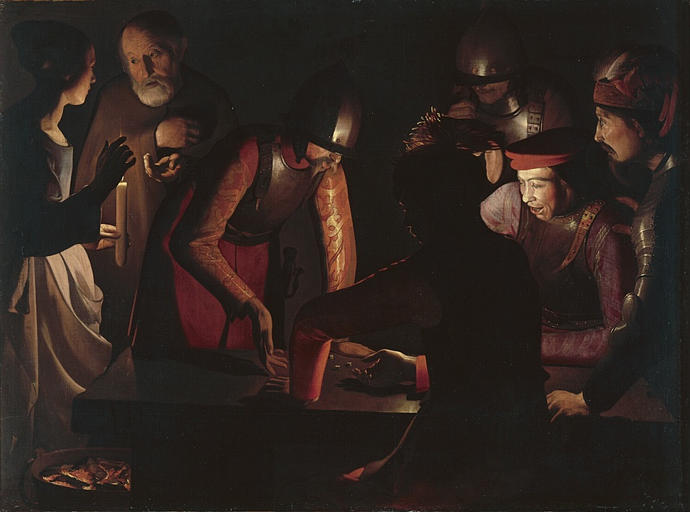
Francisco de Zurbaran’s “The Denial of Saint Peter,” painted around 1650, transforms a brief Gospel verse into a gripping nocturnal drama. The canvas shows the moment in the High Priest’s courtyard when Peter, confronted by servants and soldiers, denies knowing Christ. Instead of placing Christ at the center, Zurbaran builds the composition around secondary figures, flickering candlelight and tense gestures.
A group of soldiers and officials cluster around a table in the foreground. Armor gleams, red garments catch the light, and hands move over coins and documents. At the left, a serving maid holding a candle points toward an older man with a troubled expression. This man, only partially illuminated, is Peter himself. His hand presses to his chest in a nervous defensive gesture as he protests that he does not know the prisoner taken nearby.
Zurbaran’s powerful use of chiaroscuro, dense shadows and selective highlights creates an atmosphere of moral ambiguity. The story unfolds not in a wide courtyard but in a compressed interior space, as if the drama of Peter’s conscience has been pushed into a single room. Through light, color and psychology, the painter invites viewers to stand close to the flame and feel the weight of this failure of courage.
The Biblical Narrative Behind the Painting
The subject comes from the Gospels, which recount that during Christ’s trial Peter followed at a distance and warmed himself by a fire in the courtyard of the High Priest. Several times bystanders accused him of being a disciple of Jesus. Each time Peter denied it, fearful of sharing the fate of his master. After the third denial, a cock crowed, and Peter remembered Christ’s prophecy that he would deny him three times before the cock crowed. Overwhelmed with remorse, he went out and wept bitterly.
Zurbaran chooses the instant when accusation and denial collide. There is no cock in sight, no tear on Peter’s cheek, and Christ remains offstage. Instead, the painter concentrates on the human dynamics of suspicion, fear and bravado. The soldiers lean over the table, engaged in business that may be related to the trial. The maidservant steps forward with her candle, her gesture exposing Peter to their gaze. The scene captures the precarious balance before the decisive third denial, when the apostle’s words will echo forever through Christian memory.
Composition and Spatial Drama
The composition is tightly cropped and horizontal, filling the frame with human bodies and eliminating any sense of comfortable distance. The table runs across the lower part of the canvas, creating a barrier that both divides and unites the characters. Most of the figures cluster on the right, while Peter and the maid occupy the left, slightly detached yet clearly part of the same dramatic space.
The central focus is a dark, silhouetted figure with his back to the viewer, seated at the table. Around him gather armed men, their helmets catching the candlelight. This central silhouette functions as a pivot, linking the intense conversation at the table with the quieter yet more psychologically charged exchange between the woman and Peter.
The left side of the painting is less crowded but no less important. The maidservant towers over Peter despite her smaller physical size because of her upright posture and the candle she carries. The light establishes her as the accuser whose words expose Peter. Peter himself is slightly turned away, leaning backward as if trying to withdraw into shadow. His backward movement contrasts with the forward lean of the soldier bending over the table, suggesting the outward bravado of earthly power against the inward retreat of a frightened conscience.
The background is virtually absent, swallowed in darkness. This lack of architectural detail keeps the eye on the figures and intensifies the claustrophobic feeling. The viewer is pressed into the same tight circle of light where truth and denial are about to clash.
Tenebrism and the Language of Light
Light is the true protagonist of “The Denial of Saint Peter.” A single candle, held by the maidservant, appears to be the primary source of illumination. From this small flame, bright highlights ripple outward, striking faces, armor and hands, while the rest of the space dissolves into deep shadow.
This tenebrist technique, reminiscent of Caravaggio and Georges de La Tour, allows Zurbaran to shape the moral landscape of the scene. The soldiers’ metallic helmets glitter harshly, suggesting the cold, impersonal force of authority. The red garments of the men at the table glow hot against the darkness, giving visual form to passion, anger and perhaps cruel amusement.
Peter’s face receives only partial light. One side is warmed by the candle while the other side recedes into darkness. This half-lit visage mirrors his inner division. He belongs to the circle of the disciples yet stands here among Christ’s enemies. His heart knows the truth, but fear pushes him toward falsehood. The uncertain lighting around him captures this spiritual twilight between fidelity and betrayal.
The maidservant emerges brightly against the surrounding dark, her candle illuminating her features with a stark clarity. She functions almost like a human spotlight trained on Peter. Her role as accuser is underscored by the simple fact that she literally brings him into the light.
Color, Texture and Emotional Temperature
Zurbaran’s palette in this painting is restricted yet powerful. Rich reds dominate the clothing of the officials at the table, while muted browns, blacks and grays fill the surrounding space. The maidservant’s costume introduces pale tones that catch the candlelight and help define her figure.
Red, the color of blood and passion, saturates the center of the composition. It appears in a soldier’s tunic, in the garments of the seated men, and even in glimpses of cloth beneath armor. This intense color field suggests anger, agitation and perhaps the cruelty that will soon manifest in the mocking and scourging of Christ.
In contrast, Peter’s clothing is subdued, composed of browns and grays that do not draw attention. He seems almost to dissolve into the background. This visual modesty corresponds to his desire to remain unnoticed, to slip through the crowd without being recognized. Yet the candlelight insists on bringing his face and hands into visibility, refusing to let him hide completely.
Zurbaran’s handling of texture reinforces the realistic immediacy of the scene. The gleam of polished metal contrasts with the soft folds of fabric and the rough surfaces of the table and walls. These tactile qualities make the setting tangible, as if the viewer could almost hear the clink of coins on wood or the rasp of chain mail when the soldiers shift.
The Maidservant and the Moment of Recognition
The maidservant is a key figure in the Gospel story. She is the one who first recognizes Peter and insists that he was with Jesus. In Zurbaran’s depiction, she stands at the far left, slightly apart from the cluster of men. Her body leans inward, arm extended, finger pointing toward Peter or perhaps toward the group, as if inviting them to look and judge.
Her face is lit from below by the candle, producing dramatic shadows that accentuate her features. She is not portrayed as hostile or sneering, but as firm and insistent. Her job is not to punish but to identify, yet her words set the stage for Peter’s downfall.
The candle she holds is more than a practical object. Symbolically, it represents the light of truth that exposes hidden loyalty. Ironically, the same light that reveals Peter as a disciple becomes the instrument by which he betrays his discipleship. The candle suggests that truth cannot be permanently concealed; it will shine even in a hostile environment.
Peter’s Gesture and the Psychology of Denial
Zurbaran gives Peter a poignant, psychologically rich posture. His head tilts slightly backward, eyes wide and anxious. His right hand presses against his chest, fingers spread in a familiar gesture of denial: “Who, me?” This instinctive movement expresses both self defense and wounded innocence.
His other hand, partially visible, may be raised in a vague protesting motion, but Zurbaran refrains from exaggerating the gesture. Peter does not appear as a theatrical liar but as a confused, frightened man caught in a situation that overwhelms his courage. The painter captures the complexity of shame and fear rather than simple malice.
The partial illumination of Peter’s face emphasizes that his true identity is being contested. He is not yet the repentant apostle weeping bitterly, nor the bold preacher of Pentecost. Instead, he is suspended in a moment of crisis, a liminal space where his future could still take different paths. By focusing on this fragile moment, Zurbaran invites viewers to feel empathy as well as moral warning.
The Soldiers and Officials: Indifference and Mockery
While Peter wrestles with his conscience, the soldiers and officials around the table seem absorbed in other concerns. One bends forward, hand on the wooden surface, examining something in the center of the group. Another looks down with a sardonic smile, perhaps amused by the proceedings or by the panic of those accused.
Their faces, strongly lit, show a range of expressions from curiosity to laughter. None of them appears morally troubled. For them, this night is a routine episode of power and entertainment. Coins, documents or gambling pieces on the table suggest the trivial pursuits that occupy them even as a crucial spiritual drama unfolds nearby.
This contrast between Peter’s inner turmoil and the callous indifference of the others sharpens the ethical focus of the painting. The denial takes place not in isolation but in a world where many people are more interested in games, money or gossip than in questions of truth and loyalty. Zurbaran subtly underscores the danger of such distraction, which can normalize injustice and make betrayal easier.
Night, Darkness and Spiritual Atmosphere
The setting of the painting at night is not only faithful to the biblical account but also deeply symbolic. Night is the time of secrecy, fear and confusion. In Christian tradition it often represents the darkness of sin and ignorance that Christ comes to dispel.
In “The Denial of Saint Peter,” the darkness enveloping the scene does not simply hide details; it actively shapes the mood. The small island of candlelight seems fragile amidst the black expanse, mirroring the fragile faith of Peter in a hostile environment. Shadows swallow the upper parts of the room and obscure the boundaries of the space, suggesting that forces beyond human control are at work.
Yet the presence of light, small though it is, hints that darkness is not absolute. The candle, along with the reflections on armor and skin, suggests that even in moments of failure, some illumination persists. This tension between night and light effectively translates the spiritual struggle of the story into visual terms.
Zurbaran’s Mature Style and Influences
Painted toward the end of Zurbaran’s career, “The Denial of Saint Peter” shows his mature handling of tenebrism and narrative. Earlier works often feature solitary saints against plain backgrounds. Here he tackles a complex multi figure composition, yet he retains his characteristic clarity and sculptural solidity.
The strong candlelight and compressed interior evoke comparison with French painter Georges de La Tour, whose nocturnes were known in Spain. At the same time, the realism of the soldiers and the psychological focus on Peter continue the Caravaggesque tradition that had long influenced Spanish art. Zurbaran synthesizes these inspirations into his own distinct language, marked by stillness, intensity and a deep concern for spiritual meaning.
Moral and Spiritual Reflections for Modern Viewers
Although rooted in a seventeenth century devotional context, the painting still speaks powerfully to contemporary viewers. Peter’s denial is not only an ancient story about one apostle; it is an enduring symbol of the moments when fear leads people to distance themselves from what they believe is right.
The crowded, noisy group at the table resembles any environment where social pressure, mocking laughter or concern for reputation make it difficult to stand by one’s convictions. The candlelit accuser may represent uncomfortable questions that expose hidden commitments. Peter’s nervous gesture mirrors the instinct to protect oneself even at the cost of integrity.
Zurbaran’s scene invites self examination: In what situations do we, like Peter, shrink back from identifying with the truth or with vulnerable people? How do distraction, indifference and group dynamics contribute to betrayal? At the same time, the painting hints at the possibility of repentance and transformation. Christian tradition emphasizes that Peter’s story does not end in denial; he is forgiven and becomes a pillar of the Church.
By focusing on the moment before the cock crows, Zurbaran captures the threshold between fall and conversion. Viewers who contemplate this painting may find themselves more aware of their own thresholds and more attentive to the delicate light that reveals what is at stake.
Conclusion
“The Denial of Saint Peter” stands as one of Francisco de Zurbaran’s most compelling narrative paintings. Through a masterful use of candlelit tenebrism, a carefully balanced composition and acute psychological insight, he turns a brief Gospel scene into an intense meditation on fear, loyalty and conscience.
The maidservant’s candle, the gleaming armor of the soldiers, the red garments of the officials and the half lit face of Peter together create a visual symphony of tension and ambiguity. Darkness presses in from all sides, yet small surfaces of light reveal the actors and their choices.
More than three centuries after its creation, the painting remains disturbingly contemporary. It shows how ordinary social settings, casual conversations and instinctive self protection can lead to profound moral failures. Yet by stopping the action at the very brink of denial, Zurbaran leaves open the possibility of change. The viewer stands with Peter in that uncertain glow, invited to consider which words will be spoken when the next question comes.
