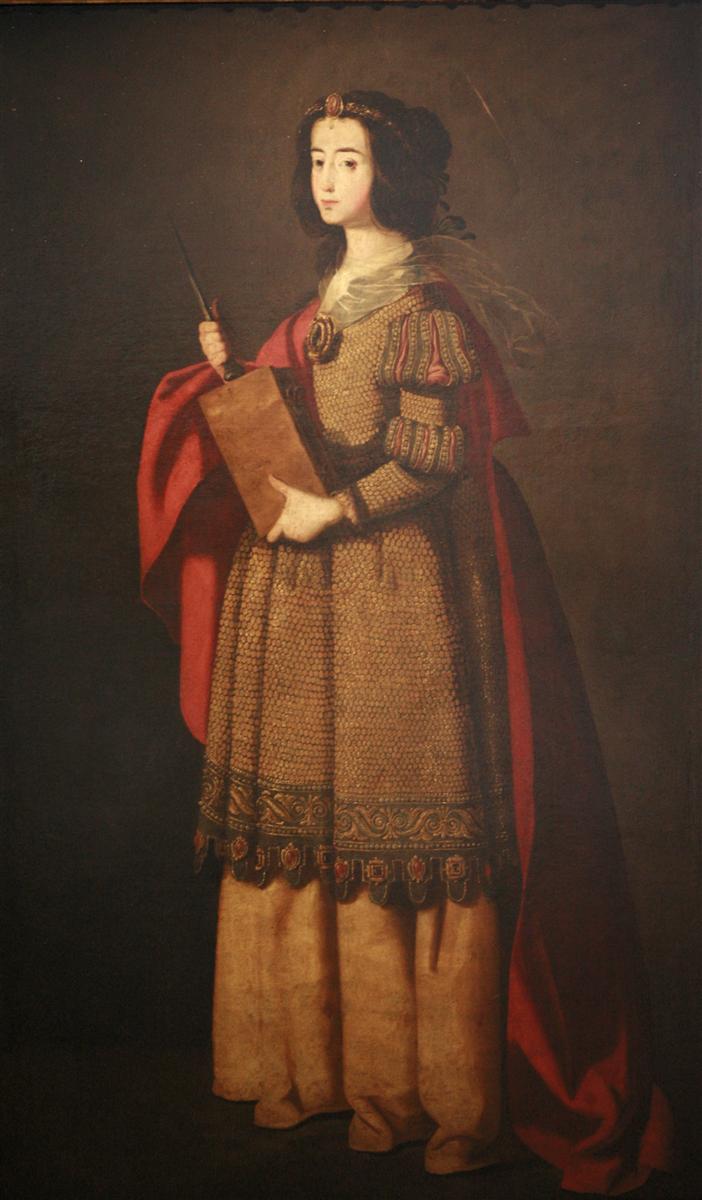
Image source: wikiart.org
Introduction to St. Engracia
Francisco de Zurbaran’s “St. Engracia,” painted around 1650, is a fascinating example of Spanish Baroque devotion combined with courtly elegance. The canvas shows the young martyr standing full length against a dark background, richly dressed in a shimmering tunic that resembles armor, a deep red cloak draped over her shoulders, and a simple long skirt beneath. She holds a book against her chest and a slender palm branch in her right hand, gazing quietly out of the painting with an expression of calm resolve.
At first glance, the painting seems almost more like a portrait of a noblewoman than a depiction of an early Christian martyr. Yet Zurbaran’s choices of costume, gesture and symbolism transform this apparently worldly figure into a powerful embodiment of heroic faith. The work reveals how seventeenth century Spanish artists could reinterpret ancient saints in a visual language that spoke directly to the tastes and devotional needs of their contemporaries.
The Legend of St. Engracia and Her Spanish Reception
St. Engracia is associated with Zaragoza and with the group known as the Martyrs of Zaragoza, who, according to tradition, were killed during the persecutions of the early fourth century. Engracia is often described as a noblewoman who opposed the pagan cults of her time and suffered cruel tortures for her Christian faith. Over the centuries her cult took particular root in Spain, where she came to symbolize constancy in the face of oppression and fidelity to the Church.
By the seventeenth century, devotion to local martyrs like Engracia fit perfectly within the Counter Reformation emphasis on heroic witnesses to the Catholic faith. Spanish patrons wanted images that honored their own regional saints and encouraged believers to imitate their virtues. Zurbaran, best known for his austere images of monks and martyrs, was ideally suited to interpret such subjects. In this painting, he creates a St. Engracia who is unmistakably saintly yet also aligned with the nobility and refinement of his time, linking past and present in a single figure.
Composition and the Commanding Vertical Figure
The composition of “St. Engracia” is straightforward but highly effective. The saint stands alone in a tall, narrow format, filling most of the height of the canvas. The dark brown background is empty and unarticulated, acting like a stage curtain that throws her luminous figure into relief. There is no architectural setting or narrative context. All attention is focused on Engracia herself.
Her stance is steady and frontal, with her weight distributed evenly on both feet. The long skirt pools slightly at the ground, anchoring her in place. The tunic that covers her torso descends almost to her ankles, its surface shimmering with countless small circular forms that evoke metal scales. Over this she wears a crimson mantle that falls in heavy folds down her back and sweeps across her left side. Her left arm cradles a substantial book, while her right hand delicately holds the palm branch vertically.
This vertical composition communicates moral firmness and spiritual stability. Engracia is not shown in the throes of martyrdom or ecstasy. Instead, she appears as a calm, dignified presence who has already made her choice and now stands as an enduring witness to it. The absence of environmental detail invites viewers to approach her as a timeless figure whose example can speak to any era.
Costume, Armor and the Fusion of Nobility and Martyrdom
One of the most striking features of the painting is Engracia’s attire. Rather than the simple robes commonly associated with early Christian women, she wears a richly decorated garment reminiscent of chain mail or scale armor, with patterned bands at the cuffs and hem. The decoration along the bottom includes ornate motifs, small medallions and gem-like forms, suggesting precious metals and stones.
Zurbaran often dressed female saints in sumptuous fabrics that echoed Spanish court dress, and here he goes a step further by transforming her tunic into a symbolic armor. This choice expresses several ideas at once. It acknowledges Engracia’s noble status while also presenting her as a spiritual warrior. The armor-like surface implies that her true strength lies not in physical weaponry but in faith. It also links her, visually, to the biblical image of the armor of God worn by those who stand firm in the spiritual battle.
The sleeves are carefully constructed with horizontal bands and puffed segments, giving them a courtly elegance. Around her shoulders the red cloak functions almost like a general’s cape, further reinforcing the idea that she is a commander in the realm of virtue. Yet the long beige skirt beneath softens the martial associations, reminding viewers that she remains a young noblewoman, not a soldier.
By combining elements of armor, court fashion and monastic simplicity, Zurbaran positions St. Engracia as both aristocrat and martyr, someone who brings the ideals of chivalry into the spiritual sphere.
The Palm and the Book as Keys to Interpretation
Two objects define the saint’s identity: the palm branch and the book. The palm is a traditional symbol of martyrdom, rooted in ancient associations between the palm tree and victory. In Christian art, to hold a palm is to be recognized as victorious over death through fidelity to Christ. Engracia grasps the slender stem near its base, holding it upright as one might hold a scepter. This subtle resemblance to a royal attribute underscores her status as a queen of heaven, crowned not by earthly power but by the triumph of faith.
The book she holds against her body suggests several complementary meanings. It may represent Scripture, indicating that her courage emerged from meditating on the word of God. It may also stand for the written record of her martyrdom and of the Church’s teaching, which she embodies and protects. The book is large and sturdy rather than small and ornamental. Zurbaran paints it with a restrained palette that matches the skirt, suggesting that for Engracia the truth contained in its pages is both weighty and foundational.
Together, palm and book create a visual dialogue between action and contemplation. The palm evokes the final act of witness, the outward declaration of faith even unto death. The book points to the interior grounding of that witness in knowledge and love of divine truth. This balance would have appealed to seventeenth century viewers who were encouraged to unite doctrinal orthodoxy with active, courageous living.
The Face of St. Engracia and the Psychology of Calm Resolve
Zurbaran’s portrayal of Engracia’s face is gentle yet resolute. She appears youthful, with smooth pale skin and dark hair that falls softly around her shoulders. Her eyes, slightly enlarged in typical Baroque fashion, gaze outward but not directly at the viewer. Instead, her look seems to pass just beyond us, suggesting inward recollection or quiet contemplation of something unseen.
Her lips are closed, neither smiling nor frowning. The expression might be described as serious serenity. It lacks the intense emotional drama found in some martyr images, such as those filled with tears or ecstatic gestures. Instead, Zurbaran gives Engracia a reserved dignity that corresponds to her noble status. This calm demeanor suggests that her strength lies in interior conviction rather than outward display.
A delicate crown or wreath rests on her head, further emphasizing her sanctity and perhaps alluding to the crown of life promised to martyrs. A transparent veil drifts behind her, catching the light, adding a subtle note of softness and femininity to the otherwise armored costume. These details remind viewers that, beneath the spiritual armor, Engracia remains a real woman whose natural beauty has been transfigured by grace.
Light, Color and the Subtle Drama of the Scene
The lighting in “St. Engracia” is characteristic of Zurbaran’s mature work. A controlled light source falls from the left, illuminating the saint’s face, the front of her armor-like tunic and the upper part of the red cloak. The background remains in deep shadow, with only the faintest variation in tone. This contrast gives the figure a sculptural presence and focuses all attention on the textures and colors of her garments.
Color plays an important symbolic role. The warm gold of the tunic suggests both the metal of armor and the glow of sanctity. Gold traditionally signifies divine glory and incorruptibility, appropriate for a saint whose soul is believed to share in heavenly light. The red cloak brings to mind both royal dignity and the blood of martyrdom. It frames the figure like a fiery aura and links her visually to Christ, who is often depicted wearing red as a sign of sacrifice.
The beige skirt and book provide a neutral base that grounds the composition. Without them, the upper part of the figure might float too freely in the dark space. Instead, their subdued tones guide the eye downward and keep the painting visually balanced. Overall, Zurbaran achieves a harmony between rich color and somber restraint, mirroring the blend of splendor and sobriety in Spanish religious culture of the time.
Zurbaran’s Stylistic Signature in the Treatment of Fabric and Form
One of Zurbaran’s great strengths as a painter lies in his ability to render fabric with tactile realism. In “St. Engracia” this skill is on full display. The tiny scale-like pattern of the tunic is carefully suggested, catching highlights that make it gleam. The folds of the red cloak fall with natural weight, particularly where it drapes behind her left arm and cascades down to the floor. The long skirt shows subtle creases and shadows that indicate the thickness of the material.
Despite this attention to textile detail, Zurbaran never lets ornament overwhelm form. The figure remains solid and simplified, shaped by large planes of light and shadow. The armor pattern is indicated rather than obsessively detailed, allowing the tunic to read clearly from a distance. The painter combines close observation of surfaces with an almost sculptural understanding of volume. This combination contributes to the impression that Engracia is both three dimensional and timeless.
The dark monochrome background, another Zurbaran hallmark, isolates the figure and emphasizes her contemplative character. There is no distraction of landscape or architectural architecture. The saint exists in a kind of spiritual space, halfway between earth and heaven, accessible to prayerful imagination.
Devotional Function and Counter Reformation Spirituality
For Zurbaran’s original audience, this painting would not have been merely decorative. It would have served a devotional function, inspiring prayer and imitative desire. St. Engracia stands as a model of virtue for both women and men. Her noble bearing and rich dress would have appealed to aristocratic patrons, while her martyrdom and fidelity to truth spoke to the wider Catholic community.
The Counter Reformation emphasized the intercession of saints and the value of courageous witness in a world perceived as threatened by heresy and moral laxity. By presenting Engracia as a beautiful, strong, well educated woman who chose God above worldly advantages, Zurbaran offered viewers a concrete image of what sanctity might look like within their own social context. Her armor suggests readiness for spiritual battle, but her calm expression and book remind believers that this battle is fought through perseverance in faith and adherence to doctrine, not through violence.
The vertical format and life size scale encourage a face to face encounter. Standing before the canvas, viewers find themselves at approximately the same height as the saint, as if sharing the same space. This proximity fosters a sense of personal relationship. The painting invites conversation in prayer, as if Engracia were a spiritual companion rather than a distant historical figure.
Legacy and Contemporary Appreciation
Today, “St. Engracia” continues to captivate museum visitors and art lovers. Modern viewers may be especially struck by the painting’s blend of historical martyrdom with elements of fashion and armor that feel surprisingly modern. The idea of a woman armored for spiritual struggle anticipates later images of female strength and agency. At the same time, Zurbaran’s restrained emotional tone and masterful handling of light keep the work rooted in its Baroque origins.
The painting also offers valuable insight into the role of women saints in early modern Spain. Figures like Engracia were presented as heroines of virtue whose beauty and nobility were placed wholly at the service of God. While their lives were shaped by patriarchal structures, their images allowed for a certain elevation of feminine courage and intelligence, especially when linked to martyrdom and fidelity.
From an art historical perspective, “St. Engracia” stands as a fine example of Zurbaran’s late style, in which he increasingly combined the austere spirituality of his earlier monastic works with richer costume elements and more courtly grace. The painting demonstrates how he could invest even a static, frontally posed figure with psychological depth and symbolic resonance.
Conclusion
Francisco de Zurbaran’s “St. Engracia” from 1650 is a compelling union of noble portrait, symbolic armor and devotional image. The young martyr stands alone in a dark, undefined space, her golden scale-like tunic and red cloak gleaming in a controlled light. With palm branch and book in hand, she embodies both victorious witness and thoughtful contemplation. Her calm, serious gaze and monumental stillness invite viewers to reflect on the strength that comes from unwavering faith.
Through careful attention to costume, color, and pose, Zurbaran translates an early Christian story into a language that spoke to seventeenth century Spain and still resonates today. “St. Engracia” remains a powerful visual meditation on courage, purity and the quiet yet unshakable dignity of a soul fully dedicated to God.