Image source: wikiart.org
Introduction to Saint Ursula
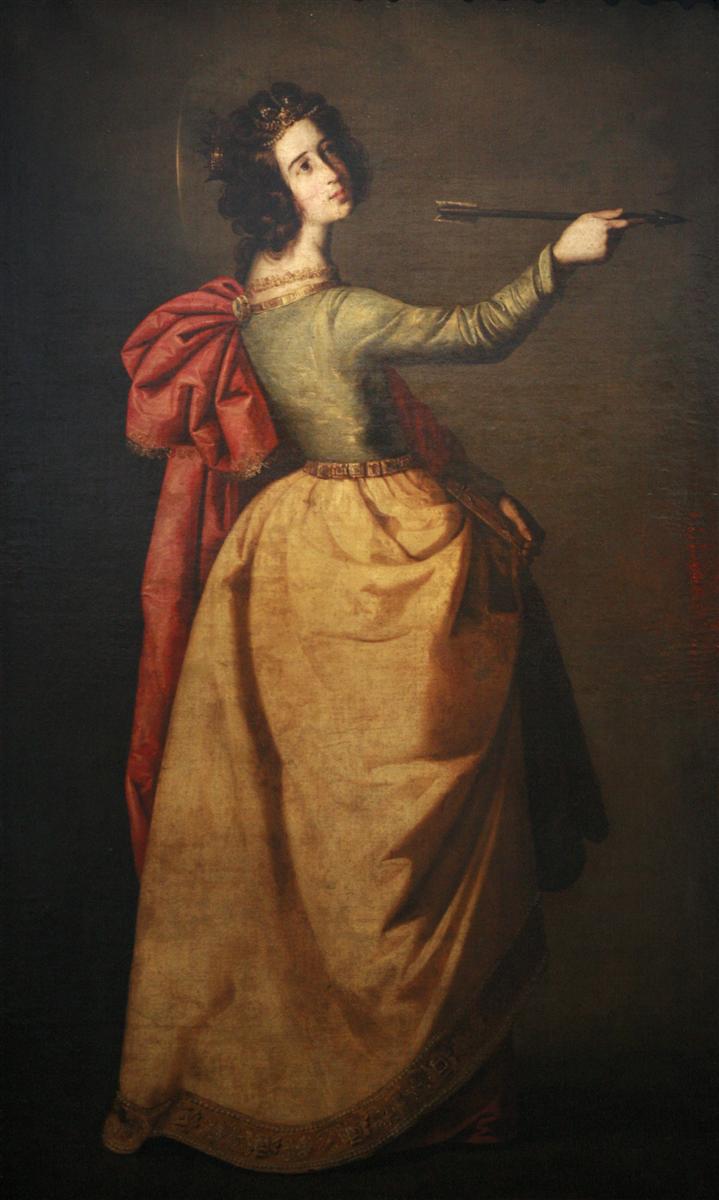
Francisco de Zurbaran’s painting “Saint Ursula,” created around 1650, is a striking example of Spanish Baroque sanctity presented through elegant restraint. The saint appears as a solitary full length figure set against a deep, shadowed background. Dressed in a sumptuous gown with a voluminous golden skirt and a soft green bodice, she turns in graceful profile while directing an arrow outward with her extended right arm. A red mantle cascades from her shoulders and a delicate crown rests on her curls, just in front of a faint halo.
Although nothing dramatic occurs in the picture, the sense of quiet intensity is unmistakable. The saint’s pose, the single attribute of the arrow, and her thoughtful upward gaze combine to express both her royal status and her martyrdom. Zurbaran places Ursula at the threshold between earthly nobility and heavenly glory, transforming her into a model of courageous purity for seventeenth century viewers and for us today.
The Legend of Saint Ursula and Its Baroque Appeal
To grasp the symbolic richness of the painting, it is helpful to recall the story of Saint Ursula. According to medieval legend, Ursula was a British princess who embarked on a pilgrimage to Rome accompanied by a large company of virgins. On their way back through Cologne they were attacked by barbarian forces, typically identified as Huns. Ursula refused to surrender her vow of chastity and was killed by an arrow, which became her principal attribute in art.
By Zurbaran’s time, the historical details of the legend were debated, but Ursula remained a beloved figure, especially in communities of women religious. She embodied ideals of virginity, fortitude, and spiritual royalty. The image of a young princess choosing death rather than compromise resonated strongly in Counter Reformation Spain, where martyr saints were seen as heroic defenders of Catholic faith and moral integrity.
Zurbaran does not attempt to narrate the entire story. Instead, he condenses the legend into a single iconic figure, allowing her costume, posture, and arrow to suggest the narrative. The result is a painting that is both historically rooted and timeless in its focus on personal courage.
Composition and Gesture A Saint in Motion
The composition of “Saint Ursula” is dominated by the tall, narrow format of the canvas. Ursula’s figure almost touches the top and bottom edges, emphasizing her statuesque presence. She stands with her weight on one leg, creating a subtle contrapposto that gives her body an elegant S shaped curve.
Her torso twists gently. The head tilts back and turns toward the viewer, while the right arm extends forward and to the right, holding the arrow horizontally. This complex rotation animates the figure without requiring overwhelming movement. It suggests that Ursula is simultaneously rooted and ready, poised at the moment before her final witness.
The direction of the arrow leads the viewer’s eye into the space beyond the painting, as if she were pointing toward her unseen persecutor or toward the destiny that awaits her. The slight upward tilt of her chin and the openness of her expression intensify this sense of readiness. She does not shrink back; she faces what is coming with calm clarity.
Zurbaran balances this dynamic gesture by allowing her skirt to fall in heavy, measured folds that ground her firmly. The painting thus combines motion and stability, capturing the inner strength that underlies her outward grace.
Light and Shadow The Drama of a Single Figure
Like many of Zurbaran’s works, “Saint Ursula” relies on dramatic chiaroscuro. A strong, focused light falls from the left, illuminating the saint’s face, upper torso, and the broad front of her golden skirt. The right side of her body recedes into shadow, while the background remains a deep, velvety darkness.
This lighting isolates Ursula from any specific setting. She seems to emerge from the gloom like a vision, suspended between heaven and earth. There are no architectural details or landscape elements to distract the viewer. All attention is concentrated on the figure and the meaning embodied in her gesture.
The contrast between luminous fabrics and dark ground enhances the sense of spiritual radiance. The golden skirt in particular appears almost to glow from within, echoing the idea of a soul filled with grace. The faint halo around her head is subtle compared to this radiance. Zurbaran suggests that holiness shines not only from symbolic rings of light but also through the entire bearing of the saint.
Color and Costume Royal Splendor and Spiritual Dignity
Zurbaran’s color choices reveal his sensitivity both to symbolism and to visual harmony. Saint Ursula’s costume combines a soft green bodice, an expansive golden skirt, and a rich red cloak tied in a large bow across her back. Each color carries symbolic associations while also contributing to a balanced palette.
The green of the bodice suggests youth, hope, and vitality. It hints at the freshness of Ursula’s age and at the life she could have enjoyed had she chosen worldly security instead of martyrdom. The golden skirt speaks of royalty and spiritual glory. Its wide surface allows Zurbaran to display his mastery in rendering the play of light across heavy fabric, with subtle variations of ochre, amber, and muted brown.
The red mantle introduces a note of intensity. Red is the color of blood and martyrdom, as well as of love. Draped behind her and tied in a decorative knot, it can be read as a visual prophecy of the blood she will shed out of love for Christ. At the same time, its placement on her back keeps the composition elegant rather than violent.
A delicate belt cinches her waist, and a finely worked crown rests among her curls. These details confirm her noble birth and royal status, yet they are not ostentatious. Zurbaran avoids glittering jewels or elaborate patterns. The overall effect is one of dignified simplicity rather than courtly display, consistent with Ursula’s decision to place her nobility at the service of virtue rather than vanity.
The Arrow as Symbol of Martyrdom
In many depictions, Saint Ursula holds a flag or stands amid groups of virgins, but Zurbaran chooses to emphasize a single attribute: the arrow. He renders it with realistic precision, its shaft slender, its point sharp and metallic. Yet its significance is far more than that of a weapon.
By presenting the arrow horizontally and outward, Zurbaran suggests that Ursula is already accepting it. She does not clutch it defensively against her chest, nor does she drop it in fear. Instead, she offers it forward as if to indicate, “This is the instrument through which I will be united with Christ.”
The direction of the arrow away from her body has another effect. It prevents the painting from becoming morbid or graphically violent. We are reminded of her martyrdom in a contemplative, almost abstract way. The viewer is invited to consider the meaning of her sacrifice rather than the physical details of her death.
In the context of Counter Reformation spirituality, such imagery encouraged believers to face their own trials with similar willingness, even if their struggles were interior or moral rather than explicitly violent. Ursula’s arrow becomes a symbol not only of historical martyrdom but of any decisive act of fidelity to conscience.
Saint Ursula’s Expression and Interior World
One of the most compelling aspects of the painting is Saint Ursula’s face. Zurbaran portrays her with youthful features, large eyes, and softly parted lips. Her expression is not frightened or rigidly ecstatic. Instead, there is a thoughtful, slightly wistful quality, as if she feels both the weight of her choice and the attraction of the heavenly promise.
Her gaze is directed slightly upward and to the side, not directly at the viewer. This indirect glance creates a sense of interior absorption. It suggests that her attention is fixed on a reality beyond what we can see, perhaps on Christ himself or on the heavenly reward awaiting her.
The slight tilt of her head and the gentle curls falling around her face give her an approachable human warmth. She is not an inaccessible icon but a young woman whose courage is born from a deeply personal relationship with God. Viewers are invited to empathize with her, to imagine their own inner debates and acts of trust mirrored in her poised, reflective expression.
Zurbaran’s Treatment of Female Sanctity
Throughout his career, Zurbaran painted numerous female saints, often depicted alone against dark backgrounds, wearing rich garments that blend worldly beauty with spiritual seriousness. In “Saint Ursula,” he continues this approach but with particular delicacy.
He presents Ursula as both princess and martyr, yet he avoids stereotypical eroticization or sentimental fragility. Her body is fully covered by heavy garments, her pose dignified, her expression intelligent. She is clearly beautiful, but her beauty serves to underline the nobility of her sacrifice, not to invite superficial admiration.
This respect for the integrity of the female saint was especially important in a monastic context. Many of Zurbaran’s works were destined for convents, where nuns sought models of chastity, determination, and contemplative depth. Ursula, with her combination of elegance and austerity, would have reminded them that their own vows were part of a long tradition of courageous women who chose spiritual fidelity over social expectation.
Spatial Simplicity and Spiritual Focus
The absence of elaborate scenery in “Saint Ursula” is not accidental. By eliminating narrative background, Zurbaran concentrates the viewer’s attention on the figure as a timeless emblem of faith. The dark, neutral space behind her functions almost like a spiritual void, out of which the saint emerges as a luminous answer to human darkness.
This spatial simplicity also reflects Zurbaran’s affinity with sculptural traditions. Many Spanish churches were filled with polychrome wooden statues of saints, often presented within niches. The painting echoes this devotional format. Ursula appears almost statue like, yet enlivened by soft flesh tones and the subtle movement of fabric.
Such an approach made the painting particularly effective as an object of prayer. Viewers could stand before it as they might before a statue, meditating on the saint’s virtues and asking her intercession. The lack of distracting details facilitated contemplation and allowed the imagination to supply the rest of her story.
A Baroque Heroine for Modern Viewers
Although the legend of Saint Ursula may seem distant from contemporary concerns, Zurbaran’s painting continues to speak powerfully. In a world that frequently pressures individuals to compromise their values or to conform to external expectations, Ursula’s poised fidelity offers a compelling alternative. She embodies the courage to remain true to one’s deepest convictions, even at great cost.
The painting also invites reflection on how noble qualities can be redirected from self centered ambition to self giving love. Ursula’s royal attire reminds us that she possessed status and privilege, yet she chose to use her freedom in service of a higher calling. Her pointing arrow can be seen as an invitation to direct our own gifts toward something beyond comfort or recognition.
Visually, the painting appeals to modern sensibilities through its minimalism and emphasis on a single figure. The dark background, the controlled palette, and the clean lines of the composition give it a timeless elegance that transcends its historical period. Art viewers who appreciate simplicity and psychological depth find in “Saint Ursula” a work that is both contemplative and emotionally resonant.
Conclusion The Poised Courage of Saint Ursula
Francisco de Zurbaran’s “Saint Ursula” is a masterful meditation on a young princess who chose martyrdom rather than surrender her integrity. Through a carefully constructed composition, dramatic light, rich yet restrained color, and a single eloquent attribute, the painter captures the essence of her legend without resorting to crowded narrative scenes.
Ursula stands tall and graceful, her golden skirt glowing against the dark ground, her red mantle hinting at the blood of martyrdom, her crown and belt recalling her royal birth. The arrow she holds outward links her to the story of her death while also symbolizing any decisive act of faith. Her thoughtful upward gaze and slightly tilted head reveal an interior world where fear has given way to trust.
For viewers of every era, this painting offers a vivid image of feminine courage rooted in contemplation. “Saint Ursula” reminds us that sanctity is not only about dramatic miracles but also about the quiet resolve to live and die according to conscience. In the serene strength of her pose, Zurbaran gives us a Baroque heroine whose witness remains strikingly relevant today.