Image source: wikiart.org
Introduction to The Immaculate Conception
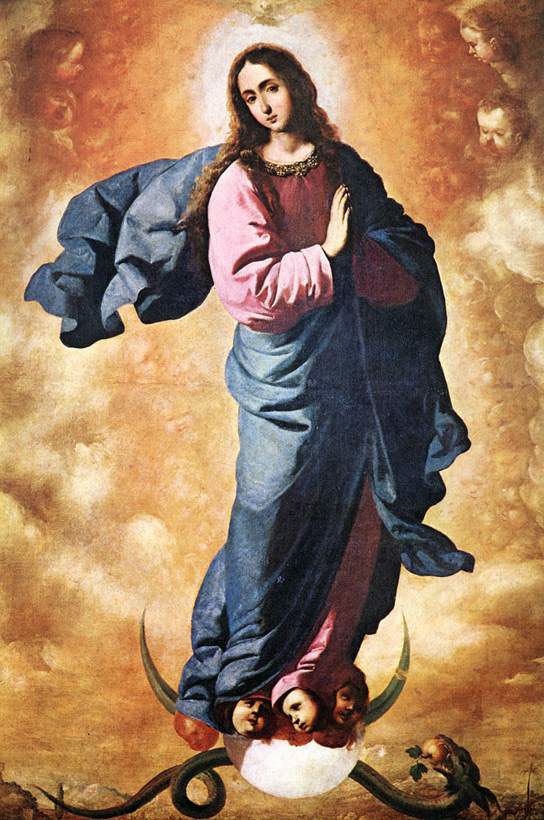
Francisco de Zurbaran’s “The Immaculate Conception,” painted around 1640, is one of the most lyrical and influential Marian images of the Spanish Baroque. The composition is at once simple and charged with symbolism. A young Virgin Mary appears suspended in a glowing sky, hands gently joined, robe billowing as if moved by an invisible breeze. She stands upon a gleaming moon, supported by cherubic heads, while beneath her feet a serpent writhes and an apple hints at the drama of the fall.
This painting belongs to a long visual tradition that sought to express the Catholic belief that Mary, mother of Christ, was preserved from original sin from the first moment of her conception. In seventeenth century Spain, devotion to the Immaculate Conception was particularly intense, and artists like Zurbaran played a central role in giving this doctrine a visible and emotionally powerful form. “The Immaculate Conception” presents Mary not as remote queen, but as a youthful, approachable figure, radiant with purity yet deeply human in her expression.
Historical and Devotional Context
To understand Zurbaran’s painting, it helps to recall the theological and cultural background. The idea that Mary was conceived without sin had been cherished in popular devotion for centuries, but it was the subject of intense debate among theologians. Spain embraced the doctrine with special fervor. Monarchs, universities, and religious orders championed the cause, and churches commissioned altarpieces that proclaimed Mary’s unique holiness.
Painters in Seville, including Murillo and Zurbaran, developed a recognizable iconography for the Immaculate Conception. Influenced by the descriptions of the Woman of the Apocalypse in the Book of Revelation, they portrayed Mary standing on a crescent moon, clothed in the sun, with stars or angelic heads around her. These images were meant to be didactic, clearly expressing theological ideas, but also emotional, stirring love and trust in the viewer.
Zurbaran, known for his austere monastic scenes and intense single-figure saints, brought to the theme of the Immaculate Conception a distinctive combination of clarity, solemnity, and tenderness. His Mary is not a distant cosmic vision, but a young girl whose purity and grace are made visible through simple gestures and luminous color.
The Composition and Overall Structure
At first glance, the painting seems dominated by a single vertical figure. Mary occupies the entire height of the canvas, her body forming a gentle S-curve that echoes the serpentine movement at her feet. Her head tilts slightly to one side, and her hands are joined near her chest in a modest gesture of prayer. This graceful pose creates a sense of motion and softness even though she remains perfectly still.
Surrounding Mary is a warm golden sky filled with vaporous clouds. Small cherubic faces emerge from the clouds, subtly reinforcing her proximity to the heavenly realm. There is no architectural frame, no landscape, no earthly horizon. The entire space is sky, suggesting that Mary exists already in an elevated spiritual sphere.
At the very bottom of the painting, a luminous white sphere, crescent moon, cherub heads, serpent, and apple form a compact, symbolic base. The vertical axis runs from the serpent and fruit of the fall up through the moon to Mary’s serene face and halo. In this way, the composition narrates salvation history in a single column of imagery, from sin and temptation up to redemption and purity.
The Figure of Mary Youthful and Serene
One of the most striking aspects of Zurbaran’s Immaculate Conception is Mary’s youthful appearance. She is neither child nor fully mature woman, but a young adolescent, perhaps around fourteen or fifteen years old. Her features are delicate, her skin smooth and luminous, her long brown hair falling in gentle waves over her shoulders.
Her expression is calm and inward. The eyes are slightly lowered, not in fear but in contemplative modesty. There is a hint of gentle melancholy, as if she perceives both the beauty of her calling and the cost that it will eventually entail in the life and death of her son. This blend of innocence and quiet gravity creates a powerful psychological portrait. Mary is pure, but not naive; chosen, but not proud.
Her hands, joined at the center of her chest, add to the sense of prayerful stillness. The gesture is simple, without the exaggerated eloquence common in some Baroque art. Zurbaran prefers a restrained language of piety, which draws the viewer into Mary’s interior attitude rather than overwhelming with theatrical emotion.
Color and Drapery The Iconic Blue and Rose
Zurbaran’s use of color is essential to the painting’s impact. Mary wears a rose colored tunic and a deep blue mantle. These two colors had long been associated with her in Christian art, but Zurbaran intensifies their symbolic and emotional power.
The rose tunic suggests warmth, humanity, and love. It aligns Mary with the earth and with the ordinary flesh she shares with every human being. The blue mantle, by contrast, evokes the heavens, spiritual wisdom, and divine favor. When the blue cloak wraps around the rose tunic, the image visually expresses the union of humanity and grace that defines Mary’s Immaculate state.
The drapery itself is painted with broad, sculptural folds. The mantle billows to the left, caught as though by a celestial breeze, creating a sense that Mary is being gently lifted. The lower part of the blue cloak falls in heavy, vertical folds, giving her figure weight and dignity. These contrasting movements within the drapery help stabilize the composition while also suggesting inner vitality.
Light plays delicately across the fabric, creating subtle highlights and deep shadows that give the garments a tangible presence. Yet the colors retain a softness that keeps the overall effect contemplative rather than ostentatious.
The Heavenly Atmosphere Clouds and Cherubs
The background of the painting consists of a swirling golden cloudscape. It is not a realistic sky, but a visionary space. The warm tones range from pale cream to rich amber, giving the impression that Mary is surrounded by divine light.
Within these clouds small cherubic heads appear, most clearly visible around the upper right and left of the canvas. These childlike faces, with rosy cheeks and tiny wings, are traditional symbols of heavenly hosts. Their presence emphasizes that Mary is honored in heaven as well as on earth.
The cloud forms are painted in broad, soft strokes, contrasting with the more sharply defined figure of Mary. This difference in handling helps her stand out as the central focus while still embedding her firmly within the heavenly realm. The halo surrounding her head is not a hard disc but a luminous glow that merges with the surrounding light, reinforcing the sense that her holiness is not an added decoration but something that radiates naturally from her being.
The Moon, Cherub Heads, and the Serpent at Her Feet
The lower part of the composition condenses a wealth of biblical symbolism. Mary stands upon a gleaming white orb, which reads as both globe and radiant cloud. Around it curves a delicate crescent moon. These elements allude to the apocalyptic Woman in the Book of Revelation, described as “clothed with the sun, with the moon under her feet.” Placing the moon beneath Mary’s feet indicates her superiority to changeable earthly cycles and her participation in God’s eternal light.
Supporting the orb are several cherub heads, their faces turned outward. They act almost like living brackets or clouds that keep Mary aloft. Their presence suggests that heaven itself supports the doctrine of her Immaculate purity.
Most dramatic is the serpent coiled at the very bottom, mouth open, body twisted. It evokes the serpent of Genesis, symbol of Satan and of the temptation that led to humanity’s fall. There is also a small apple nearby, a reminder of the forbidden fruit. By positioning the serpent beneath the orb and moon which Mary stands on, Zurbaran visually declares that through her, God has begun to crush the power of evil. She is the new Eve whose obedience reverses the disobedience of the first woman.
The entwined serpent and apple create a dark, tense knot of forms, strongly contrasting with the serene verticality above. This contrast dramatizes the victory of grace over sin without needing explicit narrative scenes.
Theological Meaning Made Visible
Every element of Zurbaran’s composition is designed to convey the core idea of the Immaculate Conception: that Mary, from the first instant of her existence, was preserved from the stain of original sin in view of the merits of Christ.
Her youthful, unblemished face symbolizes innocence untouched by corruption. The rose and blue garments express the marriage of human nature and divine grace. The luminous sky and cherubs declare heaven’s affirmation of her special status. The moon beneath her feet and the serpent subdued under the orb illustrate her triumph over the consequences of the fall.
At the same time, her posture of prayer and her slightly inclined head show that her privileges do not make her arrogant. She remains the humble servant of the Lord, receiving everything from God. In this way, the painting teaches not only about Mary’s unique holiness, but also about the pattern of holiness open to all believers: a life where grace conquers sin through humble openness to God’s will.
Zurbaran’s Artistic Approach Compared to Other Immaculate Conceptions
In the same period, other painters were also creating images of the Immaculate Conception, perhaps most famously Murillo. Murillo’s versions often feature a more crowded sky of swirling angels and dramatic light effects, with Mary sometimes appearing almost weightless.
Zurbaran’s approach is more austere and focused. He reduces the cast of characters to Mary, a few cherubs, and symbolic elements. The space is uncluttered, the gestures restrained, the colors harmonious rather than dazzling. His Mary feels closer to the quiet saints he painted for cloisters and monasteries, yet she is surrounded by cosmic symbols.
This combination of simplicity and grandeur gives Zurbaran’s painting a contemplative power. It is easy to imagine monks or nuns praying before such an image, letting its clear forms and balanced composition guide their meditation. Where other artists emphasize dynamic movement, Zurbaran emphasizes stability. Mary stands firm above the serpent, a gentle but unshakable presence.
Emotional Impact and Devotional Use
“The Immaculate Conception” was not intended merely as a theological diagram. It was also meant to foster devotion. The gentle tilt of Mary’s head, the softness of her features, and the luminous harmony of color invite viewers into a relationship of trust and affection. She appears approachable, someone who understands human frailty but is not burdened by it.
For seventeenth century Spanish viewers, gazing on this image would have encouraged them to seek Mary’s intercession in their struggles with sin. The painting visually reassures them that evil, symbolized by the serpent, is not ultimate. Under Mary’s feet, through Christ’s future sacrifice, its power is broken.
The calmness of the composition has a quieting effect. Even the swirling clouds and billowing cloak do not introduce chaos. They surround a central stillness. In a church interior, lit by candles and accompanied by music or whispered prayers, this painting would have functioned as a visual anchor, drawing hearts toward contemplation of God’s mercy acting through Mary.
Relevance for Contemporary Viewers
Today, viewers from many backgrounds can appreciate “The Immaculate Conception” on multiple levels. Art lovers can admire Zurbaran’s control of composition, his refined sense of color, and his ability to render drapery and flesh with convincing weight and luminosity. Students of religious history can see in the painting a vivid expression of Spanish Catholic identity in the Baroque period.
Even for those less familiar with Marian doctrine, the painting raises timeless questions about innocence, evil, and hope. The image of a young woman standing serenely above a dark serpent speaks to the human desire for goodness that can withstand destructive forces. The contrast between Mary’s calm and the serpent’s contorted movement can be read as a symbolic statement about the peace that comes from inner integrity.
In an age often marked by fragmentation and moral ambiguity, Zurbaran’s clear, centered composition offers a sense of stability and direction. It invites viewers to imagine a life where grace, symbolized by the radiant light and harmonious colors, has the final word over chaos and fear.
Conclusion A Vision of Purity and Victory
Francisco de Zurbaran’s “The Immaculate Conception” is a masterful fusion of doctrinal clarity and poetic beauty. Through a single standing figure framed by luminous clouds and symbolic elements, the painter communicates a complex theology of grace and redemption. Mary appears as the new Eve, preserved from sin, crowned by divine favor, yet humble and prayerful.
The moon and cherub heads lift her above the world, while the serpent and apple beneath her feet recall the fall overcome by her obedience. The rose and blue garments wrap her in warmth and majesty, and the soft golden sky proclaims that she already belongs to the realm of glory.
More than three centuries after it was painted, this image continues to captivate. It speaks of a purity that does not distance itself from humanity but rather stands at the heart of it, offering hope. In Zurbaran’s hands, the doctrine of the Immaculate Conception becomes a visual hymn to God’s power to transform and elevate human nature. Mary stands quietly in the center of the canvas, hands folded, eyes gentle, a sign that light is stronger than darkness and that grace can indeed triumph over the serpent that threatens the human story.