Image source: wikiart.org
Introducing Saint Lucy by Francisco de Zurbaran
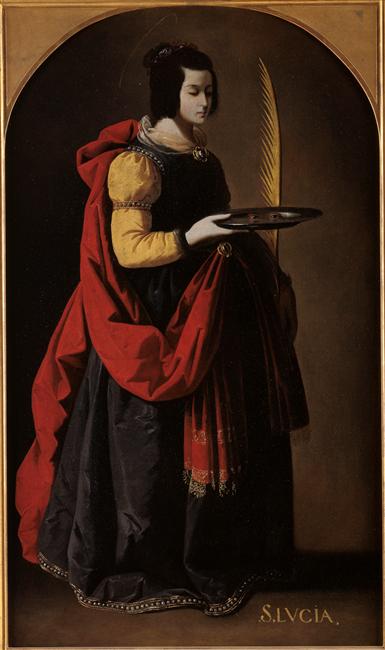
Francisco de Zurbaran’s “Saint Lucy,” painted around 1640, is one of the most haunting and elegant images of the young martyr in Spanish Baroque art. The saint stands alone, framed by a shallow arch, set against a dark and nearly empty background. She is presented full length, dressed like a noblewoman of seventeenth century Spain, her black gown and crimson mantle falling in heavy folds around her. In one hand she holds the palm branch of martyrdom, and in the other a shallow tray that carries a terrible yet quiet symbol of her suffering.
At first glance the painting reads like a formal court portrait. Only gradually do the signs of sanctity announce themselves. The inscription “S. LVCIA” along the bottom edge confirms her identity. Zurbaran transforms a legendary virgin martyr from early Christian Syracuse into a serene Sevillian lady whose holiness is expressed above all through stillness and presence. The result is an image that invites long contemplation and rewards close attention to gesture, color and light.
The Story and Cult of Saint Lucy
Saint Lucy was a Christian virgin martyr from Syracuse in Sicily, traditionally believed to have died during the persecutions under Diocletian in the early fourth century. Her name, derived from the Latin word for light, quickly became linked with sight and spiritual illumination. Medieval legends recount that she dedicated her life to Christ, refused marriage, and gave her wealth to the poor. For this she was denounced to the authorities and subjected to cruel tortures.
One of the most enduring details from her legend concerns her eyes. Variants of the story describe her eyes being gouged out by her persecutors or removed by Lucy herself to discourage a persistent suitor. God then restored her sight as a sign of favor. Because of this, images of Saint Lucy often show her holding a dish or cup containing a pair of eyes. She became the patron saint of those with eye diseases, and her feast in December was associated with the growing hope of light in the dark of winter.
When Zurbaran painted this canvas in Seville, devotion to Saint Lucy was widespread. Convents, churches and lay confraternities invoked her as an intercessor for clarity of vision, both physical and spiritual. The painting was likely created for a religious community that wanted a powerful yet restrained image of the saint to accompany prayer and liturgy.
Composition and the Power of Stillness
The composition of “Saint Lucy” is strikingly simple. The saint stands almost motionless in the center of the vertical canvas. There is no narrative background, no crowd of onlookers or scenes of torture. Only a soft, neutral ground stretches behind her. This simplicity focuses all attention on the figure herself.
Lucy is shown in profile three quarters, facing left. Her head is slightly bowed and her eyes look downward, avoiding direct contact with the viewer. The pose suggests humility, introspection and quiet strength. Her feet are hidden under the long hem of her gown, so she seems rooted to the earth, almost statue like.
The arched top of the painting frames her like a niche in a chapel, reinforcing the impression that she is a living statue or an apparition from another realm. This architectural framing device also emphasizes verticality, drawing the viewer’s gaze upward from the dark hem, along the rich folds of fabric, to her calm face and the tall palm leaf rising behind her. The resulting effect is one of monumental dignity, even though the figure remains slender and youthful.
Clothing and Color in Saint Lucy
Zurbaran was a master at painting textiles, and “Saint Lucy” is a superb example of his love for fabric. The saint wears a dark, almost black gown that reaches to the floor. The dress has a subtle sheen, suggesting a heavy, expensive material such as silk or satin. At the neckline and sleeves it is decorated with a narrow band of ornament that catches the light. Over this gown she wears puffed yellow sleeves, whose volume and brightness provide a vivid contrast to the dark bodice and skirt.
The most striking garment, however, is the red mantle that wraps around her shoulders and falls in elaborate folds down her side. This mantle seems to swirl around her body, with one end tucked at her waist and the other hanging behind her like a rippling banner. The red is deep and saturated, rich without becoming garish. It evokes both royal dignity and the blood of martyrdom.
Around her waist, a dark sash or girdle pulls the various layers together. At her neck she wears a delicate white collar or chemise that softens the line between skin and cloth. Her dark hair is styled in a modest yet elegant arrangement, held in place by a small ornament.
The palette of black, red and gold, relieved by small touches of white, creates a visually powerful harmony. It also carries symbolic weight. Black suggests seriousness and renunciation of worldly vanities. Red recalls sacrifice and love. Gold tones hint at heavenly glory. Together they present Saint Lucy as a noble woman whose earthly beauty has been transfigured by devotion.
Light, Shadow and the Baroque Atmosphere
Light is crucial to the mood of this painting. As in many of Zurbaran’s works, the illumination appears to come from the upper left, casting a soft beam across the saint’s face and upper body. Her features, the palm leaf, the rim of the tray and the folds of the mantle all catch this light, while the rest of the canvas recedes into shadow.
This controlled chiaroscuro gives the figure three dimensional solidity and heightens the sense of spiritual drama. The world around Saint Lucy is dark and indistinct, yet she herself is sharply defined, as if emerging from shadow into the light of grace. The effect is contemplative rather than theatrical. The soft transitions between light and dark invite the viewer to linger on details and to meditate on the interior light guiding the saint.
The dark background also has a practical function. It allows the bold colors of her garments to stand out without competition. The luminous red and soft yellow play against the deep brown and black, producing a luxurious yet solemn atmosphere that suits both her royal heritage and her martyrdom.
The Symbolism of the Palm and the Tray
In her right hand, Saint Lucy holds a long palm frond that rises almost to the top of the canvas. In Christian iconography, the palm is the classic sign of martyrdom, drawn from the imagery of Revelation, where the victorious stand before God with palms in their hands. The palm here is slender but tall, echoing the saint’s upright stance and reinforcing the idea of victory through suffering.
In her left hand she carries a shallow metal tray. Zurbaran paints it from a slightly elevated angle so that its contents are visible without being aggressively displayed. Upon the tray rest two small shapes that represent Lucy’s eyes, the symbol most closely associated with her. Zurbaran chooses not to depict them in a gruesome or overly realistic way. They are suggested rather than anatomically detailed, more like emblems than literal remains.
This restraint is significant. It allows the painting to acknowledge the horror of her mutilation while maintaining an atmosphere of dignity and purity. The tray becomes a sign of her sacrifice, something she offers to God rather than a macabre curiosity. In a devotional context, it also reminds viewers of their own need for healed and purified vision, both physical and spiritual.
Saint Lucy as a Sevillian Noblewoman
One of the fascinating aspects of Zurbaran’s saintly portraits is how closely they resemble contemporary Spanish women. Saint Lucy here could easily be mistaken for a young Sevillian aristocrat if we were to ignore her attributes. Her hairstyle, clothing and jewelry correspond to fashions of Zurbaran’s time.
This choice was deliberate. For audiences in seventeenth century Spain, seeing biblical and early Christian figures dressed like local nobles made them feel closer and more relevant. It suggested that sanctity was not confined to faraway times and places but could be lived out in their own world. Convent communities, especially, cherished these images as models of ideal Christian womanhood.
Saint Lucy’s poised demeanor and modest elegance would have resonated with women who sought to combine social grace with religious seriousness. Zurbaran thus bridges the gap between legend and present reality, presenting Lucy as both a historical martyr from Sicily and a timeless example for Sevillian viewers.
Psychological Presence and Inner Life
Beyond clothing and symbols, the psychological presence of Saint Lucy makes this painting especially compelling. Her face conveys a subtle mixture of youthfulness and maturity. The skin is smooth, the features regular, yet there is a seriousness in the eyes and mouth that suggests a soul tempered by decision and trial.
She does not meet our gaze directly. Instead, her eyes are lowered slightly, as if absorbed in prayer or contemplation. This downward gaze signals humility, but it is not a gesture of fear. Her posture remains upright and composed. The tension between interior recollection and outward dignity creates a powerful sense of inner life.
The closed lips hint at silence, appropriate for a martyr who bore witness through action more than through speeches. There is no trace of pain on her face; the suffering is transfigured into calm determination. This transformation invites viewers to see in her not the cruelty of her tormentors but the strength of her faith.
Zurbaran’s Style and the Spanish Baroque Context
“Saint Lucy” exemplifies many characteristics of Zurbaran’s mature style. He preferred strong, simple compositions, limited color ranges and sculptural clarity. Compared to some Italian and Flemish Baroque works filled with swirling movement, his paintings often feel still and concentrated. This quality suited the spiritual climate of Counter Reformation Spain, where religious art was meant to foster meditative prayer rather than mere excitement.
Zurbaran also had a special gift for painting religious figures as if they were real people standing in the same room as the viewer. The tactile fabrics, the believable faces and the carefully observed light give his saints a physical immediacy that makes them feel close and accessible. At the same time, their gravitas and isolation from everyday surroundings set them apart as inhabitants of a higher spiritual realm.
In “Saint Lucy,” this dual quality is very clear. She is a young woman we could almost greet or approach, yet the darkness around her and her concentrated gaze remind us that we are witnessing someone already absorbed in divine things.
Spiritual Meanings for Contemporary Viewers
For modern viewers, Zurbaran’s “Saint Lucy” continues to speak in several ways. The image addresses the theme of sight and light, both literally and metaphorically. Her lost and restored eyes point toward a deeper longing for clarity, truth and inner illumination. In a world overloaded with visual stimuli, the painting proposes a different kind of seeing: calm, steady, focused on what truly matters.
The contrast between her sumptuous clothing and her readiness for martyrdom also raises questions about the relationship between comfort and commitment. She is not a ragged ascetic but a woman of means who nevertheless chooses fidelity to Christ over security. Her example suggests that holiness does not require fleeing culture or beauty, but reorienting them toward higher love.
The quiet strength in her posture can inspire anyone facing pressure to compromise convictions. Saint Lucy does not resist with anger or display; she simply stands firm, bearing the symbols of what she has suffered with dignity. For people navigating challenges to their faith, integrity or moral choices, this restrained courage can be deeply encouraging.
Conclusion
Francisco de Zurbaran’s “Saint Lucy” is a masterpiece of Spanish Baroque devotion. Through a single standing figure, rich but controlled color, and potent symbolic objects, he conveys a story of martyrdom, light and inner freedom. The young saint appears as a Sevillian lady enveloped in glowing fabrics, yet her lowered gaze, palm branch and tray transform the elegant portrait into a profound meditation on sacrifice and spiritual vision.
The painting invites viewers to slow down, to trace the line of the palm leaf, to follow the folds of the red mantle, to contemplate the small emblems resting on the tray, and finally to rest on Lucy’s serene face. In doing so, they are drawn into the same quiet space of contemplation that the saint inhabits.
More than three centuries after its creation, “Saint Lucy” still radiates a calm yet powerful light. It offers not only a glimpse into the faith and artistic culture of seventeenth century Seville, but also a timeless image of a young woman whose steadfast love transformed suffering into glory.
