Image source: wikiart.org
Introduction to St. Anthony of Padua
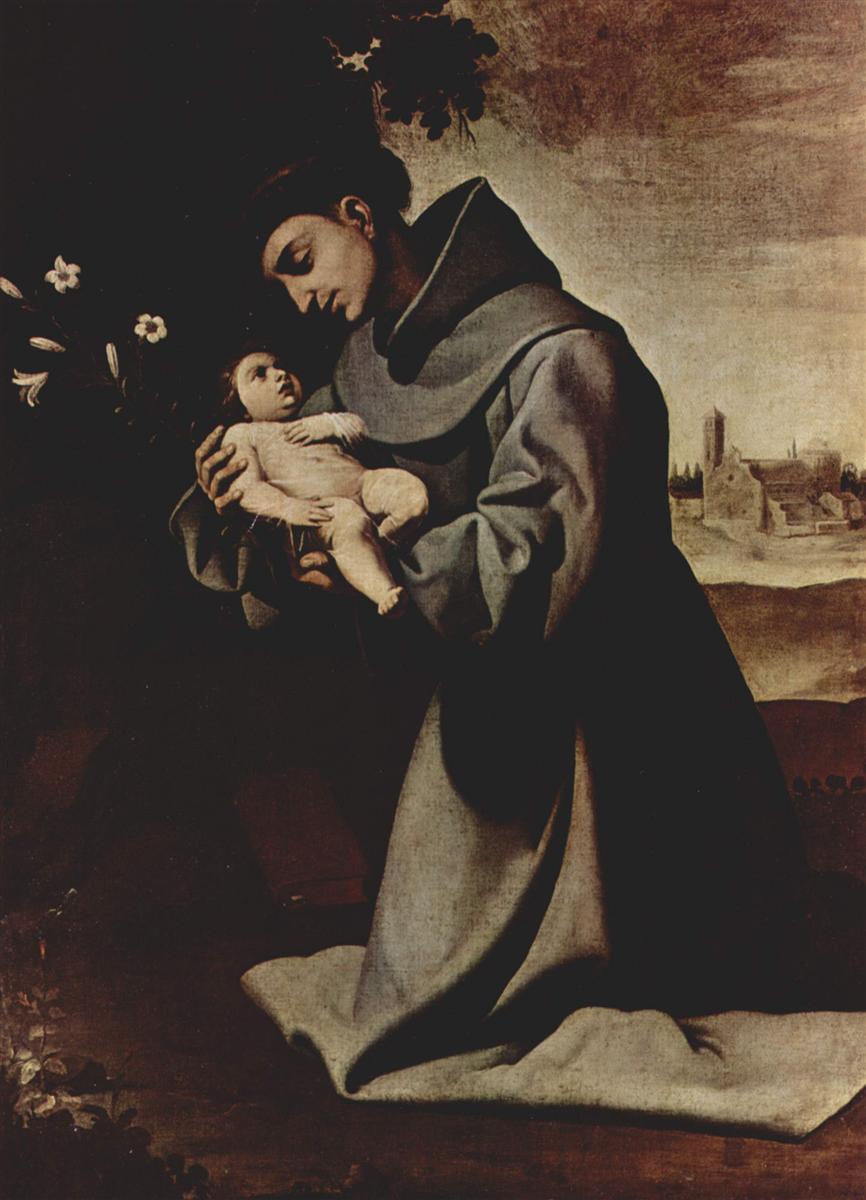
Francisco de Zurbaran’s “St. Anthony of Padua,” painted around 1640, is a tender and contemplative vision of one of the most beloved saints in Catholic devotion. The painting shows the Franciscan friar kneeling in a darkened space, cradling the Christ Child in his arms. The figure of St. Anthony emerges from deep shadow, his grey habit catching a soft light, while behind him a quiet landscape with a small church unfolds under a muted sky. Nearby a spray of white lilies glows gently in the darkness, reinforcing the theme of purity and spiritual love.
At first glance the composition seems simple, almost reserved. There is no crowd of angels, no lavish architectural frame, no narrative bustle. Yet this very simplicity allows Zurbaran to concentrate all emotional energy on the intimate encounter between saint and child. Through careful control of light, color and gesture, he transforms a standard iconographic motif into a deeply personal meditation on humility, contemplation and spiritual fatherhood.
Historical Background and Devotional Context
St. Anthony of Padua, a thirteenth century Portuguese Franciscan, was renowned for his preaching, learning and miracles. By the seventeenth century he was one of the most popular saints in Catholic Europe. In Spain his cult was especially strong, associated with lost objects, help in need and powerful intercession. Artists frequently depicted him in brown or grey Franciscan habit, often shown with a book, a lily and the Christ Child.
The specific motif of St. Anthony holding the Child Jesus stems from a legend in which the saint, while praying alone at night, received a vision of the infant Christ resting on the open pages of Scripture. This image symbolized his deep understanding of the Word of God and his intimate union with the Savior. In Counter Reformation art the theme offered a powerful way to express mystical contemplation within the life of a popular, approachable saint.
Zurbaran, working in Seville and closely linked with monastic patrons, was perfectly placed to translate this subject into visual form. His painting reflects the spiritual concerns of his time. It stresses inner devotion over external spectacle and presents Anthony as a model for the contemplative life, not only for friars but also for lay believers.
Composition and Spatial Structure
The composition of “St. Anthony of Padua” is vertical and pyramidal. The kneeling saint occupies most of the canvas. His habit forms a broad base at the bottom and narrows upward toward his bowed head. The Christ Child rests near the center of this triangle, creating a focus point where the lines of the composition converge.
The space around the figure is largely dark, especially on the left, where the background almost disappears into a velvety blackness. On the right, however, the darkness opens to reveal a low horizon line with a small church or monastery complex under a cloudy sky. This alternate zone of light gives depth to the scene and situates Anthony in a world that is recognizably earthly, not purely visionary.
The cluster of lilies rises behind the saint’s shoulder, their stems curving upward and their blossoms pointing toward the upper left corner. This diagonal counters the downward tilt of Anthony’s head and the horizontal position of the Child’s body. Taken together, these lines create a subtle dynamic tension within an overall atmosphere of stillness, preventing the scene from feeling static.
The Figure of St. Anthony
Zurbaran’s portrayal of St. Anthony balances realism with idealization. The saint’s face is youthful but serious, with smooth skin and gently modeled features. His eyes are downcast toward the Child, and his lips are closed in a quiet expression of awe and affection. The tonsure, the shaved crown of a friar, clearly identifies him as a member of the Franciscan order. Yet the expression is not that of a distant ascetic. Instead, it suggests a deeply human tenderness.
The grey habit, rendered in Zurbaran’s characteristic sculptural manner, envelops Anthony’s body in heavy folds. The thick cloth pools around his knees, spreading over the ground in soft waves. Highlights pick out the angles of his sleeves and hood, while shadows sink into the recesses of the folds. This careful modeling gives the figure a monumental presence, as if he were a carved statue animated by inner life.
Anthony’s posture is full of reverence. He kneels, torso slightly bent forward, arms cradling the Child close to his chest. The position conveys humility and service. At the same time, the way he supports the Child’s head and body communicates a protector’s strength. Through this pose, Zurbaran expresses both the friar’s submissive devotion to Christ and his role as a spiritual guardian of the faithful.
The Christ Child and the Intimacy of the Embrace
The Christ Child in Zurbaran’s painting is small, fragile and very human. He is not a highly idealized infant glimmering with supernatural brilliance, but a real baby with soft limbs and curious eyes. He lies in Anthony’s arms, one hand resting on his chest, the other reaching lightly toward the saint. His gaze is directed up toward Anthony’s face, creating a reciprocal line of attention that locks the two figures into an intimate dialogue.
Zurbaran’s handling of the Child’s body emphasizes vulnerability. The little legs are slightly bent, toes relaxed, while the torso twists gently. A thin cloth winds around the lower body, both covering and revealing. This naturalistic approach makes the Incarnation tangible. Viewers are reminded that the Son of God truly became a dependent infant, entrusting himself to human care.
The closeness of the figures suggests a mutual affection that goes beyond hero worship. Anthony does not hold the Child at arm’s length on display. Instead, he draws Jesus in, almost touching his cheek to the infant’s head. This enveloping embrace conveys a sense of spiritual adoption. The saint receives Christ into his heart, and in turn Christ offers himself as a gift of love and wisdom.
Light, Shadow and Atmosphere
Light in this painting plays a crucial role in shaping mood and meaning. A gentle illumination falls from the right, striking Anthony’s face and upper body as well as the Child. The rest of the scene recedes into shadow. The dark area on the left is nearly absolute, interrupted only by the faint glow of lilies and leaves. This dramatic contrast of light and dark reflects the tenebrist style that Zurbaran had adapted from Caravaggist tendencies, yet he uses it in a more meditative than theatrical way.
The illuminated figures appear to emerge from an enveloping night, suggesting the spiritual notion that divine revelation breaks into the darkness of the human heart. The light that caresses Anthony and the Child is not harsh. It is warm and soft, evoking the gentle radiance of grace rather than the glare of judgment. This quality underscores the theme of tender mercy, central to devotion to St. Anthony.
The distant landscape under a muted sky is bathed in a diffused, almost smoky light. This subtle background illumination contrasts with the concentrated brightness on the figures, reinforcing the idea that the encounter between saint and Child is of a different order than ordinary reality. The small church in the distance seems slightly hazy, as if seen through memory or contemplation.
Symbolism of Lilies, Book and Landscape
Although the painting appears simple, Zurbaran quietly weaves in traditional symbols associated with St. Anthony. The lilies behind the saint are the most obvious. Their white blossoms signify purity of heart and chastity. In Christian iconography lilies often accompany the Virgin Mary and other saints known for their innocence. Here they reinforce Anthony’s role as a model of virtue and his dedication to a life of evangelical poverty and celibacy.
In many images of St. Anthony a book appears as well, alluding to his learning and powerful preaching. In this painting the book is less prominent, likely resting on the ground near his knees. Its presence, though discreet, recalls the legend of the Child appearing on the saint’s open Scriptures. The message is clear. True understanding of the Word comes not only through study but through loving encounter with the living Christ.
The small church or monastery in the background carries several layers of meaning. It situates Anthony in relation to the institutional church and the religious life. It may represent Padua, where the saint’s shrine became a major pilgrimage site, or more generally the community of believers nourished by his teaching. At the same time, its distance suggests that the profound experiences of contemplation occur in a space that transcends physical location, even though they are rooted in the life of the Church.
Emotional Tone and Spiritual Message
The dominant emotion in “St. Anthony of Padua” is quiet tenderness. No one cries out or gestures dramatically. Instead, there is a sense of interior peace. Anthony’s features express awe and gratitude, while the Child’s gaze is calm and trusting. This restrained emotional language aligns with the spiritual culture of seventeenth century monasticism, which valued interior recollection and gentle affection for Christ.
The painting’s spiritual message is rich. It speaks of humility, as the saint kneels before a Child whom he recognizes as his Lord. It speaks of contemplation, as Anthony withdraws from the busy world into a darkened space where only he and Jesus are fully visible. It also speaks of missionary zeal, for the same saint who holds the Child in silence is remembered as a fiery preacher who brought many to the faith.
For viewers, the work invites imitation of Anthony’s attitude. Standing before the canvas, one is almost drawn into the circle of intimacy between saint and Child. The viewer is encouraged to imagine taking the place of Anthony, receiving Christ with the same trust and love. In this way the painting becomes a visual guide for personal devotion.
Zurbaran’s Style and the Spanish Baroque
“St. Anthony of Padua” is a clear example of Zurbaran’s mature style. His figures have sculptural solidity, as if carved from blocks of light and shadow. Drapery is rendered with weight and gravity, yet without fussy detail. Faces and hands are treated with simplicity and dignity. The overall effect is one of concentrated presence.
Spanish Baroque art is often associated with intense religiosity and a focus on the reality of the sacred. Zurbaran contributes to this tradition by presenting saints not as distant, untouchable icons but as concrete, relatable figures. Anthony’s bare feet, simple habit and youthful features make him approachable. At the same time, the controlled lighting and solemn mood remind the viewer that this is a holy encounter.
Compared with more dynamic Baroque compositions filled with swirling clouds and vigorous gestures, this painting is remarkably quiet. Yet its stillness does not mean lack of power. On the contrary, the restraint heightens the sense of spiritual depth. Zurbaran proves that drama can be achieved through silence as much as through motion.
Devotional Function and Original Setting
While the precise original location of this painting is not always known, works of this kind were typically created for churches, monasteries or private chapels. Placed near an altar or in a side chapel dedicated to St. Anthony, the painting would have served as a focus for prayer, especially on the saint’s feast day. Devotees seeking his intercession for lost objects, health or spiritual help would have prayed before this image, perhaps lighting candles at its base.
Its life size figure and intimate subject matter make it particularly effective in such a context. Worshippers could feel that St. Anthony was present with them, presenting the Christ Child on their behalf. The painting thus functions not only as illustration but as a kind of spiritual bridge between earthly believers and heavenly intercessors.
Legacy and Contemporary Appreciation
Today, “St. Anthony of Padua” continues to resonate with audiences for both artistic and spiritual reasons. Art historians value it as a prime example of Zurbaran’s ability to translate complex theological ideas into simple, emotionally compelling images. The balanced composition, rich yet limited palette and masterful handling of light make it a touchstone for studies of Spanish Baroque painting.
For many contemporary viewers, even those outside the Catholic tradition, the painting’s depiction of tenderness between adult and child speaks to universal themes of care, trust and protection. In a world often marked by noise and distraction, the quiet intimacy of this scene offers a kind of visual refuge. It invites a slower way of looking and a deeper engagement with the inner life.
The image also continues to shape popular imagination about St. Anthony. Reproductions of similar compositions appear in churches and homes throughout the world, testifying to the lasting power of this seventeenth century visual language.
Conclusion
Francisco de Zurbaran’s “St. Anthony of Padua,” painted around 1640, is a moving synthesis of spiritual depth and artistic mastery. Through a simple yet carefully structured composition, the artist presents the beloved Franciscan saint in an intimate encounter with the Christ Child. The sculptural drapery, luminous yet gentle lighting, symbolic lilies and distant church all contribute to a contemplative atmosphere where humility, purity and loving devotion are the dominant notes.
Rather than relying on outward drama, Zurbaran draws the viewer into the quiet exchange of glances between Anthony and the Child. The painting invites us to share in the saint’s wonder, to approach Christ with the same tender reverence, and to recognize that true wisdom is found not only in books but in personal communion with the living Word made flesh. As a result, “St. Anthony of Padua” remains a timeless work that continues to inspire both art lovers and seekers of spiritual consolation.