Image source: wikiart.org
Introduction to Agnus Dei
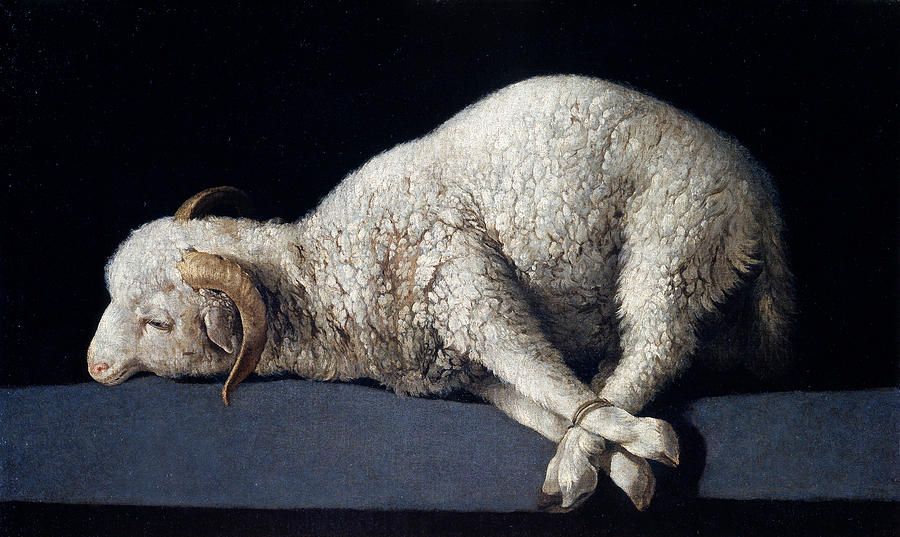
Francisco de Zurbaran’s “Agnus Dei,” painted around 1640, is one of the most haunting and distilled images of the Spanish Baroque. At first glance it appears astonishingly simple. A single lamb lies on a narrow ledge in front of a deep black background. Its legs are bound together with a thin rope. The animal’s head droops slightly, eyes half closed, as if caught in a state between sleep and surrender. There are no surrounding objects, no landscape, no human figures. Yet this quiet still life carries immense spiritual weight.
The title, “Agnus Dei,” Latin for “Lamb of God,” makes clear that Zurbaran is not merely painting an animal. He is presenting a concentrated symbol of Christ’s sacrificial death. By stripping away every distraction, he invites the viewer into a meditative encounter with the mystery of redemption. The painting functions both as a work of striking realism and as a devotional icon, bridging the everyday world of farm animals and the cosmic drama of salvation.
The Lamb of God and Its Iconographic Tradition
The image of the lamb has deep roots in Christian theology and art. In the Old Testament, lambs were offered in temple sacrifices and at Passover, where the blood of the lamb marked the homes of the Hebrews and signaled liberation from slavery. In the New Testament, John the Baptist points to Jesus and proclaims, “Behold the Lamb of God, who takes away the sin of the world.” Early Christians quickly adopted the lamb as a symbol of Christ, combining references to sacrifice, innocence and victory.
In medieval and Renaissance art the Lamb of God often appears standing triumphantly, holding a banner and perched on a book sealed with seven seals. Sometimes it is surrounded by angels or placed on an altar. Zurbaran’s treatment is quite different. His lamb is not triumphant. It is passive, bound and awaiting slaughter. This choice emphasizes the vulnerability and real suffering associated with Christ’s Passion, in harmony with the intense devotional culture of seventeenth century Spain, where contemplation of the wounds of Christ and the reality of his sacrifice played a central role.
By giving the work the explicit title “Agnus Dei,” Zurbaran guides the viewer to read this realistic lamb as a theological symbol. The painting thus exists on two levels at once. It is a study of animal form and texture, and it is also a silent visual meditation on the self giving love of Christ.
Composition and the Power of Simplicity
The composition of “Agnus Dei” is radical in its simplicity. The lamb occupies almost the entire horizontal span of the canvas, aligned parallel to the edge of the ledge on which it rests. Its body forms a compact arc, from the rounded back down to the nose that nearly touches the surface. The legs, bound together, cross neatly, creating a small knot of tension near the front of the figure.
This horizontal alignment, combined with the stable, low viewpoint, creates a sense of stillness. There is no dramatic diagonal thrust, no swirling drapery. The calm line of the lamb’s body is interrupted only by the slight rise of the horns and the droop of the head. The overall effect is almost architectural. The animal becomes a solemn, sculptural form placed in a void.
The ledge itself is painted in muted grayish blue, functioning like an altar or a tomb slab. Its long, straight line contrasts with the soft curves of the lamb’s fleece. The deep black background eliminates any sense of depth or environment. As a result, the viewer’s attention cannot wander. It is forced to rest on the single, central object, much as the faithful at Mass focus attention on the consecrated host on the altar.
This compositional austerity is one of the reasons the painting feels so modern. It anticipates later minimalism and demonstrates how a single carefully placed form can carry immense emotional and symbolic weight.
Light and Color in a Baroque Meditation
Zurbaran was a master of dramatic lighting, and “Agnus Dei” shows this skill in a quietly intense way. A soft but focused light falls from the left, bathing the lamb’s body and casting gentle shadows that model its three dimensional form. The top of the back, the crest of the head and the bound legs catch the brightest highlights, while the underside of the body sinks into shadow.
This interplay of light and dark, characteristic of Baroque tenebrism, does more than describe physical shape. It creates an atmosphere of solemn mystery. The lamb seems to emerge from a surrounding darkness that has no clear boundary. The black background can be read as the void of death, the unknown depths of suffering, or the infinite mystery of God. Against this abyss, the illuminated body shines with quiet dignity, suggesting that sacrificial love brings light into darkness.
The color palette is extremely restrained. The fleece is painted in off whites and pale grays, with subtle warm tones. The horns have a light brown hue, while the ledge is a cool gray blue. The background is a deep, velvety black. This limited range of colors reinforces the contemplative character of the work. There is no decorative flourish, no bright red of blood, no gilded halo. The painting depends instead on tonal contrasts and delicate variations within a narrow spectrum.
Texture and Sensory Realism
One of the most remarkable features of “Agnus Dei” is the extraordinary rendering of texture. Zurbaran’s close observation of the lamb’s fleece gives the surface a tangible, almost tactile presence. Each curl of wool is suggested through subtle highlights and shadows, yet the artist avoids mechanical detail. The fleece reads as soft, dense and slightly coarse, convincing the viewer that this is a real animal that could be touched.
The horns, by contrast, are smooth and slightly glossy, curving elegantly away from the head. Their warm color and harder texture provide a visual counterpoint to the softness of the wool. The snout and closed eyelids are painted with gentle transitions of tone, suggesting the delicate skin beneath the fur.
The rope binding the legs is rendered with equal care. Its thin fibers twist and catch the light, emphasizing the tension at the point of bondage. This realistic specificity heightens the emotional impact. The viewer feels not only the physical presence of the lamb but also the discomfort implied by its constrained posture.
This combination of sensory realism and symbolic meaning is characteristic of Zurbaran. By making the lamb so palpably real, he prevents the viewer from dismissing it as a mere abstraction. The sacrifice symbolized here is not vague or distant. It is concrete and embodied.
The Bound Lamb and the Theme of Obedient Sacrifice
The most striking detail of the composition is the binding of the lamb’s legs. In many pastoral scenes, lambs appear standing freely or playing in fields. Here, the animal is immobilized. The rope ties the front legs together and passes behind, a clear sign that it is being prepared for slaughter.
This bound posture echoes the biblical story of the binding of Isaac, where Abraham ties his son on the altar before God intervenes. It also recalls the lambs led to sacrifice in temple rituals. For Christian viewers, the image inevitably evokes Christ who submits willingly to arrest, trial and crucifixion. Just as the lamb does not struggle in the painting, Christ remains largely silent before his accusers, embracing his fate out of obedience to the Father.
Despite this clear reference to violent death, Zurbaran chooses not to show any wounds or blood. The emphasis is on the moment before the sacrifice, the calm stillness of total surrender. The lamb’s closed eyes and relaxed mouth suggest neither panic nor pain but a mysterious peace. This aspect of the painting speaks deeply to the spiritual practice of resignation and trust. It invites viewers to consider what it means to yield oneself entirely to a higher will.
Silence, Solitude and Contemplative Atmosphere
A powerful sense of silence pervades the painting. There is no human presence, no background narrative, no indication of place or time. The lamb lies alone on its ledge in a featureless void. This isolation heightens the contemplative mood. The viewer is alone with the symbol of Christ’s sacrifice, without distraction.
The horizontal format and low vantage point place the lamb almost at eye level, reinforcing a feeling of intimacy. One might imagine kneeling before a small altar in a dim chapel, where this image is the only visible object. In this setting, the painting supports practices of mental prayer encouraged by Spanish mystics, who recommended focusing the imagination on a single aspect of Christ’s Passion and remaining there in wordless reflection.
The stillness is so complete that even the potential motion of breathing seems suspended. The lamb appears caught in an eternal present, always awaiting sacrifice yet never killed within the painted moment. This timeless quality aligns with the liturgical understanding of the Eucharist, in which the Christian community is believed to participate continually in the one sacrifice of Christ that transcends chronology.
Zurbaran’s Spiritual Realism and Artistic Context
“Agnus Dei” stands out even within Zurbaran’s deeply religious oeuvre. The artist is known for his monumental representations of monks, martyrs and saints, often depicted with everyday objects that carry symbolic meanings. In this work, he reduces the subject matter still further, focusing on a single symbolic animal.
The painting demonstrates the essence of Zurbaran’s spiritual realism. He does not idealize the lamb into a decorative emblem. Instead, he paints it with the same honesty and gravity that he gives to human figures. At the same time, he invests that realism with devotional purpose. The animal becomes a mirror in which believers can contemplate the mystery of Christ’s love.
Within the broader Spanish Baroque, the painting shares affinities with the tenebrist works of artists influenced by Caravaggio, who used strong contrasts of light and dark to heighten emotional impact. Yet Zurbaran’s approach is less theatrical than many Italian examples. There are no violent gestures or turbulent clouds. His drama unfolds through quiet concentration.
The work also participates in the tradition of still life painting, or bodegón, which flourished in Spain. These paintings often presented humble food items on a table, lit dramatically against dark backgrounds, inviting viewers to see spiritual significance in ordinary things. “Agnus Dei” can be read as an exalted bodegón, where the food prepared for sacrifice is recognized as the body of Christ.
Multiple Versions and Devotional Use
Zurbaran returned to the theme of the Lamb of God several times, producing multiple versions with slight variations in posture and size. This repetition suggests that the subject was in demand among patrons and held ongoing personal significance for the artist. Smaller canvases may have been intended for private devotion in monastic cells or domestic oratories, while larger versions could serve as powerful focal points in chapels.
The portability and clarity of the image made it ideal for individual meditation. Unlike complex narrative scenes that require knowledge of many characters and events, “Agnus Dei” communicates its meaning immediately. Yet the simplicity never becomes superficial. The longer one contemplates the painting, the more layers of implication emerge, from biblical references to reflections on innocence, suffering and trust.
Contemporary Resonance and Lasting Appeal
In the modern era, “Agnus Dei” continues to captivate viewers of diverse backgrounds. Its stark composition and restrained palette appeal to contemporary tastes that value minimalism and psychological intensity. Even for those unfamiliar with Christian iconography, the image of a bound animal lying in silence evokes powerful feelings of empathy and moral questioning.
Many viewers see in the lamb not only Christ but also a symbol of all innocent victims of violence. The painting can thus open conversations about sacrifice, injustice and the dignity of vulnerable life. Its refusal to sensationalize suffering encourages a respectful, contemplative response rather than voyeuristic fascination.
From an art historical perspective, the work is often praised as one of the finest still lifes of the seventeenth century, a demonstration of how simple subject matter can achieve monumental power. It is frequently reproduced in textbooks and exhibitions as a hallmark of Spanish Baroque painting and as a testament to Zurbaran’s extraordinary ability to join realism with mystical depth.
Conclusion
“Agnus Dei” by Francisco de Zurbaran is a masterpiece of spiritual concentration and artistic economy. With a single bound lamb lying on a narrow ledge against a black void, the painter evokes the entire drama of Christ’s sacrificial love. Through subtle modeling of light, exquisite attention to texture, and a composition stripped of all superfluous detail, Zurbaran transforms an image of an animal into a profound icon of faith.
The painting’s calm stillness, contemplative silence and poignant symbolism continue to speak across centuries. It invites viewers to stand in quiet reflection before the mystery of an innocent victim who accepts suffering out of love. In doing so, “Agnus Dei” exemplifies the power of art not only to depict the visible world, but also to open a window onto the deepest truths of the human and divine heart.