Image source: wikiart.org
Introduction to The Mercy of Fra Martin de Vizcaya
Francisco de Zurbaran’s painting “The Mercy of Fra Martin de Vizcaya,” created in 1639, is a powerful visual meditation on charity, humility, and everyday holiness within the monastic world. Instead of showing a spectacular miracle or a heavenly vision, Zurbaran focuses on a simple gesture: a monk handing bread to a group of poor men. Yet through his careful composition, dramatic light, and psychological insight, this ordinary act of generosity becomes a profound statement about Christian mercy and the dignity of the poor.
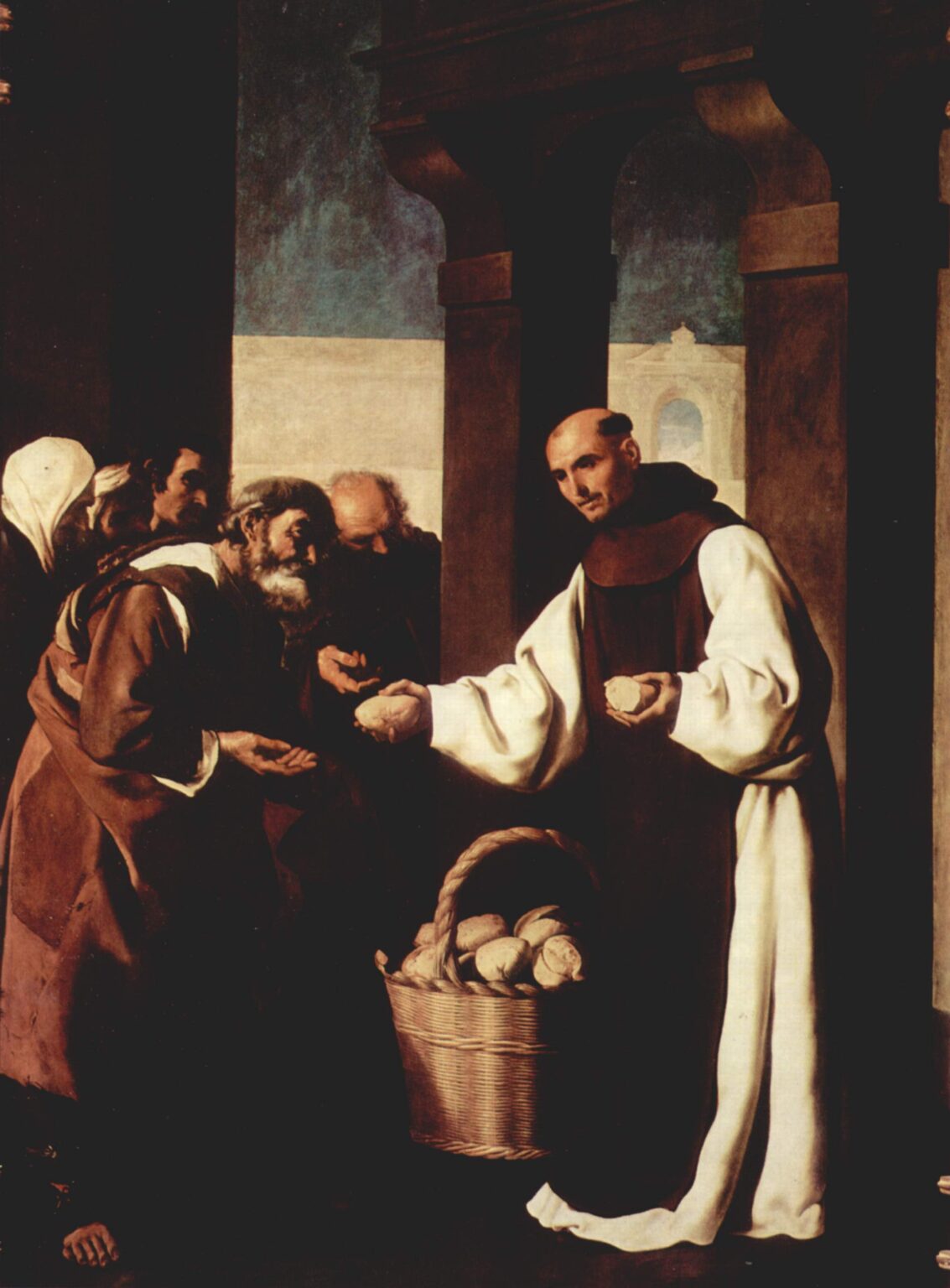
Fra Martin stands on the right, framed by dark architectural piers. His white habit glows against the shadowed background as he bends forward to place a round loaf in the outstretched hands of a gray bearded man. At his feet sits a large basket overflowing with bread. On the left, a small crowd of needy figures presses forward, their faces eager and worn. The scene takes place at the threshold of a monastery or church, where stone columns meet an open courtyard and pale sky.
At first glance, the painting seems almost documentary, as if Zurbaran had simply recorded a daily scene from a charitable brother’s life. Closer inspection reveals how deliberately every element is arranged, from the angle of Fra Martin’s arms to the play of light across his habit and the basket. The result is a work that speaks both to seventeenth century monastic ideals and to enduring questions about generosity, community, and the sacred value of food.
Historical and Spiritual Background
Fra Martin de Vizcaya was a real religious figure, remembered for his dedication to feeding the poor from the resources of his monastery. In Counter Reformation Spain, such acts of concrete charity were considered essential expressions of genuine faith. Monasteries were expected not only to pray and maintain liturgy but also to respond to the material needs of their surrounding communities.
Zurbaran painted this canvas for a Carthusian monastery that valued silence and contemplation, yet also admired stories of practical mercy performed by fellow religious. By highlighting Fra Martin’s generosity, the painting offers monks a model of how contemplative life can flower into service. Charity is not separate from prayer but rather its natural fruit.
The act of giving bread had particular resonance in a Catholic culture shaped by devotion to the Eucharist. Bread was not simply food. It carried sacramental echoes, reminding believers of Christ who called himself the Bread of Life. When Fra Martin distributes loaves to the hungry, he imitates on a small scale the divine generosity made visible in the Mass. Zurbaran’s painting quietly suggests this connection without depicting a formal liturgy.
Composition and Use of Space
The composition of “The Mercy of Fra Martin de Vizcaya” is strongly vertical. Two massive architectural piers rise from bottom to top, framing the monk at the right and separating him from the group of poor men on the left. These piers create a rhythm of dark columns and lighter gaps that echo the structure of a cloister or monastic entrance. Within this architectural frame, the human drama takes place.
Fra Martin is positioned slightly off center to the right, his body forming a gentle diagonal from his head down through his extended arms to the basket on the floor. This diagonal suggests movement and openness. He is not closed in on himself, but leaning outward toward the needy. On the left, the group of men forms its own diagonal, sloping inward as they approach the monk. The two diagonals meet at the point where the bread passes from giver to receiver, emphasizing this moment as the heart of the narrative.
The background is simplified yet carefully considered. Above the heads of the figures we glimpse a wall, a pale band of architecture, and a strip of deep blue sky. This layered backdrop avoids distraction while giving the scene a sense of place. The open sky hints that the act of mercy is not hidden but part of the broader world, a witness to any who might look.
The floor is dark and nearly featureless, directing attention upward toward the figures and the basket of bread. The vast verticality of the columns reinforces the idea that this small act takes place under the watchful presence of God, in a space that is both earthly and sacred.
Fra Martin as a Model of Monastic Charity
Fra Martin is immediately identifiable as a religious through his habit, which appears to be that of a white robed monk with a brown scapular and hood. His head is shaved in the traditional tonsure, leaving a ring of hair that frames his bald crown. His expression is calm, focused, and gentle. There is no trace of condescension in his face. He leans slightly forward with a look of patient attention, as if each person in line were important to him individually.
His body language communicates humble authority. He stands upright but relaxed, one foot slightly advanced. His right arm extends to give a loaf to the man before him, while his left hand holds another piece of bread ready for the next hungry person. This double gesture shows that his charity is steady and ongoing. He is not making a grand theatrical donation but carrying out a habitual duty, loaf after loaf, day after day.
The white of his habit is illuminated by a strong light source coming from the left, transforming the fabric into a luminous field against the deep shadows around him. This visual prominence underscores his role as the channel of mercy. The light that falls on him suggests divine grace working through human hands. Yet the folds of his garment, rendered with Zurbaran’s typical attention to texture, remind us that he is a real person of flesh and cloth, not an abstract symbol.
The Poor Recipients of Mercy
On the left side of the painting, a group of men presses forward in a tightly knit cluster. Their clothing is worn and dark, their faces lined with age and hardship. Each figure is individualized. An older man with a gray beard leans forward with hands cupped, ready to receive the bread. Behind him a balding man with a furrowed brow stares intently at Fra Martin. Another figure, partially hidden, watches from the shadows. A woman with a white head covering stands slightly apart, adding variety to the group and quietly reminding the viewer that poverty affects all members of society.
Zurbaran does not caricature these people. He treats them with the same seriousness and care that he gives to monks and saints. Their faces are strong, dignified, and expressive. They do not grovel or appear ashamed. Instead, they come forward with a mixture of need and trust. Their open hands echo the open hands of Fra Martin. Both giver and receivers participate in a shared act of exchange.
The placement of the poor within the darker half of the composition has a symbolic dimension. They dwell in the shadows of want and social marginalization, yet the light touching the monk’s hands and the bread begins to spill onto them as well. Zurbaran suggests visually that mercy carries light into the darkness of poverty, not in a sentimental sense but in the very real relief of hunger.
The Basket of Bread and Eucharistic Resonance
At the bottom center-right of the painting rests a large wicker basket filled with round loaves of bread. Its handle curves upward, forming a strong visual link between the floor and the figures above. Zurbaran paints the basket with meticulous realism: the woven fibers, the subtle highlights on the curved rim, the varied textures of the loaves piled inside.
This basket is more than a prop. It is a symbol of abundance and generosity. The fact that it is full suggests that Fra Martin has enough to feed many, even if the monastery itself is not wealthy. The image counters any fear that charity will lead to scarcity. In the economy of grace, giving multiplies goods rather than diminishes them.
For viewers attuned to Catholic symbolism, the basket of bread inevitably recalls the Eucharist and the miracle of the loaves and fishes. The simple round loaves resemble communion hosts in enlarged form, and their distribution by a religious figure evokes the role of the priest at Mass. Zurbaran does not depict a formal liturgy, yet he hints that every act of feeding the hungry participates in the logic of the Eucharist, where Christ gives himself as food to the world.
Light, Shadow, and Dramatic Focus
Chiaroscuro is one of Zurbaran’s strongest tools in this painting. The scene is divided into areas of deep shadow and bright illumination. The left side, where most of the poor stand, is significantly darker, with faces emerging from obscurity. The right side, where Fra Martin and the basket are located, is bathed in light.
This contrast does not imply moral judgment on the poor. Rather, it strengthens the visual narrative. The light highlights the path of the bread from basket to hands, drawing the viewer’s eye along the arc of generosity. At the same time, the partially shadowed faces of the poor remind us that their stories are complex and often hidden. They are people whose suffering may go unnoticed unless someone steps forward to see and respond.
The background architecture is also treated with varying light. The band of pale wall and the distant archway are softly lit, suggesting a world beyond the immediate action. This subtle background light prevents the painting from feeling claustrophobic. It tells the viewer that charity, though performed in a specific place, radiates outward.
Emotional Tone and Human Interaction
The emotional tone of “The Mercy of Fra Martin de Vizcaya” is calm, serious, and quietly hopeful. There is no sentimental smiling, no dramatic weeping. Instead, Zurbaran presents a sober moment of encounter between those who have and those who lack, framed by the steady dignity of monastic life.
Fra Martin’s gentle tilt of the head and slight smile suggest compassion without self display. He seems more interested in the people before him than in his own image. One can almost imagine him asking each recipient about their needs, listening to their stories.
The poor, in turn, show gratitude without humiliation. Their body language hints at respect for the monk and for the place where they stand. The older man leans forward, ready to receive, yet his posture retains a certain nobility. Their presence at the doorway of the monastery implies that the community has made itself accessible, not withdrawn behind closed doors.
This quiet mutual respect gives the painting a deeply human warmth. It shows charity not as mere almsgiving but as genuine encounter, where each person recognizes the other’s humanity.
Zurbaran’s Artistic Vision of Charity
In many of his works, Zurbaran painted saints in solitary contemplation, surrounded by symbolic objects. In “The Mercy of Fra Martin de Vizcaya,” he turns his attention to communal life and the outward flow of monastic spirituality. Yet his fundamental concerns remain the same: the interplay of light and darkness, the dignity of simple things, and the presence of grace in everyday actions.
The painting reveals his sensitivity to social realities. Spain in the seventeenth century faced economic difficulties, outbreaks of disease, and significant poverty. By portraying a monk feeding the poor, Zurbaran acknowledges these challenges while offering a model of response. He does not idealize poverty, but he also does not portray the poor as threatening or distant. They are neighbors at the monastery door.
Artistically, the work demonstrates Zurbaran’s mastery of group composition. The crowd of figures on the left is complex yet readable, each head placed carefully to avoid confusion. The strong verticals of the architecture and the brilliant white of the habit create an ordered framework for the human interaction. The painting is both carefully structured and emotionally alive.
Contemporary Resonance and Reflection
Today, “The Mercy of Fra Martin de Vizcaya” continues to speak to concerns about social justice, economic inequality, and the role of religious communities in serving the marginalized. Viewers may see in Fra Martin the prototype of modern soup kitchen volunteers, community organizers, or anyone who shares their resources with those in need.
The painting encourages reflection on the relationship between contemplation and action. Fra Martin’s serene expression suggests that his charity flows from interior prayer. His giving is not frantic or impatient. It is grounded in a sense of God’s abundance. This balance provides a valuable lesson for contemporary efforts toward compassion, which can easily become overwhelmed or purely activist without interior depth.
Additionally, the work prompts us to consider our own attitudes toward those who are poor or displaced. Do we, like the monk, meet them at the threshold with open hands, or do we remain inside the safe walls of our own comfort? Zurbaran’s image gently challenges viewers to imitate the steady generosity depicted on the canvas.
Conclusion A Painted Homily on Bread and Mercy
“The Mercy of Fra Martin de Vizcaya” by Francisco de Zurbaran is far more than a historical anecdote rendered in paint. It is a visual homily on the meaning of mercy, especially as expressed in the simple act of sharing bread. Through strong composition, luminous light, and compassionate depiction of both monk and poor, Zurbaran shows how humble gestures can radiate divine grace.
Fra Martin stands as a bridge between the ordered world of the monastery and the often chaotic world of human need. His hands, full of bread, reach out across the architectural threshold, uniting contemplation and service. The basket at his feet and the queue of hungry faces suggest that this is not a one time event but a rhythm of life.
For viewers in any age, the painting offers a clear invitation: to recognize the sacred in everyday acts of giving, to honor the dignity of those in need, and to allow the bread we share to become a sign of deeper solidarity and love. In this quietly powerful work, Zurbaran transforms charity into an enduring work of art, where the light of compassion continues to fall on outstretched hands.