Image source: wikiart.org
Introduction to St Francis Kneeling
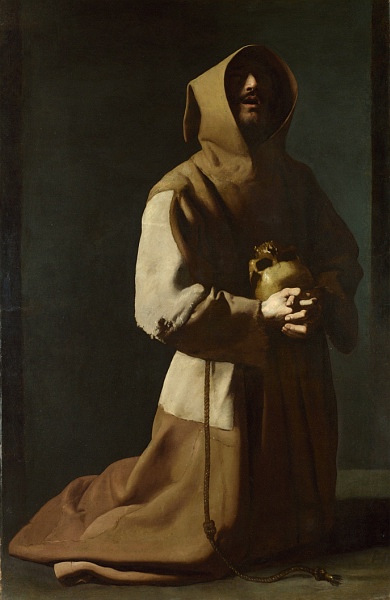
Francisco de Zurbaran’s “St Francis Kneeling,” painted in 1639, is one of the most intense and intimate images of devotion in Spanish Baroque art. The composition is disarmingly simple. A lone friar, dressed in the rough brown habit of the Franciscans, kneels on the floor in a dark and empty space. His hood covers most of his face, leaving only the lower part visible in a slice of light. In his hands he holds a skull, clasped as carefully as if it were a delicate relic.
There is no landscape, no elaborate architecture, no decorative narrative setting. Zurbaran strips away everything that might distract from the encounter between the saint, the symbol of death, and the mysterious light that touches him. The result is a work that feels both austere and deeply moving, a painted meditation on poverty, humility, and the nearness of eternity.
Historical and Spiritual Context
St Francis of Assisi was one of the most beloved saints in early modern Spain. His embrace of poverty, love for the crucified Christ, and tenderness toward creation made him an ideal model for Catholic reform after the Council of Trent. Images of Francis were omnipresent in churches and monasteries, reminding viewers of the call to interior conversion.
Zurbaran, working mainly in Seville, painted numerous versions of St Francis for different patrons. Some show him in ecstatic contemplation of a crucifix, others depict him receiving the stigmata. “St Francis Kneeling” belongs to a quieter tradition that emphasizes penitence and reflection. Here Francis is not in ecstasy but in sober, recollected prayer, contemplating the reality of death and the promise of eternal life.
For Carthusian and Franciscan communities, such an image would have been a powerful tool for meditation. It condensed into a single figure the ideals of withdrawal from worldly vanity and constant remembrance of mortality, both central themes in seventeenth century spirituality.
Composition and Pose of St Francis
The composition is dominated by the kneeling figure, placed slightly to the left of center. Francis occupies almost the entire height of the canvas. His body forms a strong vertical axis from the hem of the habit at the lower left up to the pointed peak of the hood. This verticality suggests spiritual aspiration, a reaching upward toward God, even though the saint’s posture is humble and low to the ground.
The legs are folded beneath him, with the broad skirt of the habit spread along the floor, forming a wide base that stabilizes the composition. His torso leans slightly forward. Both hands hold the skull against his chest. The angle of the wrists and fingers shows gentle care rather than tension.
Because the hood hides his eyes, the face is reduced to the shadowed line of the nose, the faint suggestion of a beard, and the soft curve of the mouth. This anonymity universalizes the figure. He is recognizably Francis by his habit and rope belt, but he could also stand for any monk or believer who kneels in prayer. The lack of visible eyes also shifts emphasis onto the gesture of the hands and the presence of the skull, which becomes an object of contemplation not only for the saint but also for the viewer.
Zurbaran uses a very shallow space. There is almost no sense of depth behind Francis. A dark wall and a bit of floor are all that we see. This compressed setting makes the figure feel closer, as if he has stepped out of the darkness of contemplation into the light that we share.
Light, Shadow, and the Drama of Contemplation
Light is the true protagonist of this painting. A strong illumination comes from the left, falling across the front of the habit, the hands, and the skull. The right side of the figure and the background are swallowed in deep shadow. This intense contrast, known as tenebrism, reveals Zurbaran’s knowledge of Caravaggio and his followers, while still retaining a uniquely Spanish sobriety.
The light does more than model the folds of cloth. It creates a spiritual atmosphere. The illuminated parts of Francis’s habit glow with a quiet, warm tone that suggests both the physical roughness of the fabric and the inner warmth of grace. The light on the skull is especially striking. It turns the bone into a pale, almost luminous object, making death itself appear strangely purified.
The way the light grazes the edges of the hood and face adds to the sense of mystery. We see just enough to recognize a human countenance, but not enough to read detailed emotion. This partial visibility invites viewers to project their own inner states onto the figure. The darkness surrounding Francis suggests the unknown, the silence of contemplation, and the divine mystery that lies beyond human understanding.
The Habit, Rope, and Franciscan Poverty
Zurbaran devotes meticulous attention to the Franciscan habit. The garment is composed of heavy wool, rendered with broad planes of color and subtle variations of texture. The seams, patches, and worn edges are carefully observed. On the left sleeve, the fabric appears frayed, hinting at long use.
The habit is not merely costume. It embodies Franciscan poverty. By painting it in such loving detail, Zurbaran honors the spiritual value of simplicity. There are no rich embroideries or luxurious colors. The browns and off whites create a palette of earth tones, connecting the saint to the soil and to ordinary people who wore similar rough clothing.
At the saint’s side hangs a long knotted cord, the characteristic rope belt of the Franciscans. Its length is exaggerated slightly, allowing it to lie in a curve on the floor with the knots clearly visible. Traditionally, these knots represent the vows of poverty, chastity, and obedience. In the painting, the rope functions almost like a line that leads the viewer’s eye from the lower edge up toward the saint’s folded hands. Visually and symbolically, it ties his life of vowed discipline to his act of prayer.
The Skull and Memento Mori Symbolism
The skull that Francis holds is the principal attribute in this painting. It anchors the entire devotional theme. In Christian iconography, a skull often serves as a memento mori, a reminder of the inevitability of death and the need to prepare for it spiritually. For St Francis, who wrote about “sister death” and welcomed his own dying as a gateway to God, the skull is not a source of horror but a companion in prayer.
Zurbaran paints the skull with the same care he gives to fabrics. The bone has a slightly yellowed hue, with soft highlights that emphasize its roundness. It is not dramatically damaged or gruesome. Instead, it appears polished by time, almost like an object kept on a monk’s desk for constant meditation.
The way Francis cradles the skull is revealing. His hands do not grasp it tightly; they support it from below, with the fingers gently curved around its sides. This cradle like hold suggests reverence. It is as if he recognizes in the skull the truth of his own mortality and the mortality of all people. By holding it close to his heart, he embraces that truth rather than fleeing from it.
For the viewer, the skull’s placement at the center of the light makes it almost impossible to ignore. The painting invites us to follow Francis’s example, to confront the reality of death and to let that awareness purify our priorities.
Emotional Tone and Psychological Depth
Despite the simplicity of the setting, “St Francis Kneeling” carries rich psychological nuances. The saint’s posture is one of humility, yet there is nothing timid or defeated about him. The straight line of the back and the steady support of the hands convey inner strength. This is a humility born of choice, not of oppression.
Because the eyes are hidden, the emotional tone depends on body language and on the few visible features of the face. The slightly open mouth can be read as a sign that he is murmuring a prayer or quietly breathing in the silence of contemplation. There is a hint of tension in the angle of the jaw, as if he is both grieving his sins and accepting forgiveness.
The overall mood is sober and introspective rather than ecstatic. This sets the painting apart from more theatrical Baroque images of saints in visionary rapture. Zurbaran seems interested in the day to day reality of monastic prayer, the disciplined practice of kneeling in silence and focusing on eternal truths. In this sense, the painting offers a more realistic, and perhaps more accessible, model of holiness.
Zurbaran’s Painterly Technique
“St Francis Kneeling” showcases many of Zurbaran’s characteristic technical strengths. His use of oil paint is economical but highly effective. Instead of elaborate glazes and flourishes, he relies on firm drawing, clear tonal contrasts, and carefully placed highlights.
The fabric of the habit is built up with large, confident brushstrokes that create broad planes of light and shadow. The edges are crisp where the illuminated habit meets the dark background, giving the figure a sculptural solidity. In some areas, the paint is slightly textured, enhancing the illusion of coarse cloth.
The skin of the hands and face is painted with muted, earthy tones. Zurbaran avoids rosy coloring, choosing instead a palette that suggests a life of fasting and exposure to the elements. The transitions between light and shadow on the fingers are smooth, giving them a lifelike volume.
The background is handled with remarkable restraint. There are no distracting details, only a subtle gradation from darker tones on the right to slightly lighter ones on the left, where the light source is implied. This minimalism focuses attention completely on the figure and on the spiritual drama contained within the pose.
St Francis Kneeling Within Zurbaran’s Oeuvre
Throughout his career, Zurbaran returned repeatedly to the theme of solitary saints in contemplation. These figures, often shown half length or full length against a dark ground, exemplify his particular contribution to Spanish Baroque art: the union of intense spirituality with almost tangible realism.
“St Francis Kneeling” can be seen as a culmination of this approach. Compared to earlier works where Francis is surrounded by rocks, crucifixes, or landscapes, this painting is more distilled. It reduces the saint’s experience to the essentials of habit, body, skull, and light.
The painting also reflects Zurbaran’s closeness to monastic patrons. Carthusians and Franciscans valued silence, solitude, and death awareness. This image gives them exactly what they sought: a visual companion for their own prayer, free of distractions, yet rich in symbolic content.
Within the broader European context, the work stands alongside images of St Francis by Caravaggio, Ribera, and El Greco, but with a distinct flavor. Where Caravaggio might emphasize dramatic psychological conflict, and El Greco visionary elongation, Zurbaran emphasizes grounded humility and material presence. His Francis is a man of the earth who has learned to look beyond it.
Contemporary Resonance and Viewing Experience
For modern viewers, “St Francis Kneeling” retains a powerful impact. In an age saturated with images and stimuli, the painting’s simplicity feels almost radical. The empty background and limited color palette create a visual silence that can be striking in a busy museum gallery or on a screen.
The subject matter also speaks to contemporary concerns. Many people today grapple with questions about mortality, environmental responsibility, and the value of simplicity in a consumer driven culture. St Francis, long revered as a patron of ecology and of the poor, offers a counter image to material excess. His rough habit and attentive contemplation of a skull challenge the viewer to reflect on what truly matters.
Moreover, the painting invites personal identification. Anyone who has ever knelt to pray, meditate, or simply gather strength in a difficult moment can see something of their own posture in Francis. The hidden eyes and partially obscured face make room for viewers to imagine their own inner experiences within the image.
Conclusion A Quiet Icon of Poverty and Eternity
“St Francis Kneeling” by Francisco de Zurbaran is a masterful fusion of realism and contemplation. Through a single figure in a sparse setting, the painting encapsulates core themes of Franciscan spirituality: poverty, humility, and constant remembrance of death as a doorway to God.
The strong contrasts of light and darkness, the carefully rendered habit, the gently cradled skull, and the anonymous, hooded face all contribute to a sense of profound stillness. Nothing in the painting is superfluous. Every object and gesture points toward the simple act of a man kneeling before the mystery of his own mortality and the mercy of God.
For seventeenth century monks, this work would have been a companion in prayer, a visual echo of their interior practices. For viewers today, it remains a compelling invitation to slow down, to confront the reality of finitude, and to rediscover the beauty of a life oriented toward what endures. Zurbaran’s brush gives body to silence and form to reflection, making “St Francis Kneeling” not only an artistic masterpiece but also a timeless guide to the art of contemplative living.