Image source: wikiart.org
St Francis of Assisi Through Zurbaran’s Eyes
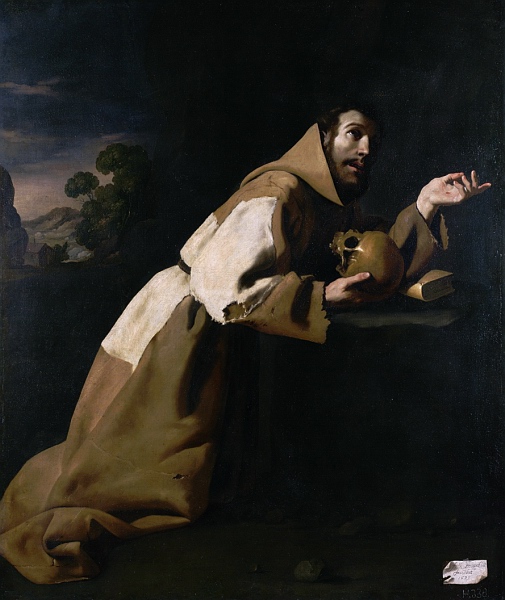
Francisco de Zurbaran’s “St. Francis in Meditation,” painted in 1639, is one of the most compelling images of the saint created in seventeenth century Spain. At first glance the canvas appears almost empty. A vast darkness occupies much of the surface, from which a single kneeling figure emerges. St Francis, wrapped in his patched brown habit, leans forward with both hands resting on a stone ledge. In his arms he cradles a skull and beside him rests a thick book. His face is turned upward, lit by an unseen light that carves his features out of the gloom.
Despite the simplicity of the scene, the painting is charged with emotion. Francis seems caught between awe, fear and love, his mouth slightly open as if whispering a prayer. The skull reminds him of death and the fragility of life, while the book suggests Scripture or the rule that guides his vocation. Zurbaran does not surround the saint with decorative objects, elaborate architecture or crowds of angels. Instead he places him in near solitude, face to face with mystery.
Franciscan Spirituality in Seventeenth Century Spain
To understand the power of this work, it helps to recall the significance of St Francis in Catholic devotion. The thirteenth century founder of the Franciscan order had become, by Zurbaran’s time, one of the most beloved saints in Europe. He was admired for his poverty, humility and ardent love for Christ crucified. Artists often depicted him receiving the stigmata, preaching to birds or embracing a crucifix.
In Counter Reformation Spain, Francis embodied ideals that the Church wanted to promote: simplicity of life, radical trust in God, and passionate meditation on the Passion. Monasteries, confraternities and lay believers all turned to him as model and intercessor. Paintings of Francis in prayer or ecstasy served as visual aids for meditation, encouraging viewers to imitate his interior focus even if they could not imitate his extreme poverty.
Zurbaran, who worked extensively for religious orders in Seville and surrounding regions, painted St Francis many times. His versions often present the saint alone, in a habit that looks worn and heavy, with little ornament. “St. Francis in Meditation” follows this pattern but intensifies it, stripping the scene down almost to essentials. The result is an image that speaks directly to the heart of Franciscan spirituality: contemplative encounter with God in solitude, with death and the Gospel as constant companions.
Composition and the Gesture of Kneeling
The composition of the painting is deceptively simple. St Francis occupies the right side of the canvas, kneeling on a rocky floor that blends into the dark background. His body forms a diagonal that moves from the lower right corner toward the center, where his upturned face catches the light. This diagonal is balanced by the horizontal line of the stone ledge on which his hands rest.
The saint’s posture is crucial to the painting’s emotional tone. He is not sitting calmly or standing in triumph. He is kneeling, leaning forward with his weight supported by his forearms. The position suggests urgency, even physical strain, as if Francis has thrown himself down in prayer and is now lifting his face toward the unseen light.
His right hand, partially visible, presses the skull against his chest while the left is more open, palm up, in a gesture of offering or pleading. The head is tilted slightly, eyes wide and fixed on something beyond the frame. This combination of bent body and lifted face captures the paradox of Christian humility: one bows down before God yet raises the heart in trust.
The surrounding darkness further emphasizes the figure’s isolation. There are no other people in the scene, and the only hints of landscape appear in a narrow strip to the left, where a twilight sky and distant trees can be glimpsed. Everything else is swallowed by shadow. This compositional choice brings the viewer’s attention entirely to Francis and his intense inner dialogue with God.
Tenebrist Light and the Drama of Revelation
One of the most striking features of “St. Francis in Meditation” is Zurbaran’s use of light. The painting belongs firmly to the tenebrist tradition that developed after Caravaggio, in which strong contrasts between light and shadow create dramatic focus. Here, a concentrated beam of light falls from the upper left, illuminating Francis’s face, hands and parts of his habit while leaving the rest in deep darkness.
The source of this light is not visible. It seems to come from outside the picture, which invites a spiritual interpretation. Viewers can easily read it as the light of divine grace or revelation, breaking into the obscurity of the world just as it breaks into the gloom of the canvas. Francis’s gaze clearly follows the path of this invisible light, reinforcing the idea that he is receiving some inner illumination.
The modeling of his features is particularly sensitive. Shadows hollow his cheeks and deepen the sockets of his eyes, while a highlight touches the tip of his nose and the edges of his lips. This careful play of light and dark lends his expression an almost sculptural intensity. He appears both physically present and spiritually absorbed.
The skull is also dramatically lit. The upper part catches the beam, gleaming pale against the brown folds of the habit. Its empty eye sockets echo Francis’s wide, fervent eyes, creating a visual dialogue between living and dead, time and eternity.
The Habit as Second Skin
Zurbaran was renowned for his ability to depict cloth. In this painting the Franciscan habit is almost a character in itself. Made of coarse, undyed wool, the garment hangs heavy and voluminous around the saint’s body. The painter carefully renders its rough texture, frayed edges and patched areas, especially on the shoulders and sleeves.
The folds of the habit follow the curve of Francis’s posture, cascading down from his shoulder and pooling on the ground. Highlights trace the ridges of the cloth, while shadows sink into the creases, giving the fabric a strong sense of weight. This physical heaviness underscores the saint’s embrace of poverty and penance. His clothing is not fashionable or refined, but simple and worn, a visible sign of his rejection of worldly luxury.
At the same time, the habit wraps him like a second skin. Its hood frames his face, and its loose sleeves envelop his arms as he cradles the skull. The garment seems almost to merge with the surrounding darkness, suggesting that Francis has stripped away any identity apart from his calling. He is simply a poor man clothed in humility, kneeling before the light of God.
Symbols of Skull and Book
Two objects accompany Francis in his meditation: a skull and an open book. Both are traditional symbols in Christian art, especially in representations of penitents and contemplatives.
The skull speaks of mortality. It reminds viewers that life is brief and that death comes to all, regardless of rank or fortune. For Francis, who embraced poverty and suffering, the skull is not a morbid curiosity but a tool for spiritual focus. By contemplating death he can detach his heart from worldly attachments and fix it on eternal realities.
Zurbaran places the skull directly in Francis’s arms, close to his chest. This intimate contact conveys both acceptance and compassion. Francis does not hold death at arm’s length; he presses it to himself, acknowledging it as part of his human condition yet offering it up to God. The skull’s smooth form contrasts with the rough texture of the habit, and its pale color stands out against the dark background.
The book, resting on the stone ledge near his left hand, most likely represents Scripture or perhaps the Franciscan Rule that guides the order. Its pages are slightly open, yet Francis’s attention is not on the text at this moment. Instead he looks upward, as if moving from written words to direct communion with the divine. The book’s presence, however, reminds the viewer that this ecstatic state grows out of disciplined reading and reflection. Francis’s vision is rooted in the word, not detached from it.
Together, skull and book encapsulate the two poles of his meditation: awareness of death and listening to God’s message. The painting invites viewers to hold these realities together in their own spiritual lives.
Landscape and the Edge of the World
Although most of the background is dark, Zurbaran includes a small section of landscape on the left. In this window of lighter tones we glimpse a hill, a cluster of trees, and a sky that seems to glow with the fading light of sunset. The landscape is modest and distant, almost like a memory.
This detail deepens the painting’s meaning in several ways. First, it locates Francis in the natural world, recalling his famous love for creation. Even in this moment of intense inner focus, the outside world is not entirely excluded. The trees and sky hint at the larger environment in which his spiritual journey unfolds.
Second, the landscape provides a visual contrast to the interior darkness. It suggests that Francis has withdrawn from the world to seek solitude, leaving behind the open spaces and entering a cave or cell. The viewer stands with him at the threshold between these realms. The world is still visible, but it is far away, muted, almost irrelevant compared with the encounter taking place in the shadowed foreground.
Finally, the strip of sky may carry symbolic resonance. The transition from light to dark across the canvas can be read as a metaphor for the soul’s passage from worldly light to the deeper, more mysterious light of God.
Psychological and Spiritual Interpretation
What exactly is St Francis experiencing in this moment? Zurbaran leaves the narrative deliberately ambiguous. There is no crucifix in view, no clear sign of stigmata being received, no angelic figure to explain his expression. Instead we are invited to contemplate the psychological tension visible in his face and posture.
His eyes are wide and fixed upward, his brow slightly furrowed. The mouth is parted, as if in whispered prayer or startled exclamation. This blend of wonder and fear suggests that Francis is encountering something both attractive and overwhelming. Perhaps he is contemplating the suffering of Christ, or hearing an inner call to deeper poverty, or simply overwhelmed by the sense of God’s presence.
The skull in his arms contributes to the intensity of this experience. Holding death so close, he may feel the fragility of his own life more keenly, which can drive him to cling to God with greater urgency. The open palm of his left hand suggests surrender. Whatever God asks, he is ready to accept.
For viewers, this ambiguity is fruitful. Rather than illustrating one specific episode, the painting becomes a general image of contemplative crisis, the moment when prayer passes from routine recitation to a profound, unsettling encounter with the divine. It invites us to see ourselves in Francis’s place, kneeling in darkness with our own mortality in our arms, turning our face toward a light we cannot fully see.
Zurbaran’s Signature Style
“St. Francis in Meditation” showcases many qualities that made Zurbaran a central figure in Spanish Baroque art. His ability to render fabrics with tactile realism, his mastery of tenebrist lighting, and his preference for strong, simple compositions are all evident.
Unlike some contemporaries who favored swirling motion and elaborate ornament, Zurbaran often chose stillness and clarity. Here, the entire drama resides in a single figure and a few objects. Yet this restraint does not diminish impact. On the contrary, the simplicity intensifies the viewer’s concentration.
The painting also reveals Zurbaran’s empathy for monastic life. He understood the world of cloisters, cells and silent chapels. His St Francis is not an abstract symbol but a believable human being who could be encountered in a Franciscan convent in his own time. This grounded realism allowed seventeenth century viewers to feel that the saint was close to them, sharing their struggles and guiding their prayer.
Contemporary Relevance
Although created for a religious context centuries ago, “St. Francis in Meditation” speaks powerfully to modern viewers. In a world saturated with noise and distraction, the image of a single figure kneeling in silent darkness can feel almost shocking. It reminds us of the value of solitude and reflection, of creating spaces where we can confront questions of mortality, purpose and faith.
The painting also hints at the emotional complexity of authentic spirituality. St Francis does not appear serenely detached or perpetually joyful. His prayer involves struggle, intensity and perhaps even fear. This honesty can encourage viewers who find their own spiritual search marked by doubts or inner conflict. Zurbaran’s Francis suggests that such experiences are not signs of failure but part of the journey toward deeper trust.
Finally, the image of the saint embracing a skull resonates with contemporary efforts to recover a more realistic relationship with death. In many modern societies death is hidden away or treated only clinically. This painting presents a different attitude: an honest acknowledgment of mortality that leads not to despair but to a more passionate orientation toward what truly matters.
Conclusion
Francisco de Zurbaran’s “St. Francis in Meditation” is a quiet masterpiece of spiritual portraiture. Through a stark composition, dramatic lighting and carefully chosen symbols, the painter offers an intense vision of the Franciscan ideal. The saint kneels alone in darkness, habit worn and patched, arms wrapped around a skull, eyes lifted toward an unseen light. Book and landscape stand nearby as reminders of Scripture and the world he has left behind, yet the center of gravity lies in his encounter with the divine.
This canvas invites viewers into the same posture of reflection. It asks us to consider our own mortality, our relationship to material comfort, and our willingness to listen for God’s voice in the silence. At the same time, it showcases Zurbaran’s unique combination of realism and mysticism, making the invisible drama of the soul visible on canvas.
More than three centuries after its creation, “St. Francis in Meditation” continues to draw viewers into the mystery of prayer, where light meets darkness and a human heart opens itself completely to the presence of God.
