Image source: wikiart.org
Introducing Zurbaran’s Annunciation for the Monastery of Nuestra Señora de la Defensión
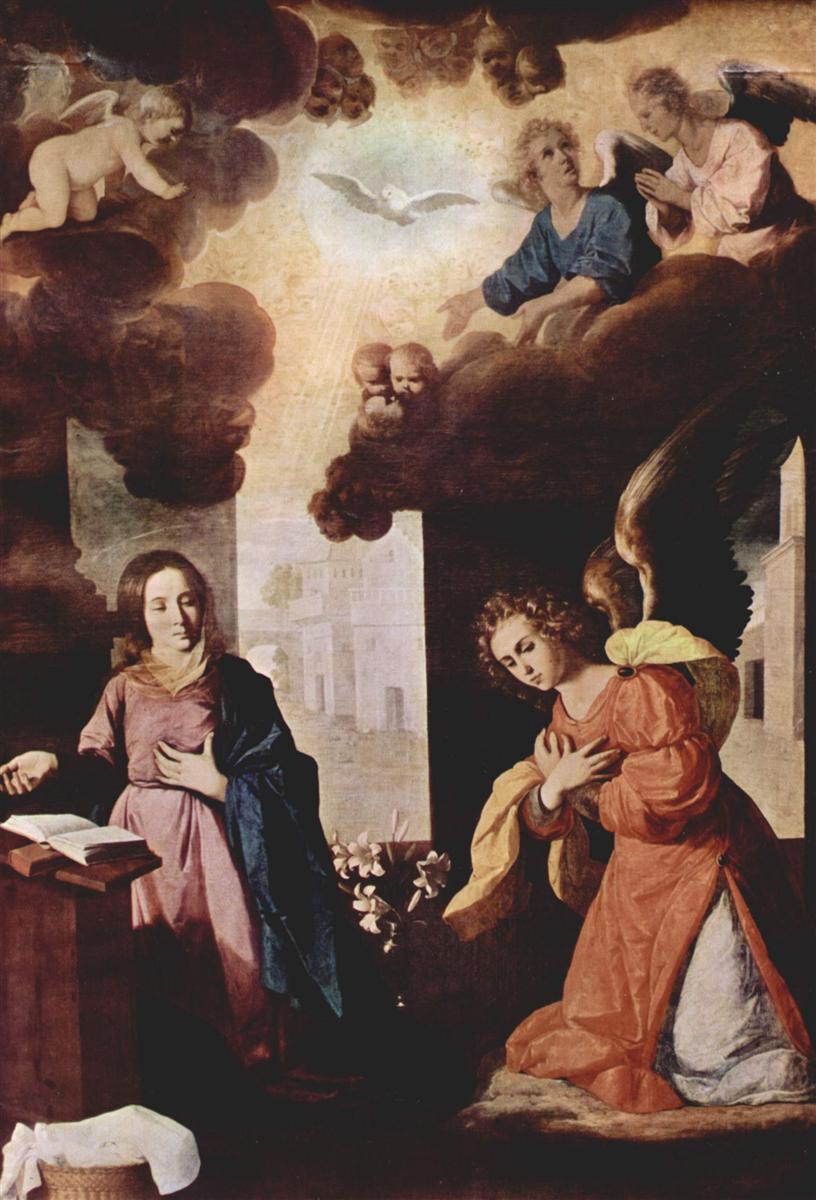
Francisco de Zurbaran’s “Monastery of Nuestra Señora de la Defensión at Jerez de la Frontera, The Annunciation,” painted in 1638, is one of his most lyrical treatments of the Gospel story in which the angel Gabriel announces to Mary that she will conceive and bear the Son of God. Created for a Cistercian monastery near Jerez, the painting combines Zurbaran’s trademark sobriety with an unusually tender and airy atmosphere.
The canvas is divided between the quiet interior where Mary kneels beside a lectern and the vast celestial realm that opens above. Clouds, cherubs and angels roll across the upper half, surrounding the radiant dove of the Holy Spirit. Below, the archangel Gabriel kneels on a cushion, hands crossed over his chest, while Mary breaks off her reading to listen, one hand resting on her heart. The overall effect is both intimate and cosmic. A simple room becomes the stage for the mystery of the Incarnation, and everyday objects such as a book or a basket of linens share space with musical angels and heavenly light.
Historical and Monastic Context
The painting was commissioned for the Monastery of Nuestra Señora de la Defensión, a Cistercian house that valued silence, contemplation and Marian devotion. In seventeenth century Spain the Annunciation was a favored theme for monastic communities because it united two central ideals: humble obedience to God’s will and the hidden life of prayer.
Zurbaran, already famous in Seville for his large altarpieces and his series of monastic figures, was a natural choice for such a commission. His ability to give spiritual gravity to simple objects and to portray saints as solid, contemporary figures matched the Cistercian spirit. In this Annunciation he takes a narrative familiar to every monk who recited the Angelus each day and renders it newly vivid, both doctrinal and deeply human.
Composition and the Meeting of Two Worlds
At first glance the composition seems clearly divided into an upper heavenly register and a lower earthly one. The top is filled with clouds, cherub heads and angels who lean forward as if watching the drama below. Light streams from a circular opening in the clouds where the Holy Spirit appears as a white dove.
On the lower level, Mary stands at the left of the canvas in front of a lectern with an open book. Behind her a doorway reveals a pale cityscape of towers and walls, an evocation of Nazareth that also recalls the white architecture of Andalusian towns. On the right, Gabriel kneels, richly robed, wings folded behind him. Between them on the floor blooms a small cluster of lilies, their whiteness catching the light.
Despite this vertical division, Zurbaran carefully knits the two realms together. The shaft of radiance that emanates from the dove and passes through the clouds falls in the general direction of Mary, suggesting the descent of divine grace. The gestures of the angels above point downward, while the tilt of Mary’s head and Gabriel’s body leads the viewer’s eye upward again. The painting becomes a visual conversation between heaven and earth, linked by light, gesture and prayer.
The Virgin Mary as Reader and Listener
Zurbaran portrays Mary as a young woman absorbed in spiritual reading when the angel arrives. She is dressed in a rose colored gown with a deep blue mantle wrapped around her shoulders. The garments fall in long, simple folds, echoing the austere taste of the Cistercian patrons yet maintaining a quiet elegance.
Her head is slightly bowed, eyes lowered, one hand resting on her chest while the other hovers near the open book on the lectern. This pose conveys both surprise and inner recollection. Mary is not portrayed as dramatically recoiling or wildly astonished. Instead she seems to pause, already steeped in the Scriptures that have prepared her to recognize God’s voice.
The lectern and book emphasize that this is a woman formed by meditation on the Word. According to traditional theology, Mary conceived Christ first in her heart and mind before conceiving him in her womb. Zurbaran suggests this interior conception by showing her in the act of reading when the angel speaks. Her hand over her heart indicates a response of faith that begins inside before it is spoken aloud.
Her face is modest and gentle, framed by simple hair and a pale veil. Zurbaran avoids any excessive idealization. She looks like a devout young woman from seventeenth century Andalusia, which allowed the nuns of the monastery to identify closely with her.
The Archangel Gabriel in Humble Adoration
On the right side, the archangel Gabriel kneels on a small cushion, body inclined toward Mary. Unlike the martial angels of some Baroque paintings, Zurbaran’s Gabriel is more like a young courtier paying homage to his queen. He wears a flowing red robe with a golden mantle that falls down his back and over one arm. The warm colors form a visual counterpart to Mary’s cooler pink and blue, creating a harmonious balance across the canvas.
Gabriel’s hands are crossed over his chest, fingers lightly touching. This gesture expresses both reverence and announcement. He has just spoken the words “Hail, full of grace,” but in Zurbaran’s depiction his attitude is almost contemplative, as if he himself is moved by the mystery he proclaims. His wings, painted in soft browns and ochres, partially frame his figure and emphasize his otherworldly nature.
The angel’s curly hair, youthful face and gentle expression make him seem approachable rather than terrifying. This fits with the Gospel narrative, where the first words addressed to Mary are words of reassurance. The angel’s kneeling posture also contrasts with his exalted status, underlining that even celestial beings bow before the mystery of the Incarnation.
Heavenly Spectators and the Descent of the Spirit
The upper half of the painting is crowded with clouds and angelic figures. On the left, a small putto leans forward on a dark cloud, watching intently. On the right, two larger angels, one in blue and one in pale pink, kneel on a cloudbank. Their bodies are oriented toward the center where the dove appears, yet their faces turn partly toward the scene below. Behind them clusters of cherub heads emerge from the clouds, their rounded faces lit by the glow that emanates from the Spirit.
At the center of this celestial choir is a radiant circle of light in which the dove of the Holy Spirit is suspended, wings outstretched. Thin rays of light stream downward, illuminating the clouds and suggesting that the entire heavenly host is bathed in the same grace that soon will overshadow Mary.
These upper figures serve several functions. Theologically they affirm that the Annunciation is an event involving the whole Trinity and the company of heaven, not a private moment hidden from cosmic view. Artistically they balance the composition, filling what would otherwise be a large empty sky and providing a rich counterpoint to the relatively simple earthbound figures. Spiritually they invite the viewer to imagine joining in the angelic contemplation of this mystery.
Architecture, Open Space and the Sense of Place
One of the subtle pleasures of the painting lies in the architecture glimpsed through the open doorway behind Mary. Instead of an interior fully enclosed, Zurbaran opens a window to a pale, hazy cityscape. Low buildings, towers and walls rendered in delicate grays and whites recede into the distance.
This urban background locates the scene in Nazareth yet also echoes Spanish cities of Zurbaran’s own day. The light here is cooler and more diffused than the golden radiance above, evoking the ordinary world that goes about its business unaware of the angelic visitation happening in a quiet room.
The architecture in the foreground, with its vertical columns and dark interior walls, frames Mary and Gabriel like figures in a sacred stage set. The perspective lines draw the viewer’s eye inward, toward the meeting between the two figures, then outward again through the doorway toward the city. In this way the painting connects the intimate encounter with the broader world that will be transformed by Mary’s yes.
Symbolic Objects at Mary’s Feet
Near the center bottom of the composition, a cluster of white lilies blooms between Mary and Gabriel. Lilies are a traditional symbol of purity and are especially associated with the Annunciation. Their placement at the threshold between the two figures suggests that Mary’s virginal integrity remains intact even as she receives the angel’s message of motherhood. The flowers also recall the Cistercian devotion to Mary as “flower of the field” and “lily among thorns.”
Near the left edge of the painting a woven basket and a folded cloth or towel rest on the floor. These humble domestic objects allude to Mary’s role in the everyday tasks of the household. They root the scene in real life and emphasize that divine grace enters into the sphere of ordinary work. For the monastic viewers, these items could symbolize the daily chores of the convent, sanctified by prayer just as Mary’s chores are sanctified by the Incarnation.
The open book on the lectern is another significant symbol. It represents both the prophecies that foretold the coming of the Messiah and the personal meditation that prepared Mary’s heart. In the monastic context it also mirrors the daily practice of lectio divina, the slow, prayerful reading of Scripture through which monks sought to encounter the living Word.
Color, Light and Zurbaran’s Poetic Atmosphere
Although Zurbaran is often associated with stark contrasts of light and dark, this Annunciation has a surprisingly soft palette. The lower portion of the painting is dominated by gentle pinks, blues and warm earth tones. The upper portion glows with creams, golds and soft browns. There are still areas of deep shadow, especially in the architectural framing and in the darker portions of the clouds, but the overall effect is less dramatic and more lyrical than in some of his other works.
Light plays a unifying role. A diffused illumination falls from the upper left, brightening Mary’s face and the page of her book. A somewhat stronger radiance emanates from the circle around the dove, sending subtle beams across the clouds. These overlapping sources of light create a visual correspondence between the physical and spiritual illumination. The same light that brightens Mary’s face is also the light of the Spirit descending from above.
Zurbaran’s handling of drapery enhances this sense of gentle movement. Mary’s cloak, Gabriel’s robe and the angels’ garments above all have soft, rounded folds that catch light and lead the eye in slow curves. There are no violent diagonals or swirling motions. Instead the fabric seems to breathe quietly, echoing the calm yet profound exchange taking place.
Zurbaran’s Interpretation Within the Tradition of the Annunciation
The Annunciation had been depicted countless times before Zurbaran. Famous examples by Fra Angelico, Leonardo da Vinci and El Greco would have been known at least through prints or local works influenced by them. Zurbaran’s version shares some common elements – the lectern, the lily, the kneeling angel – but has its own distinct character.
Where many earlier artists emphasize architectural elegance or complex symbolic programs, Zurbaran focuses more on the emotional and spiritual relationship between Mary and Gabriel. His Mary is not startled or ecstatic but recollected and thoughtful. His Gabriel is deferential rather than triumphant. The angels above do not dominate the scene but witness it quietly.
The painting reflects Spanish Counter Reformation concerns. It presents Mary as humble, obedient and immersed in Scripture, virtues the Cistercian monks and nuns sought to imitate. It also underscores the role of interior prayer: the decisive moment of salvation happens not in a noisy public square but in the stillness of a private room where a young woman listens to God.
Spiritual Meaning and Monastic Meditation
For the monks of Nuestra Señora de la Defensión, this painting would have functioned as more than decoration. It was a visual aid to meditation. As they entered the chapel or passed through the cloister, they could contemplate Mary’s poised modesty, Gabriel’s reverence and the descent of the Spirit.
The scene invited them to ask whether they, like Mary, were ready to hear and respond to God’s word in their own lives. The lilies at the center could remind them of their call to purity of heart. The open book could urge fidelity to daily reading. The basket and cloth could sanctify their routine tasks. The clouds bursting with angels might console them with the thought that their hidden lives participated in the broader worship of heaven.
Even today the painting speaks to viewers who may not live in monasteries. It suggests that moments of revelation often come amid ordinary activities, in quiet rooms, through the slow reading of a book, or in the middle of everyday chores. The Annunciation is at once utterly unique and strangely familiar, and Zurbaran’s gentle treatment emphasizes this paradox.
Conclusion
“Monastery of Nuestra Señora de la Defensión at Jerez de la Frontera, The Annunciation” is a rich synthesis of Francisco de Zurbaran’s gifts as a painter of sacred narratives. Through a balanced composition, nuanced light, and tender attention to gesture and expression, he turns the familiar Gospel story into a scene that feels both intimate and cosmic.
Mary stands as a model of contemplative listening, grounded in Scripture and everyday work yet open to the astonishing newness of God’s call. Gabriel embodies reverent proclamation, announcing the mystery with humility. The angels and cherubs above witness the scene with awe, and the descending dove draws a luminous line between heaven and earth.
Created for a Cistercian monastery, the painting continues to invite viewers into a posture of quiet receptivity. It reminds us that, like Mary, we are most ready to receive transforming grace when we are attentive, prayerful and willing to say yes to what we do not fully understand. In Zurbaran’s serene and glowing vision, the Annunciation becomes not only a historical event but an ever-present invitation to let the divine Word enter our own lives.