Image source: wikiart.org
Introduction to Adoration of the Shepherds
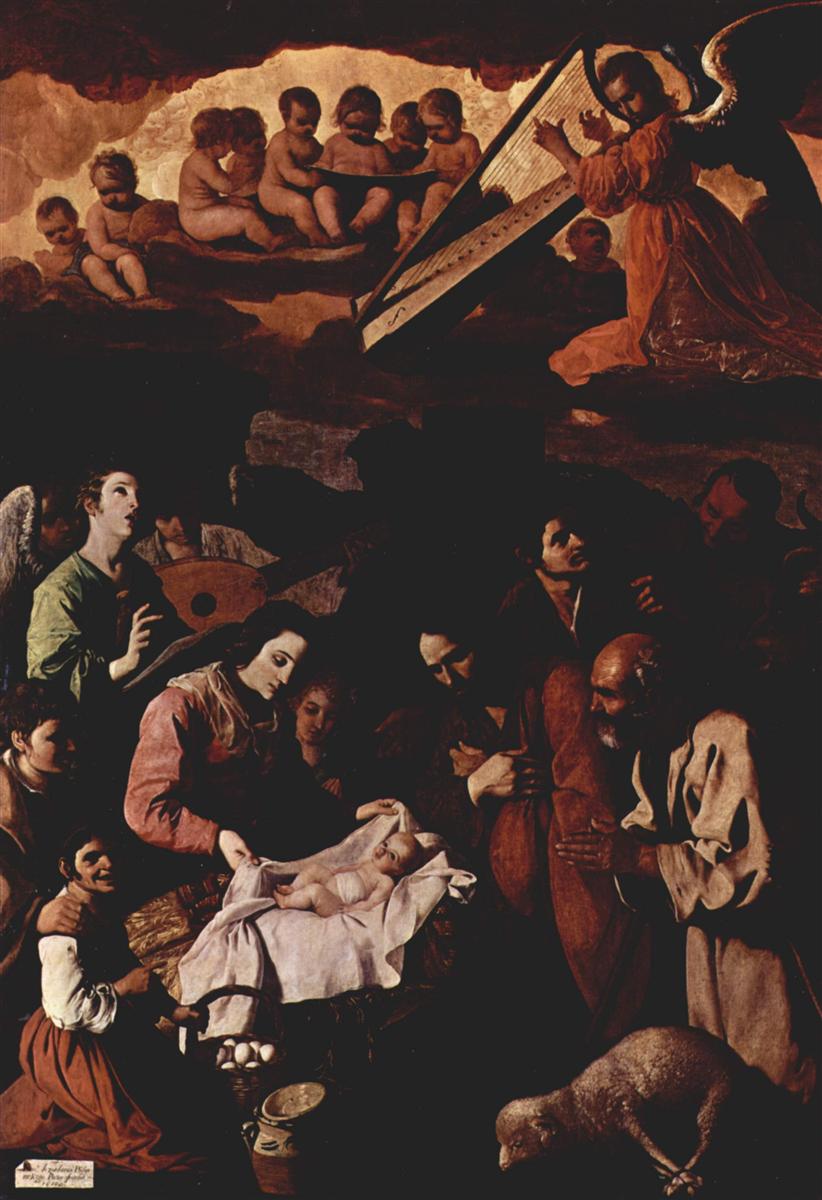
Francisco de Zurbaran’s “Adoration of the Shepherds,” painted in 1638, is a rich and dramatic meditation on the birth of Christ. The scene is filled with figures, yet it remains focused on a single, luminous center: the infant Jesus, swaddled in cloth and presented to a circle of awestruck shepherds and attendants. Above, an angelic concert bursts through an opening in the clouds, where putti sit on banks of glowing vapors and a great angel plays a monumental psaltery or harp.
At first glance the composition feels almost theatrical. Strong contrasts of light and shadow, emotional faces, and rich fabrics create a sense of heightened drama. Yet, as viewers spend more time with the painting, a different quality appears. The work becomes an intimate devotional image, inviting quiet reflection on humility, music, and the mystery of the Incarnation. Zurbaran unites heaven and earth into a single vertical axis, from the lamb in the foreground to the angel musicians in the sky, creating a seamless movement between the human and the divine.
Historical and Religious Context
The subject of the Adoration of the Shepherds has long been a favorite theme in Christian art. It refers to the Gospel of Luke, which describes how angels announced the birth of Christ to shepherds keeping watch over their flocks. The shepherds came in haste to Bethlehem, where they found the child lying in a manger and glorified God for what they had seen. The story emphasizes that the first to recognize the Messiah were not kings or scholars, but humble workers of the fields.
In seventeenth century Spain, this emphasis on humility and divine favor toward the poor resonated strongly with Counter Reformation spirituality. Religious art was intended to be both doctrinal and affective. It had to teach correct belief while also awakening love and devotion in the viewer. Zurbaran, who worked primarily in Seville, was highly valued by monastic and ecclesiastical patrons for his ability to portray sacred subjects with intense emotional realism and meditative stillness.
“Adoration of the Shepherds” was painted at a time when Spanish artists were exploring new ways of combining dramatic lighting with spiritual depth. The influence of Caravaggio can be seen in the strong contrasts and the use of humble models, yet Zurbaran’s approach is quieter and more contemplative. His shepherds and angels are not simply actors in a spectacle. They are participants in a true mystery, presented in a way that invites viewers to share their wonder.
Composition and Spatial Structure
Zurbaran organizes the scene in two distinct but related zones. The lower half of the painting is occupied by the earthly group gathered around the Christ child. The upper half is filled with angels and putti in the clouds. These zones are connected by the diagonal of the giant psaltery that the kneeling angel plays. The stringed instrument reaches from the upper right down toward the center, linking the music of heaven with the humility of the stable.
In the lower group, Mary sits slightly to the left of center, dressed in red and blue, her head bent in gentle contemplation as she holds the cloth on which the infant lies. The Christ child lies horizontally, forming a visual axis that several figures lean toward. The shepherds and attendants cluster around, their bodies forming a loose semicircle that frames the baby. On the right, an elderly shepherd with a white beard bends forward, hands pressed to his chest in reverence. On the left, a young woman kneels with a basket of eggs, a traditional symbol of new life and offering.
The space is tight, as if the viewer has stepped into a crowded stable. Darkness around the edges pushes the figures forward, giving them sculptural presence. The vertical format of the composition enhances the sense that heavenly and earthly realms are stacked one above the other, yet interacting in a dynamic way through gesture and gaze.
Light, Color and Atmosphere
Light in this painting functions both realistically and symbolically. A warm, golden glow illuminates the cloud bank above, where the putti sit and the main angel plays the psaltery. This light seems to come from within the clouds themselves, suggesting divine radiance. It spills downward toward the figures below, but does not fully banish the darkness of the stable. Instead, pools of light pick out particular faces and objects, creating an interplay of brightness and shadow that heightens the emotional intensity.
The Christ child, wrapped in pale cloth, is the brightest element in the lower half. His skin and linen catch the light in a way that makes him almost shimmer against the darker surroundings. Mary’s red garment and blue mantle provide strong, saturated color near the center. The shepherds wear earth tones of brown, green, and dull red, echoing the colors of soil and fields. The lamb in the foreground is rendered with soft, muted whites that harmonize with the linen around the child.
In the upper register, the clouds range from deep brown and crimson to creamy gold, forming a kind of celestial stage. The angel’s robes are a vivid orange, and the putti are painted with warm flesh tones that echo the child’s skin. This chromatic harmony between sky and stable suggests continuity between the two realms. While the atmosphere is charged with drama, the overall color scheme remains earthy and rich, rooted in the reality of the physical world.
The Figures of Mary, Christ and the Shepherds
At the heart of the painting stands the interaction between Mary, the infant Jesus, and the visiting shepherds. Mary appears as a young woman, her features soft and contemplative. She does not gaze directly at the viewer but focuses on the child in her lap. Her hands hold the cloth carefully, as if presenting Christ not only to the shepherds but also to all who behold the image. Her calm presence anchors the scene, providing a contrast to the more expressive faces around her.
The infant Jesus lies at the center, his small body gently twisted, one arm slightly raised. Unlike more idealized Nativity images where the child glows with supernatural light, Zurbaran paints him with the tender realism of a real baby. This naturalism makes his vulnerability more apparent and underscores the theological point that God has truly taken on human flesh.
The shepherds surrounding the child display a range of reactions. The older bearded shepherd on the right leans forward in a gesture of devout wonder, his hands clasped as if in prayer. Another figure behind him peeks over his shoulder, curious yet hesitant. On the left side, younger shepherds and attendants press closer, eyes turned toward the child. Their clothing and rough features signal their humble status, yet their intense attention marks them as privileged witnesses to the divine event.
The young girl crouched in the lower left corner offers a basket with eggs and a small pot. Her smiling face and red skirt bring a touch of domestic warmth to the scene. She represents the simple gifts of the poor, transformed into worthy offerings by love and faith.
The Celestial Concert Above
While the lower half of the painting depicts the human response to Christ’s birth, the upper half reveals heaven’s participation. In the clouds, a group of putti cluster together, some holding what looks like a musical scroll. Their chubby bodies and playful poses introduce an element of joyous innocence. Yet their faces are serious, absorbed in the music that honors the newborn king.
The dominant figure in the sky is the kneeling angel playing a large psaltery or harp that stretches diagonally across the upper section. The angel’s wings unfurl behind him, and his orange robe billows with a sense of motion. His fingers pluck the strings, and his gaze is directed downward. The instrument itself acts as a bridge between heaven and earth, its lower end pointing toward the child below. It suggests that music is the medium through which celestial praise descends to the human realm.
This heavenly concert echoes the Gospel narrative in which a multitude of the heavenly host praise God and proclaim peace to people of good will. Zurbaran turns that proclamation into visible sound. The viewer almost hears the gentle hum of strings and the choral voices of the putti. The musical theme also connects to the shepherds, who traditionally played flutes and pipes while tending their flocks. Here, their rustic songs are taken up and perfected by angels.
Symbolism of Objects and Animals
Zurbaran enriches the painting with a number of symbolic objects that deepen its meaning without distracting from the central scene. The lamb in the lower right corner is perhaps the most obvious. It recalls Christ as the Lamb of God who will one day be sacrificed for the sins of the world. Its humble posture, head lowered, foreshadows the Passion while also grounding the scene in the pastoral context of shepherds and flocks.
The basket of eggs held by the girl symbolizes new life and resurrection. Eggs are often associated with Easter, yet their presence here hints that the birth of Christ already contains within it the promise of future renewal. The small pot beside the basket may reference the everyday nourishment that the Holy Family and the shepherds share, suggesting that Christ comes into ordinary human needs and work.
Musical instruments themselves carry symbolic values. The psaltery in the sky represents the harmony of heaven, while the lute or guitar held by the angel on the left side of the lower group connects sacred joy with human art. Even the cloth in which the child is wrapped can be seen as a sign of both care and future suffering, echoing burial shrouds that will later enfold his body.
Emotional Tone and Devotional Message
“Adoration of the Shepherds” balances grandeur with intimacy. The large scale of the canvas and the dramatic contrast of light and shadow give the scene a monumental feeling, suitable for a church or monastic refectory. At the same time, the gestures and expressions of the figures invite personal identification.
Viewers can sense the emotional journey of the shepherds, from initial surprise at the angelic message to profound reverence before the child. The painting encourages those who look at it to place themselves in the circle around the manger, to approach with the same humility and awe. Mary’s quiet focus and Joseph’s more shadowed presence reinforce the idea that contemplation and silent adoration are appropriate responses to the mystery of God made flesh.
The juxtaposition of heavenly musicians and earthly peasants carries a clear devotional message. It tells believers that their humble lives are not separate from the divine realm. The music of heaven accompanies the simple offerings of eggs and baskets. The high and the low, the infinite and the ordinary, meet in the person of Christ. This message would have been especially powerful for the poor and for members of religious communities who owned little yet sought to offer themselves entirely to God.
Zurbaran’s Style and Spanish Baroque Spirituality
This painting is exemplary of Zurbaran’s mature style. His figures possess a sculptural solidity, as if carved from blocks of light and shadow. The draperies, particularly in Mary’s cloak and the garments of the shepherds, are rendered with heavy folds that convey weight and texture. Faces are individualized and often somewhat rugged, far from the suave idealization of Italian court painting.
Zurbaran’s brand of Spanish Baroque spirituality emphasizes contemplation, humility and the palpable presence of sacred realities. Even in a busy composition like this, he avoids excessive movement or contorted poses. The drama comes from the light and from the intensity of inner emotion, not from theatrical gestures. This approach invites viewers not only to admire the work from a distance but to dwell with it, to read it slowly as one would read a spiritual text.
Compared with more exuberant Nativity scenes by artists such as Rubens, Zurbaran’s “Adoration of the Shepherds” feels more inward and meditative. Yet it is no less powerful. Its concentrated lighting, careful grouping of heads and hands, and subtle symbolism reveal an artist deeply attuned to the desires of seventeenth century Spanish devotees for art that could sustain long periods of prayerful looking.
Legacy and Contemporary Relevance
Today, “Adoration of the Shepherds” continues to resonate for modern viewers. Some are drawn by its technical mastery: the handling of light, the convincing textures of cloth, hair and flesh, and the elegant integration of many figures into a coherent whole. Others are captivated by its emotional honesty. The shepherds do not look like idealized heroes, but like real people whose wonder and reverence are easily understood.
The painting also speaks to contemporary concerns about the value of humility and the dignity of ordinary life. In a culture that often values fame, wealth and spectacle, Zurbaran’s choice to highlight poor shepherds as the first worshippers of Christ offers a counter message. It suggests that significance is found not in status but in openness to the divine and in the willingness to respond with gratitude.
For those interested in the relationship between art and music, this work offers a fascinating visual reflection on how sound, worship and community are intertwined. The heavenward sweep of the psaltery and the attentive faces of the putti illustrate how music can serve as a bridge between human emotion and spiritual truth.
Conclusion
Francisco de Zurbaran’s “Adoration of the Shepherds,” painted in 1638, is a rich tapestry of devotion, music and humble wonder. By uniting a crowded stable scene with a radiant celestial concert, the artist creates a powerful image of heaven and earth meeting around the newborn Christ. The careful composition, dramatic lighting, expressive faces and meaningful symbols all work together to convey the central message of the Nativity story: that God enters the world in simplicity and invites the poor and lowly to be the first to rejoice.
Through this painting, Zurbaran demonstrates his ability to transform a familiar biblical narrative into a deeply contemplative vision. The work invites every viewer to join the shepherds in their adoration, to listen for the silent music that seems to emanate from the canvas, and to ponder the mystery of divine love revealed in the small, vulnerable body of the child at its center.