Image source: wikiart.org
Introduction to St Bonaventure at the Council of Lyons
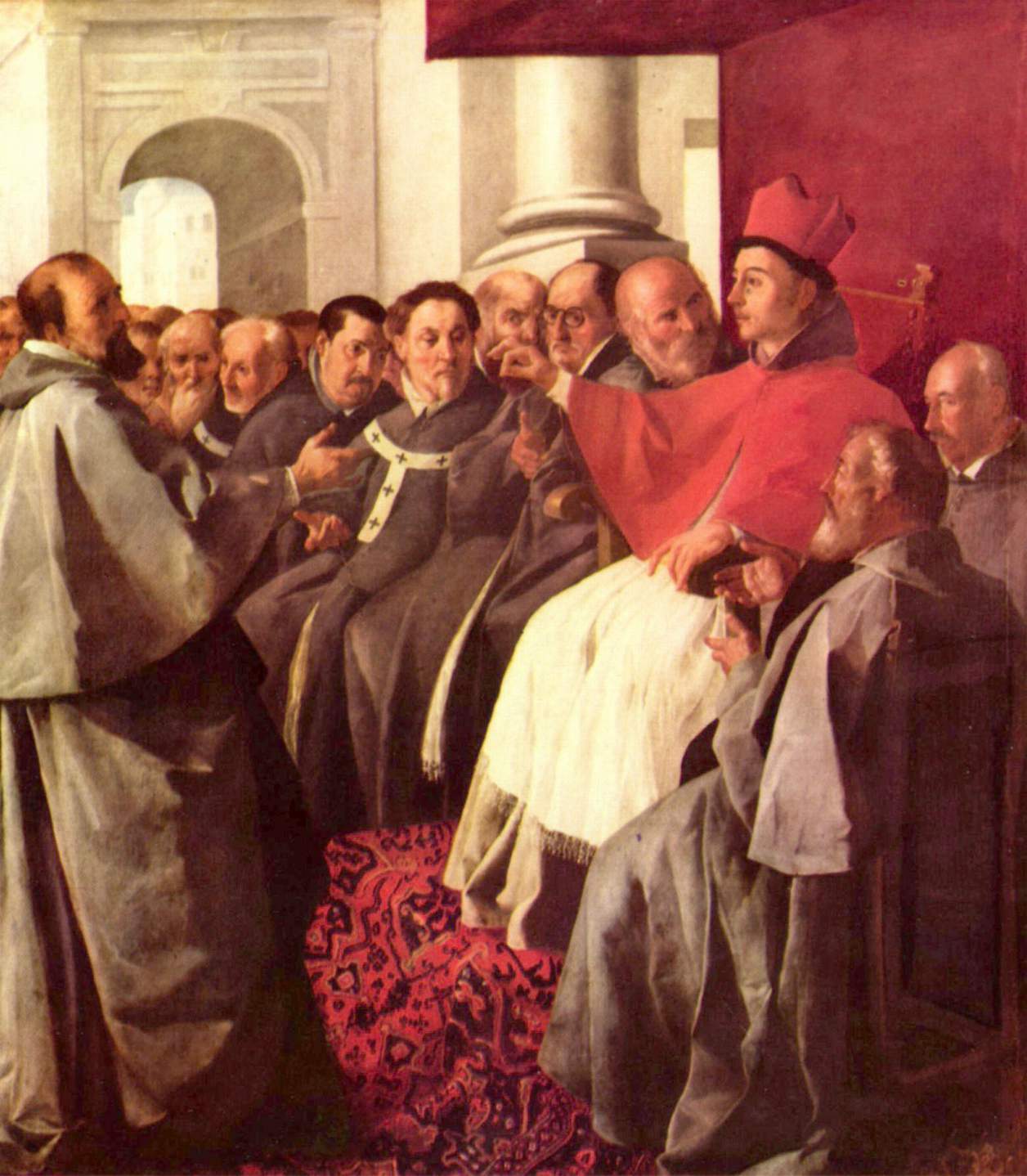
Francisco de Zurbaran’s “St Bonaventure at the Council of Lyons,” painted in 1637, transports the viewer into the charged atmosphere of a high medieval council chamber. Instead of saints in solitude or mystical visions in the clouds, Zurbaran presents an intellectual drama. A group of serious faced prelates and friars sit closely packed in a shallow space, their gazes converging on one central exchange. On the right, a cardinal in brilliant red robes leans forward, hand lifted in a firm gesture. Opposite him stands a Franciscan in a gray habit, often identified as St Bonaventure, who listens intently with hand raised in respectful response.
The canvas captures the momentary tension of a debate, the collision of ideas, and the balance of authority and humility. In this painting Zurbaran brings his mastery of light, texture, and psychological observation to bear on a complex historical subject. The result is both a vivid reconstruction of thirteenth century ecclesiastical politics and an embodiment of the Baroque fascination with eloquence and persuasion.
Historical Background The Council of Lyons and St Bonaventure
The Second Council of Lyons, held in 1274, was one of the great gatherings of medieval Christendom. Convened by Pope Gregory X, it aimed to address issues ranging from church reform and crusading plans to the hoped for reunion between the Latin and Greek churches. Among the prominent figures present was St Bonaventure, the Franciscan theologian and minister general of the order, celebrated for his learning and holiness.
Bonaventure’s participation in the council symbolized the importance of mendicant orders in the intellectual and spiritual life of the Church. As a cardinal and theologian, he embodied both scholarship and governance. Tradition remembers him as a voice of moderation and unity, someone who could bridge ideological divides.
By the time Zurbaran painted this scene in seventeenth century Spain, Bonaventure had long been venerated as a doctor of the Church. Spanish religious culture, shaped by the Counter Reformation, valued his combination of mystical spirituality and sharp intellect. Painting him at the Council of Lyons allowed Zurbaran to present a model of learned yet obedient leadership at a moment when the Catholic Church again relied on theologians to respond to controversy and defend doctrine.
Overall Composition and Spatial Organization
At first glance, the composition seems crowded. A long row of seated clerics extends from the foreground into the middle distance, their gray habits and white collars forming a solid band. On the right, the red robed cardinal provides a strong vertical anchor, while behind him a massive column and an expanse of red drapery mark the space of authority.
The viewpoint is slightly elevated and very close to the figures. This perspective pushes the clergy toward the viewer, creating a sense that we are sitting only a few steps away, overhearing the debate. The space is shallow, with the back wall and archway appearing close behind the seated group. The compressed setting conveys the intensity of the council and the closeness of minds engaged in discussion.
Zurbaran organizes the composition around several intersecting diagonals. One runs from the standing Franciscan on the left across the faces of the seated friars and up toward the cardinal’s head. Another descends from the red drapery down through the cardinal’s outstretched arm and into the gesturing hands in the center. These lines draw the eye repeatedly back to the central exchange between St Bonaventure and the cardinal, making it clear that this is the heart of the narrative.
The richly patterned carpet in the lower portion of the painting adds a horizontal plane that grounds the figures. Its intricate reds echo the cardinal’s vestments and contrast with the muted gray of the habits, visually separating the world of hierarchy and ceremony from the humble simplicity of the mendicant friars.
The Cardinal in Red Symbol of Authority
The most visually arresting figure is the cardinal, seated on the right, wearing a bright red mozzetta and matching cap. His robes spill over the edge of the chair and onto the carpet, occupying a large portion of the right side of the painting. This expansiveness signals his rank and power.
His posture combines ease and authority. He leans slightly forward, one hand extended as if making a precise argument or delivering a decision. The other hand holds a document, hinting at decrees and official texts. His expression is alert and serious, with eyes focused on Bonaventure. He listens, but his gesture suggests that he retains the final word.
The red drapery behind him frames his figure like a canopy, reinforcing his status as representative of the papal court. The column beside him adds architectural weight, evoking the solid foundations of the institutional Church. In this visual arrangement, the cardinal becomes the embodiment of ecclesiastical power and judicial judgment.
Yet Zurbaran does not portray him as harsh or tyrannical. The face, though firm, does not lack human warmth. His engagement with St Bonaventure appears genuine. This nuance is important, because the painting is not about conflict between good and evil, but about respectful negotiation within a shared faith.
St Bonaventure The Franciscan Voice
Opposite the cardinal stands the figure in gray Franciscan habit, identified as St Bonaventure. Unlike the blaze of red, his clothing is modest and nearly monochrome. Still, Zurbaran ensures that he stands out through posture and placement. He is one of the few standing figures, and his body creates a vertical line that balances the cardinal on the right.
Bonaventure’s head inclines slightly forward, and his right hand is raised in a thoughtful gesture. His mouth is parted as if mid speech. The gesture is not aggressive but earnest, suggesting that he speaks from conviction and experience rather than from a desire to dominate. His left hand, partially visible, helps direct the conversation toward the seated clergy, indicating that he addresses the council as a whole.
The Franciscan habit, painted with Zurbaran’s characteristic attention to folds and textures, expresses simplicity and poverty. It contrasts with the ornate red garments and the richly woven carpet, making Bonaventure a visual symbol of the Gospel values the Franciscans championed. Despite this outward humility, he stands with quiet confidence, secure in his theological reasoning and spiritual authority.
The Listening Clergy Portraits of Reaction
One of the most fascinating aspects of the painting is the row of seated clerics between the two main protagonists. Rather than painting a uniform crowd, Zurbaran gives each face distinct features and expressions. Some friars appear intent and serious, their brows furrowed as they follow the argument. Others seem skeptical or puzzled. A few glance sideways at one another as if silently commenting on what they hear.
This variety of reactions transforms the scene from a static assembly into a living debate. The council is not a mere formality. Minds are at work. Opinions differ. Decisions carry weight. The viewer senses that words spoken here will influence doctrine and policy.
The clerics’ habits are painted in cool grays and dark tones, with narrow white collars that catch the light. This subdued palette allows their faces to become focal points. The play of highlights and shadows across their heads and shoulders ties them together visually while still allowing space for individuality.
Through these portraits, Zurbaran demonstrates his keen observation of human character. He suggests that even in the most solemn settings, human responses range from enthusiasm to hesitation. The painting thus becomes a study of collective decision making, where consensus must be forged from many different temperaments.
Light, Color, and Texture
Zurbaran employs a carefully controlled light source that seems to come from the upper left, illuminating the faces and front surfaces of the figures while leaving the back of the hall in softer shadow. This lighting focuses attention on the debate and adds volume to the bodies and draperies.
Color plays a crucial role in structuring the composition. The dominant hues are the grays of the Franciscan habits, the warm flesh tones of the faces, and the intense red of the cardinal’s garments and the carpet. The red, used sparingly but boldly, signals authority and draws the eye to the right side of the canvas.
The carpet deserves particular notice. Its intricate pattern and vivid color demonstrate Zurbaran’s skill with texture. The decorative motifs are not merely ornamental. They provide a visual rhythm under the figures and enhance the sense of depth as the design recedes toward the back of the room. The contrast between the soft woolen folds of the habits and the rich weave of the carpet underscores differences in status and lifestyle within the same Church.
Architectural elements are painted in cooler, lighter tones. The archway at the back of the hall opens onto a bright exterior, suggesting the wider world beyond the council chamber. The stone column and wall are rendered with smooth surfaces that contrast with the complex textures of cloth and hair. These elements give the scene a solid frame and remind the viewer that the debate unfolds in a monumental, enduring institution.
Gesture and Narrative
Zurbaran’s narrative strategy relies heavily on gesture. The painting contains no overtly miraculous events or dramatic actions. Instead, the story emerges from the way figures position their bodies and hands.
The cardinal’s outstretched arm, angled toward Bonaventure, conveys both invitation and instruction. It is the gesture of someone who asserts a point or calls for clarification. Bonaventure’s raised hand answers this gesture, creating a dialogue across the space. The clerics in between function as an echo chamber, their subtle movements and glances reflecting the impact of the words being exchanged.
Even small details contribute to the sense of narrative. A friar in the middle turns his head slightly away, perhaps in disagreement or surprise. Another leans forward, eager to catch every word. An older cleric at the far right bends his head in a more contemplative pose, as if weighing the arguments internally.
By orchestrating these gestures with precision, Zurbaran transforms a council session into a visual drama about communication, persuasion, and communal discernment.
Theological and Political Meanings
Although the painting refers to a specific historical council, it also carries broader meanings relevant to Zurbaran’s own time. In seventeenth century Spain, the Church faced continuing challenges from Protestantism and internal reform movements. The example of St Bonaventure – a learned theologian loyal to papal authority yet rooted in a mendicant order – offered a model for how intellectual vigor and obedience could coexist.
The dialogue between the cardinal and the Franciscan can be read as a symbolic reconciliation between institutional hierarchy and the spirit of poverty. The cardinal’s posture acknowledges Bonaventure’s contributions, while the saint’s respectful stance recognizes the cardinal’s authority. Together they embody an ideal of harmony within the Church, necessary for confronting external threats and guiding the faithful.
The painting also illustrates the importance of councils and collective decision making in shaping doctrine. It suggests that truth in the Church is discerned through reasoned debate and listening, not imposed without discussion. This message would have resonated strongly in a culture that valued theological disputation and saw universities and religious orders as key guardians of orthodoxy.
Zurbaran’s Artistic Approach
“St Bonaventure at the Council of Lyons” shows Zurbaran working outside the more familiar realm of solitary saints and mystical visions. Yet many of his characteristic strengths remain evident. He brings the same careful attention to fabric, light, and physical presence that he uses in his monastic portraits and altarpieces.
What is particularly impressive here is his ability to manage a large group composition without losing clarity. Each figure is placed with purpose. The visual hierarchy is clear but not rigid. The viewer understands who holds authority, who speaks, and who listens, yet no one is reduced to a mere prop.
The painting also reveals Zurbaran’s interest in narrative realism. Although the setting is historical and idealized, the emotions and gestures feel grounded in real human experience. The painting could almost be a snapshot from an actual meeting, frozen at the moment when a crucial point is raised. This combination of historical grandeur and everyday humanity is one of the hallmarks of Baroque painting.
Emotional Tone and Viewer Experience
The emotional tone of the painting is serious and contemplative, yet it is not devoid of warmth. The close proximity of the figures and the careful rendering of their faces draw the viewer into the conversation. We sense the weight of the issues under discussion, but we also perceive camaraderie and shared purpose among the clergy.
For a viewer standing before this canvas, the eye naturally moves from Bonaventure to the cardinal and back again, then wanders along the row of listeners, reading their reactions. The scene encourages reflection on how we ourselves participate in discussions of faith or ethics, whether as speakers, listeners, or silent judges.
The painting’s measured mood contrasts with more overtly emotional religious scenes, such as martyrdoms or visions of heaven. Instead of ecstasy or horror, we encounter concentration and dialogue. Zurbaran invites us to consider the intellectual dimension of spiritual life, where ideas and arguments play a crucial role in guiding action.
Conclusion A Drama of Faith, Reason, and Authority
“St Bonaventure at the Council of Lyons” by Francisco de Zurbaran is a remarkable visual meditation on the interplay of spirituality, intellect, and ecclesiastical power. Through the tense yet respectful exchange between a Franciscan saint and a cardinal, the painting embodies the processes by which the Church seeks truth and unity.
The compressed composition, vivid contrast between gray habits and red robes, and expressive portraits of listening clerics draw the viewer into the heart of a historical moment that feels surprisingly contemporary. We witness the drama of persuasion, the challenge of integrating prophetic voices with institutional authority, and the ongoing task of discerning the right path for a community of faith.
Zurbaran’s mastery of light, texture, and gesture turns this council scene into more than a historical re enactment. It becomes a timeless reflection on how ideas are debated, how consensus is shaped, and how humility and authority can meet. As we look at St Bonaventure standing before the council, we see not only a saint of the past but a model of thoughtful, courageous engagement in the service of truth.