Image source: wikiart.org
Introducing Francisco de Zurbaran’s “St. Apollonia”
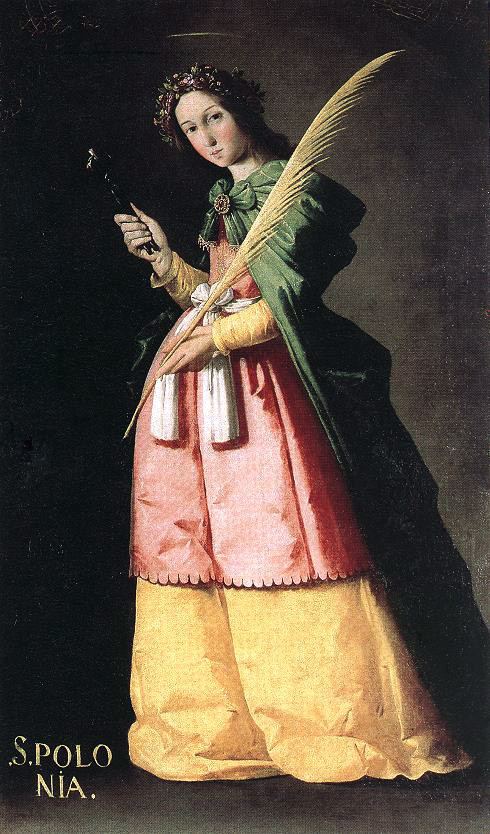
Francisco de Zurbaran’s painting “St. Apollonia,” created around 1636, presents a serene yet quietly dramatic image of one of early Christianity’s most distinctive martyrs. The saint stands alone against a dark, undefined background, her figure almost life size and positioned slightly off center. She gazes gently toward the viewer, holding the traditional attributes that immediately reveal her identity: a long palm frond in one hand, symbol of martyrdom, and a pair of metal pincers gripping a small tooth in the other.
At the lower left, the inscription “S. POLO NIA.” confirms her name. Zurbaran dresses Apollonia not in simple antiquated garments but in richly colored contemporary clothing, turning her into a dignified Spanish lady of the seventeenth century. Her dress is a harmonious combination of pink, yellow and green, crowned by a wreath of flowers in her hair. The soft fall of the fabric, the careful rendering of textures, and the saint’s calm, introspective expression give the painting an air of quiet nobility.
From the first glance, the work reflects the spiritual climate of Counter Reformation Spain. It offers a clear and emotionally accessible image of a saint whose story would have been familiar to Catholic viewers. Yet the painting is also a subtle study of femininity, inner strength and dignity in the face of suffering.
The Legend of St. Apollonia and Her Iconography
St. Apollonia was an early Christian martyr from Alexandria, traditionally believed to have been killed during persecutions in the third century. According to the account of St. Dionysius of Alexandria, she was seized by a mob, beaten, and had her teeth violently knocked out or extracted. Threatened with death by fire unless she blasphemed Christ, she instead leapt voluntarily into the flames.
This striking story quickly led to a very specific iconography. In Western art Apollonia is almost always shown with a pair of pincers holding a tooth, a visual shorthand for her torture and a symbol of her willingness to endure physical pain rather than abandon her faith. Over time she became the patron saint of dentistry and of those suffering with toothaches, a role that gave her a special place in everyday devotional life.
Zurbaran’s painting adheres to this iconographic tradition but transforms it through his distinctive style. The pincers are clearly visible in her left hand, yet they are small and understated, not grotesque. The tooth they hold is tiny, barely noticeable from a distance, suggesting that what matters is not the gruesome detail of her torture but the inner fortitude that allowed her to endure it. The martyr’s palm in her right hand balances the composition and proclaims her victory over death.
Composition and the Solitary Standing Saint
Like many of Zurbaran’s single saint portraits, “St. Apollonia” adopts a simple, frontal composition. The saint stands full length, facing slightly toward the viewer’s left. Her body forms a gentle S curve, with her head tilted in a modest, almost shy inclination. The overall pose is relaxed yet dignified, free of dramatic gestures.
The background is a deep, nearly featureless darkness. There is no landscape, architecture or narrative setting. This lack of context focuses all attention on Apollonia herself. She becomes a kind of sacred presence, almost like a statue temporarily animated by the painter’s light. The dark ground also makes her bright clothing and pale face stand out with particular clarity.
The inscription at the bottom left anchors the composition and provides a visual counterpoint to the diagonal line of the palm. Zurbaran visually balances the large lower area of yellow skirt with the more compact shapes of the upper torso and head. The triangular arrangement of skirt, cloak and palm frond creates stability and harmony.
By isolating Apollonia in this way, Zurbaran gives the viewer the sensation of encountering the saint directly, as if she were standing in a niche or chapel, ready to receive prayers. The painting functions less as a narrative illustration and more as a devotional portrait designed for contemplation.
Costume, Color and the Elegance of Sanctity
One of the most captivating aspects of “St. Apollonia” is the saint’s elaborate costume. Zurbaran was a master of painting textiles, and here he uses fabric and color not only to delight the eye but also to convey the saint’s spiritual nobility.
Apollonia wears a long yellow skirt that falls in soft, weighty folds to the floor. The color is warm and luminous, catching the light on its creases while sinking into deep gold shadows in the recesses. Over the skirt she wears a pink overdress with a scalloped hem, a tone that adds a gentle, feminine warmth. A white apron hangs from her waist, its simple vertical bands introducing a note of modesty and domestic association.
Over her shoulders rests a green cloak, fastened at the chest with a decorative clasp. The cloak drapes diagonally across her body, its darker tone framing the lighter pink and yellow beneath. Green, often associated with hope and renewal, here suggests the spiritual life that sustains Apollonia in suffering.
Around her neck and head, Zurbaran introduces touches of ornament that heighten her status. A wreath of flowers crowns her hair, introducing small bursts of red and white that echo the colors of her dress. The floral crown evokes virginity and spiritual springtime, suggesting that martyrdom is the blossoming of her faith rather than its destruction.
The overall color scheme pink, yellow, green and white is rich but harmonious. These hues, illuminated by a soft, directional light, create a sense of quiet splendor. Apollonia appears as a noblewoman of heaven, dressed not for worldly display but for the honor of her divine Bridegroom.
Light, Shadow and Zurbaran’s Spiritual Chiaroscuro
Although “St. Apollonia” is not as dramatically lit as some of Zurbaran’s more tenebrist works, light still plays a crucial role. A gentle, focused illumination falls from the left, modeling the saint’s face, hands and garments. The light picks out the texture of fabrics, the glint of the metal pincers and the subtle highlights on the palm leaves.
The right side of the figure falls into deeper shadow, particularly along the cloak and skirt. This gradation from light to dark gives Apollonia a strong sense of volume and presence. She stands not as a flat decorative pattern but as a three dimensional figure whose body occupies space.
The interplay of light and shadow also carries symbolic weight. Apollonia’s face is softly illuminated, emphasizing her inner purity and serenity. The dark background suggests the world of violence and persecution from which she has emerged, while the light that envelops her indicates the grace that has made her victorious.
Zurbaran’s use of restrained light as a metaphor for spiritual illumination is characteristic of Spanish Baroque painting. Here it underlines the idea that the saint’s beauty comes from within. Even the painful symbols of her martyrdom the pincers and tooth are touched by this light, transformed from instruments of cruelty into emblems of glory.
Expression and Psychological Depth
While the painting is outwardly simple, Apollonia’s expression repays close observation. Her head is slightly tilted, her eyes are directed toward the viewer yet seem to gaze inward at the same time. The corners of her mouth hint at a gentle, almost contemplative smile. There is no trace of fear, anger or physical pain. Instead she appears calm, self possessed and quietly confident.
This interior serenity is key to the painting’s impact. Zurbaran does not show Apollonia in the throes of martyrdom but after the event, transfigured by grace. The pincers in her hand refer to suffering now past, while her composed face and upright posture convey the peace that follows a faithful witness.
The slight tilt of her head also lends her a touch of youthful modesty. Although she is a heroic figure, she does not present herself as grand or imposing. The effect is to make her approachable. For seventeenth century viewers, especially women in convents who prayed before such images, Apollonia would have appeared as a spiritual sister and friend, not a distant, intimidating heroine.
The Attributes: Palm, Pincers and the Meaning of Martyrdom
The two objects Apollonia holds are essential to understanding her story and the painting’s symbolism. In her right hand she grasps the long palm frond, which extends almost the full height of the canvas. The palm is a traditional sign of martyrdom, derived from ancient imagery of victory. In Christian art, martyrs often carry palms as signs that they have triumphed over death through fidelity to Christ.
In her left hand, Apollonia delicately holds a pair of iron pincers. At the tips of the tongs gleams a tiny tooth, just visible against the dark background. This attribute points specifically to the manner of her torture. Yet there is nothing grotesque in the way Zurbaran presents it. The pincers are small, almost elegant, and the tooth is a tiny highlight rather than a gory detail.
The way Apollonia holds these objects is revealing. She does not brandish them in a theatrical gesture. Instead, her hands rest gently across her body, the palms held as if in a quiet offering. The palm and pincers become like relics she carries reverently, reminders of what she has offered to God.
These attributes transform the painting into a silent narrative. Without them, Apollonia might simply appear as a beautiful young noblewoman. With them, her identity as a martyr and intercessor becomes clear. The viewer is drawn to reflect on the paradox that instruments of violence become, in Christian understanding, symbols of victory and healing.
Zurbaran’s Series of Female Martyrs
“St. Apollonia” belongs to a larger group of paintings in which Zurbaran portrayed female martyrs such as St. Catherine, St. Agnes and St. Lucy. In each case he followed a similar format: a single figure standing against a dark background, richly dressed in contemporary Spanish clothing, holding the attributes of martyrdom.
This approach was well suited to the devotional needs of Spanish convents and churches, where such images would line the walls like a heavenly court of sisters and queens. The paintings functioned as models of virtue for nuns and laywomen, emphasizing not only chastity and obedience but also courage and readiness to suffer for the faith.
Apollonia fits perfectly into this gallery. Her clothing echoes that of other Zurbaran martyrs, yet each figure has distinctive colors and attributes. The repetition of format with variation of detail allowed viewers to recognize and differentiate the saints while perceiving them as part of a shared spiritual family.
Through this series, Zurbaran helped shape the visual imagination of early modern Catholicism, especially regarding the role of women in the story of salvation. His female martyrs are never passive victims. They are calm, dignified and resolute, their beauty intertwined with moral strength.
Spiritual Meaning and Devotional Function
Beyond its artistic qualities, “St. Apollonia” served a clear religious purpose. For believers suffering toothaches or dental problems, Apollonia was a powerful intercessor. They would pray before images like this asking for relief from physical pain, confident that the saint who once endured agony in her own mouth would understand and help.
At a deeper level, the painting invites reflection on how physical suffering can be united with spiritual meaning. Apollonia’s story shows that pain does not have the last word. By choosing fidelity to Christ over self preservation, she transformed torture into testimony. Zurbaran’s serene depiction of her after the fact emphasizes this transformation. The viewer is encouraged to see in her a model for facing trials with faith and hope.
The painting also speaks to themes of identity and vocation. Apollonia stands as an individual, holding the instruments that define her story, yet she is also part of a long tradition of witnesses. For those contemplating their own path in life, she represents the call to integrity, to hold fast to one’s beliefs even when they bring hardship.
Conclusion
Francisco de Zurbaran’s “St. Apollonia” is a masterful example of Spanish Baroque devotion. Through a simple yet eloquent composition, rich colors, and subtle handling of light and expression, the artist turns a relatively obscure early Christian martyr into a vivid spiritual presence.
The painting’s power lies in its balance. It combines realism with symbolism, contemporary fashion with timeless sanctity, physical beauty with the memory of pain. Apollonia’s calm gaze, the gentle fall of her garments, and the modest presentation of her martyr’s tools all contribute to an atmosphere of peaceful strength.
For viewers then and now, the work offers more than information about a saint. It creates a space for contemplation, inviting us to consider how courage, fidelity and inner grace can transform even the harshest experiences. In the quiet figure of St. Apollonia, Zurbaran presents a vision of holiness that is at once gentle and unshakable, rooted in everyday reality yet oriented toward eternal glory.