Image source: wikiart.org
Introduction to The Immaculate Conception by Francisco de Zurbaran
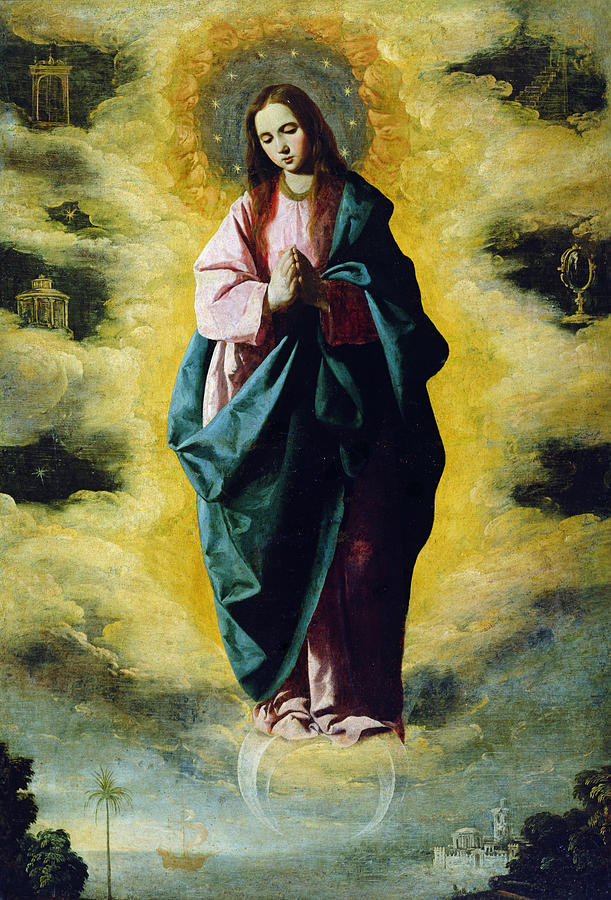
Francisco de Zurbaran’s “The Immaculate Conception,” painted around 1635, is a luminous vision of the Virgin Mary that captures one of the central devotions of seventeenth century Spain. The canvas presents Mary as a young girl suspended in mid air, hands joined in prayer, wrapped in a deep blue mantle and soft rose gown. She stands upon a glowing crescent moon, floating above a distant city and sea, while a halo of golden light and clouds surrounds her like an immense crown.
The subject represents the belief that Mary was preserved from original sin from the first moment of her existence. Long before this doctrine was formally defined, Spanish theologians, confraternities, and artists celebrated it with passionate conviction. Zurbaran’s painting belongs to this fervent culture. It is not simply an illustration of a theological point but a carefully crafted image of purity, protection, and heavenly beauty.
This version of “The Immaculate Conception” revisits ideas the artist had already explored, but it does so with new clarity and radiance. The work combines rich symbolism with a poetic atmosphere, offering viewers an image that is both doctrinal and deeply personal.
Historical and Spiritual Context
In the early seventeenth century, Spain considered itself the special champion of the Immaculate Conception. Cities, universities, and religious orders took official vows to defend the belief. Public processions, sermons, and debates made the doctrine part of everyday religious life. Painters were asked again and again to give visual form to this mystery, creating a shared iconography that faithful viewers could instantly recognize.
Zurbaran worked in Seville, a city renowned for its devotion to the Virgin. Here confraternities and convents commissioned altarpieces and private devotional works devoted to Mary under many titles. Among these titles, the Immaculate Conception had a unique place, since it spoke not of a moment in Mary’s adult life but of the very beginning of her existence.
By portraying Mary as a young girl, untouched by sin and filled with grace, artists like Zurbaran invited viewers to consider the absolute freshness and loveliness of a soul fully united with God. In this painting, the Virgin appears as a quiet, prayerful presence, embodying the ideal of innocence that Spanish believers cherished.
Composition and Spatial Structure
The composition is vertically oriented, emphasizing Mary’s rise above the earth. She stands slightly off center, but her long mantle and gently curving figure form the clear axis of the painting. Her feet rest upon a transparent crescent moon, which glows softly against the darker atmosphere of the lower register. Beneath the moon stretches a low horizon with a harbor, a ship, palm trees, and a compact city that likely represents Seville.
Above this earthly scene opens a vast expanse of cloud and light. A halo of golden radiance surrounds Mary, blending into a ring of pinkish clouds filled with tiny stars. This ring functions as both a crown and a doorway into the heavenly realm. Beyond it, the sky deepens into cooler blues and grays, creating a sense of depth and distance.
Around the clouds appear small symbolic objects: a mirror, a gate or tower, a star, and other emblematic shapes. These discrete motifs float in the atmosphere like medallions, transforming the sky into a tapestry of Marian titles. Despite the number of elements, the overall composition feels balanced and calm. All lines and shapes ultimately lead the eye back to the central figure of Mary.
The Figure of the Virgin Mary
Zurbaran portrays Mary as a very young woman, almost adolescent. Her features are delicate and gentle, with a smooth oval face, refined nose, and closed lips. Her eyes are lowered, not in timidity but in contemplative prayer. The tilt of her head, slightly to one side, expresses modesty and inner focus. She is aware of her exalted role yet chooses the posture of humility.
Her hands are joined at her chest, fingers interlaced in a traditional gesture of piety. This simple pose contrasts with the elaborate symbolism around her. It suggests that the core of her identity lies not in external splendor but in interior relationship with God. The calm expression on her face reinforces this. There is no ecstasy or outward drama, only quiet attention and receptivity.
Mary’s clothing follows the familiar palette of Marian imagery. She wears a rose colored gown that speaks of love and tenderness, and over it a deep blue cloak that signifies heavenly grace and queenly dignity. The cloak gathers around her body in broad folds that fall straight down, emphasizing the verticality of the figure. At the bottom, the fabric swells slightly, echoing the curve of the crescent moon and helping to visually anchor her in the air.
Light, Color, and Atmosphere
Light is one of the most striking aspects of this painting. The entire scene appears suffused with a warm golden glow that seems to emanate from Mary herself. The ring of radiance surrounding her is brightest near her figure and gradually softens as it extends into the clouds. This creates a gentle halo effect that highlights her centrality.
The colors are harmonious and carefully chosen. The rose of Mary’s gown is soft and slightly muted, preventing it from competing with the brilliance of the light. The blue cloak is rich and cool, balancing the warmth of the surrounding glow. Together, these two colors form a chord that is instantly recognizable as Marian.
The clouds are painted in a range of creams, yellows, and grays, with subtle shifts that suggest movement and depth. Some areas are darker, especially near the edges and lower region, while others catch the golden light. This variation keeps the background from feeling monotonous and gives it a living, breathing quality.
The lower section, with its sea and city, uses cooler tones: pale blues, soft greens, and grayed whites. These colors recede in space, making the luminous figure above them appear even more prominent. The overall atmosphere is serene and slightly dreamlike, as if the viewer has entered a vision rather than a physical scene.
Marian Symbols and Theological Meaning
Scattered among the clouds are several symbolic objects that deepen the painting’s theological content. On one side appears a mirror, often interpreted as the “mirror without stain,” a title taken from the Litany of Loreto. This symbolizes Mary as the pure reflection of divine perfection, free of any blemish. The fact that the mirror floats in the sky rather than standing on earth reinforces its mystical nature.
Elsewhere we see architectural forms resembling a tower or gate. These recall titles such as “Tower of David” and “Gate of Heaven,” reminding viewers that Mary is both strong defense and entrance into divine life. A star, shining among the clouds, evokes the title “Star of the Sea,” guiding souls through the storms of this world.
Each of these symbols would have been familiar to seventeenth century viewers from prayers and sermons. By visualizing them around Mary, Zurbaran turns the surrounding sky into a cloud of praise. The symbols function almost like verses in a silent hymn, each one naming a facet of her role in salvation history.
The crescent moon beneath Mary’s feet has particular importance. Drawn from the Book of Revelation’s description of a woman clothed with the sun, with the moon under her feet, it marks her victory over changeability and darkness. In this painting the moon is pale and translucent, shaped like a delicate cradle that supports but does not encumber her. It suggests that she rides above night and instability, firmly grounded in God’s light.
The City and Sea Below
At the bottom of the composition Zurbaran paints a small but vivid view of a coastal city. A ship with billowing sails glides across the water, while palm trees and vegetation frame the scene. On the right, a fortified cluster of buildings rises near the shoreline, including what appears to be a tower or church. Many historians identify this city as Seville, the artist’s own home and one of the main centers of Marian devotion in Spain.
If the city does represent Seville, then Mary’s position above it takes on special resonance. She appears as the heavenly patroness watching over the harbor, blessing the ships that depart to distant lands and the people who live within its walls. The palm tree and ship also have symbolic meaning. The palm hints at victory and eternal life, while the ship has long been a metaphor for the Church navigating through the seas of history.
This combination of local geography and universal symbol allows the painting to speak both to a specific community and to the broader Christian world. Viewers in Seville could see their city literally under Mary’s feet, while viewers elsewhere could interpret the scene as representing any Christian community sheltered by her intercession.
Emotional Tone and Devotional Function
The emotional tone of “The Immaculate Conception” is one of gentle joy and quiet trust. There is none of the intense drama or pathos that we find in Zurbaran’s depictions of martyrs. Instead, the painting invites a more meditative response. The softness of Mary’s features, the smooth flow of her garments, and the warm enveloping light create a sense of calm.
For seventeenth century believers, this image would have functioned as a focus for prayer. Standing before it in a church or private chapel, a viewer could recite the Ave Maria or the Litany of Loreto, mentally linking each line of prayer to the symbols in the clouds. Mary’s downward gaze and joined hands encourage viewers to imitate her prayerfulness. She becomes not only an object of devotion but also a model of how to stand before God.
The painting also addresses fears and uncertainties. The distant sea suggests travel, commerce, and risk. The city hints at political change and human fragility. Above these realities, Mary remains serene and luminous. The message is clear: in the midst of earthly instability, there is a pure and stable source of protection. This reassurance would have been especially meaningful in a time marked by plagues, wars, and economic challenges.
Zurbaran’s Style in The Immaculate Conception
Zurbaran is often associated with austere images of monks and martyrs set against dark backgrounds. In this painting he adopts a lighter, more radiant palette, yet his characteristic clarity remains. The forms are sharply defined, and there is no unnecessary ornament. Even the clouds, though full of movement, are described with disciplined brushwork.
The figure of Mary has a sculptural presence, as if she were a carved statue suddenly animated by light. This sculptural quality reflects the influence of Spanish polychrome sculpture, which often provided models for painters. At the same time, the delicate shading of her face and the subtle transitions in her garments reveal Zurbaran’s sensitivity to flesh and fabric.
His handling of light is particularly sophisticated. Instead of a single strong spotlight, he allows the glow to spread gradually, creating a gentle transition from brilliance near Mary to shadow near the edges. This effect lends the painting a sense of tranquility, even while it maintains the visual focus on the central figure.
Legacy and Contemporary Appreciation
Today, “The Immaculate Conception” stands as one of the most beautiful examples of Spanish Marian painting. It helps viewers understand how theology, local devotion, and artistic skill combined in the Baroque period to create images that are both intellectually rich and emotionally accessible.
Modern audiences may no longer be fully immersed in the doctrinal debates of the seventeenth century, yet the painting continues to communicate. Many viewers are drawn first to the serene face of the Virgin and the striking contrast between her luminous form and the soft, swirling clouds. As they look more closely, they begin to notice the mirror, the tower, the star, and the distant ship, discovering layers of meaning that invite slower contemplation.
For art lovers, the work is an opportunity to appreciate Zurbaran’s range. It shows that the painter capable of intense, shadow filled scenes could also handle airy, celestial compositions with equal conviction. For those interested in spirituality, the canvas offers a visual meditation on innocence, guidance, and maternal care.
Conclusion A Luminous Image of Purity and Protection
Francisco de Zurbaran’s “The Immaculate Conception” from around 1635 is a glowing statement of faith translated into paint. By presenting Mary as a youthful figure in prayer, suspended above a city and sea, he unites heaven and earth in a single vertical vision. The crescent moon, the halo of clouds and stars, and the floating symbols drawn from Marian litanies all work together to proclaim her special place in salvation history.
Yet the painting is more than doctrinal illustration. Through tender expression, harmonious color, and masterful use of light, Zurbaran creates an image that feels intimate and accessible. Mary appears not as a distant queen but as a gentle intercessor, looking down in quiet concern. Her presence offers comfort to viewers past and present, suggesting that in the midst of storms and uncertainties there is a pure and steadfast source of help.
In this canvas, as in much of his work, Zurbaran shows how art can open a window onto the invisible, inviting contemplation and trust. “The Immaculate Conception” remains a testament to the enduring power of Marian imagery and to the artist’s ability to give form to one of the most cherished mysteries of Spanish devotion.