Image source: wikiart.org
A Nocturnal Vision Filled With Light
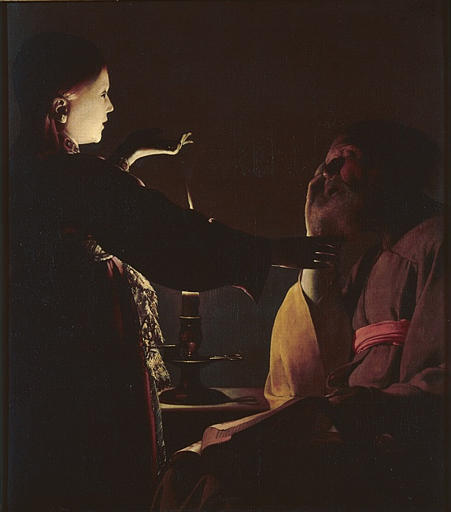
Francisco de Zurbaran’s “The Dream of Saint Joseph,” painted around 1635, is a quiet yet electrifying scene of revelation. The painting shows an elderly, bearded Joseph seated in deep shadow, his eyes half closed as he leans back in sleep or drowsy prayer. Beside him stands a radiant child, glowing with unearthly light, who gently touches Joseph’s face while pointing upward with the other hand. Between them, a single candle burns on a small table, its flame echoing the supernatural brightness that pours from the child’s face and hands.
The entire composition is cloaked in darkness except for the areas touched by this mysterious light. The result is a work of intense intimacy. We feel as if we have stepped quietly into a private chamber at night and caught the exact moment when heaven interrupts an old man’s rest with a message that will change the course of salvation history.
Biblical Background of Saint Joseph’s Dreams
In the Gospel of Matthew, Joseph the carpenter receives a series of visions in his dreams. In the first, an angel appears and tells him not to fear taking Mary as his wife, since the child she bears is conceived by the Holy Spirit. In a later dream, an angel warns him to flee to Egypt with Mary and the Christ child to escape Herod’s massacre. Another dream signals when it is safe to return.
Zurbaran’s painting does not pinpoint exactly which dream he represents. Instead, he condenses the theme of angelic visitation into a single, timeless episode. Joseph appears already older and weary, suggesting a life of hard work and responsibility. The childlike messenger leans in with an attitude of kindness and urgency. Whether this is the first reassurance about Mary, the warning to flee, or an imagined moment of nightly consolation, the painting captures the spiritual heart of all Joseph’s dreams: God’s guidance arriving in the silence of night, light breaking through uncertainty.
Spanish Counter Reformation spirituality had a deep devotion to Saint Joseph as model of obedience, chastity and paternal care. Paintings like this one encouraged believers to see Joseph not as a silent extra in the Nativity story but as a man of prayer who receives and obeys God’s word.
Composition and the Close Chamber Setting
Zurbaran chooses a tightly framed composition that focuses on the relationship between Joseph and the child. There is no landscape, no elaborate architectural background. We are in a simple interior, probably Joseph’s workshop or a humble room. The table supporting the candle is low and plain. A large book rests open on Joseph’s lap, suggesting Scripture or devotional reading that has lulled him into sleep.
The figures are placed close to the picture plane. Joseph sits toward the right side of the canvas, his body turned slightly toward the child. The child occupies the left, standing in profile but with the head turned toward Joseph. This arrangement creates a gently curving line that guides the viewer’s eye from the child’s illuminated face, down the extended arm to Joseph’s bearded head, then back along the horizontal line of the table and book.
The strong vertical of the candle and its stand anchors the center of the painting, almost like a small column between human and heavenly realms. It also forms a visual hinge between the earthly and supernatural light sources. The small flame is real fire, yet its glow is weak compared to the brilliant whiteness that envelops the child’s features. Zurbaran invites us to compare them and realize that God’s presence is brighter than any candle.
The surrounding darkness deepens the sense of enclosure. Walls and ceiling vanish into blackness, making the room feel both small and boundless, a symbolic space where the ordinary constraints of time and place melt away.
Tenebrism and the Power of a Single Light Source
“The Dream of Saint Joseph” is one of Zurbaran’s finest explorations of tenebrism, the dramatic use of strong contrast between light and dark. A single candle flame is the only visible light source, yet the painting shows two different kinds of illumination. The flame casts a warm, reddish glow on the child’s sleeve, the brass candlestick and the nearby surfaces. At the same time, a cooler, more intense light seems to emanate from the child’s face and hands, making them almost phosphorescent.
Joseph’s head and beard catch some of this halo, while the rest of his body recedes into shadow. His tunic and cloak are painted in muted tones that absorb light rather than reflect it. This allows the viewer to focus on his expression and on the gesture of the child.
The careful modeling of faces and hands with sharp highlights and deep shadows gives the figures a sculptural solidity. It also heightens the sense of mystery. The darkness suggests the unknown and the subconscious, appropriate for a nighttime dream. The sudden beam that falls across Joseph’s face evokes the moment when understanding dawns, when fear or confusion yields to trust.
This interplay of darkness and light is more than a technical tour de force. It is a visual theology of revelation. God speaks in the dark silence of human limitation, and his word arrives as light that does not destroy shadow but transforms it.
The Child Messenger and Questions of Identity
Art historians have long debated whether the luminous child in the painting is meant to be an angel or the Christ Child himself. Zurbaran leaves the figure slightly ambiguous. The child has no obvious wings, unlike traditional angels, but the eerie glow and the serious, knowing expression suggest a heavenly nature.
If the figure is an angel, then the painting adheres closely to Matthew’s text: God sends an angel to Joseph in his dreams. The tenderness of the interaction, though, invites a second reading. The child could be the young Jesus appearing to his earthly guardian, a vision that confirms the deep bond between them. In this interpretation, Joseph’s dream is not only a message but a personal encounter with the mystery he has been entrusted to protect.
Zurbaran paints the child with a delicate face, smooth skin and neatly arranged hair. The features are not sentimental. The child looks calm, serious and focused. The hand that touches Joseph’s cheek is gentle but firm, as if waking a beloved parent while at the same time blessing him. The other hand points toward an unseen realm, reminding Joseph that the message comes from above.
Whether angel or Christ, the child represents divine communication in a form that is approachable and intimate. Instead of a distant, terrifying vision, Joseph receives a visitor who stands at eye level, luminous but not overwhelming, speaking the language of touch and quiet gesture.
Saint Joseph as Old, Tired and Reverent
In the lower right corner, Joseph’s figure embodies human weakness illuminated by grace. Zurbaran portrays him as a robust but aging man with a long gray beard, lined forehead and heavy eyelids. His posture suggests the moment when sleep is giving way to sudden wakefulness. The head tilts back, the mouth slightly opens, and the muscles around the eyes tense as the bright light interrupts his rest.
Joseph’s clothing is simple, reflecting his identity as a working carpenter. A coarse tunic, a cloak thrown over his shoulder and a red sash subtly echo the daily reality of physical labor. The book on his lap hints at his spiritual life. Even after a day of work, he reads or prays, and it is in this attitude of quiet devotion that the divine message finds him.
Zurbaran avoids any exaggerated dramatic gesture. Joseph does not leap up or throw his arms wide. Instead he sits still, receptive. His hands are relaxed, one loosely resting on the open page, the other perhaps beginning to rise toward the child. This restraint underscores Joseph’s character: a man of silent obedience who listens more than he speaks.
By choosing this humble, unheroic moment, Zurbaran reminds viewers that sanctity can look like ordinary fatigue. God speaks in the everyday, even when we are too tired to expect anything extraordinary.
Symbolic Objects: Candle, Book and Colors
Although the setting is sparse, the few objects and colors that Zurbaran includes carry symbolic weight.
The candle at the center is the most obvious symbol. In Christian tradition, the candle represents Christ as Light of the World. Here it also stands for the flickering, limited light of human understanding. The child’s more intense glow surpasses the candle, but both lights work together to reveal Joseph’s face and the open book.
The book itself suggests Scripture, the law and the prophets that Joseph as a faithful Israelite would know. It may also represent the unfolding plan of God. Joseph reads the word written in ink, then in his dream receives the living Word in the form of the message-bearing child. The open pages catch just enough light to be visible, but their text is unreadable to us, highlighting the mystery that Joseph alone is currently invited to understand.
Color symbolism reinforces the emotional and spiritual tone. The child’s garments, though mostly lost in shadow, contain touches of warm red or pink and deep blue, colors traditionally associated with Christ and Mary. Joseph’s earthy browns and muted yellows underline his humanity. The red sash around his waist can symbolize love and sacrifice, hinting at his willingness to protect the holy family even at great cost.
Together these details create a subtle network of meanings that reward slow looking.
Zurbaran’s Dialogue With Caravaggio and Other Night Scenes
Zurbaran was deeply influenced by the naturalism and dramatic lighting of Caravaggio and his followers. “The Dream of Saint Joseph” clearly belongs to this tradition of nocturnal scenes where a candle or hidden lamp provides intense illumination. Yet Zurbaran adapts this language to his own quiet temperament.
Where Caravaggio often focused on moments of violent action or emotional shock, Zurbaran gravitates toward contemplative states. His figures appear self contained, their gestures pared down to essentials. In this painting, there is no chaotic activity, only two figures and a candle, rendered with almost mathematical clarity.
The effect is very different from theatrical Baroque works filled with swirling drapery and complex architectural settings. Zurbaran compresses everything into a small, focused drama that feels more like a scene from everyday life than a grand spectacle. This restraint increases the painting’s spiritual intensity. The viewer is not distracted by decorative elements and can instead meditate on the exchange of gaze and touch between Joseph and the child.
The painting also stands in conversation with other depictions of Joseph’s dreams, such as those by Georges de La Tour or Guido Reni. Comparisons highlight Zurbaran’s choice to emphasize the child’s light rather than the candle alone, and to place Joseph in such close proximity to his visitor that it almost feels like a domestic scene between father and son.
Emotional Atmosphere and Inner Spiritual Experience
Although the painting is small in scale and limited in setting, its emotional depth is considerable. The darkness, the seated posture of Joseph, and the silence implied by the scene create a mood of introspection. When we look at the painting, we instinctively lower our own voice, as if not to disturb the conversation.
The child’s gesture of touching Joseph’s face is profoundly tender. It recalls how a child might lovingly wake a parent, yet here the roles are reversed: the parent is the one being cared for. The image thus communicates something essential about Christian spirituality, where God stoops down to comfort and guide even those who are supposed to be protectors.
At the same time, there is an undercurrent of tension. Joseph’s eyes strain toward the light. The dark space behind him hints at uncertainty, danger and the unknown future. Yet the light on his face and the calm presence of the child reassure us that he is not alone in facing those challenges.
Zurbaran’s painting therefore becomes a visual meditation on trust. Joseph does not know what the future holds, but he knows who is calling him. That knowledge is enough to move him from fear to obedience.
Place in Zurbaran’s Oeuvre and Spanish Devotional Culture
“The Dream of Saint Joseph” fits perfectly within Zurbaran’s broader production, which is filled with saints experiencing visions, monks in contemplation and biblical scenes treated with austere realism. At the same time, it stands out because of its unusual intimacy and domestic scale.
Spanish Catholicism in the seventeenth century placed strong emphasis on personal devotion in the home, not only in churches and monasteries. Paintings of Saint Joseph, the Holy Family and nocturnal Nativity scenes were popular choices for private chapels and family oratories. A work like this could easily have hung in a small room where a devout viewer might meditate on Joseph’s humility while saying night prayers.
Zurbaran’s Joseph also contributed to the growing cult of the saint as patron of good death and protector of families. His peaceful though startled expression, caught between sleep and wakefulness, could remind believers to entrust their own final hours to Joseph’s care.
Contemporary Resonance and Lasting Appeal
For modern viewers, “The Dream of Saint Joseph” continues to captivate through its mysterious lighting and psychological subtlety. Even without explicit religious belief, one can recognize in Joseph’s experience the universal moment of being awakened to a new insight or called to a difficult task. The painting speaks about guidance that comes quietly, about the importance of listening to inner promptings in the stillness of night.
The image also resonates with contemporary interest in mindfulness and interiority. It invites viewers to step away from noise and distraction, to imagine themselves in Joseph’s place, visited by a message that can only be heard in silence.
Artistically, the painting remains a masterclass in how to create drama with minimal means. Two figures, a book and a candle become enough to construct a whole world of meaning. The restrained palette and the skillful use of chiaroscuro make it a favorite among admirers of Baroque light effects.
Conclusion
Francisco de Zurbaran’s “The Dream of Saint Joseph” is far more than a simple religious picture. It is a concentrated exploration of how divine guidance enters human life, using the language of light, gesture and intimate domestic space. Through tenebrist contrast, a tightly focused composition and subtly expressive figures, Zurbaran allows viewers to witness the exact instant when an ordinary, weary man becomes the guardian of extraordinary mystery.
The glow on the child’s face, the candle’s small flame and the old carpenter’s awakening gaze form a visual triangle that continues to draw our attention centuries later. In this quiet nocturne, Zurbaran teaches that revelation often comes not in thunder and spectacle but in the tender touch of a child, in the barely audible voice that speaks in our dreams and in our hearts.