Image source: wikiart.org
Introduction to The Death of Hercules by Francisco de Zurbaran
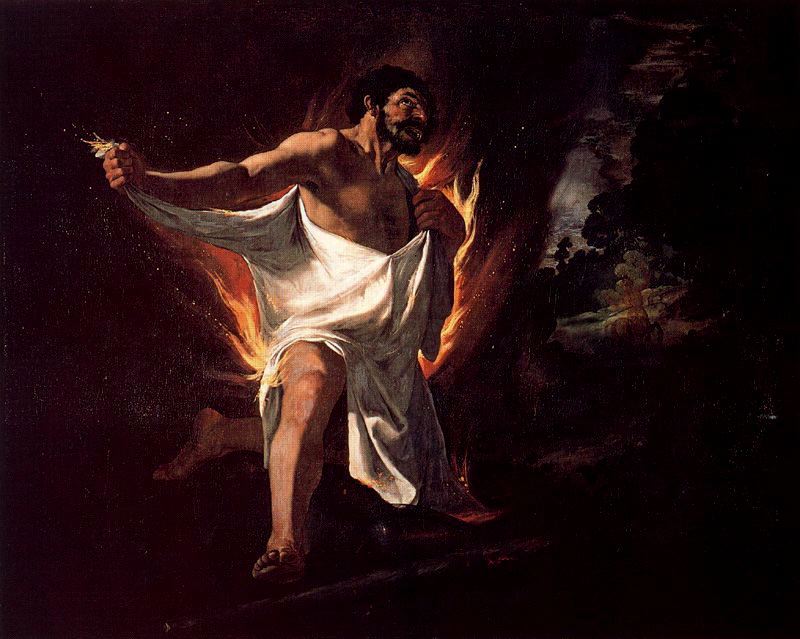
Francisco de Zurbaran’s “The Death of Hercules,” painted in 1634, is one of the most dramatic scenes in the artist’s celebrated cycle of the Labors and fate of the Greek hero. Here the story has moved beyond triumph and conquest. We no longer see Hercules as the confident slayer of monsters or conqueror of beasts. Instead, Zurbaran captures the moment when the hero’s own body betrays him, consumed by the poison of the tunic sent by his wife Deianeira and soaked with the blood of the centaur Nessus.
In a dark landscape lit almost entirely by the flames that engulf his body, Hercules strides forward, his powerful torso twisting as he attempts to tear away the deadly garment. The white cloth clings to his figure as if fused with his skin. His face is a mask of anguish and defiant will. The scene condenses an entire tragic narrative into one intense instant, where physical torment, moral consequence, and heroic dignity collide.
“The Death of Hercules” reveals how Zurbaran could bring the full language of Spanish Baroque spirituality to a pagan subject. Suffering, sacrifice, and the search for transcendence are central themes here, just as in his paintings of Christian martyrs. Through his treatment of light, anatomy, and gesture, he turns a mythological catastrophe into a meditation on the limits of strength and the cost of flawed choices.
Mythological Background and Narrative Context
The legend behind this painting is rooted in the later years of Hercules. After completing his Labors, the hero marries Deianeira. While traveling with her, he encounters the centaur Nessus, who offers to carry Deianeira across a river but then attempts to abduct her. Hercules shoots Nessus with a poisoned arrow tipped with the venom of the Hydra. As he dies, the centaur tells Deianeira that his blood will ensure Hercules’ fidelity if used as a love charm. Deianeira, unaware that the blood is contaminated, later soaks a tunic in it and sends it to Hercules.
When Hercules puts on the tunic, the poison sears his flesh. It cannot be removed, and the pain is unbearable. In some versions, he throws himself onto a funeral pyre on Mount Oeta to end his torment. Zeus then grants him immortality, raising him to Olympus. Zurbaran chooses the moment when the poison begins to burn and Hercules struggles in agony, a scene that precedes his final apotheosis.
For a seventeenth century audience, this story carried a strong moral charge. Hercules falls not in battle but through deception, misjudgment, and the dark side of passion. The tragedy underlines the fragility of even the greatest hero. In a royal palace, such an image might serve as a warning that no amount of earthly power can protect against the consequences of error and betrayal.
Composition and Movement
Zurbaran’s composition is dominated by the dynamic figure of Hercules, placed slightly left of center and moving diagonally forward. His body forms a sweeping arc, starting from the extended foot at the lower left, rising through the bent knee and muscular torso, and culminating in the outstretched arm that tears at the burning cloth. This arc drives the entire composition, giving it a sense of explosive motion.
The surrounding space is largely engulfed in darkness. To the right, a patch of landscape with trees and distant light suggests the world beyond Hercules’ immediate suffering. But most of the canvas is a void, broken only by the orange and yellow flames that flare around the hero’s back and shoulders. The fire acts as both visual focus and narrative engine. It explains his contorted posture and illuminates the figure like a torch in a night scene.
The diagonal movement across the picture plane conveys urgency. Hercules is not calmly accepting fate. He strides forward as if trying to escape an invisible trap, though the flames cling to him. The viewer feels the tension between his forward thrust and the immobility of his doom. This struggle against inevitability is a key emotional element in the painting.
The Heroic Body in Agony
Zurbaran presents Hercules as a muscular adult at the height of his physical powers. His torso is broad, his abdomen defined, his arms thick with strength. The hero’s left shoulder and arm are particularly prominent as they pull back the edge of the tunic, revealing straining muscles. Even in torment, the body looks capable and powerful.
This emphasis on physical strength makes the suffering more poignant. Hercules represents the ideal human body, yet that body is now the site of unbearable pain. The contrast between heroic anatomy and desperate posture reminds viewers that no level of physical perfection can secure invulnerability.
The hero’s face intensifies this sense of tragic conflict. Light falls across his beard and cheekbones, picking out his grim expression. His brows are knitted, eyes turned upward with a mixture of rage and appeal. The mouth is slightly open, as if in a cry or gasp. Unlike the serene martyrs of some religious paintings, Hercules is not at peace. He fights against his pain, reflecting the human instinct to resist suffering even when it is inescapable.
The Burning Tunic and Symbolism of the Cloth
The white tunic in this painting is not just a piece of clothing. It is the central symbol of Hercules’ downfall. Zurbaran paints it as if it is both garment and shroud, swirling around the hero’s body yet clearly attached to his flesh. The folds are wide and energetic, suggesting his frantic attempts to rip it away. At the same time, its whiteness makes it stand out starkly against the dark background and the fiery halo.
The cloth has a double symbolism. On one level it represents deception and misplaced trust, since Hercules’ wife believed she was securing his love. On another, it is a visual echo of the sacrificial garments worn by martyrs and penitents. Wrapped in a deadly tunic, Hercules becomes a kind of involuntary sacrifice, his body consumed as if offered up to the gods.
For a Christian viewer, the burning tunic might recall the idea of purifying fire, or the way in which sin clings to the soul until burned away. Although the myth is pagan, Zurbaran’s treatment invites parallels with spiritual themes of purification, punishment, and eventual transformation.
Fire and Light as Dramatic Forces
Fire is the most obvious and dramatic element in the painting. Zurbaran’s flames are not decorative. They lick around Hercules’ back and shoulders, radiating outward in a sharp halo that cuts into the darkness. The colors range from deep orange near the body to lighter yellow at the tips, with touches of white that indicate intense heat.
This fire serves several functions. It is the literal manifestation of the poison burning Hercules’ flesh, turning invisible venom into visible torment. It is also the main source of illumination, casting warm highlights onto his skin and the folds of the tunic. The flames create a strong contrast between hot light and cold shadow, a hallmark of Baroque aesthetics that amplifies emotional impact.
Symbolically, the fire can be read as the consuming power of passion and fate. The same strength that made Hercules a hero now feeds the flames that destroy him. The fire is both external and internal, both physical and metaphorical. In visual terms, it creates a sense that the hero is not just in front of the fire but wrapped within it, as if his entire being is undergoing a violent transformation.
The Dark Landscape and Spiritual Isolation
While most of the canvas is dominated by Hercules and the flames, the right side opens onto a distant landscape. Faint trees, rocks, and a patch of sky appear in cooler, more subdued colors. This quiet, almost idyllic corner contrasts sharply with the drama of the foreground.
The distance between the fiery hero and the peaceful landscape emphasizes his isolation. Hercules is alone in his suffering, separated from the calm world of nature and humanity. The small scale of the distant trees and hills makes his figure appear even larger and more monumental, as if he is a tragic titan whose agony the world barely notices.
The darkness that surrounds him also has a spiritual dimension. It suggests a moral and emotional void, the solitude that comes when a hero reaches the end of his strength and must confront his fate without allies. The light of the fire illuminates only his immediate surroundings, leaving the rest of the world in shadow. This limited illumination reflects his narrowed experience, confined to pain and struggle.
Zurbaran’s Hercules Cycle and Royal Patronage
“The Death of Hercules” was part of a series commissioned for the Palacio del Buen Retiro in Madrid, a royal residence associated with Philip IV. The cycle portrayed various Labors and episodes from the hero’s life, aligning Hercules with the ideals of monarchy – courage, perseverance, and the defense of order.
In this context, the death scene acquires a particular significance. It shows that even the greatest hero meets an end, yet that end can lead to transformation and glory. According to myth, Hercules’ mortal body dies, but his divine aspect ascends to Olympus. The king who viewed this cycle might see in it an image of the burdens and eventual fate of rulers, who must struggle, suffer, and finally relinquish earthly power.
Zurbaran, known for his religious works, applies his experience with martyrdom and sainthood to this classical subject. The hero’s pose, the stark light, and the intense focus on the moment of suffering echo his treatment of Christian themes, suggesting that the virtues exemplified by Hercules – resilience, acceptance of suffering, and eventual transcendence – are of universal value, not limited to one belief system.
Emotional Tone and Psychological Complexity
The emotional tone of “The Death of Hercules” is rich and layered. On the surface, the viewer perceives intense physical pain, expressed through the twisting body and grimacing face. But beneath this physical anguish lies a deeper psychological drama.
Hercules is not only in pain; he is confronting the knowledge that his strength cannot save him. For a hero whose identity is built on physical power, this realization is devastating. There is anger in his posture, a sense of rebellion against the injustice of his fate. His stride forward, despite the flames, suggests both defiance and desperation.
At the same time, there is a hint of submission beginning to emerge. The upward tilt of his head can be read as appeal to the heavens, an implicit acknowledgment that his fate lies beyond his own control. This combination of rebellion and surrender gives the painting a tragic grandeur. Hercules remains heroic not because he escapes suffering but because he continues to act within it, pushing forward until his last moment.
The Painting’s Modern Resonance
For contemporary viewers, “The Death of Hercules” continues to speak powerfully. The image of a strong individual grappling with uncontrollable pain or betrayal resonates beyond classical mythology. It can stand for any situation in which human capabilities are pushed to their limits – illness, emotional trauma, or moral crisis.
The painting also raises questions about the nature of heroism. In many modern stories, heroes are defined by invulnerability or easy victory. Zurbaran’s Hercules offers a different model. Heroism here includes the capacity to face defeat, to endure suffering, and to accept that some consequences cannot be reversed. This more complex vision of the hero aligns with current interest in vulnerability and resilience rather than perfect control.
From an art historical perspective, the painting is admired for its mastery of light and anatomy, and for the way Zurbaran blends classical subject matter with the emotional intensity of Spanish Baroque style. It demonstrates that his talent extended far beyond religious commissions, and that he could bring depth and seriousness to mythological themes as well.
Conclusion A Tragic Hero at the Threshold of Transcendence
“The Death of Hercules” by Francisco de Zurbaran is a powerful meditation on strength, suffering, and the limits of human control. Through a single figure set against darkness and fire, the artist encapsulates the climax of a legendary life. Hercules, once a triumphant slayer of monsters, now battles an invisible enemy burning beneath his skin. His body, rendered with sculptural precision, becomes a theater where anguish and courage enact their final encounter.
The burning tunic, the swirling flames, and the stark contrast between the hero’s illuminated form and the dark surroundings create a scene of intense drama. Yet beneath this drama lies a profound reflection on the fragility of power and the possibility of transformation through suffering. Just as Hercules’ mortal life ends so that he may be elevated to Olympus, the painting suggests that human experiences of pain and loss may carry within them the seed of a higher meaning.
Zurbaran’s work invites viewers to confront their own struggles with honesty and bravery. It reminds us that heroism is not the absence of suffering but the way one moves through it. In the figure of Hercules tearing at the fiery cloth, we see both the agony of defeat and the dignity of a soul that refuses to surrender its last measure of strength.