Image source: wikiart.org
Introduction to the “Vision of Blessed Alonso Rodríguez”
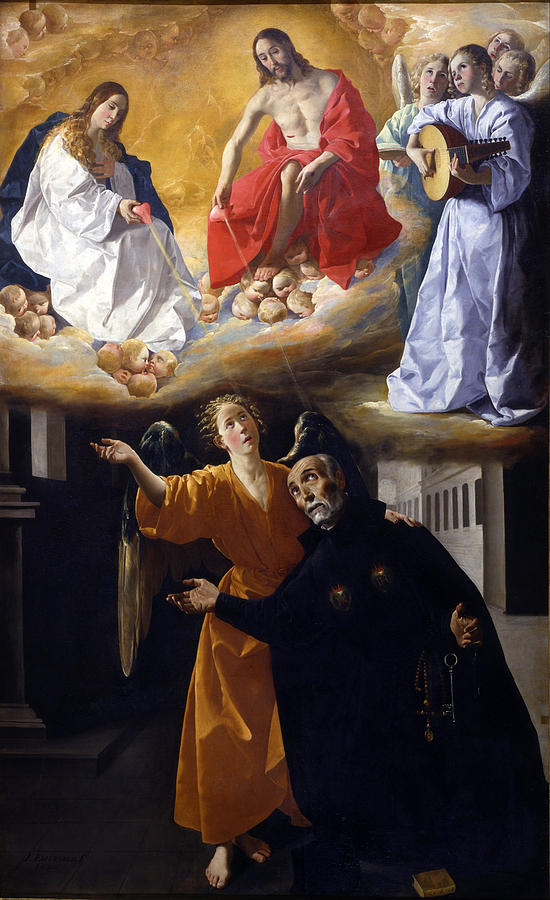
Francisco de Zurbaran’s “Vision of Blessed Alonso Rodríguez,” painted in 1633, is one of the most complex and luminous works of Spanish Baroque spirituality. The large vertical canvas is divided into two clearly distinct realms. The lower half shows the aged Jesuit lay brother Alonso Rodríguez being guided by an angel through an architectural space. Above, the heavens open to reveal Christ, the Virgin Mary and a choir of angels seated on clouds of cherub heads, bathed in a golden light. A thin diagonal thread of light links the old monk on earth with the radiant Christ above, visually expressing the moment when a humble servant of God receives an extraordinary mystical vision.
From the first glance the painting feels both theatrical and deeply intimate. The sharp contrast between the dark foreground and the blazing celestial region creates a sense of revelation. Yet the subject itself is quiet and contemplative. Alonso does not perform a miracle or suffer martyrdom; he simply gazes upward, stunned by the beauty and mercy granted to him. Zurbaran transforms this inward, invisible experience into a rich, visible narrative where each figure, gesture and color contributes to a profound meditation on prayer, intercession and divine consolation.
Historical and Devotional Context
Alonso Rodríguez was a Jesuit lay brother who lived in the late sixteenth and early seventeenth centuries. For many years he served as porter of the Jesuit college in Palma de Mallorca, a seemingly modest position that involved welcoming visitors, caring for the door and performing simple tasks. Behind this ordinary exterior, however, he cultivated a life of intense prayer and self sacrifice. After his death he quickly became an object of veneration, especially among Jesuits, who regarded him as a model of holiness in humble service.
In Zurbaran’s Spain, the early decades of the seventeenth century saw a strong emphasis on interior devotion and the value of mystical experiences. Religious orders commissioned paintings that would encourage contemplation and present their members as examples of sanctity. The Jesuits in particular were keen to promote figures like Alonso Rodríguez, whose hidden sanctity matched their spirituality of disciplined prayer and obedience.
Zurbaran created this painting for a Jesuit environment, very likely a college or church where members of the order would see it regularly. The work therefore functions not only as a narrative of one man’s vision but as a visual teaching about Jesuit ideals. Alonso appears in the black habit of the Society of Jesus, decorated with the flaming heart symbols of devotion to Jesus and Mary. His vision unites him with the heavenly family of Christ, the Virgin and the angels, presenting him as a trusted friend of the divine household.
Composition and Division between Earth and Heaven
The painting’s structure is carefully designed to separate and yet connect the earthly and heavenly realms. The lower half is relatively dark, dominated by architecture, shadows and the solid mass of Alonso’s black habit. The upper half erupts in golden light, clouds and shimmering fabrics. The change from one zone to the other is not abrupt; instead, clouds seep downward like a ceiling of glory hovering above the figures below.
At the top center Christ sits or rather half stands on a cloud, his body turned slightly toward the Virgin Mary on his left. He wears a red mantle that reveals his torso and suggests both his resurrection and his sacrificial love. Mary kneels or sits on another cloud, robed in white with a blue mantle, her head bowed in humility. On the right an angel in white plays a stringed instrument, surrounded by other angelic figures who watch the scene or join in song. All of them rest on clouds filled with the tiny faces of cherubs, a visual shorthand for the multitude of heavenly spirits.
In the lower half, an angel dressed in a vivid orange garment stands beside Alonso Rodríguez, guiding him gently with an arm around his shoulders. The angel points upward with the left hand, inviting Alonso to look toward the divine vision. Alonso, slightly bent by age, turns his head upward and presses his hands together in prayerful emotion. Behind them a colonnade recedes into the distance, creating depth and suggesting the setting of a monastic or college cloister.
The connection between the two levels is made by a thin, almost threadlike ray of light that descends from the heart of Christ to Alonso’s chest. This diagonal line quietly unifies the composition. It tells the viewer that what takes place above and what happens below are not separate stories but one continuous act of grace.
The Figure of Blessed Alonso Rodríguez
Zurbaran presents Alonso as a frail but dignified old man. His face is lined and pale, his eyes moist and fixed on the vision above. He wears the simple black habit of a Jesuit, falling straight to the floor with few embellishments. Only the embroidered hearts on his chest and the rosary and key that hang from his belt break the monochrome surface. These details remind us of his role as porter and of his devotion to the Hearts of Jesus and Mary.
His posture is one of awe and humility. He leans slightly into the supporting arm of the angel, suggesting both physical weakness and spiritual reliance on divine aid. His hands, clasped near his chest, attempt to respond to the overwhelming grace that he sees. The old man does not stride forward confidently; he is drawn, almost carried, into the radiant mystery.
Zurbaran’s portrayal is tender and realistic. The wrinkles on Alonso’s forehead, the sparse beard, and the slight hollows under his eyes all speak of years of labor and asceticism. Yet the expression on his face is filled not with fatigue but with quiet joy and wonder. The artist invites the viewer to recognize that sanctity can be hidden under very human features. Alonso is not idealized into a flawless youth; he remains recognizably old and fragile, which makes his union with heavenly glory all the more moving.
The Guiding Angel and the Language of Gesture
Beside Alonso stands a luminous angel, playing the role of spiritual guide. The angel’s robe is a rich orange or golden yellow, cinched at the waist and falling in large folds that catch the light. Bare feet touch the ground lightly, indicating the angel’s presence in the earthly sphere while wings, partly visible behind, signal a heavenly origin.
The angel’s gestures are eloquent. With one arm wrapped protectively around Alonso’s shoulders, the figure expresses reassurance and companionship. With the other arm raised and the hand pointing toward the vision, the angel acts as interpreter, inviting both Alonso and the viewer to direct their attention upward. The face of the angel is youthful and serene, the gaze lifted toward Christ and Mary above.
This double gesture summarizes the role of angelic beings in Christian art: they comfort, guide and direct human beings toward God. In the context of Jesuit spirituality, the angel can also be interpreted as symbolizing obedience, spiritual direction and the inner promptings of grace. Alonso does not climb into the vision on his own; he is drawn there by a companion who knows the way.
Zurbaran paints the angel with warm, luminous colors that contrast with the black habit of Alonso and the cooler tones of the architecture. This contrast emphasizes the angel as a bridge between dark earth and golden heaven. The angel belongs to both worlds and thus can lead the viewer from one to the other.
The Heavenly Court: Christ, Mary and the Angelic Musicians
The upper part of the painting is filled with radiant figures. At the very center sits Christ, slightly inclined forward on a bed of clouds. He is depicted in the traditional iconography of the glorified yet wounded Savior. His chest is bare, revealing the wound near his side, while his red mantle wraps around his waist and legs, flowing in rich folds. His expression is gentle and attentive as he looks toward Mary, who is seated on his right, from the viewer’s perspective.
Mary’s pose is one of intercession. She is dressed in white, symbolizing purity, with a blue mantle that alludes to her role as Queen of Heaven. Her head is bowed and she appears to offer something to Christ or to extend a thread of light downward, suggesting her mediation on behalf of Alonso. The long golden hair that falls over her shoulders adds softness to her figure, while her posture emphasizes humility and loving concern.
To the right of Christ, an angel dressed in brilliant white plays a stringed instrument, similar to a lute or guitar. Other angels cluster behind, some singing, others watching the scene with attentive reverence. The presence of music indicates that Alonso’s vision is not only visual but auditory, a participation in the celestial liturgy where angels praise God eternally.
The cloudscape beneath these figures is populated with cherub heads, rendered in rosy tones. These small faces create a sense of fullness and movement, as if the entire sky were alive with spiritual presence. The background is a warm golden yellow, suggesting the uncreated light of divine glory. In this environment Christ appears not as a distant judge but as a compassionate Savior, Mary as loving mother and the angels as joyful companions.
The Thread of Light and the Symbolism of the Heart
One of the most intriguing details in the painting is the thin ray or thread of light that runs diagonally from Christ’s heart down to Alonso’s chest. This line is easy to miss at first glance, yet once seen it becomes the key to understanding the entire composition. It is as if an invisible cord of love links heaven and earth, drawing the humble Jesuit into the embrace of the Trinity.
On Alonso’s black habit, Zurbaran has embroidered two flaming hearts, one representing Jesus and the other Mary. These hearts are not decorative emblems but central symbols of Spanish devotional culture, especially in Jesuit circles. They signify a deep, affective love that unites the believer with Christ’s own passion. The ray of light appears to connect these hearts with the living heart of Christ above, turning what could be mere emblem into active, flowing grace.
In this way, the painting visually expresses the idea that contemplation is a movement of love between the human heart and the divine. Alonso’s devotion throughout his life has prepared him to receive this vision. The burning hearts on his habit show that his interior life is already oriented toward Christ and Mary; the vision simply makes visible what was previously hidden. The ray of light confirms that his prayer is answered and his love returned.
Color, Light and Spatial Atmosphere
Zurbaran’s mastery of color and light is essential to the painting’s impact. The lower half is dominated by dark tones: the black of Alonso’s habit, the deep browns of the architecture, and shadows that pool in corners. Against this darkness, the angel’s orange robe glows like a small sun, and the bare feet and hands of both figures catch warm highlights.
In contrast, the upper realm is suffused with golden light. Christ’s red mantle, Mary’s white and blue garments, and the white robes of the musical angel are all intensified by the yellow background. The colors are rich but not gaudy. Instead they create an atmosphere of warmth, joy and spiritual energy.
The transition between lower darkness and upper radiance is handled through the cloud layer, which softens the boundary between earth and heaven. The edges of the clouds are tinged with gold where the light hits them and with gray where they sink into shadow. This interplay of tones gives the impression that the clouds are drifting into the earthly space, bringing heaven closer to Alonso and to the viewer.
The architecture in the background of the lower half is simple yet effective. A row of columns and a dark passageway provide depth, drawing the eye slowly backward. This perspective contrasts with the timeless, almost weightless space of the clouds above. Earthly space is linear and structured, while heavenly space is fluid, limitless and filled with light.
Zurbaran’s Style and the Spiritual Intensity of Spanish Baroque
“Vision of Blessed Alonso Rodríguez” showcases many traits that define Zurbaran’s mature style. His figures are solid and sculptural, modeled by strong light that emphasizes volume and texture. Drapery folds are described with clarity, whether in the heavy black habit or the floating red mantle. Faces are individualized, with subtle expressions that convey interior states rather than theatrical gestures.
As in many of his works, Zurbaran balances realism with a sense of quiet mysticism. The architecture, clothing and even the musical instrument could belong to the seventeenth century, giving the painting a contemporary feel for its original viewers. At the same time, the luminous clouds and cherub heads situate the scene in a timeless spiritual realm.
Spanish Baroque art often sought to make sacred mysteries tangible without losing their sense of awe. Zurbaran achieves this by placing the viewer at eye level with Alonso and the guiding angel, inviting us to stand beside them and look up. We share their perspective and thus participate in the vision. Yet the radiant distance of the heavenly court reminds us that this is an encounter with something far beyond ordinary experience.
Emotional and Theological Layers
Beyond its beauty, the painting offers a rich theological message. It presents contemplation not as an escape from the world but as a grace granted to those who faithfully perform humble duties. Alonso’s sanctity grew not from public miracles but from quiet service as porter. His vision therefore affirms the value of everyday fidelity.
The presence of Christ and Mary emphasizes the central Christian belief in mediating love. Christ, with his wounded yet glorified body, is the bridge between God and humanity. Mary, kneeling in white, participates as intercessor, a mother who pleads for her children. The angels, musicians and cherubs amplify this atmosphere of loving communication between heaven and earth.
Emotionally the painting is filled with tenderness. Alonso’s frailty, the angel’s protective arm, Christ’s gentle gaze and Mary’s bowed head all express compassion rather than fear. This is not a terrifying apocalyptic vision but a consoling revelation that crowns a life of fidelity. It encourages viewers to trust that their own struggles and prayers might also be heard and answered, even if in ways invisible to others.
Contemporary Relevance and Lasting Appeal
For modern viewers, the painting continues to speak in powerful ways. The idea of a humble worker unexpectedly touched by a transcendent experience resonates beyond specific religious contexts. Many people can identify with the desire for meaning, connection and reassurance that there is a reality greater than visible routine.
The image of the guiding angel also has broad appeal. It suggests that no one walks alone, that assistance and guidance can arrive in subtle forms when least expected. The bond of light between Christ and Alonso becomes a metaphor for any moment when a person feels suddenly seen, loved or understood at a deep level.
From an art historical perspective, the work stands as a prime example of Spanish Baroque devotion at its most refined. It demonstrates how Zurbaran could orchestrate complex iconography, powerful contrasts of light, and nuanced human emotion into a coherent vision. The painting remains a rich object of study for those interested in the intersection of art, spirituality and cultural history.