Image source: wikiart.org
Introduction to Hercules Fighting with the Nemean Lion
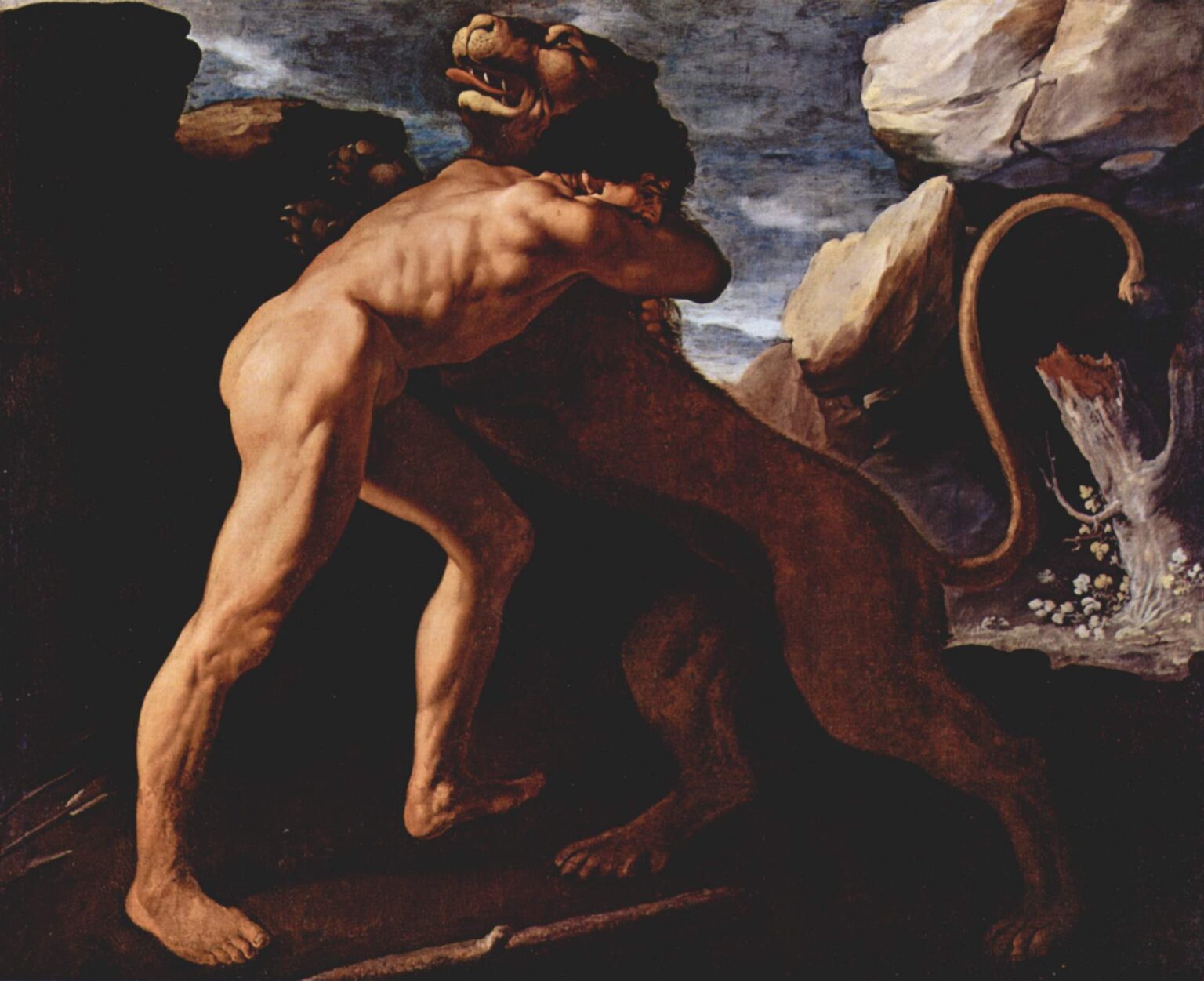
Francisco de Zurbaran’s “Hercules Fighting with the Nemean Lion,” painted in 1634, is a raw and physical exploration of heroism. In this powerful canvas, Zurbaran abandons his usual saints and friars in favor of a pagan hero from Greek mythology. Hercules, shown fully nude, wrestles the monstrous lion in a struggle that consumes almost the entire picture space. Their bodies lock together in a knot of muscle and fur, silhouetted against a dark rocky landscape and a stormy sky.
The painting does not present the moment of triumph, when the beast lies dead. Instead, Zurbaran chooses the instant where victory is still uncertain and the hero’s body is pushed to its limits. This choice makes the work less a simple illustration of myth and more a meditation on effort, courage, and the human body as an instrument of will.
Created for the Palacio del Buen Retiro in Madrid as part of a cycle on the Labors of Hercules, the painting reveals how a Spanish Baroque master could transform classical legend into a visual statement about strength, discipline, and moral fortitude.
The Myth of Hercules and the Nemean Lion
In Greek mythology, the first of Hercules’ famous Twelve Labors was to defeat the Nemean Lion, a monstrous beast that terrorized the region around Nemea. The lion’s skin was said to be impenetrable to weapons. Hercules tried arrows and club, but nothing pierced its hide. Realizing that brute force was his only option, he grappled with the beast and strangled it with his bare hands. Afterward he skinned the lion using its own claws and wore its hide as armor.
This story made the fight with the Nemean Lion a symbol of pure physical strength and unarmed courage. In a Christian monarchy like seventeenth century Spain, Hercules served as an allegory of the virtuous ruler or the ideal soldier, someone who uses strength to restore order. By including this labor in the decoration of a royal palace, patrons linked the mythic hero to the Spanish crown, suggesting that the king, like Hercules, must subdue monstrous threats to the realm.
Zurbaran’s painting taps into this moral dimension. Although the subject is pagan, the message about courage, perseverance, and victory over seemingly invincible adversity would have resonated strongly with his contemporaries.
Composition and the Geometry of Struggle
The composition is dominated by a powerful diagonal that runs from Hercules’ planted left foot at the lower left corner up through his extended leg, torsion of his torso, and finally to the lion’s gaping mouth near the upper right. This diagonal gives the entire scene a sense of forward thrust and dynamic tension. The bodies of man and beast almost fuse into a single massive form, occupying the central portion of the canvas and pushing against the surrounding dark space.
Hercules’ back is turned toward the viewer. We see the entire length of his body from calves to neck, every muscle taut as he presses his weight into the lion. His arms wrap around the animal’s head and neck, pulling them close to his own chest. The lion, with its forelegs braced and hindquarters tensed, resists the pressure. Its head is forced backward, jaws open in a silent roar, capturing the moment when strength, breath, and life are being squeezed out.
Around this central knot of bodies, Zurbaran keeps the environment simple. Large boulders frame the right side, while shadow fills much of the left. A strip of sky at the top and a sliver of rocky ground at the bottom complete the setting. This minimalism focuses attention on the physical confrontation and avoids any distracting narrative detail. The viewer is fully absorbed in the torque of bodies and the drama of the encounter.
The Heroic Nude and Anatomical Precision
One of the most daring aspects of the painting is the full nude figure of Hercules. In Spanish religious art, male nudes were usually limited to images of the crucified Christ or martyrs. Here, however, Zurbaran embraces the classical tradition of the heroic nude, presenting Hercules as a model of idealized yet believable anatomy.
Every muscle group is carefully rendered. The tension in the calves and thighs reveals the strain of maintaining balance and leverage. The glutes and lower back show compressed power. The sweep of the latissimus and the bulge of the shoulders express the force of his grip around the lion’s neck. Veins stand out along the forearms and legs, hinting at pounding blood and exertion.
Despite this attention to anatomy, the figure does not feel like a cold academic study. The slight twist of the hips, the tilt of the head buried against the lion, and the flexion of the toes gripping the rock all contribute to the sense of living struggle. The skin is painted in warm tones that catch the light and stand out dramatically against the darker fur of the lion.
By presenting Hercules without any clothing or armor, Zurbaran emphasizes that his victory depends entirely on his natural strength and determination. There are no weapons, no divine helpers, only the disciplined human body pushed to its limits.
Light, Color, and Baroque Atmosphere
Zurbaran uses a classic Baroque contrast of light and shadow to heighten drama. The main light source strikes Hercules from the left, illuminating his back, shoulders, and legs with a warm glow. The lion’s head and upper body also catch this light, while the rest of the animal merges with the dark rock and shadowed ground.
This strong chiaroscuro creates a sculptural effect. The lit portions of Hercules’ body almost appear carved out of stone, a living statue writhing against the beast. The dark recesses between his limbs and the lion’s torso add depth and mystery. The viewer’s eye moves from highlight to highlight across the surface of the flesh, tracing the line of the struggle.
The color palette is restrained. Earthy browns and deep reds dominate the lion’s hide and the rocky terrain. Hercules’ skin brings warmth and life, standing out against the muted surroundings. The sky, visible in cool gray and blue tones at the top of the canvas, serves as a distant backdrop, its turbulence echoing the violence of the fight below.
Overall, the atmosphere feels heavy and charged, as if the air itself is tense. The combination of dark earth tones and bright flesh tones underscores the contrast between mortal vulnerability and heroic force.
Symbolism of the Nemean Lion
The Nemean Lion is more than a dangerous animal. In classical and later Christian allegory, it represents any monstrous challenge that seems impossible to overcome. Its invulnerable hide suggests problems that resist ordinary solutions, whether war, heresy, or personal vice.
In Zurbaran’s painting, the lion’s massive body and powerful legs communicate raw, untamed nature. Its open mouth and visible teeth hint at the threat of devouring violence. Yet its position is already compromised. Hercules has locked his arms around the beast’s neck and is slowly forcing it back. The lion’s tail, curling around the right edge of the canvas, adds a note of instinctive agitation.
Spanish viewers of the seventeenth century might have interpreted this image as a metaphor for moral or political struggle. Hercules could be seen as representing the Christian hero, the virtuous ruler, or even the disciplined soul, while the lion could stand for sin, chaos, or external enemies of the faith. By choosing the moment of intense effort rather than the aftermath, Zurbaran underscores that virtue is not simply a state but an active, ongoing combat.
Landscape and the World of the Labors
Although the landscape is secondary to the figures, it plays a significant role in framing the drama. The rocky outcrops on the right and left create a narrow canyon-like space where the fight occurs. This confinement intensifies the action, making it feel like a private arena where escape is impossible.
The rocks themselves, painted in gray and brown with sharp edges and cracks, suggest a harsh and unforgiving environment. They mirror the hardness of the challenge Hercules faces. At the right edge, a dead tree trunk clings to the rocks, its bark stripped and its branches truncated. Nearby, small pale flowers emerge from the ground. This juxtaposition of death and fragile life hints at the stakes of the struggle, where destruction and renewal are both possible outcomes.
The strip of sky above is cloudy, with patches of blue breaking through. It provides a visual relief from the dark lower half of the painting. One might read it as a sign that beyond the immediate violence, a broader cosmic order still exists, and that Hercules’ victory will restore harmony between human effort and the natural world.
Zurbaran’s Interpretation of Heroism
Francisco de Zurbaran is best known for his images of saints and monks, not classical heroes. Yet in “Hercules Fighting with the Nemean Lion,” he applies the same seriousness and simplicity that characterize his religious works. There is no decorative armor, no audience of gods or nymphs, no ornate landscape. Instead, the painting focuses entirely on the intense encounter between man and beast.
This focus reflects a particular vision of heroism. For Zurbaran, heroism is not about ostentatious display but about concentrated effort, discipline, and perseverance. Hercules’ face is mostly hidden, buried against the lion’s mane. We do not see a proud expression or theatrical gesture. The hero’s glory lies in his willingness to engage fully with the challenge before him, body and soul.
At the same time, Zurbaran’s treatment of the nude body reveals admiration for human physicality. The painting celebrates the strength and beauty of the male form, but it does so in a way that emphasizes function, not vanity. Every muscle is engaged in the task at hand. In this way, Hercules becomes an image of bodily capacities harnessed to a higher purpose.
Emotional and Psychological Dimensions
Although the painting emphasizes physical struggle, it also carries psychological depth. Because Hercules’ face is largely hidden from us, we must read his mental state through his body. The powerful arch of his back, the tension in the hands and feet, and the forward drive of his stance all express determination. He refuses to yield, even though the lion’s size and power are formidable.
The lion’s face, by contrast, is fully visible. Its mouth is open and the head is tilted back. The expression can be read as rage, fear, or the first signs of suffocation. This human like emotion on the animal’s face intensifies the drama and adds a hint of empathy. We witness not only the hero’s strength but also the beast’s desperation.
The painting thus captures a complex moment where victory and death coexist. Hercules’ survival depends on the lion’s destruction, and the lion’s struggle underscores the cost of that triumph. For viewers, this tension invites reflection on the nature of power and the ethical weight of overcoming enemies, whether external or internal.
Legacy and Modern Reception
“Hercules Fighting with the Nemean Lion” remains one of Zurbaran’s most dynamic works and stands out in his oeuvre for its mythological subject matter. It shows that he could rival Italian and Flemish contemporaries in the depiction of the male nude and in the staging of violent action.
Today, the painting draws viewers not only through its narrative but also through its raw physicality. In an age fascinated by athleticism, body image, and struggle, the image of Hercules locked in combat with the lion has renewed relevance. It can be read as a metaphor for personal challenges, whether mental health struggles, social injustice, or physical training. The emphasis on effort, rather than triumphal posing, resonates with contemporary ideas about resilience.
Art historians appreciate the painting for its contribution to the understanding of Spanish Baroque classicism, where religious and mythological themes often intersected. The work demonstrates how a devout Catholic artist could engage deeply with pagan mythology, finding in it moral and spiritual lessons that aligned with Christian values.
Conclusion A Vision of Struggle and Strength
Francisco de Zurbaran’s “Hercules Fighting with the Nemean Lion” offers more than a vivid scene from ancient legend. Through careful composition, anatomical precision, and dramatic lighting, he transforms the myth into a timeless image of human effort against overwhelming odds. The entwined bodies of hero and beast form a single, dynamic mass, set against a backdrop of harsh rocks and troubled sky.
Hercules’ nude figure embodies disciplined strength and unwavering resolve. The Nemean Lion, teeth bared and body tensed, represents the terrifying reality of challenges that seem impossible to subdue. The painting captures the moment when the outcome hangs in the balance, when sweat, muscle, and will determine whether life or death will prevail.
For viewers past and present, this work invites reflection on the struggles that shape character and destiny. It suggests that true heroism lies not in effortless victory but in the willingness to engage fully with difficult tasks, relying on cultivated strength and inner courage. In this sense, Zurbaran’s Hercules stands as a universal symbol of perseverance, echoing the message that every great achievement begins with a hard fought battle.