Image source: wikiart.org
First Impressions of Zurbaran’s Heroic Vision
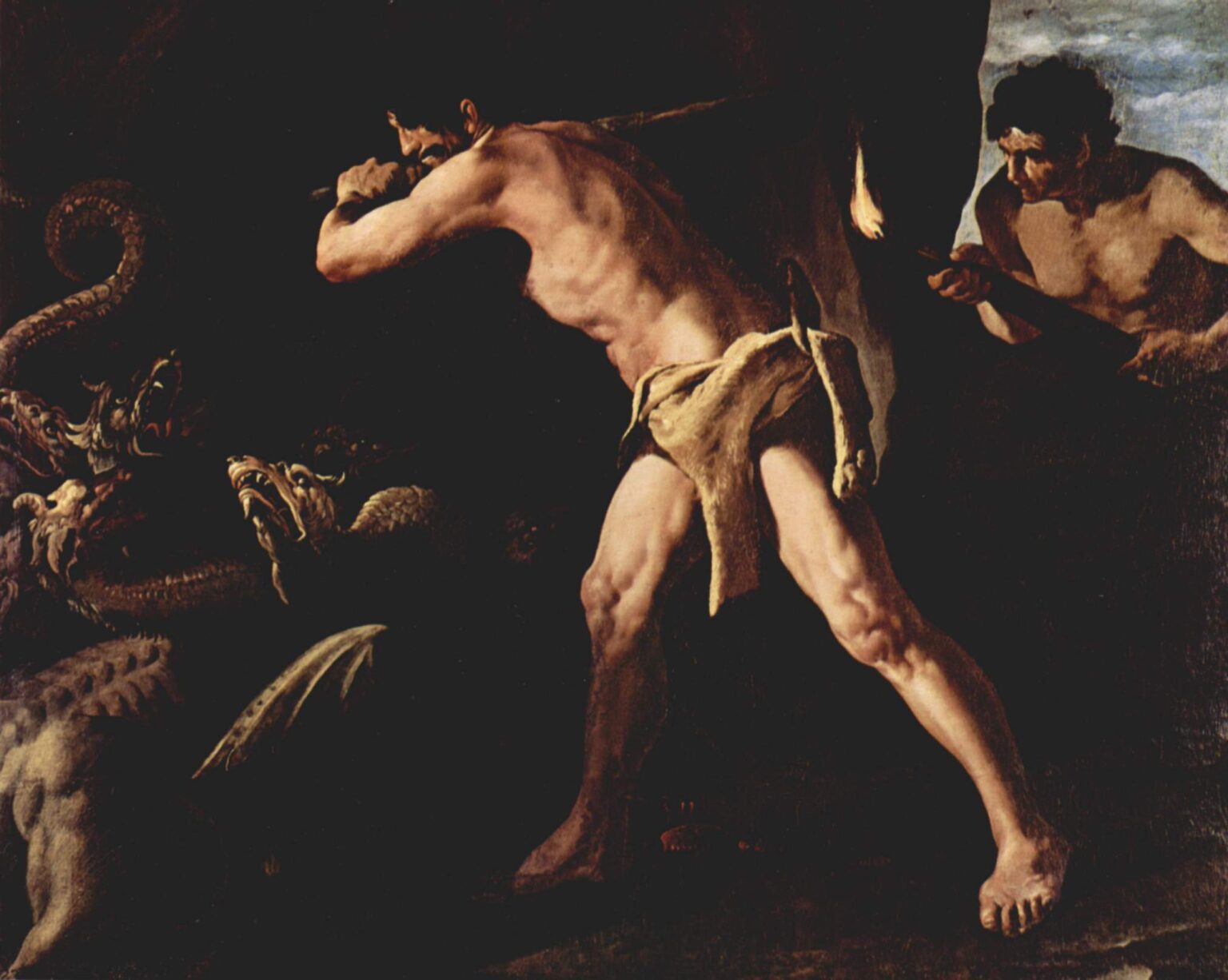
Francisco de Zurbaran’s “Hercules Fighting with the Lernaean Hydra,” painted in 1634, explodes with muscular energy and nocturnal drama. The scene is set inside a dark cavern where the semi nude hero, seen from the back, lunges forward in a wide stance. His powerful arms raise a club above his head at the very moment he is about to strike the writhing monster. Coils, scales and multiple snarling heads of the Hydra surge up from the lower left, their pale jaws catching the same hard light that sculpts Hercules’s body.
To the right, a second figure holds a torch aloft, illuminating the combat with flickering light and defining the edges of the rocky cave. Almost the entire left half of the painting is consumed by darkness and monstrous forms, while the right half is dominated by the taut body of the hero. The contrast between light and shadow, human flesh and reptilian scales, courage and chaos immediately announces the painting as a Baroque meditation on struggle and victory.
Mythological Background and Royal Context
The subject comes from the famous Twelve Labors of Hercules. The second labor required the hero to slay the Lernaean Hydra, a monstrous serpent with multiple heads living in the swamps of Lerna. The Hydra’s most terrifying power was its regenerative ability. Whenever one head was cut off, two more would grow in its place. In some versions of the myth, Hercules’s nephew Iolaus helped him by burning the neck stumps with fire so that new heads could not regenerate.
Zurbaran painted this work as part of a series of mythological scenes for the Hall of Realms in the Buen Retiro palace in Madrid. Philip IV commissioned paintings of Hercules to decorate this ceremonial space, presenting the hero as a political symbol of royal strength and virtue. In this context Hercules was an allegory of the king himself, laboring to defeat threats to order and faith.
Although Zurbaran is primarily known for religious art, his interpretation of Hercules shows how Baroque artists adapted classical mythology for contemporary purposes. The Lernaean Hydra becomes more than a creature from Greek legend. It represents the forces of chaos, sin and disorder that a righteous ruler must subdue. The darkness of the cavern echoes the moral darkness that the hero must enter in order to conquer it.
Composition and the Diagonal of Combat
The composition is built on a powerful diagonal that runs from the lower left where the Hydra’s bodies surge, through the trunk and shoulders of Hercules, up to the torch held by his companion. Hercules’s body forms the central bridge across this diagonal. His left leg is thrust forward, his right leg pulled back, giving him a stable yet dynamic stance. The twist of his torso, with the upper body turning toward the monster while his hips remain slightly turned toward the right, creates a spiraling movement that feels full of tension.
The Hydra fills the left foreground with a chaotic mass of curves and pointed shapes. Snakes coil upward, jaws opened in snarling defiance. Their forms push back against the diagonal of Hercules’s attack, creating a visual clash between linear strength and sinuous resistance. The right background opens onto a small patch of blue sky, the one distant glimpse of the world outside the cave, while the rocky walls close in around the figures.
Zurbaran’s control of space is deliberate. The viewer stands close to the action, positioned almost at ground level beside Hercules. This proximity intensifies the sense of danger and makes the viewer feel almost part of the scene. The composition never feels crowded, however. The dark cavern absorbs excess detail, allowing the main silhouettes of hero, helper and monster to remain clear and legible even from a distance.
Light, Shadow and the Cave of Struggle
One of the most striking aspects of the painting is its tenebrist lighting. The primary light source is the torch held by the secondary figure on the right. Its flame casts a harsh, directional light across Hercules’s back, shoulders and legs, modeling his body with strong highlights and deep shadows. The same light glances off the Hydra’s heads and coils, revealing their slimy surfaces and gleaming teeth.
The rest of the cavern is plunged into near blackness. This contrast between the illuminated bodies and the surrounding darkness enhances the sense of isolation. Hercules is literally a figure of light stepping into a realm of darkness where monstrous forces dwell. The torchlight suggests the guidance of reason, fire and human ingenuity in the face of overwhelming danger.
The narrow beam of light also allows Zurbaran to emphasize the textures of skin, rock and scales. Hercules’s flesh glows with a warm tone, whereas the Hydra appears colder, its scaly body catching light in sharper, more fragmented highlights. The torch’s glow diminishes as it moves into the recesses of the cave, where forms are suggested rather than described. This manipulation of light and shadow heightens the drama and directs the viewer’s attention to the decisive clash of club and heads.
Hercules’s Body as Instrument of Heroic Virtue
Zurbaran treats Hercules’s body as a central symbol. Seen from the back and in three quarter view, it provides a dynamic display of anatomy. Muscles bulge along the shoulders, arms and legs, the spine twists, and the weight of the body is clearly distributed between the two feet. The hero wears only a simple animal skin around his waist, leaving the rest of his body exposed as an emblem of strength.
This emphasis on physical power is not mere bravura. In the Baroque period, the human body was often used as a metaphor for moral and spiritual qualities. Hercules’s muscular back suggests not only physical might but also the fortitude required to confront evil. His firm stance and raised club communicate determination and willingness to endure hardship.
The choice to show Hercules from behind also has narrative significance. The viewer does not see his face in detail, which prevents us from reading his personal emotion too easily. Instead we experience him primarily through action. He is defined by what he does rather than by what he feels. This depersonalization elevates him from an individual to an archetype of virtuous struggle.
The Hydra and the Imagery of Chaos
Opposite the hero, the Hydra appears as a composite of multiple serpentine bodies and heads. Zurbaran’s monster is less a natural creature and more a visual embodiment of chaos. Its forms are difficult to count or categorize. Coils overlap, heads emerge from unexpected angles, and the creatures seem to merge into one another.
The heads that catch the light show sharp teeth, gaping mouths and bulging eyes. Their expressions range from snarling rage to open mouthed hiss. The coils in the shadows suggest that there is more monster hidden in the darkness than we can see, reinforcing the myth that cutting off one head results in more reappearing. This gives the impression that Hercules is fighting not a single enemy but an endlessly regenerating threat.
The Hydra’s color palette is muted, with tones of dull green, brown and gray. These colors contrast with the warm flesh of the hero and the orangish flame of the torch. The monster thus appears cold and slimy, covered in scales that refuse to catch the light warmly. It belongs to the subterranean world of the cave, a physical manifestation of what is base, instinctive and wild.
The Companion with the Torch
The second figure in the painting, often interpreted as Iolaus, plays a crucial supporting role. Positioned to the right of Hercules and partly obscured by the rock wall, he holds the torch carefully, leaning forward to bring the flame closer to the heads of the Hydra. His body is less illuminated than that of the hero, but his face and arms catch enough light to reveal his concentration.
This companion introduces the theme of cooperation and intellect. In the myth, Hercules discovers that he cannot defeat the Hydra by brute force alone. When he cuts off one head, more regrow. Iolaus offers the solution by using fire to cauterize the necks. Zurbaran captures this moment of teamwork, suggesting that true heroism requires both strength and clever strategy.
The torch also has symbolic resonance. Fire is associated with purification, enlightenment and divine favor. By placing it in the hands of the assistant, Zurbaran hints that guidance, counsel and perhaps even grace come through others. Hercules’s solitary power is not enough; he needs the light held by his ally. This detail enriches the painting’s moral message, showing that the battle against monstrous forces is a communal effort.
Baroque Movement and Emotional Tension
The painting is a textbook example of Baroque dynamism. There is almost no static element. Hercules’s muscles are tensed, the Hydra coils and strikes, the torch flame flickers, and even the edges of the cave seem to vibrate with the energy of combat. The curved back of Hercules, the serpentine shapes of the Hydra and the swirling smoke around the torch all contribute to a sense of constant motion.
Emotionally, the scene captures a moment of intense suspense. The club is raised but not yet delivered; the heads are lunging but have not yet struck. The viewer’s eye moves restlessly between weapon and monster, anticipating the blow. This frozen instant before impact is filled with psychological tension. It suggests the split second in which fate hangs in the balance and the outcome depends on human courage and divine support.
By choosing this precise moment, Zurbaran invites the viewer to experience the thrill and anxiety of decision. Hercules’s labor becomes a metaphor for those moments in life when one must act decisively against overwhelming odds. The painting’s emotional force lies in this identification.
Symbolic Meanings and Moral Interpretation
In the royal context for which the painting was created, the Lernaean Hydra could be interpreted as representing various threats to the Spanish monarchy. These might include political rebellion, foreign enemies or heresy within the realm. Hercules, standing for the king, confronts these dangers with strength and divine sanction. The torch bearing helper could symbolize wise ministers, counselors or the Church offering guidance and doctrinal clarity.
On a broader level, the painting can be read as an allegory of the human soul confronting sin and temptation. The Hydra, with its many heads, resembles the recurring vices that resurface even when suppressed. Hercules’s repeated blows and the burning of the necks through fire parallel the spiritual disciplines and graces required to root out deep seated faults. The dark cave stands for the inner depths of the human heart where these struggles take place.
The labor also suggests the necessity of persistence. Since the Hydra regenerates, a single stroke is never enough. Similarly, spiritual and moral growth is not achieved through one action but demands ongoing effort. Zurbaran’s painting, with its emphasis on sustained combat rather than quick victory, communicates this message with visual power.
Zurbaran’s Style and Transformation of Myth
Although mythological subjects were less common in Zurbaran’s oeuvre than religious ones, he brings to this painting the same seriousness and sense of spiritual gravity that characterize his depictions of saints and monks. His Hercules is not a flamboyant classical hero adorned with decorative armor or accompanied by symbolic attributes. Instead he is stripped almost entirely bare, a working hero engaged in a task that resembles labor more than spectacle.
Zurbaran’s naturalistic anatomy, combined with his Caravaggesque lighting, links the painting to the broader European Baroque. Yet there is also a Spanish austerity in the limited color range and the absence of classical architectural settings. The cave is a simple, rough space, closer to the monastic cells that populate his religious works than to the ornate temples seen in Italian mythological paintings.
By treating the subject with such gravity, Zurbaran elevates the myth from entertainment to moral exemplar. Hercules becomes akin to a saint performing a spiritual battle. The painting thus bridges the gap between pagan legend and Christian allegory, a typical Baroque strategy that allowed classical themes to coexist with Counter Reformation piety.
Lasting Impact and Contemporary Resonance
Today “Hercules Fighting with the Lernaean Hydra” is admired both as a technical tour de force and as a remarkably intense psychological study. The muscular back of Hercules and the writhing coils of the Hydra remain unforgettable images of struggle. Viewers who may not know the full myth can still sense the drama of a human figure confronting something monstrous and seemingly unstoppable.
The painting resonates with contemporary audiences because its theme is universal. Everyone faces “Hydras” of one kind or another problems that seem to multiply when attacked, inner conflicts that do not disappear easily, social injustices that regenerate. Zurbaran’s vision of a hero who continues to strike, supported by the light of a companion, speaks to the perseverance required in such battles.
The work also illustrates the enduring power of myth when reinterpreted through different cultural lenses. In Zurbaran’s hands, Hercules is no longer simply a Greek demigod. He becomes a timeless figure of resistance against darkness, a symbol of the courage that individuals and communities must summon when confronting the many headed threats of their own times.
Conclusion
“Hercules Fighting with the Lernaean Hydra” stands as one of Francisco de Zurbaran’s most compelling mythological works. Through a carefully balanced composition, dramatic torchlight, and masterful depiction of anatomy and monstrous form, the artist captures the very essence of heroic struggle. In the dark cavern, the warm flesh of Hercules contrasts with the cold coils of the Hydra, while the torch bearing companion adds both literal light and symbolic guidance.
The painting operates on multiple levels. It is an exciting scene from classical mythology, a royal allegory of political power, and a spiritual metaphor for the soul’s battle against recurring vice. Zurbaran’s ability to weave these layers together without sacrificing pictorial clarity demonstrates his sophistication as a Baroque master.
Even centuries after it was painted, the image retains its force. It draws viewers into the charged instant before the club descends, inviting them to reflect on their own confrontations with darkness and their need for strength, wisdom and perseverance. In Hercules’s tense body and the Hydra’s snarling heads, Zurbaran leaves us a vivid and enduring symbol of the human capacity to face what seems invincible and continue to fight for the light.