Image source: wikiart.org
First Impressions of Zurbaran’s “Apostle St. Andrew”
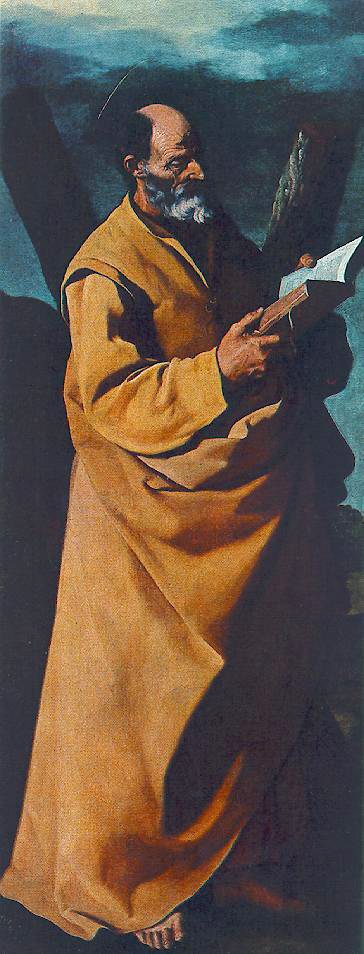
Francisco de Zurbaran’s “Apostle St. Andrew,” painted in 1631, is a tall, narrow canvas that presents the apostle as a solitary, monumental figure. The vertical format accentuates his height and gives him a statuesque presence. He stands barefoot, wrapped in a warm ocher robe that almost completely envelops his body. In one hand he holds an open book, in the other the crude diagonal beam of a cross, the instrument of his martyrdom.
Against a dark, turbulent sky, Andrew appears as a quiet yet unshakable witness. His head is turned slightly, his gaze lowered toward the text before him. A discreet halo circles his balding head, identifying him as a saint but not separating him from the world of flesh and gravity. The heavy folds of his robe catch the light, creating a powerful contrast with the deep shadows behind him.
At first glance, the painting seems utterly simple: one figure, one setting, a few essential objects. Yet Zurbaran uses this simplicity to concentrate spiritual meaning. “Apostle St. Andrew” invites the viewer into a contemplative encounter with a man who embodies humble authority, scriptural wisdom, and steadfast fidelity in the face of martyrdom.
Historical and Religious Context
St. Andrew, brother of St. Peter, was one of the first disciples called by Christ. According to tradition he preached the Gospel in various regions after the Resurrection and was eventually martyred in Greece. Later legends claimed that he was crucified on an X shaped cross, often called the “saltire,” because he did not consider himself worthy to die in the same manner as Christ.
In seventeenth century Spain, devotion to the apostles was central to Catholic identity. They were seen as the original guardians of the faith and models for bishops, missionaries, and ordinary believers. Series of apostle paintings were popular commissions for churches and monasteries, each canvas portraying a single apostle with his characteristic attributes. Zurbaran painted several such series for religious institutions in Seville and elsewhere.
“Apostle St. Andrew” forms part of this tradition. Instead of presenting Andrew in an elaborate narrative scene, Zurbaran isolates him as a monumental, almost sculptural presence. This approach suited the aims of Counter Reformation spirituality, which favored clear, emotionally direct images that would foster prayer and imitation. The painting shows Andrew not in the moment of martyrdom but as a mature, meditative apostle, rooted in Scripture and marked by the cross that will one day claim his life.
Composition and Vertical Emphasis
The canvas is unusually tall and narrow, and Zurbaran uses this format to great effect. Andrew is placed centrally, his body extending from the lower edge to near the top, creating a strong vertical axis. His head is slightly below the upper border, leaving enough space for the dark sky and halo. The result is a figure that dominates the composition yet remains comfortably framed.
The apostle’s body is turned in three quarter view, with his right shoulder slightly advanced. His left hand holds an open book at chest height, while his right arm bends to grasp the diagonal beam of a cross that rises behind his back. The cross runs from the lower left to the upper right, forming a dynamic diagonal that enlivens the otherwise stable composition.
This interplay between the vertical figure and the diagonal cross creates a subtle tension. The cross seems to press against Andrew’s shoulder, a reminder of the burden he bears as follower of Christ. Yet his posture is calm and composed. The book he reads provides a counterbalance to the cross, suggesting that his mission is grounded not only in suffering but in the word of God.
Andrew’s bare feet peek out from beneath the heavy robe, grounding him firmly on the earth. They introduce a touch of human vulnerability into the otherwise monumental figure, reminding us that this towering apostle is still a man of flesh and blood.
Light, Shadow, and the Dramatic Background
Zurbaran’s mastery of light and shadow is fully evident in this painting. A strong, directional light falls from the left, illuminating the apostle’s face, beard, hands, and the front planes of his robe. The opposite side recedes into rich shadow, creating a sense of volume and depth.
The background is composed of deep blues and blacks, suggesting a stormy sky or a dark, undefined space. It is not a detailed landscape but a turbulent atmosphere that heightens the drama of the figure. Against this dusk like setting, the warm tones of the robe glow even more intensely.
The lighting has a symbolic dimension. The apostle stands in a realm of darkness, representing the world in ignorance or sin, yet he is bathed in light that falls upon him like divine grace. His book, too, catches the light, signifying the illumination of Scripture. The cross remains more shadowed, an ominous yet accepted reality that belongs to his vocation.
This tenebrist treatment is typical of Zurbaran, who often used strong contrasts to separate the sacred figure from its surroundings and to focus the viewer’s attention on key spiritual symbols.
The Robe and the Language of Fabric
One of the most striking features of “Apostle St. Andrew” is the enormous robe that wraps the apostle from neck to feet. Painted in warm ocher and golden brown, it falls in large, sculptural folds that swirl gently around his body. The fabric seems heavy and coarse, yet it moves with subtle rhythm, catching the light on its ridges and dissolving into shadow in its recesses.
Zurbaran was renowned for his ability to depict textiles, and here the robe becomes a central expressive element. It does more than clothe Andrew. It gives his figure bulk and gravity, transforming him into a kind of living column. The robe’s vertical sweep reinforces the saint’s stability and steadfastness, qualities associated with apostleship.
Symbolically, the robe’s simple, earthy color suggests humility and poverty. Unlike a richly embroidered vestment, this garment is plain and practical, suitable for a traveling preacher. The absence of floral decoration or luxurious trim keeps the focus on Andrew’s character rather than his social status.
At the same time, the robe’s sculptural beauty hints at spiritual nobility. The apostle may be clothed in humble fabric, but the way the light caresses it suggests inner glory. The garment becomes a visual metaphor for the Christian paradox in which ordinary lives are transfigured by grace.
The Book as Sign of Apostolic Teaching
In his left hand Andrew holds an open book, angled so that the viewer can see the white pages against the darker background. The text itself is not legible, but its presence is unmistakable. This book is a symbol of the Gospel and of Andrew’s role as teacher and preacher.
The apostle’s gaze is directed toward the book, his brows slightly furrowed in concentration. He appears absorbed in reading or meditating on the words before him. This emphasis on study underlines the intellectual and contemplative dimension of apostolic ministry. Andrew is not only a witness by his actions and martyrdom, but also by his understanding of Christ’s message.
The book’s whiteness acts as a small but important source of light within the composition. It echoes the highlights on the robe and beard, visually linking the apostle’s body and mind with the contents of the book. The viewer is reminded that Scripture nourishes the soul and guides the believer’s steps.
For devout viewers in Zurbaran’s time, such imagery would have reinforced the importance of hearing and meditating on the word of God, especially through the teaching of the Church founded on the apostles.
The Cross and the Foreshadowing of Martyrdom
Behind Andrew’s shoulder and rising diagonally across the painting is the rough beam of a cross, the attribute that identifies his martyrdom. Unlike the delicate, finely carved crosses sometimes seen in devotional art, this one appears crude and heavy, like a real piece of timber prepared for execution.
Andrew’s right hand grips the wood firmly yet without visible strain. This gesture suggests both acceptance and readiness. He does not shrink from the cross, nor does he flaunt it. It is simply part of his identity as follower of Christ.
The diagonal placement of the beam introduces a subtle sense of movement, as if the cross were both a burden he carries and a path he follows. Visually, it counterbalances the verticality of the figure, creating an X like pattern that recalls the traditional form of Andrew’s crucifixion.
Symbolically, the presence of the cross behind Andrew reflects the Christian belief that discipleship involves self denial and willingness to suffer for the truth. Yet Zurbaran chooses not to depict the horrifying moment of crucifixion. Instead he shows a man who lives daily in the shadow of the cross, sustained by the word of God. This emphasis on interior preparation rather than external drama fits well with monastic spirituality of the period.
Expression, Gesture, and Inner Life
Andrew’s face is marked by age and experience. His forehead is wrinkled, his beard thick and streaked with gray. Yet there is a calmness in his features that suggests wisdom rather than weariness. His slightly lowered eyelids and concentrated gaze on the book indicate deep attention.
Despite the powerful presence of cross and robe, the apostle’s expression remains introspective. He is not addressing the viewer or performing a dramatic gesture. Instead, he is caught in a moment of private meditation. The viewer becomes a quiet observer of this interior dialogue between the apostle and the text he reads.
His bare feet, one visible at the bottom of the robe and the other implied, add an additional layer of meaning. They signal humility and closeness to the earth, recalling Christ’s instruction for disciples to travel lightly, without unnecessary possessions. The feet also ground the otherwise towering figure, emphasizing his humanity.
Through these subtle details, Zurbaran conveys a sense of psychological depth. Andrew is not simply an emblem of apostleship. He is portrayed as a real person who thinks, prays, and grapples with the demands of his mission.
Zurbaran’s Style and the Spanish Baroque Tradition
“Apostle St. Andrew” fits comfortably within the larger context of Spanish Baroque art, yet it bears Zurbaran’s distinctive touch. The strong contrasts of light and shadow, the sober palette, and the focus on a single, life size figure are hallmarks of his work. He was particularly skilled at transforming religious figures into monumental, almost sculptural presences that seem to share the viewer’s space.
Unlike some Baroque painters who filled their compositions with swirling draperies and complex movement, Zurbaran favors stability and clarity. In this painting, the composition is simple, the gestures restrained, the emotional tone serious and contemplative. This restraint allows the viewer to focus on the theological and spiritual content of the image without distraction.
Zurbaran’s background in Seville, a city deeply shaped by monastic culture and Counter Reformation piety, influenced his art. Many of his patrons were religious orders that valued austerity and interiority. “Apostle St. Andrew” reflects this environment. The painting serves both as a work of art and as a visual tool for meditation, encouraging viewers to consider their own response to the Gospel and the cross.
Spiritual Meaning and Devotional Use
In a devotional setting, this painting would have functioned as more than a representation of a historical figure. It offered believers a model of discipleship and contemplation. Andrew stands as a reminder that following Christ involves listening to the word, accepting the cross, and persevering with humility.
The viewer is invited to imitate the apostle’s concentration on Scripture. The book he reads becomes a silent invitation to open the Gospels and allow them to illuminate one’s life. At the same time, the cross behind his shoulder encourages acceptance of trials and sacrifices that come with faithful living.
The painting also speaks to the idea of vocation. Andrew was called from his work as a fisherman to become a “fisher of men.” In Zurbaran’s portrayal, we see the mature fruit of that calling: a man who has grown in wisdom, peaceful courage, and inner freedom. For priests, monks, and laypeople praying before this image, Andrew would embody the hope that a lifetime of fidelity can transform ordinary lives into luminous witnesses.
Even for contemporary viewers outside the original religious context, “Apostle St. Andrew” retains its power. The concentration of the figure, the quiet acceptance of the cross, and the integration of learning and suffering speak to universal human questions about purpose, perseverance, and meaning in the face of hardship.
Conclusion
Francisco de Zurbaran’s “Apostle St. Andrew” is a masterful exploration of apostolic identity. Through a simple yet powerful composition, he presents the apostle as a towering yet humble figure, wrapped in a robe of warm light, grounded by bare feet, and accompanied by the book of Scripture and the cross of martyrdom. The dramatic background, careful modeling of fabric, and restrained emotional tone all work together to create an atmosphere of serious contemplation.
The painting exemplifies Zurbaran’s ability to blend realism with spiritual depth. Andrew is portrayed as both a historical follower of Christ and a timeless model for believers. His attentive gaze on the book, firm grip on the cross, and calm presence amid darkness invite viewers to reflect on their own relationship with the word of God and the demands of discipleship.
In this tall, narrow canvas, Zurbaran captures a whole theology of vocation and faithfulness. “Apostle St. Andrew” continues to speak across the centuries, offering a contemplative image of strength rooted not in worldly power but in the quiet courage of a heart transformed by the Gospel.