Image source: wikiart.org
Introduction to Francisco de Zurbaran’s “Saint Lucy”
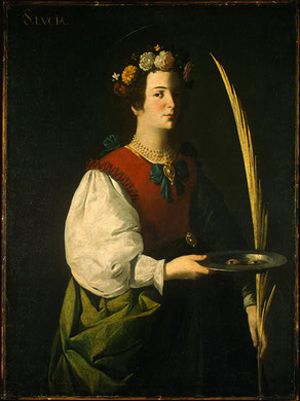
Francisco de Zurbaran’s “Saint Lucy,” painted around 1630, is a compelling example of Spanish Baroque devotion distilled into a single, unforgettable figure. Against a dark, undefined background, the young martyr stands in half length, richly dressed, crowned with flowers, and holding the two primary attributes that identify her: a palm of martyrdom and a metal plate on which rest a pair of disembodied eyes. At the upper left we read the inscription “S. LVCIA,” quietly confirming her identity.
From the first glance the painting balances beauty and horror, elegance and sacrifice. Saint Lucy appears serene and almost aristocratic, yet she presents to the viewer a shocking symbol of bodily mutilation. Zurbaran transforms this potentially gruesome subject into a sober and dignified portrait of sanctity. The restrained drama, the tactile rendering of fabrics, and the concentrated light that falls on her face and garments all place the work among the finest of Zurbaran’s female saint images.
Historical and Devotional Context
The painting belongs to the intensely religious climate of early seventeenth century Spain. The Counter Reformation encouraged artworks that would promote devotion to saints and martyrs, offering them as models of steadfast faith. Saint Lucy, a virgin martyr from Syracuse traditionally believed to have died under the persecution of Diocletian, was widely venerated throughout Catholic Europe. Her cult was particularly strong in Mediterranean regions where her feast day in December was associated with light in the darkest season.
According to legend, Lucy had consecrated her virginity to Christ and refused marriage to a pagan suitor. Accused of being a Christian, she endured torture and ultimately martyrdom. Medieval variations of her legend added a striking detail: because she had promised her eyes to no one but Christ, her persecutors gouged them out, yet God miraculously restored her sight. In art she thus came to be represented with a pair of eyes on a plate or in a cup, a symbol of both her suffering and her spiritual vision.
In Zurbaran’s Spain, such images served several functions. They adorned altars and convent spaces, reminding viewers of the saints’ heroic witness. They also offered consolation and inspiration, particularly to women in religious communities who saw in these virgin martyrs an ideal of courageous fidelity. “Saint Lucy” was likely part of a series of single saint images meant to decorate a church or convent, each figure presented almost as a life sized, heavenly intercessor.
Composition and Pose
Zurbaran’s composition is remarkably simple yet carefully calculated. Saint Lucy is placed slightly off center, turned in three quarter view toward the right. Her head is lifted, her gaze directed outward toward the viewer’s left, giving her an alert, contemplative look. The figure fills most of the vertical space, while the dark background recedes into near blackness.
Her right arm rises diagonally to hold the long palm frond, which stretches almost the full height of the canvas and introduces a strong vertical accent. Her left arm extends horizontally, supporting the shallow metal plate. The two attributes create a subtle cross like structure, with the palm forming the vertical and the plate the horizontal, quietly recalling the instrument of Christ’s own martyrdom.
The placement of the figure at the edge of a pool of light strengthens the sense of presence. The upper right remains dark, while the illumination focuses on Lucy’s face, torso, and hands. This focus directs the viewer’s attention to the saint’s expression and to the symbolic objects she carries. The surrounding darkness acts like a curtain that shuts out any distraction, turning the painting into a contemplative encounter between viewer and saint.
Light, Shadow, and Baroque Drama
Zurbaran is famous for his use of tenebrism, the dramatic interplay of light and shadow. In “Saint Lucy,” a concentrated beam of light falls from the left, modeling her face and garments with remarkable clarity. The light grazes the flowers in her hair, glints off the pearls and jewels at her chest, and picks out the highlight on the metal plate.
The background, by contrast, is a deep, velvety darkness. This contrast does more than create a striking visual effect. It symbolizes the spiritual reality of the saint. Lucy is literally a bearer of light, whose very name is associated with illumination. Surrounding her with darkness and then bathing her in light underlines her role as a radiant figure who shines in the night of persecution and sin.
The shadows are soft enough to maintain the roundness of her face and the volume of the drapery, but they remain strong enough to carve out a vivid silhouette. The result is a figure that seems to emerge from the dark space toward the viewer, almost stepping into our world. This sense of immediacy is typical of Spanish Baroque religious art, geared toward fostering a personal connection with the holy person depicted.
Costume, Fabrics, and Zurbaran’s Love of Texture
One of the most striking aspects of the painting is Lucy’s elaborate costume. Zurbaran delights in the textures and colors of fabric, and here he constructs a sumptuous ensemble that fuses contemporary Spanish fashion with timeless symbolic richness.
The saint wears a brilliant red bodice, cinched at the waist, that immediately draws the eye. Red traditionally signifies martyrdom and charity, and here it visually connects Lucy with the sacrifice she has made. Over this bodice she wears a white chemise with voluminous sleeves, gathered at the wrists. The puffed white sleeves catch the light in broad, sculptural folds, demonstrating Zurbaran’s mastery of painting cloth.
Around her waist and extending downward is a green drapery that forms the lower part of her garment. The green cloth tumbles in large folds, providing a cool counterpoint to the warm red above. Green can symbolize hope and life, which is appropriate for a saint whose martyrdom is understood as a passage to eternal life.
Lucy’s costume is completed by rich accessories. A jeweled brooch glitters at her chest, possibly featuring a cameo, while a long string of pearls and a pendant hang from her neck. A sash or ribbon with jewel tones adds another touch of color. These ornaments underline her noble status and can also be read as spiritual symbols: pearls often represent purity of heart, and jewelry given up for Christ is a sign of renounced worldly vanity.
The textures are rendered with painstaking attention. The metallic gleam of the plate, the softness of fabric, the cool smoothness of pearls, and the translucent petals of the flowers all contribute to a tactile richness that invites slow looking. Zurbaran transforms the saint into a living presence whose clothing and objects feel almost touchable.
The Floral Crown and Halo
On Lucy’s head sits a garland of flowers, interwoven with her dark hair and crowned by a faint golden halo. The flowers vary in color and shape, including white, pink, and perhaps yellow blossoms. This floral wreath associates Lucy with virginity and spiritual springtime. In Christian symbolism, flowers often represent virtues blossoming under the influence of divine grace.
The halo is subtle but crucial. Rather than a sharply defined disc, it appears as a gentle glow encircling the top of her head. This restrained treatment keeps the saint grounded in realism while still marking her as sanctified. The combination of a natural wreath and a supernatural halo merges earthly beauty with heavenly glory. The viewer perceives Lucy as both a young woman of flesh and blood and a transfigured inhabitant of the heavenly court.
The Plate with Eyes and the Palm of Martyrdom
The most distinctive elements of the painting are the objects Lucy holds. In her left hand, she supports a round metal plate on which lie a pair of human eyes. Zurbaran depicts them with astonishing restraint. They are small, pale, and slightly glossy, not presented as bloody or graphic but clearly separated from the body. The plate itself is painted with cool metallic reflections, catching the light in a way that emphasizes its solid materiality.
This attribute directly references the legend of Lucy’s eyes being torn out during her martyrdom, then miraculously restored. The eyes on the plate symbolize both her physical suffering and her spiritual vision. For devout viewers, they would have suggested that true sight is not merely a bodily function but a gift of faith. Lucy, whose very name is derived from light, becomes a patroness of those seeking both physical and spiritual clarity.
In her right hand Lucy grasps the tall palm frond that rises alongside her body. The palm is a traditional symbol of martyrdom, derived from ancient imagery of victory. In Christian art, martyrs often carry palms as signs that they have triumphed over death through their faith in Christ. Zurbaran paints the palm as a slender, slightly curved stalk with pointed leaves, lit along its edge by the same light that shines on Lucy’s face.
Together, the plate and the palm form a visual summary of Lucy’s story. The palm proclaims her victory, the eyes embody the particular cruelty she endured. Yet in the painting, these objects are handled with a calm dignity that transforms horror into testimony.
Expression, Gesture, and Inner Life
Although the painting includes dramatic attributes, Lucy’s expression is surprisingly composed. Her face is youthful and fair, with softly modeled cheeks and a slightly parted mouth. She looks off into the distance rather than directly confronting the viewer. This sideways gaze suggests contemplation rather than confrontation. She appears absorbed in a reality beyond the frame, perhaps in the presence of Christ or in anticipation of her final reward.
Her posture is poised and stately. The left arm that holds the plate is extended but relaxed, while the right hand clasps the palm with gentle firmness. There is no sign of tension or pain in her body language. Zurbaran chooses to show the saint not in the moment of torture but in the state of glorified serenity that follows it. Her calm demeanor invites the viewer to reflect on the spiritual strength that enabled her to endure.
The slight turn of her head and shoulders also introduces elegance, echoing contemporary portraits of noblewomen. By giving her the poise of a courtly lady, Zurbaran dignifies Lucy and perhaps appeals to female patrons who would recognize in her both an ideal of holiness and an ideal of cultivated femininity.
Zurbaran’s Style and the Tradition of Single Saint Portraits
“Saint Lucy” belongs to a broader tradition in Spanish art in which saints are portrayed as single, standing figures isolated against dark grounds. Zurbaran excelled in this format. He painted numerous representations of female martyrs such as Saint Catherine, Saint Agnes, or Saint Apollonia, as well as male saints and monastic figures. In each case he combined the realism of portraiture with the hierarchy of sacred art.
What distinguishes his approach is the fusion of simplicity and richness. The compositions are uncluttered, yet the fabrics and objects are lavishly detailed. The faces are not highly individualized yet convey a quiet psychological depth. This style suited the spiritual aims of the Counter Reformation, which sought clarity, emotional immediacy, and doctrinal correctness in religious images.
In “Saint Lucy,” Zurbaran’s characteristic restraint is evident. He does not crowd the canvas with narrative scenes from her life. Instead he presents a timeless image that encapsulates her identity and virtues. The result is almost iconic. For worshippers, it would function as a focus for prayer, allowing them to address the saint directly as if she stood before them. For modern viewers, it offers a powerful example of how Baroque realism and spiritual symbolism can coexist.
Spiritual Meaning and Devotional Function
Beyond its artistic qualities, the painting carries rich spiritual meaning. Saint Lucy appears as a figure of courage, purity, and steadfast faith. Her rich dress, once a sign of worldly status, is now dedicated entirely to the glory of God. The plate of eyes reminds believers that physical suffering, even the loss of such an essential sense, can become a path to deeper vision when embraced for Christ.
The dark background can be interpreted as the world of persecution and sin. In this darkness Lucy stands luminous, a witness to the light of Christ that no violence can extinguish. For seventeenth century viewers facing social upheaval, illness, or personal hardship, such an image would have provided consolation and encouragement.
The painting also speaks to the theme of identity. The inscription “S. LVCIA” at the upper left affirms her name, yet the story told by the attributes reveals the deeper meaning of that name. Lucy is not simply a historical figure but a living presence in the communion of saints, an intercessor for those who seek light, protection, and clarity in their lives.
For modern audiences, the painting continues to resonate. The combination of beauty and vulnerability in Lucy’s figure invites reflection on how inner integrity can persist even when the body is threatened or scarred. Her calm dignity confronts contemporary culture’s preoccupation with physical appearance and eyesight, suggesting that true vision lies in the capacity to see with the heart.
Conclusion
Francisco de Zurbaran’s “Saint Lucy” is a masterful embodiment of Spanish Baroque spirituality. Through a simple yet powerful composition, dramatic lighting, sumptuous fabrics, and carefully chosen symbols, the artist creates a memorable image of a young martyr who unites grace and steadfast courage. The painting balances intimacy and distance, presenting Lucy as both a noblewoman of flesh and blood and a radiant inhabitant of heaven.
The subtle glow of her halo, the delicate flowers in her hair, the gleam of pearls and metal, and the soft folds of her garments all contribute to an atmosphere of quiet magnificence. At the same time, the plate with eyes and the palm of martyrdom anchor the work in the harsh reality of persecution.
Whether viewed in its original devotional context or in a modern museum, “Saint Lucy” continues to invite contemplation. It encourages viewers to consider the relationship between outer sight and inner vision, between bodily suffering and spiritual triumph, between darkness and the light that saints are believed to reflect. In Lucy’s poised figure, Zurbaran offers a lasting portrait of faith that shines across the centuries.