Image source: wikiart.org
Introduction to Beato Serapio by Francisco de Zurbaran
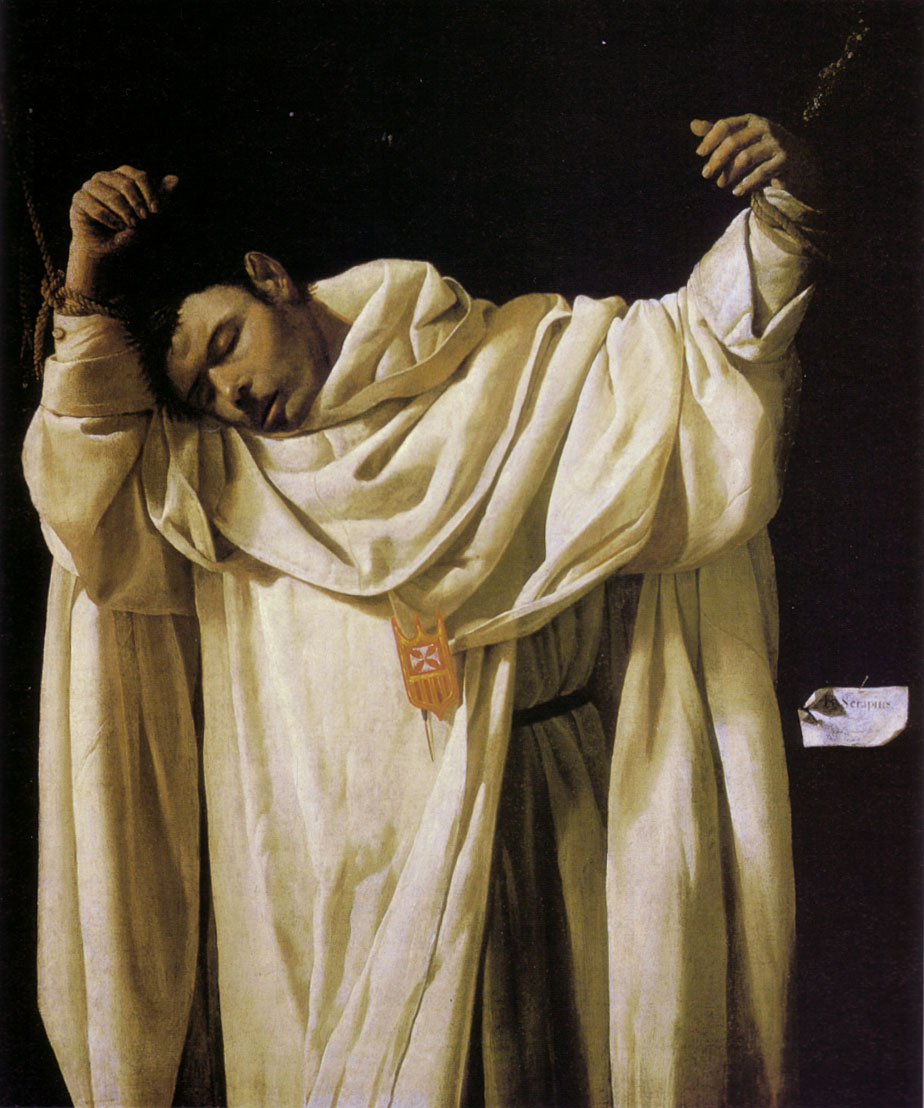
Francisco de Zurbaran’s painting “Beato Serapio,” completed in 1628, is one of the most haunting and meditative images of martyrdom in seventeenth century Spanish art. At first glance the work appears almost shockingly simple. A single monk, dressed in an ample white habit, hangs with his arms raised and his head tilted to one side, set against a deep black background. Yet the longer the viewer contemplates the painting, the more complex and powerful it becomes. “Beato Serapio” draws together the spirituality of the Counter Reformation, the austerity of monastic life and the dramatic visual language of the Baroque into a single image that feels both intimate and monumental.
Zurbaran created this work for the Mercedarian monastery in Seville, where it served as a devotional image honoring a martyred brother of the order. Instead of depicting violent action or gruesome wounds, the painter offers a quiet, almost tender representation of sacrifice. The body of Serapio seems to sleep, wrapped in an ocean of white fabric that glows against the darkness. This combination of stark realism and spiritual calm explains why the painting still captures the imagination of viewers today.
Historical and Religious Context of “Beato Serapio”
To understand the emotional power of “Beato Serapio,” it is helpful to consider the religious climate of Spain in the early seventeenth century. The country was a center of the Counter Reformation, when the Catholic Church used painting and sculpture to inspire devotion, teach doctrine and celebrate the examples of saints and martyrs. Artists were encouraged to create images that were clear, emotionally moving and doctrinally sound. Zurbaran excelled at this kind of sacred art, especially for religious orders in Seville and the surrounding region.
The subject of the painting, Serapion, was a Mercedarian friar who lived in the thirteenth century. The Mercedarian Order, officially known as the Order of the Blessed Virgin Mary of Mercy, devoted itself to the redemption of Christian captives held by Muslim powers. According to tradition, Serapion offered himself as a hostage in place of captive Christians and was brutally killed when the ransom did not arrive. By the seventeenth century he was revered in Spain as a heroic martyr who embodied self sacrifice and faith.
Zurbaran does not show the historical setting, the captors or the instruments of torture. Instead he distills the story into its spiritual core. The viewer encounters not a literal scene from history, but the enduring image of a martyr who has surrendered his life to God. This approach reflects the contemplative spirituality of the time, which encouraged believers to meditate on the inner meaning of the saints’ lives rather than only on external events.
Zurbaran and the Language of Spanish Baroque Painting
Francisco de Zurbaran was one of the leading painters of the Spanish Baroque, alongside artists such as Diego Velázquez and Bartolomé Esteban Murillo. Known for his intense realism, strong contrasts of light and shadow and deep religious feeling, he became particularly associated with images of monks, hermits and martyrs. “Beato Serapio” is a quintessential example of his style.
In contrast to some Italian Baroque artists who favored dynamic compositions filled with movement and color, Zurbaran often preferred a still, frontal presentation. His figures frequently appear isolated in empty space, illuminated by a serene but powerful light. This quiet intensity gives his paintings a sense of inner gravity. In “Beato Serapio,” the figure of the monk occupies almost the entire canvas, turning the painting into a kind of monumental portrait of sanctity and suffering.
Zurbaran’s training included exposure to the naturalism of Caravaggio and his followers, who used strong light and shadow to model figures and to heighten drama. Yet the Spanish painter transforms this vocabulary into something more austere and contemplative. The light that falls on the white habit of Serapio is not theatrical but steady and penetrating, revealing every fold of the fabric and every subtle tone of the cloth. Through this careful realism Zurbaran makes the spiritual visible.
Composition and Pose: A Martyr in Suspended Stillness
The composition of “Beato Serapio” is deceptively simple. Serapio’s body is presented almost frontally, slightly turned to the viewer’s left. His arms are raised and bound with ropes at the wrists, disappearing into the darkness at the top corners of the canvas. This gesture immediately indicates that he is captive, yet there is no sign of struggle. His head falls to the side, eyes closed, lips parted as if in sleep. The result is a pose that combines surrender, exhaustion and peaceful acceptance.
The figure fills the pictorial space from top to bottom, so that the viewer confronts the martyr at nearly life size. There is very little sense of depth. The dark background pushes the body forward, making the physical presence of the saint almost tangible. At the same time, the lack of setting detaches him from any specific place, turning the image into a universal statement about sacrifice and faith.
Zurbaran uses diagonals in a subtle way to give structure to the composition. The line of the head tilted to the left is echoed by the slope of the folded cowl and the descending curves of the drapery. These diagonals counter the verticality of the hanging figure, preventing the image from feeling rigid. Yet the overall impression remains one of profound stillness, as if time itself had been suspended at the moment of death.
Light, Shadow and the Mystical Atmosphere
One of the most striking elements of “Beato Serapio” is the way Zurbaran uses light. A single, unseen source illuminates the figure from the left, leaving the background in complete darkness. This technique, often associated with tenebrism, creates an intense contrast between the luminous whites of the habit and the enveloping black space around him. The effect suggests that the monk is emerging from darkness into spiritual light, reinforcing the theme of martyrdom leading to salvation.
The shadows play across the folds of the cloth, shaping them into sculptural volumes. Yet the light never becomes harsh. Instead, it has a quiet, contemplative quality, like light entering a silent chapel. This contributes to the sense that we are witnessing a sacred vision rather than an ordinary human scene.
The face of Serapio is partially in shadow, which adds to the mystery. We can read the features clearly, but they are softened by the play of light. There is no grimace of pain, no dramatic expression. The half shadow allows the viewer to project his or her own sense of emotion onto the face, whether sorrow, compassion or admiration. In this way, Zurbaran invites an intimate, personal response to the image.
The White Habit as Central Visual Theme
If there is a single visual protagonist in this painting, it is the Mercedarian white habit that wraps the body of Serapio. Zurbaran transforms this garment into a vast field of off white tones, from creamy ivory to cool gray. The folds and layers form intricate patterns, almost like waves of cloth cascading down the figure. This monumental drapery serves several purposes at once.
First, it emphasizes the purity and sanctity of the martyr. In Christian symbolism white is associated with innocence, spiritual cleanliness and the glory of resurrection. By exaggerating the volume and luminosity of the habit, Zurbaran turns it into a physical manifestation of Serapio’s inner holiness.
Second, the sculptural quality of the drapery underscores the stillness of the scene. The heavy folds hang with a sense of weight and gravity, reminding us that this is a real human body subject to physical laws. Yet the precision with which they are rendered gives the painting an almost abstract beauty, as if the fabric were a landscape of light and shade.
Third, the habit unifies the composition. Since the background is completely dark and there are almost no additional objects in the scene, the white garment provides the main field of visual interest. The viewer’s gaze moves across its ridges and valleys, drawn ever closer to the quiet face that emerges from the upper part of the cloth. The habit is not simply clothing but the vehicle through which the viewer’s meditation travels.
Symbols of Identity and Martyrdom
Although the painting appears very sparse, Zurbaran includes two small but important details that identify the subject and deepen the meaning of the work. On the chest of the monk hangs a small badge bearing the red cross of the Mercedarian Order. This emblem tells the viewer that Serapio belongs to a community dedicated to the redemption of captives. The badge is painted with the same care as the folds of the habit, yet its warm color stands out against the white fabric, catching the eye and reminding us of the order’s mission and the sacrificial nature of Serapio’s death.
To the right of the figure, pinned to the cloth or attached to the background, is a small piece of paper bearing an inscription. In many of Zurbaran’s works this trompe l’oeil label functions like a caption within the painting, identifying the saint or martyr. It imitates the real labels that might accompany a relic or devotional image in a monastic setting. In “Beato Serapio” this piece of paper links the silent image to the world of text, devotion and liturgy. It also reinforces the illusion that we are standing before a real object in a chapel rather than a mere depiction on canvas.
The ropes tied around Serapio’s wrists are another powerful symbol. They are plain, utilitarian cords, but they carry the entire weight of the martyrdom narrative. Through them we know that he is bound, constrained and ultimately killed for his faith. At the same time, there is a visual echo between the spiral of the ropes and the curling edges of the paper badge and label. Even these instruments of suffering are woven into the quiet harmony of the composition, suggesting that the martyr’s pain has been transfigured into spiritual beauty.
Emotional Impact and Spiritual Meaning
The emotional tone of “Beato Serapio” is remarkably restrained. There is no blood, no screaming, no onlookers reacting with horror or grief. Instead, the painting conveys a deep sense of resignation and peace. Serapio’s closed eyes and relaxed mouth suggest that the moment of intense suffering has passed and that he is now crossing the boundary between life and death. The viewer is invited to consider not the cruelty of his execution but the serenity of his surrender to God.
For the Mercedarian monks who originally viewed this painting in their monastery, the image would have been both a reminder and a challenge. Serapio embodied the highest ideal of their order: the willingness to risk or give one’s life to free others. Contemplating his calm figure, the monks could meditate on the meaning of their own vows and the cost of true charity. The painting thus functioned as a spiritual mirror, reflecting back the values of the community.
For modern viewers, the painting still speaks powerfully about sacrifice, conscience and inner dignity. Even outside its original religious context, the image of a solitary human being who accepts death rather than betray his beliefs resonates deeply. The silence of the background and the absence of narrative detail allow the viewer to project a wide range of meanings onto the figure, from resistance and courage to quiet endurance.
Comparison with Other Martyrdom Scenes
Within the broader tradition of European art, martyrdom scenes often include dramatic landscapes, hostile crowds and spectacular episodes of violence. Painters such as Titian or Rubens filled their canvases with dynamic compositions where bodies twist and struggle, angels descend from heaven and executioners wield weapons. Compared to these works, Zurbaran’s “Beato Serapio” appears almost minimal.
This simplicity, however, is precisely what makes the painting so original. By reducing the scene to a single figure, a dark background and a glowing habit, Zurbaran shifts the focus from external drama to internal transformation. The viewer does not witness the moment of physical torture but the quiet aftermath, when the martyr has already embraced his fate. The violence is implied rather than shown.
Within Zurbaran’s own oeuvre, the painting stands out as one of his most refined treatments of monastic sanctity. He painted many images of saints and monks absorbed in prayer or reading, but in “Beato Serapio” the contemplative quality is combined with the ultimate act of self giving. The result is a work that feels both like a portrait and a monument, an image of an individual and a timeless symbol.
Legacy and Modern Reception of “Beato Serapio”
Today “Beato Serapio” is widely regarded as one of Zurbaran’s masterpieces and a landmark of Spanish Baroque painting. Its stark beauty and psychological depth have attracted art historians, theologians and contemporary artists alike. The painting has been praised for its extraordinary handling of white, its subtle modeling of light and its profound emotional resonance.
Modern viewers often respond to the painting’s sense of human vulnerability. Although Serapio was a religious figure, his body hanging in space and his bowed head evoke universal themes of suffering and mortality. The absence of graphic detail allows the image to transcend differences of time and belief. In museums and reproductions around the world, “Beato Serapio” continues to invite quiet contemplation.
The work also exemplifies the particular character of Spanish Golden Age art, with its fusion of intense realism and deep spiritual feeling. Through Zurbaran’s brush, the cloth, ropes and human flesh become vehicles of transcendence. The painting reminds us that Baroque art was not only theatrical and exuberant, but also capable of incredible restraint and inwardness.
Conclusion: Why “Beato Serapio” Still Matters
“Beato Serapio” by Francisco de Zurbaran, painted in 1628, remains a powerful statement about faith, sacrifice and the dignity of the human person. Its composition is extraordinarily simple, yet each element is carefully chosen. The dark background isolates the figure, the white habit glows with spiritual intensity, and the bound arms and tilted head speak of suffering accepted in peace. Together, these elements create a visual meditation that continues to move viewers centuries after its creation.
The painting offers more than a historical record of a thirteenth century martyr. It invites anyone who stands before it to consider questions of conscience, courage and inner freedom. In an age when dramatic spectacle often dominates visual culture, Zurbaran’s quiet, concentrated image of martyrdom has a special relevance. Its silence encourages contemplation rather than distraction, reflection rather than noise.
By focusing so intently on one solitary figure, Zurbaran succeeds in making the story of Beato Serapio both deeply personal and broadly universal. The monk in his luminous habit becomes a symbol of steadfastness in the face of oppression, a reminder that true heroism may appear not in dramatic gestures but in the calm acceptance of suffering for a higher good. That combination of realism, spirituality and psychological depth explains why “Beato Serapio” remains one of the most unforgettable paintings of the Spanish Baroque.