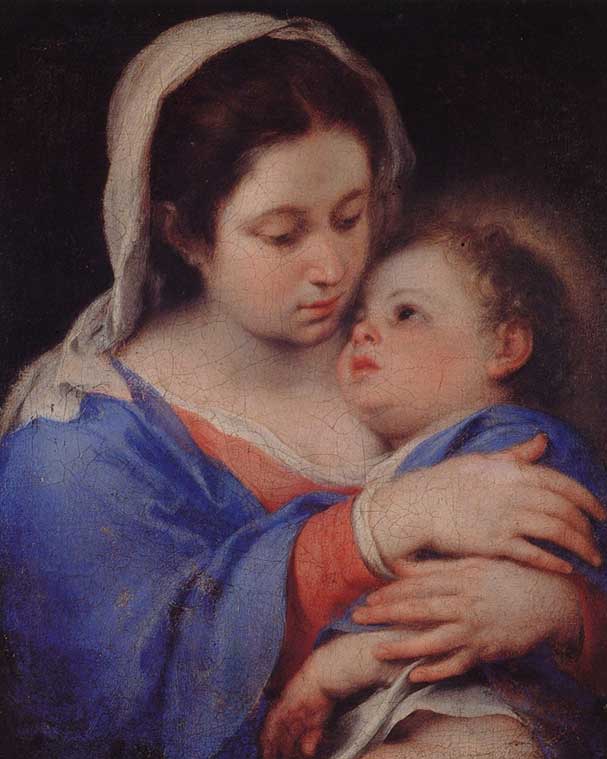
Image source: wikiart.org
Introduction
“Virgin and Child” by Bartolome Esteban Murillo is one of those paintings that feels less like a distant sacred icon and more like a quiet moment overheard between a mother and her baby. The composition is simple: Mary bends her head toward the Christ Child, who rests against her shoulder and gazes up at her with trusting eyes. There is no elaborate background, no ornate throne or procession of angels. Everything in the painting is focused on the intimate bond between two figures wrapped in soft light and gentle color.
Murillo, working in seventeenth century Seville, became famous for exactly this kind of image. His Madonnas are not remote queens of heaven but tender, approachable mothers. In this work he distills his approach to its purest form. The viewer is drawn close, almost into the embrace itself, and invited to contemplate the mystery of the Incarnation not through theological symbols alone but through the visible language of affection, touch, and human vulnerability.
Murillo And The Devotion To The Virgin
To understand the power of this “Virgin and Child,” it helps to remember the cultural and spiritual environment in which Murillo painted. Seville in the Baroque period was a city saturated with Marian devotion. Confraternities, processions, and altarpieces celebrated Mary under titles like Our Lady of the Rosary, the Immaculate Conception, and Our Lady of Sorrows. Artists were constantly asked to produce images that could nourish this devotion, encouraging viewers to love Mary as spiritual mother and model of faith.
Murillo became one of the greatest interpreters of Marian themes. He painted large doctrinal canvases such as his many Immaculate Conceptions, but he also created smaller and more intimate works like this one. These were often intended for private homes or small chapels, where believers could pray in front of an image that felt personal rather than monumental.
In “Virgin and Child,” Murillo offers not a dramatic revelation but a quiet contemplation. The absence of heavy symbolism allows the viewer to approach Mary and Christ much as a child might approach its own mother – through gentle closeness and trust.
Composition And The Embrace
The composition is tightly cropped so that Mary and the Child fill almost the entire frame. There is no visible setting, only a dark, undefined background that pushes the figures forward. This choice increases the sense of intimacy and directs all attention to their faces and hands.
Mary tilts her head down and slightly to the side, her eyes lowered toward the child. Her nose and forehead form a soft line that almost touches the child’s brow. The Christ Child leans back into her arms, his face turned upward with a look that blends curiosity and contentment. Their heads together create a gentle diagonal that guides the eye from Mary’s gaze down to the child’s eyes, then back up again in a circular rhythm.
The positioning of Mary’s arms is crucial. One arm supports the child’s back, the hand visible under his arm and across his chest. The other arm wraps across his body from the front, hand resting near his side. These overlapping arms form a protective cradle, emphasizing that the child is encircled on all sides by maternal care. The viewer almost feels the weight of the little body and the softness of the embrace.
Expressions And Emotional Depth
Murillo’s great gift is his ability to convey emotion without exaggeration. Mary’s expression is profoundly tender but quiet. Her mouth is relaxed, corners turned very slightly downward, as if she were on the verge of a thoughtful smile or a gentle word. Her eyes do not stare into the distance in ecstatic vision, as in many earlier Marian images. Instead they focus on the child, absorbed entirely in him. This makes her love feel concrete and personal.
The Christ Child’s face is wonderfully alive. His cheeks are plump and flushed, his lips slightly parted. He does not look at the viewer but at Mary, as if seeking reassurance, conversation, or closeness. This direct gaze from child to mother subtly reverses traditional devotional dynamics. Instead of the viewer addressing Christ through Mary, we see Christ himself looking to Mary with trusting dependence. The relationship between them becomes the central subject.
Through these expressions Murillo manages to hold together two truths at once. On one level we are simply watching a mother and baby, a subject that anyone can understand regardless of religious background. On another level, Christians recognize in this tender exchange the theological heart of the Incarnation: God made vulnerable, resting in human arms, and Mary responding with reverent love.
Color, Light And Atmosphere
Color plays a major role in the painting’s emotional impact. Murillo uses the traditional Marian blue for the Virgin’s mantle, but he softens it into gentle, almost velvety tones. Underneath, a warm red garment peeks out, symbolizing love and perhaps the future Passion of Christ, yet it never dominates. Instead, red and blue interact harmoniously, wrapping Mary like a calm, protective aura.
The Christ Child wears a pale garment with touches of the same blue, visually linking him to his mother. This echo of color suggests that their lives are intertwined, that his identity is shaped in relation to hers.
Light is soft and diffused. It falls most strongly on the faces and hands, leaving the background in deep shadow. There are no sharp contrasts or dramatic rays. Instead, Murillo bathes the scene in a warm, gentle glow that feels like the natural light of a quiet interior. This softness enhances the sense of serenity and domestic peace. The delicate craquelure in the paint surface, visible today, even adds to the feeling of an old, cherished image handled and prayed before for generations.
Drapery And Symbolic Details
Murillo is careful with the details of clothing and drapery. Mary’s white veil frames her face and falls softly over her shoulders. White, the color of purity, underscores her role as immaculate mother. Yet the veil is not stiff or regal; it looks like practical cloth a young woman might wear in daily life. This combination of symbolism and realism is central to Murillo’s approach.
The folds of the blue mantle are painted with broad, confident strokes, but they remain secondary to the figures. They create a flowing diagonal from Mary’s shoulder down to the child’s legs, reinforcing the movement of the embrace. The garments of both figures are somewhat simplified, with few decorative details. Murillo is not interested in fashionable display; he wants the viewer to dwell on faces, hands, and the emotional line between mother and child.
Even the child’s small hand resting against Mary’s chest carries symbolic weight. It reminds us that the one she holds is not only her baby but also the one whose heart will be pierced, whose life will be given. Still, the painting does not dwell on sorrow. Any foreknowledge of future suffering remains quietly embedded under the surface of present tenderness.
Humanizing The Sacred
One of the reasons Murillo’s religious paintings were so beloved in his own time and remain captivating today is his ability to humanize sacred subjects without diminishing their spiritual significance. In “Virgin and Child” he does this through scale, gesture, and a kind of intimate informality.
There is no throne, no crown, no visible halo. Sanctity is suggested by the figures’ serenity and by traditional colors, but it is not insisted upon with rigid iconographic markers. Mary appears as a young woman that viewers might recognize from their own neighborhoods. Her features are soft, her skin pale but touched with a healthy blush. The Christ Child looks like an actual toddler from seventeenth century Seville, sturdy and bright eyed.
By presenting them this way Murillo encourages the viewer to approach the divine through the lens of everyday human experience. The painting says, in effect, that holiness is not distant from ordinary affection. The love of Mary and Jesus is a glorified form of the love found in any good family. This humanization made Murillo’s work particularly effective for private devotion, because believers could feel that the sacred family understood their own joys and struggles.
Intimacy And The Viewer’s Role
The close framing and lack of background draw the viewer into the space of the painting. It feels as if we are standing just beside Mary, close enough to hear her speak or to see the child breathe. Yet the figures remain unaware of us, absorbed in each other. This creates a contemplative dynamic: we are allowed to watch a sacred intimacy without disturbing it.
For someone praying with the image, this dynamic can be powerful. The viewer might imagine being a quiet witness in the home of Nazareth, or might see themselves spiritually represented in the child resting on Mary’s breast. Many Marian devotions invite believers to entrust themselves to Mary as children, and Murillo’s painting gives visual form to that experience.
At the same time, the downward tilt of Mary’s head and the gentle curve of her body create a protective enclosure. The dark background becomes almost like a veil of silence around them. The world and its noise are shut out; only mother and child remain in focus. This sense of sheltered intimacy can make the painting feel like a visual refuge, a place to rest the eyes and heart.
Comparison With Other Murillo Madonnas
Murillo painted numerous images of the Virgin and Child, yet each has its own nuance. Some show Mary looking directly at the viewer, presenting the child for veneration. Others place them in more elaborate settings with angels, landscapes, or symbolic objects.
This particular “Virgin and Child” is among the most restrained and tender. Compared with his grander altarpiece versions, it is more private, more like a portrait than a public icon. The close cropping and absence of additional figures give it an intensity not always present in larger compositions.
The softness of the modeling and the very subtle transitions between light and shadow suggest a mature period in Murillo’s career, when he had fully developed his characteristic velvety style. The emotional focus on mutual gaze and embrace also shows the culmination of his interest in psychological realism.
Technique And Handling Of Paint
Looking closely at reproductions, one can sense Murillo’s delicate handling of paint. The faces are modeled with thin, smooth layers that allow for soft transitions of tone. There are no harsh outlines; forms emerge gently from the background. This technique contributes to the dreamlike serenity of the scene.
In the garments, especially the mantle, the brushwork becomes slightly more visible. Murillo uses broader strokes and subtle variations of blue and violet to suggest folds and depth. Highlights are applied sparingly along the edges of drapery and the bridge of the nose or cheekbones, giving the figures a gentle luminosity rather than a sharp shine.
The overall effect is one of softness and unity. Nothing feels fragmented or overly defined. This suits the subject perfectly, since the painting is less about individual textures and more about the continuous flow of affection and presence between Mary and Jesus.
Spiritual Meaning And Contemporary Resonance
Beyond its historical and aesthetic value, “Virgin and Child” continues to resonate because it touches universal themes. The tenderness of a mother for her child, the safety of being held, the calm of a simple embrace – these experiences speak across cultures and centuries.
For Christian viewers, the painting deepens these themes with theological meaning. It visualizes the mystery of God’s closeness to humanity, of divine love made visible in a child who rests in human arms. Mary’s role as mother becomes a symbol of the Church itself, called to shelter and present Christ to the world.
For viewers without specific religious commitments, the painting still offers a moving image of human intimacy. It invites reflection on one’s own relationships, on the fragile yet powerful bonds that form our earliest sense of belonging. In a world where images often emphasize shock or spectacle, Murillo’s quiet focus on tenderness can feel surprisingly refreshing and contemporary.
Conclusion
Bartolome Esteban Murillo’s “Virgin and Child” is a small masterpiece of Baroque devotion and human feeling. Through a simple composition of two closely intertwined figures, he conveys layers of meaning: the tenderness of motherhood, the vulnerability of infancy, the spiritual mystery of the Incarnation, and the quiet strength of unconditional love.
The soft light and harmonious colors create an atmosphere of gentle calm. The lack of distracting details keeps the viewer’s attention fixed on the meeting of eyes and the interlacing of hands. Mary’s protective embrace and the child’s trusting gaze transform an age old religious subject into an immediate, heartfelt encounter.
Centuries after it was painted, this work still invites viewers to pause, breathe, and contemplate the beauty of a love that is both profoundly human and, in the Christian understanding, profoundly divine. It is this fusion of everyday tenderness and transcendent meaning that makes Murillo’s “Virgin and Child” such a enduring and beloved image.