Image source: wikiart.org
Historical Context of Murillo’s “The Immaculate Conception”
Bartolome Esteban Murillo’s “The Immaculate Conception” belongs to one of the most important themes of seventeenth century Spanish art. In Seville, where Murillo lived and worked, devotion to the Immaculate Conception of the Virgin Mary was fervent and widespread. Long before the doctrine was formally defined, Spain championed the belief that Mary was preserved from original sin from the first moment of her existence. Confraternities, religious orders, and civic institutions commissioned paintings that celebrated this privilege and defended it visually.
Murillo became the leading painter of the Immaculate Conception in Spain. His versions of the subject were praised for their softness, luminous color, and tender yet exalted treatment of the Virgin. This canvas fits squarely into that tradition. Although the exact date is unknown, stylistically it belongs to his mature period, when his language had settled into the serene, radiant style that distinguishes his later works. The painting synthesizes theology, devotion, and Baroque visual drama into a single, memorable image that would have served as both an object of contemplation and a public profession of faith.
General Description and First Impression
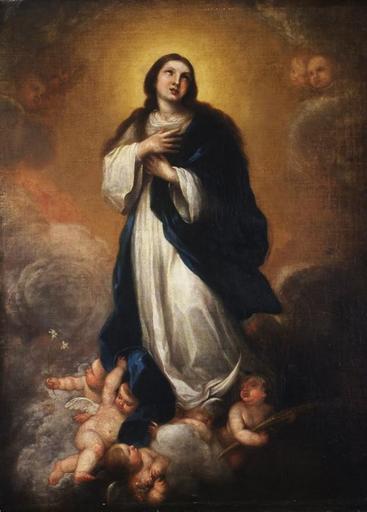
At first glance, the viewer encounters a tall, vertical composition dominated by the figure of the Virgin Mary standing above a cluster of cherubs. She is dressed in a flowing white gown and enveloped by a deep blue mantle that swirls around her body. Her hands are crossed over her chest, her eyes lifted upward in a gaze filled with reverent wonder. Behind her head, a brilliant golden light forms a halo that expands into the surrounding sky.
Beneath her feet, chubby angels support her on clouds. One clutches a small bouquet, another plays a stringed instrument, and another lifts his eyes toward her with delight. In the misty background, faint angelic faces emerge from the clouds, emphasizing that the entire scene unfolds in a heavenly realm. The lower portion of the picture is filled with vaporous grays and soft pinks, which gradually yield to the intense golden aura around Mary.
The immediate impression is one of elevation and purity. Murillo combines upward movement, radiant light, and the innocence of the childlike angels to create a vision that feels both supernatural and deeply approachable. The viewer senses that Mary is being lifted before their eyes, yet she remains gentle and human, a figure of modesty and grace rather than remote majesty.
Composition and the Central Figure of the Virgin
Murillo organizes the composition around a strong vertical axis. Mary’s figure occupies the center of the canvas, slightly off balance in a subtle contrapposto that gives her a sense of movement. Her weight appears to rest lightly on one foot, while the other is slightly bent as if she is in the act of stepping upward. The sweep of the blue mantle, which wraps around her body and cascades down toward the cherubs, amplifies this sense of ascent.
Her gesture is both simple and eloquent. By crossing her hands over her chest, Mary expresses humility, gratitude, and acceptance. The pose recalls her response at the Annunciation, when she declares herself the servant of the Lord. At the same time, the upward tilt of her head and the gentle opening of her lips suggest awe at the mystery of God’s action in her life. This combination of humility and wonder perfectly embodies the theological meaning of the Immaculate Conception, which presents Mary not as self made but as entirely graced.
Murillo elongates the figure slightly, giving her an almost column like elegance that draws the eye up through the picture. The white dress forms a luminous core, while the dark blue mantle frames her like folded wings. The effect is that of a living pillar of light rising from the clouds. The surrounding space, filled with soft vapor and angelic forms, seems to swirl in response to her ascent.
Light, Color, and Baroque Atmosphere
Light is the most powerful tool Murillo uses to convey the spiritual meaning of the scene. A golden radiance surrounds Mary’s head and upper body, forming an intense aura that gradually fades into the darker sky. This halo of light sets her apart from the surrounding clouds and cherubs, making her the undeniable focus of attention. The illumination does not come from any visible source; instead it appears to emanate from within, suggesting that holiness is not simply cast upon her from outside but shines through her whole being.
The color palette is carefully calibrated. The white of Mary’s dress symbolizes purity, innocence, and the absence of stain. Murillo paints it with soft highlights and gentle shadows that suggest delicate folds of fabric without sacrificing its glowing simplicity. The deep blue mantle, almost ultramarine, offers a rich contrast that heightens the brightness of the white. In traditional iconography, blue is associated with heaven and with Mary’s role as Queen, so the combination of white and blue visually announces her unique holiness.
The cherubs below are painted in warm flesh tones touched by rosy pinks, which create a lively contrast with the cooler whites and blues above. Their wings and the surrounding clouds are rendered in subtle grays and pale yellows, integrating them into the golden light that pervades the entire composition. The background sky transitions from darker browns and grays at the edges to luminous gold near the center, creating a vortex of light that seems to draw the entire scene upward.
This manipulation of light and color is a hallmark of Baroque painting, where atmospheric effects are used to express spiritual truths. In Murillo’s hands, chiaroscuro does not create harsh drama but a soft, enveloping glow that invites contemplation. The viewer is not startled but gently drawn into the mystery.
Iconography of the Immaculate Conception
The painting relies on well established visual symbols for the Immaculate Conception, yet Murillo renders them with his characteristic delicacy. The Virgin stands on clouds above cherubs, a sign that she participates already in heavenly glory. The small angels at her feet recall the psalm verse that speaks of God giving angels charge over his chosen one, but they also symbolize the joy of heaven at her privilege.
In many versions of the Immaculate Conception, Mary stands on a crescent moon and crushes a serpent beneath her feet, references to the woman in the Book of Revelation and to her victory over sin. In this particular canvas, the crescent and serpent are either absent or very discreet, but the sense of triumph over evil is still present. Her upward gaze and the luminous halo indicate that she is entirely oriented toward God, without the shadow of sin that weighs down ordinary mortals.
The cherubs sometimes hold attributes that allude to titles from the Litany of Loreto, such as mirror of justice, tower of David, or gate of heaven. In this painting, one angel appears to hold a musical instrument, connecting the scene with the idea of celestial praise. Another may present flowers, symbols of beauty and purity. These objects subtly reinforce the theological content without cluttering the composition.
Murillo’s decision to emphasize Mary herself rather than an array of symbols reflects a shift in Baroque spirituality. The faithful were encouraged to contemplate the person of Mary as a loving mother and intercessor, not merely as an abstract concept. By concentrating on her serene expression and graceful posture, Murillo invites viewers to form a personal relationship with her.
The Cherubs and the Heavenly Realm
The cluster of cherubs at the bottom of the painting plays an important role in creating a sense of movement and delight. Their small bodies twist and stretch in different directions, generating a swirl of forms that seems to lift Mary upward. They function almost like living clouds, a playful yet reverent support for the Immaculate Virgin.
Each cherub is individualized. One looks upward with wide eyed wonder, another focuses intently on the flowers or instrument he holds, and another turns outward, connecting the heavenly vision with the viewer’s space. Their plump limbs and expressive faces convey innocence and joy. Murillo was particularly gifted at painting children, and in these angelic figures he combines accurate observation of childlike gestures with idealized beauty.
The faint angelic heads in the upper right corner deepen the sense that the sky is filled with spiritual presence. They float lightly in the clouds, partially veiled by mist, as if emerging from a realm beyond ordinary perception. Their inclusion reminds the viewer that Mary’s privilege is not a private event but a cause of rejoicing for the entire heavenly community.
The interplay between cherubs, clouds, and light creates an immersive atmosphere. The ground is nowhere in sight. Instead, the viewer looks up into an open sky that extends beyond the frame. This visual strategy reinforces the subject matter. The Immaculate Conception concerns a spiritual reality that transcends earthly time and space. By situating the scene entirely in this intermediate zone of clouds and light, Murillo places the viewer symbolically on the threshold between earth and heaven.
Murillo’s Personal Interpretation of the Theme
While Murillo follows the standard iconography, his interpretation is marked by particular qualities. Many earlier representations of the Immaculate Conception emphasized doctrinal clarity with numerous symbols and inscriptions. Murillo simplifies. He relies on expression, gesture, and light to convey meaning. The result is a more intimate, affective image that speaks directly to the heart.
His Mary is distinctly human. She is youthful but not childlike, beautiful but without ostentatious ornament. There is no crown, no jeweled belt, no elaborate embroidery. Her sanctity is expressed through her modest posture and radiant surroundings rather than through worldly trappings. This restraint allows believers of all backgrounds to approach her without feeling distant.
Murillo also avoids the extremes of ecstatic emotion that some Baroque artists favored. Mary does not swoon or collapse in rapture. Instead, her upward gaze suggests a steady, contemplative awareness of God’s presence. This calm intensity reflects the kind of quiet, interior devotion promoted by spiritual writers of the period, who encouraged believers to cultivate a peaceful attentiveness to divine grace.
At the same time, the painting is undeniably theatrical in its use of light and clouds. Murillo balances this Baroque sense of spectacle with an underlying simplicity. The stage is vast, but the drama is gentle.
Devotional Function and Viewer Experience
For the seventeenth century faithful, a painting like “The Immaculate Conception” would have served multiple purposes. It was a public declaration of doctrinal belief, a visual proclamation that Mary was uniquely preserved from sin. It was also a focal point for prayer, especially for those who belonged to confraternities dedicated to the Immaculate Conception or who sought Mary’s protection.
Murillo’s composition encourages a specific kind of devotional response. The viewer’s eye naturally follows the cherubs upward to Mary’s luminous figure and then beyond to the golden light. This vertical movement mirrors the movement of the heart in prayer, from the concerns of earth to the contemplation of heavenly mysteries. The gentle expression on Mary’s face invites trust and affection. She appears attentive to God, but her body slightly turned toward the viewer suggests that she also notices those who pray before her.
In many churches, such paintings were placed above altars or side chapels where candles burned and rosaries were recited. The interplay of real candlelight with the painted illumination would have heightened the sense that Mary’s presence extended into the physical space. Even when viewed today in a museum or digital format, the painting retains something of that atmosphere. It continues to invite quiet reflection and to communicate a message of hope and grace.
The Broader Significance of Murillo’s Immaculate Conception Imagery
“The Immaculate Conception” is part of a series of works that helped shape the visual identity of Spanish Catholicism. Murillo’s approach became so influential that later artists and popular devotional prints often borrowed his type of the Virgin, with youthful features, crossed hands, and white and blue garments. His images helped fix in the collective imagination what the Immaculate Virgin should look like.
Beyond its historical influence, the painting also speaks to broader human themes. The idea of a life untouched by corruption, completely open to goodness, resonates even outside explicitly religious contexts. Murillo’s Mary represents a vision of human potential, of what it might mean to live in harmony with the divine will. The cherubs’ joy and the enveloping light underscore a sense of cosmic affirmation, as if the universe itself rejoices in such purity.
For contemporary viewers, the painting can function as a reminder of the value of inner integrity in a world marked by conflict and compromise. The soft yet determined gaze of Mary offers a model of steadfastness without aggression, of strength expressed through gentleness.
Conclusion
Bartolome Esteban Murillo’s “The Immaculate Conception” is a luminous synthesis of theology, devotion, and Baroque artistry. Through a carefully structured composition, subtle use of light and color, and a deeply human portrayal of the Virgin, Murillo transforms a doctrinal theme into a living, accessible image. Mary stands in radiant white and blue, lifted by cherubs, surrounded by clouds and golden light, her hands crossed in humble acceptance as she gazes toward the source of grace.
The painting reflects the fervent Marian devotion of seventeenth century Seville and Murillo’s unique ability to combine grandeur with intimacy. It invites viewers of every era to contemplate the mystery of a life completely open to God and to find in the Immaculate Virgin a figure of consolation, inspiration, and hope.