Image source: wikiart.org
Introduction
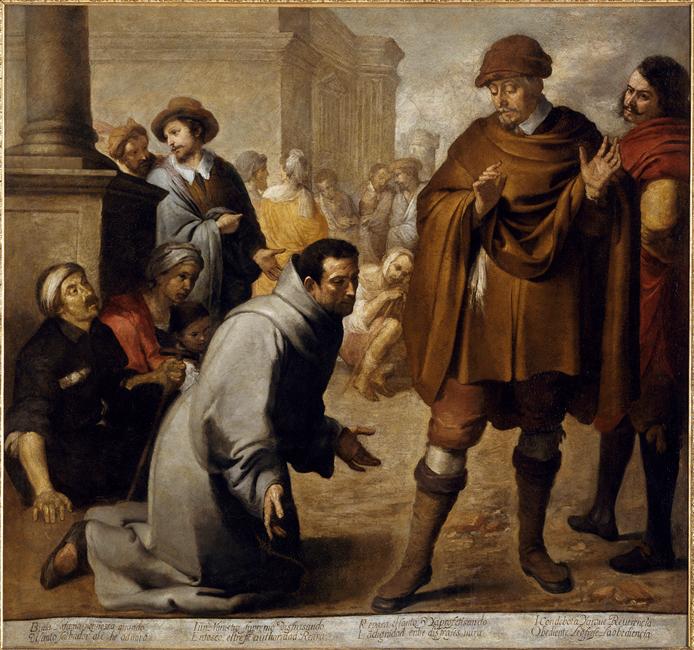
“San Salvador de Horta and the Inquisitor of Aragon” by Bartolomé Esteban Murillo is a sweeping narrative painting that brings together faith, skepticism, poverty, and power in a single charged moment. The canvas shows the Franciscan friar Salvador de Horta kneeling before a richly dressed inquisitor, while a group of sick and destitute people cluster behind him and a crowd fills the background. Murillo transforms this historical episode into a vivid public drama that explores how miracles are judged, who benefits from them, and how sanctity appears when placed under scrutiny.
Rather than focusing on a solitary saint in contemplative ecstasy, Murillo sets his scene in a bustling urban square framed by monumental architecture. The painting feels theatrical: figures enter from different sides, faces turn toward the central confrontation, and gestures communicate complex emotions. At the same time, the muted color palette and soft light typical of Murillo’s Seville style lend the composition a humane warmth. The work captures both the grandeur of Baroque storytelling and the tenderness of a painter deeply attuned to human suffering.
Historical And Religious Context
San Salvador de Horta was a sixteenth century Franciscan lay brother renowned for his extraordinary healing miracles. Born in Catalonia, he joined the Franciscan Order and quickly gained a reputation as a humble man whose prayers brought relief to the sick. Word of his cures spread so widely that he attracted enormous crowds, which in turn drew the attention of ecclesiastical authorities concerned about the authenticity and orthodoxy of his activities.
The Inquisition in Spain saw itself as guardian of doctrinal purity. Miracles, especially when associated with popular devotions outside tightly controlled liturgical contexts, could arouse suspicion. The narrative behind Murillo’s painting centers on an episode in which an inquisitor of Aragon examines Salvador’s miracles. Instead of focusing on a tribunal chamber, the artist chooses to depict the moment when the friar, surrounded by the infirm poor, kneels before the inquisitor in a public square.
Seventeenth century Spanish viewers would have recognized this scene as more than historical anecdote. It touched on pressing questions about the nature of sanctity, the role of official Church structures, and the legitimacy of popular religious enthusiasm. Murillo’s painting reflects his own devout Catholicism while also expressing sympathy for ordinary people whose hope rests on holy figures like Salvador de Horta.
The Narrative Drama Of The Scene
At the heart of “San Salvador de Horta and the Inquisitor of Aragon” lies a confrontation. On the right stands the inquisitor, upright and cloaked in a rich brown mantle, his gloved hand raised in a cautious, almost defensive gesture. On the left, kneeling in a gray Franciscan habit, is San Salvador de Horta. He leans forward slightly, hands open in a humble but firm appeal. Their eye contact forms an invisible line of tension that structures the narrative.
Behind Salvador, a cluster of poor and sick people press forward. An old woman kneels with clasped hands; another figure stretches out an arm in a pleading gesture. These people are the living evidence of the friar’s charitable mission. Their presence makes clear that official suspicion does not arise in a vacuum: real lives, real pain, and real hopes surround the saint.
In the background, a crowd of onlookers fills the space between the architectural structures. Some talk among themselves, others look toward the main group. The setting feels like a town square or church forecourt where public events and processions would normally unfold. Murillo thus situates the drama not in a secretive inquisitorial chamber but in the open, under the gaze of community and Church alike.
Composition And Spatial Organization
Murillo is a master at organizing complex groups of figures within a coherent composition. In this painting, he arranges the main actors along a broad diagonal running from the lower left, where Salvador kneels, up to the standing inquisitor on the right. This diagonal suggests both physical and symbolic movement: the saint moves toward authority; authority physically looms over him yet steps back defensively.
A massive column on the far left anchors the composition and frames the group of petitioners. Architectural elements recede into the background, guiding the eye into depth and emphasizing that this event unfolds in a structured civic and religious space. The crowd behind the main figures is handled with looser brushwork, creating a sense of distance without losing the impression of a busy gathering.
Murillo uses overlapping figures to build a sense of three dimensional space. The kneeling poor partially obscure each other, while the inquisitor’s cloak casts shadows on the man standing just behind him. This layering mimics the way bodies occupy space in real life and reinforces the painting’s documentary feel. Despite the number of figures, the composition remains readable because Murillo carefully orchestrates where light falls and how gestures direct attention.
The Figure Of San Salvador De Horta
San Salvador de Horta is depicted in a simple gray habit, consistent with his Franciscan vocation. Kneeling at the center of the painting, he embodies humility and intercession. His posture is not groveling; rather, it is dignified. One knee rests on the ground, the other leg forward for support, suggesting readiness as much as submission. His hands are extended, fingers relaxed yet expressive, as if he is simultaneously explaining, pleading, and offering himself.
Murillo gives Salvador a strong, expressive face. The brows are knit, the mouth slightly parted, and the gaze directed upward toward the inquisitor. This expression communicates a mixture of concern for the sick, trust in God, and determination to remain truthful. The saint’s body leans forward, orienting him toward the suffering people behind him as well as toward the authority in front. He becomes a bridge figure, mediating between official power and popular need.
The gray of his habit contrasts with the warmer tones around him, setting him apart visually. It anchors him in the composition and underscores his role as a humble servant of God, uncomplicated by worldly color or ornament. In an environment of rich fabrics, hats, and cloaks, his plain garment becomes a sign of spiritual authenticity.
The Inquisitor Of Aragon As Counterpoint
Opposite Salvador stands the inquisitor, dressed in earth toned clothing that conveys wealth and authority without ostentatious luxury. He wears a cloak draped around his shoulders, high boots, and a cap. His face is turned downward toward the friar, yet his body leans slightly back. This subtle backward lean, combined with the raised hand, suggests hesitation, caution, perhaps even discomfort.
The inquisitor’s right hand is gloved and lifted, palm outward in a restraining gesture. It is as if he is saying, “Wait,” or “Explain yourself.” His expression is not cruel; rather, it is skeptical and wary. Murillo avoids caricaturing him as a villain. Instead, he appears as a conscientious official confronted with something he does not fully understand.
Behind him stands another man, perhaps an assistant or colleague, who observes with interest but without the same intensity. This secondary figure reinforces the inquisitor’s status while also humanizing him: he is part of a network of officials, not a lone tyrant. Murillo’s nuanced depiction allows viewers to reflect on the complexities of institutional responsibility rather than reducing the scene to a simple saint versus persecutor drama.
The Crowd Of Sick And Poor
One of the most moving aspects of “San Salvador de Horta and the Inquisitor of Aragon” is the group of poor and infirm figures behind the kneeling saint. Murillo was famous for his compassionate portrayals of beggar children and the destitute of Seville, and he brings that same sensitivity here.
At the very front, an elderly woman kneels with hands tightly clasped, eyes fixed on Salvador. Her lined face and ragged clothing speak of long suffering and desperate hope. Another figure beside her, perhaps a younger woman or a boy, leans forward with an intense gaze. The body language of this group communicates urgency; they are physically and emotionally invested in the outcome of the interrogation.
These people are not generic props; they are individualized, breathing presences. Murillo’s brush lingers on their faces, hands, and worn garments. Through them he reminds viewers that theological debates and inquisitorial procedures have direct consequences for the most vulnerable. If Salvador’s miracles are silenced or discredited, their access to healing and comfort may vanish.
Light, Color, And Atmosphere
The painting’s light is soft and enveloping. It seems to fall from above and slightly from the left, illuminating Salvador’s habit, the faces of the poor, and the front of the inquisitor’s cloak. The background remains more subdued, with warm grays and browns that unify the crowd and architecture. This controlled light guides the viewer’s gaze from the kneeling saint to the standing official, then back to the group of petitioners.
Murillo’s color palette is dominated by earthy tones: browns, grays, warm oranges, and muted yellows. These colors create a sense of realism appropriate to a city square and the clothing of common people. At the same time, the artist introduces subtle contrasts. The cool gray of the Franciscan habit stands out against the warmer hues of the inquisitor’s cloak and the pale flesh tones of the figures.
The atmosphere is neither stormy nor idyllic. Instead, it feels heavy with human presence and moral weight. Hazy edges and soft transitions between background figures reinforce the impression of a crowded, slightly dusty urban environment. Murillo uses this atmospheric softness to emphasize emotional nuance rather than crisp detail.
Clothing, Gesture, And Symbolism
Clothing in this painting carries strong symbolic meaning. San Salvador’s simple habit signals poverty, obedience, and a life of service. The inquisitor’s well cut cloak and boots symbolize institutional power and a certain detachment from the hardships of the poor. The worn garments of the sick underline their dependence on others for survival.
Gesture is equally important. Salvador’s open hands suggest transparency, willingness to submit to examination, and compassionate intercession. The inquisitor’s raised hand embodies caution, authority, and the need for order. The clasped hands of the kneeling woman express supplication and faith. Each gesture acts as a visual shorthand for complex spiritual attitudes: humility, suspicion, desperation, and hope.
These visual cues would have been legible to Murillo’s contemporaries well versed in Baroque pictorial rhetoric. The painting therefore functions almost like a staged devotional drama where body language communicates theology as clearly as written words.
Murillo’s Baroque Style And Emotional Realism
“San Salvador de Horta and the Inquisitor of Aragon” exemplifies Murillo’s distinctive blend of Baroque grandeur and emotional realism. Unlike some artists who favored sharp contrasts and theatrical poses, Murillo softens edges and avoids extremes. His figures feel approachable, their emotions believable rather than exaggerated.
The composition does contain Baroque features: a dynamic diagonal, a crowd in the background, and a clear sense of narrative moment. Yet the artist tempers these with a gentler palette and rounded forms. The scene is dramatic in content but not overwhelmingly loud in style. This balance allows the viewer to engage deeply with the human and spiritual implications of the episode.
Murillo’s brushwork varies according to importance. Faces and hands are modeled with care, while less crucial areas, such as background architecture, are suggested with broader strokes. This hierarchy of detail directs attention where it matters most and keeps the painting visually coherent despite its complexity.
Devotional And Political Meanings
For a seventeenth century Catholic audience, this painting would carry both devotional and political resonances. Devotionally, it presents San Salvador de Horta as an exemplary figure of humility and charity, willing to submit his reputation and work to ecclesiastical judgment for the sake of truth and obedience. Viewers were encouraged to imitate his trust in God and his concern for the poor.
Politically and institutionally, the canvas reflects on the role of the Inquisition without overt condemnation. The inquisitor is portrayed as cautious rather than cruel, suggesting that the Church’s duty to test extraordinary claims can coexist with genuine holiness. At the same time, Murillo’s sympathetic depiction of the poor subtly advocates for a compassionate exercise of authority.
In this sense, the painting negotiates a delicate balance: it affirms both the charismatic power of miracle working saints and the institutional structures set up to evaluate them. Murillo invites viewers to see sanctity and authority not as enemies but as realities that must find harmony for the good of the community.
Place Within Murillo’s Oeuvre
Within Murillo’s broader oeuvre, “San Salvador de Horta and the Inquisitor of Aragon” stands out as a major narrative work that unites his interest in saints with his love for depicting ordinary people. It shares with his religious cycles a concern for spiritual transformation and the role of divine grace, and with his genre scenes a keen eye for the faces and gestures of the poor.
The painting likely formed part of a series dedicated to the life and miracles of San Salvador de Horta, a popular figure in Spanish Franciscan devotion. In such a series, this particular scene would occupy a crucial place, showing the moment when official suspicion confronted and ultimately validated the saint’s mission.
For modern viewers, the canvas reveals Murillo as more than a painter of sweet Madonnas or charming street children. It demonstrates his capacity to handle complex compositions, weighty themes, and nuanced characterizations within a single unified work.
Lasting Impact And Contemporary Relevance
Today, “San Salvador de Horta and the Inquisitor of Aragon” continues to resonate because it addresses issues that remain surprisingly current: the tension between institutional authority and charismatic figures, the scrutiny of claims of healing, and the plight of the poor in systems of power. Murillo’s compassionate eye ensures that the most vulnerable are never lost in the grand narrative.
The painting encourages reflection on how societies evaluate spiritual experiences and how those decisions affect marginalized communities. It reminds viewers that behind theological debates are real people seeking relief from suffering, just as the kneeling woman and other figures look to Salvador de Horta with desperate hope.
In a broader cultural sense, the canvas stands as a testament to the power of art to capture complex historical dynamics in a single frame. Through light, gesture, and composition, Murillo transforms a specific episode into a timeless meditation on justice, mercy, and the responsibilities of both saints and institutions.
Conclusion
“San Salvador de Horta and the Inquisitor of Aragon” by Bartolomé Esteban Murillo is a rich, multilayered painting that combines narrative energy with deep humanity. By depicting the Franciscan miracle worker kneeling before an inquisitor while the poor gather around him, Murillo explores the intersection of holiness, authority, and social need.
The carefully structured composition, warm color palette, and expressive gestures invite viewers not merely to admire the scene but to ponder its implications. San Salvador de Horta appears as a bridge between the suffering people and the cautious institution, embodying both obedience and bold charity. The inquisitor, in turn, symbolizes the difficult task of discerning truth without crushing genuine manifestations of grace.
Through this powerful work, Murillo affirms that authentic sanctity is always oriented toward the poor and that true authority must be exercised with compassion. The painting remains a compelling visual reflection on faith, power, and the enduring hope that miracles of healing and mercy continue even under the watchful eyes of earthly judges.
