Image source: wikiart.org
Historical Context of “The Immaculate Conception and heads outlined”
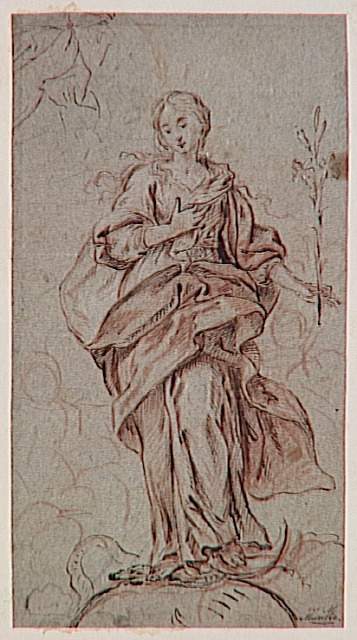
“The Immaculate Conception and heads outlined” is a delicate work by Bartolome Esteban Murillo that reveals another side of the celebrated Sevillian master. Rather than a fully finished oil painting, this piece is a refined study, probably executed in pen, ink, and wash over red chalk, showing the Virgin Mary in the familiar pose of the Immaculate Conception. Around her, faintly suggested, are the tiny heads of cherubs that Murillo would so often populate his finished canvases with.
Although the exact date is unknown, the style of the drawing places it within Murillo’s mature period in the second half of the seventeenth century. During these decades, Seville became a major center of devotion to the doctrine of the Immaculate Conception, the belief that Mary was conceived without original sin. Spanish artists were encouraged, even urged, to create images that defended and celebrated this doctrine long before it was formally defined as dogma in the nineteenth century.
Murillo became the leading painter of the Immaculate Conception in Spain. His altarpieces and large canvases on this theme were admired for their light, their softness, and their spiritual sweetness. The drawing in question is likely connected to this broader body of work. It may have been a preparatory sketch for a larger commission, a design offered to a patron, or an exercise the artist used to refine the pose, drapery, and symbolic elements before embarking on a more ambitious canvas.
First Impression and Overall Composition
At first glance, the drawing presents a single standing figure of the Virgin Mary, placed frontally but turned slightly in a graceful contrapposto. She is elevated above the ground, poised upon a crescent moon and globe, surrounded by swirling clouds. The faint outlines of angelic heads can be seen around her, like small sparks of life emerging from the mist.
The composition is vertical and elegant. Murillo structures the figure within a tall, narrow format that emphasizes Mary’s upward movement. Her slender form rises almost from the bottom edge of the sheet to the top, forming a strong central axis. Drapery flows around her body in layered folds, creating a sense of volume and gentle motion. One arm curls toward her chest in a gesture of humility and acceptance, while the other extends outward holding a stem, almost certainly a lily, symbol of purity.
Although the sheet still bears the signs of experimentation, it already displays the compositional clarity that made Murillo such a successful painter of large altarpieces. Mary is placed slightly off center, leaving room for a suggestion of surrounding glory and cherubs, but she remains the undeniable focus of the image. The viewer’s eye is guided from the base of the globe, up the diagonal lines of her drapery, along the curve of her gesture, and ultimately to her serene face.
Marian Iconography and the Immaculate Conception
The drawing draws on a complex iconographic tradition that had been developing for over a century. In Spanish art, the Immaculate Conception is usually represented by a youthful Virgin, clothed in flowing garments, standing on a crescent moon and often crushing a serpent under her feet. She is surrounded by clouds, stars, and cherubs, drawing on images from the Book of Revelation and the Song of Songs.
In Murillo’s study, many of these elements are present, even if some are only hinted at. The crescent beneath her suggests the woman “clothed with the sun, with the moon under her feet,” while the globe underlines her role as Queen of Heaven and Earth. Delicate indications of a serpent or dragon could be read near the base, referring to Mary’s victory over sin and evil.
The lily she holds speaks of her purity and virginal integrity. Her hand placed on her chest is a traditional sign of humility and consent, echoing her words at the Annunciation: “Let it be done unto me according to your word.” Through a few lines and contours, Murillo manages to condense a rich theological message: Mary as the stainless vessel chosen from the beginning to bear the Savior.
The Pose of the Virgin and Emotional Tone
Murillo’s Mary is neither stiff nor static. Her body forms a subtle S curve, with weight resting more heavily on one leg and the other gracefully bent. This contrapposto lends the figure an elegant naturalism and avoids any sense of rigidity. She appears to float rather than stand, her foot lightly touching the moon and globe.
Her face, though sketched simply, has the gentle sweetness typical of Murillo’s Marian types. The features are soft and youthful, with a slightly lowered gaze, suggesting modesty and interior recollection. There is no dramatic rapture or intense ecstasy here; instead, Murillo opts for a calm, contemplative expression that invites quiet devotion.
The overall emotional tone is one of serene triumph. Mary is elevated above the world, yet she remains approachable and human. She does not wield a sword or strike a victorious pose. Her victory over sin is expressed through tranquil purity, not aggressive power. This balance between exaltation and tenderness is a hallmark of Murillo’s religious imagery and one of the reasons his Immaculate Conceptions became so beloved.
Drapery, Line, and Baroque Movement
One of the most striking aspects of the drawing is Murillo’s treatment of drapery. Her cloak and tunic cascade around the figure in broad, sweeping folds that convey both volume and movement. The lines are confident and fluid, indicating a sure hand that understands how cloth responds to gravity and motion.
Murillo uses a combination of contour lines and hatching to suggest light and shadow. The outer edges of the garments are described with darker, firmer strokes, while interior folds and overlaps are indicated with lighter, broken lines. This approach gives the drapery a sculptural quality and helps model the figure’s body beneath.
The swirling cloak also contributes to the Baroque sense of movement. It wraps around Mary’s body as if caught in a gentle breeze, giving the impression that the entire figure is rising upward through the clouds. This upward motion is further reinforced by the vertical format, the elongated proportions, and the subtle diagonal of the lily stem. Even though the work is a drawing, its energy anticipates the flowing, luminous fabrics that would characterize Murillo’s large altarpieces.
Clouds, Cherubs, and the Suggestion of Glory
Around the Virgin’s feet and behind her figure, Murillo lightly sketches rounded forms that represent clouds and the small faces of cherubs. These are not fully developed; many appear as faint ovals or barely outlined features. Yet their presence is enough to indicate the heavenly environment that will later be elaborated in paint.
The clustering of cherub heads around Mary has both decorative and symbolic functions. Visually, they fill what would otherwise be empty space, helping to balance the composition and create a sense of depth. Symbolically, they express the idea that Mary is accompanied and honored by heavenly beings. In many of Murillo’s finished Immaculate Conceptions, these cherubs are painted with exquisite softness and playful vitality, enhancing the sense of joy in the scene.
In this earlier stage, the cherubs appear more as creative notes than completed figures. The artist is testing placements and groupings: a cluster here, a single head there, a suggestion of wings behind. The drawing allows us to witness the artist thinking visually, organizing the cloud of glory that will eventually surround the Virgin.
Medium, Technique, and the Value of the Study
Although often described as a painting, “The Immaculate Conception and heads outlined” is essentially a drawing or modello. Murillo employs a toned paper that provides a middle value, upon which he builds light and dark using ink, chalk, or wash. This method allows him to quickly establish volume and contrast without the labor of full color.
The economy of means is notable. With relatively few strokes, Murillo conveys a surprising amount of information: the fall of the drapery, the softness of the face, the position of the feet on the globe, the suggestion of clouds. The drawing shows his mastery of draftsmanship and his ability to envision complex compositions in a reduced format.
From an art historical perspective, such studies are invaluable. They show how a great Baroque painter prepared his major religious works, how he tested poses, adjusted iconographic details, and explored the emotional tone of the figure. They also reveal the spontaneity often hidden beneath the polished surface of finished paintings. Here we sense the rapid, searching hand of Murillo, less concerned with perfect finish than with capturing the essence of the idea.
Relationship to Murillo’s Painted Immaculate Conceptions
This drawing can be fruitfully compared with Murillo’s many large paintings of the Immaculate Conception housed in Seville, Madrid, and other cities. In those canvases, we see a very similar structure: a youthful Mary standing on the crescent moon, surrounded by swirling clouds and cherubs, often dressed in white and blue garments that glow against luminous backgrounds.
The drawing appears to be an early stage for this type of composition. The pose, with one hand on the chest and the other holding a lily, recurs in several of his finished works. The arrangement of drapery around the legs and the sense of upward motion are also consistent. Even the faint cherub heads foreshadow the charming cloud of angelic faces that will later populate the skies.
By studying the drawing alongside the paintings, we can see how Murillo refined and simplified his designs over time. In large canvases, he often reduces background detail to focus more fully on the figure and the play of light. The drawing, however, reveals a more exploratory stage, when he still considered different densities of clouds and clusters of cherubs.
This relationship confirms that Murillo approached the Immaculate Conception not as a single icon but as a theme to be continuously reimagined. The drawing stands as one link in this chain of variations, a step toward the luminous visions that earned him enduring fame.
Spiritual and Devotional Reading
Beyond its interest for art historians, “The Immaculate Conception and heads outlined” carries a deep spiritual resonance. The very simplicity of the drawing invites quiet contemplation. Without the distraction of full color or elaborate scenery, the viewer is drawn to the essential: the figure of Mary, her gesture of humility, and the upward movement that suggests her special relationship with God.
For believers, the image may serve as a reminder of Mary’s role as a model of purity and trust. The fact that she is rendered in light lines on a plain ground can be read symbolically: like a design lightly traced by God in human history, her vocation begins hidden and becomes gradually more apparent. The delicate cherubs emerging from the clouds evoke the idea that the work of grace often begins in subtle, almost unnoticed ways.
The standing position on the globe and moon also has spiritual implications. It speaks of Mary’s protective care over the world and her victory over evil. Yet because the drawing is not overly triumphant, the mood remains gentle and inviting. The viewer might feel not overwhelmed by majesty but drawn into a peaceful meditation on holiness as something quiet, steady, and beautiful.
Contemporary Resonance and Interpretation
For modern audiences, this drawing offers both aesthetic pleasure and insight into the creative process. In an age that often prizes finished spectacle, the opportunity to see a master’s exploratory lines reminds us that great artworks arise from humble beginnings: quick sketches, tentative outlines, adjustments, and revisions.
The figure of Mary can also speak to contemporary concerns about dignity, femininity, and spiritual identity. She is neither passive nor aggressively assertive. Instead, she embodies a strength expressed through grace, self surrender, and inner clarity. In a world marked by noise and conflict, such an image of serene strength can feel unexpectedly relevant.
Furthermore, the drawing showcases how minimal means can yield powerful results. In a culture saturated with digital images and vibrant color, this monochrome study stands out for its restraint. Its beauty lies in line, proportion, and gesture rather than special effects. It invites viewers to slow down, to trace the contours with their eyes, and to find meaning in subtlety.
Conclusion
“The Immaculate Conception and heads outlined” by Bartolome Esteban Murillo is more than a preparatory sketch; it is a compact masterpiece of Baroque devotion and draftsmanship. Created in an era when Seville championed the doctrine of the Immaculate Conception, the drawing distills the essential symbols of this belief into a single, elegant figure.
Mary stands on the globe and crescent moon, her drapery flowing in gentle movement, her hand on her chest, and her other hand holding the lily of purity. Around her, faint cherub heads and clouds hint at the heavenly glory that will later surround her in full scale paintings. Murillo’s confident lines and careful hatching give the figure volume and grace, while the toned paper and limited palette allow light and shadow to model the composition in a subtle yet effective way.
Viewed today, the work offers a window into Murillo’s creative process and into the spiritual imagination of seventeenth century Spain. It reveals how an artist could translate complex theology into a visually compelling form using only line and tone. At the same time, it speaks across centuries through its quiet beauty, inviting modern viewers to contemplate themes of purity, humility, and the mysterious workings of grace.
In its modest format, “The Immaculate Conception and heads outlined” captures the essence of Murillo’s genius: the ability to combine doctrinal clarity, emotional warmth, and refined artistic skill into images that continue to inspire, console, and enchant.