Image source: wikiart.org
Historical Context of “Christ The Column”
“Christ The Column” by Bartolome Esteban Murillo belongs to the long Baroque tradition of images depicting Christ bound to the column during the Passion. The exact date of the painting is unknown, but stylistic traits point to Murillo’s mature period, when he had already developed the soft light, tender modeling, and psychological depth for which he remains famous.
Seventeenth century Seville, where Murillo lived and worked, was a city marked by intense Counter Reformation piety. Confraternities organized processions of penitents, and churches commissioned artworks that invited the faithful to meditate on the sufferings of Christ. Scenes from the Passion were especially favored because they spoke directly to the emotional and devotional life of ordinary believers.
Within this context, “Christ The Column” occupies a special place. Rather than showing Christ alone at the pillar or surrounded by soldiers preparing for the scourging, Murillo brings in another central figure of the New Testament: Saint Peter. The result is not just a narrative of physical torture but a deeply personal encounter between Christ and the apostle who denied him. The painting becomes a meditation on repentance, forgiveness, and the intimate dialogue between the sinner and the suffering Savior.
Composition and First Impression
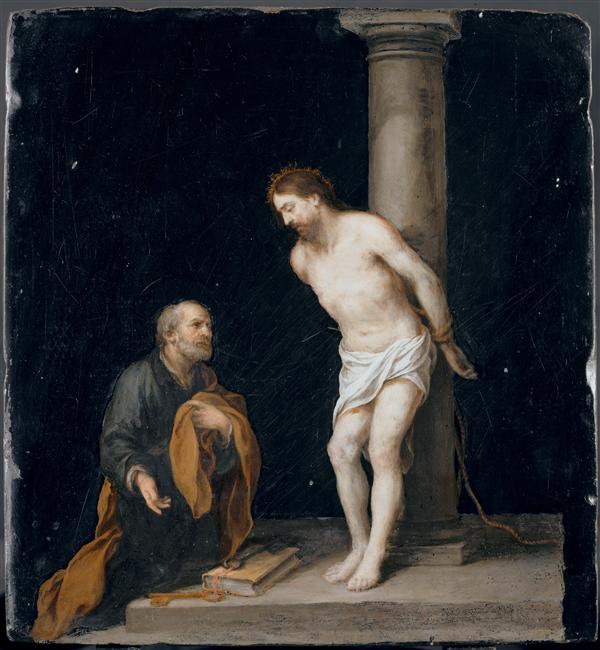
At first glance the composition seems simple. Against a nearly black background, a tall stone column rises on the right. Christ stands bound to it with hands tied behind his back, wearing only a white loincloth. His body leans slightly forward, one leg bent as if he is just shifting his weight. A faint golden halo encircles his head, and his gaze is directed downward toward a kneeling man at his feet.
That man is Peter. He kneels on the left side of the painting, close to the column but not touching it. In his hands he clutches his mantle, a warm brownish orange cloth that spills in generous folds around him. At his knees lie a set of keys and a closed book, subtle attributes that identify him as the future leader of the Church and guardian of doctrine.
The dark background strips away any distracting detail. There are no soldiers, no architectural vistas, no crowd of onlookers. The visual world of the painting consists of a stone platform, a column, one standing figure, one kneeling figure, and a few symbolic objects. This minimalism focuses all attention on the silent exchange of glances between Christ and Peter.
The composition is organized along a diagonal running from Christ’s head down to Peter’s face and then to the keys and book on the ground. This slanting axis creates a dynamic relationship between the two figures and gives the scene a subtle sense of movement, as if Peter has just arrived and Christ has just turned toward him.
The Figure of Christ at the Column
Murillo’s Christ is at once vulnerable and dignified. His body is slender but solid, modeled with soft shadows that emphasize the gentle turn of the torso and the flex of the legs. The arms disappear behind the column, their position suggesting restraint without showcasing the bonds in an exaggerated way. The loincloth is painted in luminous whites, its folds catching the light and echoing the modesty of traditional depictions.
The expression on Christ’s face is central to the spiritual meaning of the painting. His head tilts downward, eyes half closed, mouth relaxed in a way that suggests both physical exhaustion and interior contemplation. This is not the instant of the scourging itself, but a moment of pause, charged with anticipation and spiritual depth. Murillo deliberately avoids graphic violence. No blood is visible, no whip raised. Instead, he focuses on the quiet sorrow and patient endurance that precede the torture.
The halo around Christ’s head is rendered as a soft golden glow rather than a hard, linear circle. This subtle ring of light distinguishes him from Peter without breaking the naturalism of the scene. Light also falls gently on his chest, shoulders, and legs, making his body the brightest element in the painting. Against the dark void and the cool gray of the column, this warm illumination turns Christ into the visual and symbolic source of light.
Saint Peter in Penitence
On the left, Peter occupies a lower position in the composition, both literally and symbolically. He kneels with one leg forward and one bent behind him, creating a stable triangular base. His aging face is turned upward toward Christ, and his mouth seems slightly open, as if speaking or just having spoken words of regret. The eyes appear moist, capturing the traditional iconography of Peter’s tears after denying Jesus three times.
Murillo dresses Peter in a dark tunic, almost black, that merges with the background. Over it he holds an ocher mantle whose rich color contrasts with the gloom. This mantle flows to the ground, creating curves and folds that add visual interest and emphasize the physical reality of his kneeling posture. The cloth seems to slip from his shoulders, as if he has hastily thrown it on after rushing to the scene.
At his knees lie the keys and the book. The keys, one large and one smaller, symbolize the authority given to Peter in the Gospel passage where Christ entrusts him with the keys of the kingdom of heaven. The book evokes the teaching and leadership he will exercise in the early Church. Murillo places these symbols on the ground, slightly in front of Peter, as if to suggest that his future mission rests entirely on Christ’s mercy in this moment. Without forgiveness, there would be no Petrine ministry.
The psychological insight in Peter’s portrayal is remarkable. He does not appear crushed by despair, but rather filled with a painful hope. His body leans forward, hand extended in a gesture that mixes pleading, reverence, and readiness to accept responsibility. Murillo captures precisely that transformative instant when guilt turns into repentance and repentance begins to receive mercy.
The Relationship Between Christ and Peter
The power of “Christ The Column” lies in the silent conversation between its two main figures. Christ does not look away in judgment. His gaze is gentle and steady, meeting Peter’s at an angle. The downward tilt of his head shows that he acknowledges the apostle’s presence even as he bears his own suffering.
Peter, in turn, directs all his attention to Christ. His posture suggests that he has nothing to present but his weakness and his plea for forgiveness. The keys at his feet are not yet a badge of honor; they are a responsibility that he feels unworthy to carry. The visual line connecting their faces forms a bridge between divine patience and human remorse.
This encounter compresses several Gospel episodes into a single scene. Historically, Peter’s weeping occurs after the cock crows and Christ is led away from the high priest’s house. The flagellation at the column happens slightly later in the Passion narrative. Murillo combines these moments not as literal history but as spiritual synthesis. The painting becomes a timeless icon of penitence meeting mercy.
For viewers contemplating the work, the emotional energy flows along that diagonal line between Christ and Peter. One feels the gravity of betrayal, the weight of impending torture, and at the same time an undercurrent of reconciliation. The scene does not end in despair. The patience in Christ’s face and the intensity in Peter’s eyes foreshadow the forgiveness and restoration that will follow after the Resurrection.
Light, Shadow, and Spiritual Symbolism
The stark contrast between the luminous figures and the deep black background is one of the painting’s most striking features. Murillo uses chiaroscuro not just for dramatic effect but as spiritual metaphor. The darkness represents the world of sin, fear, and confusion that surrounds the events of the Passion. Within this darkness stand two figures illuminated by a light that has no visible source, suggesting divine presence.
Christ receives the greatest concentration of light. His skin tones are warm, almost golden, drawing the viewer’s eyes first to him. The column behind him is also lit, creating a vertical line that frames his figure. Peter, by contrast, is partially in shadow. Only his face, hands, and the upper folds of his mantle catch the light fully. This uneven illumination conveys both his nearness to grace and the lingering shadow of his recent denial.
The keys and book on the ground glint faintly, enough to be seen but not enough to dominate. They belong to the realm of future mission rather than present drama. The base of the column and the stone platform on which the figures stand are painted in muted grays that recede into the darkness, emphasizing that the true stage of the action is spiritual rather than architectural.
By excluding any background details, Murillo turns the entire space into a kind of interior of the soul. The dark void around the figures can be read as the inner darkness that Peter feels after his betrayal, now invaded by the light of Christ’s presence. The column itself may symbolize stability and endurance, qualities that Christ embodies perfectly and that Peter is called to acquire.
Murillo’s Style and the Intimacy of the Scene
“Christ The Column” showcases Murillo’s gift for combining Baroque drama with gentle intimacy. While other artists of his time often filled Passion scenes with multiple figures, whips, and expressive violence, Murillo focuses on psychological drama rather than physical agony. His brushwork is careful yet soft. Contours are not razor sharp but slightly blurred, giving the figures a living, breathing quality.
The anatomy of Christ is idealized but not exaggerated. Muscles are suggested rather than prominently displayed, avoiding the heroic nudity common in some Italian models. This restraint echoes Spanish spiritual sensibilities of the period, which favored an affective, interior devotion over overt spectacle.
Murillo’s color choices are limited yet rich. The warm flesh tones, the white of the loincloth, the gray of the column, the dark blue of Peter’s tunic, and the ocher of his mantle form a harmonious ensemble against the black ground. Even the halo is rendered in a subdued gold that glows rather than shines aggressively.
The small scale of the painting intensifies its intimacy. The viewer feels almost as if intruding on a private moment of prayer between Christ and his disciple. This quality would have made the work especially suitable for personal devotion in a chapel or private residence, where believers could meditate on their own need for forgiveness in light of Peter’s example.
Theological and Devotional Meanings
Theologically, “Christ The Column” explores themes of sin, repentance, and grace. Peter stands for every believer who has failed in fidelity yet longs to return to Christ. His posture shows that true repentance involves humility, trust, and the willingness to face the one we have offended.
Christ’s presence by the column embodies the mystery of redemptive suffering. Bound and about to be scourged, he has every reason to turn inward in anticipation of pain. Yet he still turns outward toward the repentant disciple. This double orientation reveals the heart of Christian belief: Christ’s Passion is not simply a personal ordeal but an act of love directed toward sinners.
The painting also reflects the Catholic understanding of Peter’s role as the first among the apostles. The keys and book indicate that his authority flows from an encounter with Christ that passes through failure and forgiveness. Leadership in the Church is grounded not in flawless virtue but in experienced mercy. For viewers in seventeenth century Spain, this would have reinforced the idea that the Church’s authority is rooted in Christ’s grace rather than human perfection.
On a devotional level, the image invites viewers to place themselves in Peter’s position. The kneeling figure becomes a mirror in which they can see their own need for repentance. The dark background functions almost like a spiritual void in which each person can imagine their own failures and fears. In that darkness the luminous figure of Christ offers calm attention and silent readiness to forgive.
Contemporary Relevance and Emotional Impact
Even today “Christ The Column” speaks with surprising immediacy. Its emotional core is not limited to religious belief. Many people know the experience of having hurt someone they love and then facing that person, hoping for forgiveness. Murillo’s painting captures exactly that difficult yet transformative moment.
The physical vulnerability of Christ, standing bound to the column, may resonate with contemporary reflections on suffering and injustice. His patient endurance and lack of anger offer a counter image to cycles of revenge and blame. Peter’s posture, blending shame and hope, reflects the psychological complexity of remorse in any human relationship.
Moreover, the simplicity of the composition gives the painting a timeless quality. Without specific historical or architectural details, the scene exists in a kind of spiritual present. Viewers of any epoch can enter the black space around the figures and feel personally addressed by the silent exchange between Christ and Peter.
Conclusion
“Christ The Column” by Bartolome Esteban Murillo is far more than a straightforward depiction of a moment in the Passion. It is a concentrated meditation on mercy, repentance, and the encounter between divine love and human failure. Through a restrained yet powerful composition, Murillo brings together the bound Christ and the kneeling Peter within a dark, almost abstract space that functions as both physical setting and interior landscape of the soul.
Christ’s gently illuminated body, patient gaze, and quiet dignity express the willingness of God to endure suffering for the sake of sinners. Peter’s kneeling posture, expressive face, and humble placement of the keys and book show the path from guilt to restored mission. The dialogue between them, conducted without a single painted word, becomes a visual theology of forgiveness.
Murillo’s soft brushwork, subtle color harmonies, and masterful use of light and shadow create an atmosphere that invites contemplative viewing. The painting asks not simply to be admired but to be pondered, perhaps in silence and prayer. Across the centuries, “Christ The Column” continues to offer viewers a powerful image of hope: that even at the darkest moments of betrayal and suffering, a path of reconciliation remains open.
