Image source: wikiart.org
Introduction to Murillo’s “The Nativity with the Annunciation to the Shepherds Beyond”
“The Nativity with the Annunciation to the Shepherds Beyond” presents one of the most intimate and luminous visions of Christ’s birth painted by Bartolomé Esteban Murillo. Although the exact date is unknown, the work reflects the mature phase of the Sevillian master, when his handling of light, tenderness, and devotional emotion had reached a particularly poetic refinement.
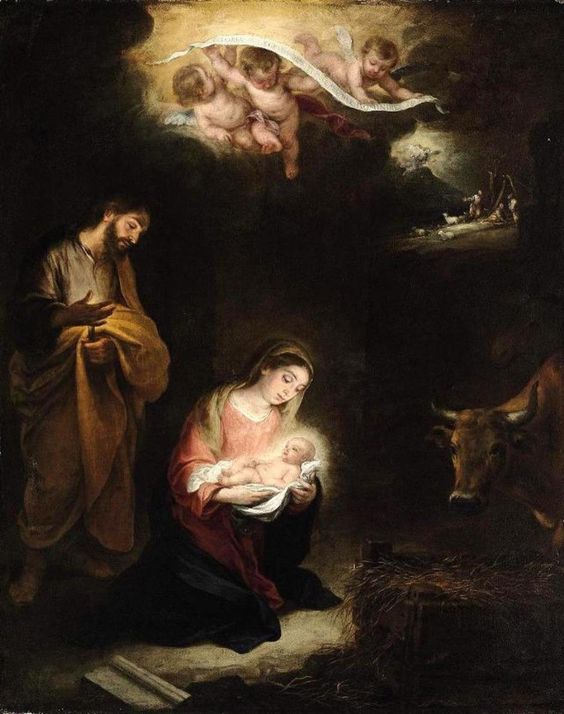
In this composition, Murillo unites two episodes from the Gospel narrative within a single nocturnal scene. In the foreground, the Virgin Mary kneels and cradles the newborn Christ, whose tiny body radiates a soft, supernatural glow. Saint Joseph stands nearby in quiet contemplation, while an ox looks on beside the manger. Above them, a cluster of cherubs unrolls a long banner, and in the far distance, bathed in silvery light, the angels announce the good news to a group of shepherds on the hillside.
The painting offers a rich meditation on humility, incarnation, and revelation. Murillo transforms the stable in Bethlehem into a theater of divine light, where heaven bends down to earth in a series of tender, luminous gestures.
Composition and Spatial Structure
Murillo organizes the canvas around a strong vertical axis of light that descends from the cherubs in the upper zone to the Christ Child in Mary’s arms. The rest of the space is largely cloaked in shadow, so the viewer’s eye is immediately drawn to this glowing column that connects heaven and earth.
The Holy Family occupies the lower center and left side of the painting. Mary kneels at the heart of the composition, her body turned slightly toward the viewer while her gaze rests lovingly on the infant she holds. Joseph stands behind and to the left, leaning forward with hands folded or clutching his cloak, his posture conveying reverent awe. On the right edge, partly emerging from darkness, the head of an ox and the rough timbers of the manger complete the familiar Nativity setting.
The upper portion of the canvas is filled with cloud and heavenly light. Three or more putti glide across the sky, their chubby bodies half wrapped in swirling drapery. They hold a long scroll, an echo of the angelic message “Glory to God in the highest” sung on the first Christmas night.
In the far background, at the upper right, Murillo opens a small window into another world. Against a pale glow, tiny figures of shepherds stand on a hillside, surprised by angels who hover above them. This miniature scene, connected to the main group through the continuous darkness and light, gives the painting its full title: the Nativity in the foreground, with the Annunciation to the Shepherds beyond.
The contrast between the intimate foreground and the distant vignette creates a layered narrative. The viewer first encounters the quiet devotion of the Holy Family and only later notices the unfolding drama of revelation to the shepherds. This compositional choice emphasizes the private, contemplative aspect of the Incarnation while still acknowledging its universal proclamation.
Light, Darkness, and the Theology of Illumination
Murillo’s mastery of light is perhaps the most striking feature of this painting. The scene is set at night, yet it is far from gloomy. Darkness serves as a backdrop against which divine light shines more clearly.
The primary source of illumination seems to be the Christ Child himself. His infant body emits a gentle glow that bathes Mary’s face and hands, Joseph’s cloak, and the nearby straw. This internal light underscores the theological belief that Christ is the “Light of the World,” bringing divine radiance into human history. The glow is not harsh or theatrical but soft and enveloping, creating a circle of warmth around the Holy Family.
A secondary source of light comes from the angels above. The cloud around them is tinged with golden and rosy hues, as if reflecting the glory of heaven. This light spills downward toward the child, reinforcing the vertical connection between the celestial and earthly realms.
In the distant background, a cool, silvery light marks the scene of the shepherds. This contrast between the warm glow around the child and the cooler halo in the distance helps separate the two narrative planes while maintaining overall harmony.
The surrounding darkness is equally important. Large sections of the painting are left in deep shadow, particularly the upper corners, Joseph’s lower body, and parts of the stable interior. This tenebrist approach heightens the sense of mystery and draws attention to the illuminated figures. It also functions symbolically, suggesting that the world before Christ lay in spiritual darkness, now pierced by the new light of salvation.
The Virgin Mary: Silent Adoration and Maternal Tenderness
Murillo’s portrayal of Mary is one of quiet adoration mixed with maternal tenderness. She kneels on the ground, her body slightly curved in a protective posture around the child. Her head is bowed, eyes lowered, and lips gently parted, as if she is murmuring a prayer or simply absorbing the miracle before her.
She wears the traditional colors: a red dress beneath a deep blue mantle. The red hints at love and future sacrifice, while the blue signifies purity and heavenly grace. Murillo paints these fabrics with soft folds and gentle highlights, allowing them to frame her face and the child without overwhelming them.
Mary’s hands cradle the infant with utmost care. The gesture is both human and symbolic. She is a young mother holding her newborn son, yet she is also the Theotokos, the God bearer, presenting the incarnate Word to the world. The tender inclination of her body shows that she understands the magnitude of this moment yet embraces it with humility.
Murillo avoids excessive idealization. Her face is beautiful but natural, with a soft blush and gentle features. This realism allows viewers to identify with her and see in her posture a model of contemplative worship: stillness, reverence, and love centered on Christ.
Saint Joseph: Guardian in the Shadows
Joseph stands slightly back from Mary and the child, wrapped in a brown tunic and a yellowish cloak. His figure is more subdued, both in color and in light, which reflects his traditional role as humble guardian rather than central protagonist.
His posture is introspective. He leans forward, hands close to his chest, eyes directed toward the child. There is a sense of protective watchfulness in his stance, yet also a touch of awe, as if he is still trying to comprehend his place in this divine drama. Murillo’s Joseph is neither old nor frail but a strong, gentle man whose quiet presence completes the Holy Family.
By placing Joseph partially in shadow, Murillo echoes the Gospel theme that Joseph operates mostly in the background, receiving divine messages in dreams and obediently safeguarding Mary and Jesus. Yet the soft light touching his face and hands indicates that he too participates in the radiance of the Incarnation.
Angels, Scroll, and the Distant Shepherds
The heavenly realm breaks into the humble stable through the group of cherubs overhead. These childlike angels are characteristic of Murillo’s style: plump, playful, and full of life. They flutter above the scene with a mixture of joy and reverence, holding a long scroll that likely bears the angelic hymn associated with Christ’s birth.
The scroll acts as a visual bridge between heaven and earth. It echoes banner shapes seen in other Nativity images and emphasizes that the birth of Christ is accompanied by a message of praise and peace. The positioning of the scroll, arching gently above the Holy Family, frames the central glow and suggests that the entire event is enveloped in divine proclamation.
In the far distance, the Annunciation to the Shepherds unfolds on a small scale. A hillside rises against the night sky, lit by a cool, otherworldly light. On it, we see diminutive figures of shepherds, some raising their arms in astonishment, others kneeling. Above them hovers a single angel or a small group, spreading the good news.
This secondary scene reinforces the universal significance of the Nativity. While the foreground focuses on private adoration, the background reminds us that this birth is being announced to ordinary people on the margins of society. Shepherds, often viewed as lowly, are among the first to receive the news, emphasizing the theme of divine favor extended to the humble.
Animals and the Humility of the Stable
The presence of the ox in the right foreground and the suggested manger point toward the humble circumstances of Christ’s birth. The ox, partially illuminated, looks toward the child with a calm, almost contemplative gaze. Its large head and warm brown tones add a rustic, earthly element that contrasts with the refined figures of the Holy Family and angels.
Traditionally, the ox and ass in Nativity scenes symbolize the recognition of Christ by the simple and the foreign, in contrast to the coldness or indifference of the powerful. Even if Murillo includes only one clearly visible animal, the atmosphere of the stable is conveyed through the rough wood of the manger and the scattered straw.
This rustic setting allows Murillo to explore the paradox of the Incarnation: the Light of the World arrives not in a palace but in a dark shelter shared with animals. The lowly surroundings accentuate the glory of the child and invite viewers to see holiness emerging in the most unexpected places.
Symbolism and Theological Themes
Throughout “The Nativity with the Annunciation to the Shepherds Beyond,” Murillo weaves a tapestry of symbolic meanings. The central glow emanating from the child speaks of divine light entering human darkness. The kneeling posture of Mary and the reverent stance of Joseph model the appropriate response to this mystery: adoration, humility, and attentive love.
The cherubs and their scroll represent heavenly joy and proclamation. Their presence suggests that the birth of Christ is not only a family event but a cosmic turning point celebrated by the entire angelic host. The distant shepherds show that the message does not remain in the stable; it goes out to ordinary people in the fields, hinting at the later mission of Christ to the poor and marginalized.
The overall movement in the composition is downward and inward. Heaven bends toward earth as the angelic light descends; Mary bends toward her child; the viewer, following these visual cues, is drawn inward toward contemplation of the infant at the center. Simultaneously, there is an outward extension through the shepherds and the implied continuation of the Gospel story.
Murillo thus creates a painting that is both contemplative and narrative, inviting viewers to meditate on the mystery while remembering its unfolding consequences in history and in their own lives.
Emotional Tone and Devotional Experience
Despite the dark setting, the emotional tone of the painting is serene and full of quiet joy. There is no frantic activity, no crowd of bustling figures. Instead, the scene is characterized by stillness. Mary kneels silently, Joseph stands in thoughtful devotion, the ox calmly looks on, and the cherubs hover in gentle motion.
This peaceful atmosphere encourages a contemplative response from the viewer. One can imagine kneeling beside Mary, feeling the soft glow of the child’s light and sharing her silent wonder. The humble surroundings and the distance from the world’s noise make the stable a sanctuary, a space set apart for encounter with the divine.
In seventeenth century Spain, such an image would have served as a powerful aid to prayer, particularly during the Christmas season. Believers were encouraged to imagine themselves present at the Nativity, offering their hearts alongside Mary and Joseph. Murillo’s painting, with its intimate scale and gentle light, is perfectly suited to such imaginative contemplation.
Place within Murillo’s Oeuvre and the Tradition of Nativity Art
Murillo painted several Nativity scenes throughout his career, often emphasizing tenderness, luminous atmospheres, and the human warmth of the Holy Family. Compared with more crowded or theatrical versions by other Baroque artists, his approach tends to be more intimate and emotionally focused.
“The Nativity with the Annunciation to the Shepherds Beyond” exemplifies this tendency. The composition is relatively simple, the number of figures limited, and the action subdued. Yet within this simplicity, Murillo achieves tremendous depth of feeling and theological richness.
The inclusion of the distant shepherd scene places this work within a broader tradition of combining multiple episodes in one image, a hallmark of Baroque narrative art. At the same time, the painting showcases Murillo’s unique ability to balance narrative complexity with contemplative clarity.
For viewers today, the painting provides a window into Spanish Baroque spirituality, where devotion to the Christ child, tender respect for Mary and Joseph, and awareness of angelic presence were central themes.
Lasting Legacy and Contemporary Resonance
Even centuries after its creation, “The Nativity with the Annunciation to the Shepherds Beyond” retains its power to move and inspire. The gentle light around the child, the quiet concentration of Mary and Joseph, and the playful yet reverent angels speak a visual language that transcends time.
Modern viewers may encounter the painting in reproductions or digital formats, yet the essential message remains clear. Amid darkness, a small, vulnerable child becomes the source of hope. The painting invites reflection on themes of humility, family love, and the unexpected ways in which grace enters ordinary life.
By uniting the private intimacy of the stable with the public proclamation to the shepherds, Murillo reminds us that spiritual experience often begins in hidden places but is destined to radiate outward. The light that illumines the faces of Mary and Joseph is meant to reach the distant hills and, ultimately, the wide world.
In this way, the painting is not only a historical artifact but a living image that continues to offer consolation and inspiration, especially during seasons when people seek renewal, peace, and a sense of wonder.
