Image source: wikiart.org
Context and Subject of “St. Paul’s Head”
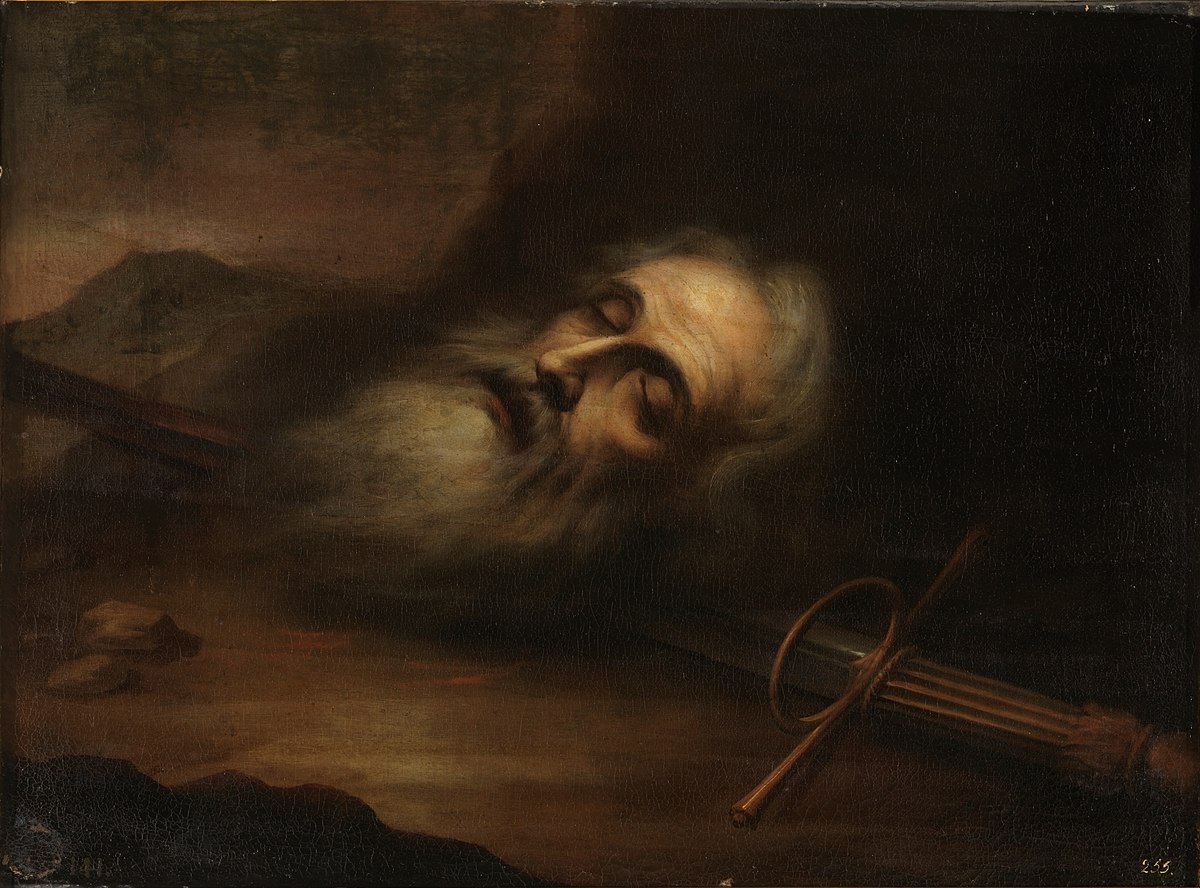
“St. Paul’s Head” is a haunting and unusual work attributed to Bartolome Esteban Murillo. Unlike his more familiar images of tender Madonnas or playful street children, this painting presents the severed head of the Apostle Paul lying in a dark, barren landscape. The date is unknown, but stylistically it belongs to Murillo’s mature period, when he was steeped in Counter Reformation spirituality and the dramatic language of the Spanish Baroque.
The subject refers to the martyrdom of Saint Paul in Rome. According to tradition, Paul was a Roman citizen and therefore executed by beheading rather than crucifixion. The sword became his attribute, symbolizing both the instrument of his death and the “sword of the Spirit” that is the word of God. Murillo distills this narrative to its starkest elements. There is no execution scene, no crowd, no architecture. Only the apostle’s head, his flowing beard, and the sword lie in a desolate space, inviting meditative reflection on death, sacrifice, and the triumph of faith.
First Impression and Emotional Tone
At first glance, the painting strikes the viewer with its stillness. The head of Saint Paul seems to float or rest lightly on the dark ground, eyes closed in a sleeplike state. The surrounding atmosphere is murky and subdued, with hints of rocky terrain and a low horizon barely visible in the shadows. A sword lies diagonally across the lower right, its hilt just catching the light.
The emotional tone is quiet but intense. Murillo does not show the moment of violence. Instead, he presents the aftermath, when the body is gone and only the head remains. This choice shifts the focus from physical brutality to spiritual contemplation. The apostle appears peaceful, even serene. His features are weathered with age, yet there is no grimace of pain. It is as if he has already passed beyond suffering into a state of rest.
This restrained approach is characteristic of Murillo. Even in a subject as macabre as a severed head, he emphasizes humanity and dignity rather than horror. The painting feels like a meditation on martyrdom, not a sensational display.
Composition and Spatial Arrangement
The composition is deceptively simple. The head of Saint Paul occupies the central portion of the canvas, slightly to the right, while the sword stretches along the lower edge. The background is mostly dark, with subtle variations that suggest distant hills and a low, dim sky. There is a sense of vast emptiness around the head, which heightens its visual and symbolic importance.
Murillo places the head at an angle, with Paul’s face turned slightly toward the viewer. This positioning creates a diagonal line that is echoed by the sword. Together, these diagonals energize the otherwise static scene and lead the viewer’s eye back and forth between the martyr and the instrument of his death. The empty space above and around the head adds to the feeling of isolation, as if time has slowed in this moment of contemplation.
The low horizon and indistinct landscape evoke a sense of exile. Paul was executed far from his native Tarsus, on soil that was not his own. The barren setting hints at this foreignness and at the earthly abandonment that often accompanies martyrdom. Yet the head is not swallowed by the darkness. It glows softly, suggesting that sanctity cannot be extinguished by death.
Light, Shadow, and the Baroque Atmosphere
Light is crucial to the power of this painting. Murillo uses a limited palette dominated by browns, grays, and muted earth tones. Out of this gloom, the apostle’s face and beard emerge with a gentle illumination. The light appears to come from an unseen source, perhaps above or slightly to the left, casting delicate highlights on the forehead, nose, and cheeks, and catching the gleam of the sword’s hilt.
This treatment of light and shadow is typical of the Baroque interest in chiaroscuro. In “St. Paul’s Head,” the contrast is not as dramatic as in some Caravaggesque works, but it is still strong enough to create depth and focus. The surrounding darkness acts almost like a frame, directing attention toward the illuminated head. It also carries symbolic meaning. The martyr’s death may seem like a plunge into darkness, yet his faith shines as a quiet light in the midst of obscurity.
The almost smoky transitions between light and shadow give the scene a dreamlike quality. It is unclear whether we are looking at a physical landscape or a spiritual vision. This ambiguity encourages viewers to interpret the painting not just as a historical depiction but as a meditative image that operates on a symbolic level.
The Face of Saint Paul
Murillo’s rendering of Saint Paul’s face is remarkably tender. The apostle is shown as an elderly man with a long, flowing beard and closed eyes. Deep lines mark his forehead and cheeks, suggesting a life of struggle, travel, and preaching. Yet the features are relaxed, the mouth gently closed, the eyelids soft. There is a sense of calm acceptance.
The choice to depict Paul with closed eyes is significant. It conveys the finality of death, but also suggests interior vision. The apostle who once saw the risen Christ on the road to Damascus has now closed his earthly eyes to see more clearly in the realm beyond. Murillo thereby hints at the Christian belief that physical death opens the door to eternal life.
The long beard, rendered with delicate strokes of white and gray, reinforces Paul’s identity as a sage and spiritual father. In life he was the great missionary theologian of the early Church. In death his head remains a symbol of wisdom and steadfast faith. Murillo’s sensitive modeling allows the viewer to feel empathy rather than revulsion. The severed head becomes a relic like those venerated in churches, an object of respect rather than fear.
The Sword as Symbol
In the lower right of the canvas lies a sword with an elegant hilt. It is partly in shadow, but enough light strikes the metal to reveal its form and make it legible. This weapon serves two interconnected symbolic roles.
First, it identifies the manner of Paul’s martyrdom. As a Roman citizen he was executed by beheading, and the sword recalls the literal instrument of his death. The presence of the sword alongside the head is a stark reminder of the cost of discipleship. Faithfulness to the Gospel brought Paul into conflict with imperial authorities and ultimately led to his execution.
Second, the sword refers to Paul’s own teaching. In his letter to the Ephesians he speaks of the “sword of the Spirit,” which is the word of God. Early Christian art and later iconography often portrayed him holding a sword to represent his role as a preacher and writer of scripture. Murillo echoes this tradition even in a painting that emphasizes mortality. The same weapon that cuts off his life also symbolizes the power of the message he proclaimed.
By placing the sword on the ground, Murillo suggests that Paul’s earthly mission is complete. Yet the glint of light on the hilt implies that the word of God he preached remains active. The apostle may be dead, but his teachings continue to cut through darkness.
Landscape, Space, and Memento Mori
The distant landscape in “St. Paul’s Head” is sparse but meaningful. Low hills and rocky forms emerge faintly from the gloom, while the ground in the foreground appears rough and dry. There are no trees, no living creatures, no signs of human habitation. The world seems emptied and silent.
This barren environment gives the painting a strong memento mori quality. It evokes the idea that earthly life is fleeting and that death eventually comes to all, even to great apostles. The absence of movement or vegetation reinforces the theme of finality. At the same time, the landscape can also be read as a spiritual wilderness, the place where faith is tested and proven.
Murillo’s decision to keep the background so understated ensures that viewers do not become distracted by narrative details. They are drawn instead into a reflective state. The painting becomes a visual aid for thinking about mortality, martyrdom, and the passing nature of worldly power compared to the enduring reality of sanctity.
Devotional and Theological Meanings
Within the context of seventeenth century Spanish Catholicism, images like “St. Paul’s Head” served devotional purposes. They were meant to inspire reverence for the saints and to encourage imitation of their virtues. Paul, once a persecutor of Christians, became one of the Church’s greatest missionaries and theologians. His death sealed his witness to Christ.
Murillo’s painting communicates several theological ideas. It emphasizes the dignity of martyrdom. Even in death, the saint appears serene, bathed in gentle light. His head rests like a precious relic rather than a grotesque object. This communicates the belief that those who die for their faith are honored in heaven and revered on earth.
The work also reflects the Christian teaching on the resurrection of the body. The severed head suggests bodily destruction, yet the calm expression hints that this is not the final word. Early Christians collected the relics of martyrs in the belief that their bodies would be glorified at the end of time. Murillo’s painting participates in this tradition, presenting the apostle’s head as something awaiting transformation rather than simply decaying.
For viewers, the image invites contemplation of their own spiritual lives. The sword, the barren landscape, and the closed eyes of the saint all prompt questions about what one lives and dies for. The painting encourages a sober awareness of mortality coupled with hope rooted in faith.
Murillo’s Style and Artistic Choices
“St. Paul’s Head” shows Murillo exploring a darker and more introspective mode than in many of his other works. Yet several stylistic features identify it as his. The soft transitions between light and shadow, the gentle modeling of flesh, and the subtle emotional nuance of the face are all hallmarks of his mature style.
His brushwork is particularly evident in the beard and hair, where fine strokes create a sense of airy softness. The texture of the ground and rocks, by contrast, is rougher, with broader touches that capture the ruggedness of the terrain. This contrast between the delicate treatment of the saint and the coarser handling of the environment enhances the sense that Paul’s sanctity stands out against a harsh world.
Murillo’s color choices are restrained but effective. Warm browns and reddish tones in the ground create a contrast with the cooler grays and whites of the beard and hair. The face is painted with a limited but rich range of flesh tones, which stand out against the deep background. The overall palette contributes to the somber mood while allowing the central elements to glow subtly.
In choosing such a stark and meditative composition, Murillo departs from more traditional narrative scenes of Paul’s martyrdom. His focus on the head alone aligns the painting with early Christian relic veneration and with later Baroque interest in vanitas and memento mori imagery. Yet he infuses the subject with his characteristic compassion, making it less a spectacle of death and more a quiet monument to fidelity.
Contemporary Resonance and Interpretation
For modern viewers, “St. Paul’s Head” can be strikingly contemporary in its psychological depth. The painting addresses themes of sacrifice, the meaning of death, and the legacy of a life dedicated to a cause. In a world still familiar with violence and persecution, the image of a saint who remained faithful to his convictions unto death carries enduring relevance.
The painting also prompts reflection on how we remember the dead. By isolating the head and sword, Murillo distills Paul’s legacy to its essentials. Viewers may be led to ask what symbols would stand for their own lives. What would remain if all superficial details were stripped away? For Paul, it is his wisdom, his faith, and the message he preached, signified by the calm face and the sword of the Spirit.
In art historical terms, the work expands our understanding of Murillo. It reveals his capacity to engage with darker, more somber subjects while maintaining his fundamental interest in human dignity. It shows that Baroque spirituality in Spain was not only about exuberant altarpieces and ecstatic visions, but also about quiet, contemplative images that confront the reality of death with faith and hope.
Conclusion
“St. Paul’s Head” by Bartolome Esteban Murillo is a powerful and introspective painting that departs from the artist’s more familiar themes to explore the stark mystery of martyrdom. Through a simple yet carefully constructed composition, Murillo presents the severed head of the apostle and the sword of his execution in a barren landscape. Light and shadow, soft modeling, and a restrained palette work together to create an atmosphere of solemn meditation.
Rather than emphasizing horror, Murillo highlights the serenity and dignity of Saint Paul in death. His closed eyes, gentle expression, and luminous beard convey the peace of a life completed in faith. The sword serves both as a reminder of his martyrdom and as a symbol of the word of God he proclaimed. The empty landscape and surrounding darkness reinforce a memento mori theme while also suggesting the enduring light of sanctity.
For viewers today, this painting remains a moving reflection on mortality, sacrifice, and spiritual legacy. It invites us to consider what we live for and what might remain when our own earthly journey ends. In its quiet way, “St. Paul’s Head” stands as one of Murillo’s most profound meditations on faith and the mystery of death.