Image source: wikiart.org
Introduction to Murillo’s “The Two Trinities”
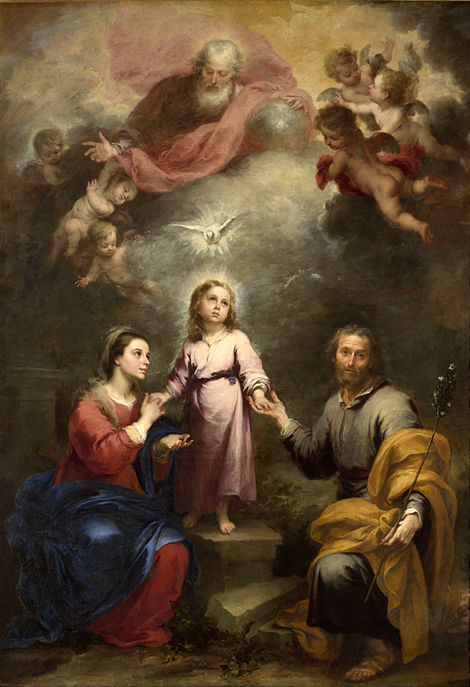
“The Two Trinities,” painted around 1682 by Bartolomé Esteban Murillo, is one of the most ambitious and theologically rich works of the Spanish Baroque. In a single luminous image, Murillo unites the Holy Trinity of Father, Son, and Holy Spirit with the earthly family of Jesus, Mary, and Joseph. The result is a sweeping vision that stretches from the dusty ground at the feet of the Holy Family to the radiant heavens where God the Father leans forward among clouds and angels.
At the center stands the youthful Christ, holding the hand of his mother on the left and his foster father on the right, while the dove of the Holy Spirit hovers above his head. Higher still, God the Father extends his arms in blessing, surrounded by a throng of playful cherubs. This vertical axis, passing through Father, Spirit, Son, and Holy Family, visually expresses the mystery that the child standing between his parents is at the same time the eternal Son united with the Father and the Spirit.
Murillo’s painting invites viewers to contemplate divine mystery within the tenderness of domestic life. It is both a lofty theological statement and a warm portrayal of a family bound together by love and faith.
Historical and Devotional Context
Seventeenth century Spain was shaped by intense Catholic devotion and the continuing influence of the Counter Reformation. Painters were encouraged to create images that not only moved the emotions but also clarified doctrine. Murillo, working in Seville, became a leading artistic voice in this climate. His gentle figures and luminous atmospheres made complex theological ideas approachable for ordinary believers.
“The Two Trinities” reflects particular interests of Spanish spirituality. Devotion to the Holy Family was rising, presenting Jesus, Mary, and Joseph as a model for Christian households. At the same time, the mystery of the Trinity remained central to Catholic belief. By placing these two themes within a single composition, Murillo offered viewers a profound meditation on how divine life is reflected within human family bonds.
The painting was likely commissioned for a religious institution or chapel where contemplation of both the Trinity and the Holy Family was encouraged. Its large scale and vertical format make it ideal as an altarpiece, guiding the gaze upward during prayer or liturgy.
Composition and Vertical Structure
Murillo organizes the scene along a strong vertical axis that runs from the ground to the highest cloud. At the bottom, Mary and Joseph sit on either side, forming a stable base. The Christ child stands between them, slightly elevated on a stone step, linking their hands. Above him, the dove of the Holy Spirit glows in a burst of light. Highest of all, God the Father leans out of a cloud bank, arms extended toward the Son.
This vertical arrangement creates a visual ladder connecting earth and heaven. The viewer’s eye naturally travels upward from the seated parents to the standing child, then to the radiant dove, and finally to the majestic figure of the Father. The surrounding angels echo this upward motion, some hovering near the dove, others clustering around the Father in playful groups.
Yet the composition is not rigid. Murillo softens the strong vertical with gentle diagonals. Mary’s body turns toward her son, and her mantle flows down in sweeping folds. Joseph, on the opposite side, sits in a relaxed pose with one knee raised and a flowering staff in his hand. Their different angles create a subtle sense of movement that keeps the painting lively without disturbing its balance.
The Holy Family as Earthly Trinity
At the heart of the lower portion of the canvas is the Holy Family. Mary sits on the left, dressed in her traditional colors of red and blue. Her red gown suggests love and sacrifice, while the blue mantle signals her heavenly dignity. She turns toward the child with a gentle, attentive expression, one hand lightly touching her chest as if in humble acceptance of her role, the other hand tenderly holding Christ’s wrist.
Joseph, on the right, wears more muted tones of brown and yellow ochre. A golden cloak wraps around him, giving him quiet nobility. He holds a flowering staff, a symbol of his divine election as guardian of the Virgin and child. His face shows warmth and calm strength. Murillo portrays him not as an elderly figure but as a mature, dependable father whose protective role is central to the family.
Between them stands Jesus, no longer a tiny infant but a young boy. He wears a light rose tunic tied at the waist with a simple cord. His bare feet rest on the stone, and his posture is upright yet relaxed. Holding a hand of each parent, he forms a living bridge between them. Through this gesture, Murillo emphasizes both the natural family bond and the spiritual role of Christ as mediator between God and humanity.
This triad of child and parents forms a kind of human echo of the divine Trinity above. The loving unity of the family on earth reflects the perfect unity of Father, Son, and Spirit in heaven.
The Heavenly Trinity and the Descent of the Spirit
The upper half of the painting reveals the heavenly counterpart. At the very top, God the Father appears as an aged yet powerful figure emerging from a bank of clouds. His long white beard and flowing robes convey wisdom and eternity. Arms outstretched, he seems to bless the scene below and to present his Son to the world. The angle of his body leans slightly toward the center, intensifying the connection with Christ on earth.
Surrounding the Father are numerous cherubs and angels. Some rest on the clouds, others fly, hands clasped or reaching outward in gestures of admiration and joy. Their lively forms and chubby faces are typical of Murillo’s charming angelic figures. They serve as celestial witnesses to the mystery unfolding below, filling the heavens with movement and music.
At the midpoint between heaven and earth shines the dove of the Holy Spirit. Bathed in radiant white light, its wings spread wide, it hovers directly above the head of the Christ child. Rays of light descend from the dove toward the boy, signaling the union of the Spirit with the incarnate Son and, through him, with the human family. The placement of the dove at the intersection of the vertical axis emphasizes its role as the bond of love between Father and Son and as the gift sent to the world.
Light, Color, and Atmosphere
Murillo’s handling of light in “The Two Trinities” plays a central role in its meaning. The painting glows with a warm, golden radiance that seems to emanate from the upper clouds and the figure of God the Father. This light pools around the dove and spreads downward, bathing the Christ child and his parents in gentle illumination. The effect suggests that the Holy Family is literally and spiritually touched by divine light.
The color palette is harmonious and rich. Mary’s deep blue mantle and red dress form a strong chromatic anchor at the lower left. Opposite her, Joseph’s golden ochre cloak and muted gray tunic create a warm counterbalance. The soft rose of Christ’s tunic harmonizes with the flesh tones of the angels and the golden light of the sky. None of the colors are harsh; instead they blend seamlessly through Murillo’s characteristic soft transitions, reinforcing the sense of unity.
The background is composed of swirling clouds that gradually shift from darker grays at the edges to glowing yellows and creams near the center. This atmospheric treatment eliminates any distraction from earthly architecture or landscape. The setting becomes a kind of sacred space where heaven and earth meet, filled only with light, cloud, and figures.
Gesture, Expression, and Emotional Tone
One of Murillo’s greatest strengths is his ability to convey emotion through gesture and expression. Here he creates a mood of serene joy and familial affection. Mary’s gaze is tender and contemplative, directed toward her son rather than toward the viewer. Joseph’s eyes are gentle and slightly introspective, as if he is quietly pondering the mystery of the child he holds by the hand.
The Christ child himself looks slightly upward, toward the descending light of the Spirit. His face is calm and serious, suggesting an awareness beyond his years. His free hand rests near his chest, which heightens the sense that he is both a boy and the divine Logos incarnate.
The angels express a lighter, more playful joy. Some lean on the clouds, others fly or clasp their hands. Their open faces and relaxed poses lessen the solemnity of the theological subject and make the scene inviting rather than intimidating.
Together, these expressions and gestures create an emotional atmosphere that is peaceful, loving, and luminous. The viewer is drawn into a space where divine mystery coexists with the warmth of family love.
Symbolism and Theological Meaning
“The Two Trinities” is layered with symbolic meaning. At the most obvious level, the painting visualizes the doctrine that the child Jesus belongs simultaneously to two families. He is the eternal Son, consubstantial with the Father and united with the Spirit, and he is also the child of Mary and the foster son of Joseph, living in a human home.
Mary represents the Church and the faithful soul, receiving the gift of the Son and responding with humility and love. Her red and blue garments recall both her humanity and her exalted role. Joseph embodies obedience, guardianship, and industrious virtue. His flowering staff echoes traditional legends that identified him as the chosen spouse of Mary when his staff miraculously bloomed.
The dove signifies the Spirit as love in motion, descending to fill the family with grace. Positioned as it is between Father and Son, the dove also reminds viewers that the life of the Trinity is a relationship of self giving love. Rays of light streaming from the dove toward the child emphasize that Christ’s human life is permeated by the Spirit from the beginning.
By placing this human family directly below the divine Trinity, Murillo suggests that every Christian household is called to reflect the love and unity of God. The painting thus becomes a visual catechism about the dignity of family life and the presence of God within ordinary human relationships.
Murillo’s Style and Artistic Legacy in this Work
“The Two Trinities” showcases many qualities that made Murillo one of the most beloved painters of the Spanish Baroque. His figures are soft, approachable, and deeply human, yet they radiate spiritual beauty. Instead of sharp contours and harsh contrasts, he uses blended brushwork and gentle transitions of tone. This creates a velvety surface where light seems to glow from within the paint layers.
His ability to handle complex compositions without losing clarity is evident here. Despite the many angels and the dramatic sky, the viewer never loses sight of the central relationship between Father, Spirit, and Son and between Jesus, Mary, and Joseph. Every visual element serves to emphasize that central axis.
Murillo’s emphasis on tenderness and domestic warmth influenced later religious art in Spain and beyond. His Holy Family and Trinity images became models for devotional prints, small altarpieces, and popular imagery. “The Two Trinities” stands as a particularly rich example of how he could combine doctrinal depth with emotional accessibility.
Lasting Appeal and Contemporary Relevance
Today, “The Two Trinities” continues to captivate viewers, whether they encounter it in person or through reproductions. Modern audiences may or may not share the theological background of seventeenth century Spain, yet the painting’s emotional core remains powerful. The sight of a child holding the hands of his parents while light cascades from above speaks to universal experiences of family, protection, and hope.
For those interested in theology, the work offers a profound visual meditation on the Incarnation and the Trinity. For students of art history, it illustrates how Baroque artists used composition, light, and gesture to turn complex doctrines into compelling visual narratives. For general viewers, it offers a sense of peace and beauty that transcends specific religious boundaries.
Murillo’s harmonious colors, soft light, and loving figures invite slow contemplation. The painting encourages viewers to consider how divine love might be reflected in their own relationships, families, and communities. In this way, the message of “The Two Trinities” remains as timely as ever, presenting a vision of unity between heaven and earth grounded in the everyday reality of a family gathered around a child.