Image source: wikiart.org
Historical Context of “The Conversion of Saint Paul”
“The Conversion of Saint Paul,” painted by Bartolome Esteban Murillo in 1682, belongs to the final years of the artist’s career, when his style had reached a mature blend of drama, softness, and spiritual intensity. Seville, where Murillo lived and worked, was a deeply religious city that embraced Counter Reformation ideals. Painters were expected to create images that were both doctrinally clear and emotionally stirring, guiding the faithful toward devotion through powerful narratives.
The subject of Saint Paul’s conversion was perfectly suited to the Baroque imagination. Drawn from the Acts of the Apostles, the story recounts how Saul, a fierce persecutor of Christians, was struck by a heavenly vision on the road to Damascus. Thrown to the ground and blinded by light, he heard the voice of Christ asking, “Saul, Saul, why do you persecute me?” This moment of divine interruption became a potent symbol of inner transformation, grace, and the possibility of radical change. Murillo’s painting offers his interpretation of this pivotal event, filled with motion, light, and spiritual tension.
By 1682 Murillo had already produced numerous religious works, often focused on tender subjects such as the Virgin and Child or saints in contemplative prayer. In “The Conversion of Saint Paul,” however, he turns to a more dynamic and dramatic scene, demonstrating that his gentle style could also encompass violent upheaval and intense emotion.
First Impressions and Overall Composition
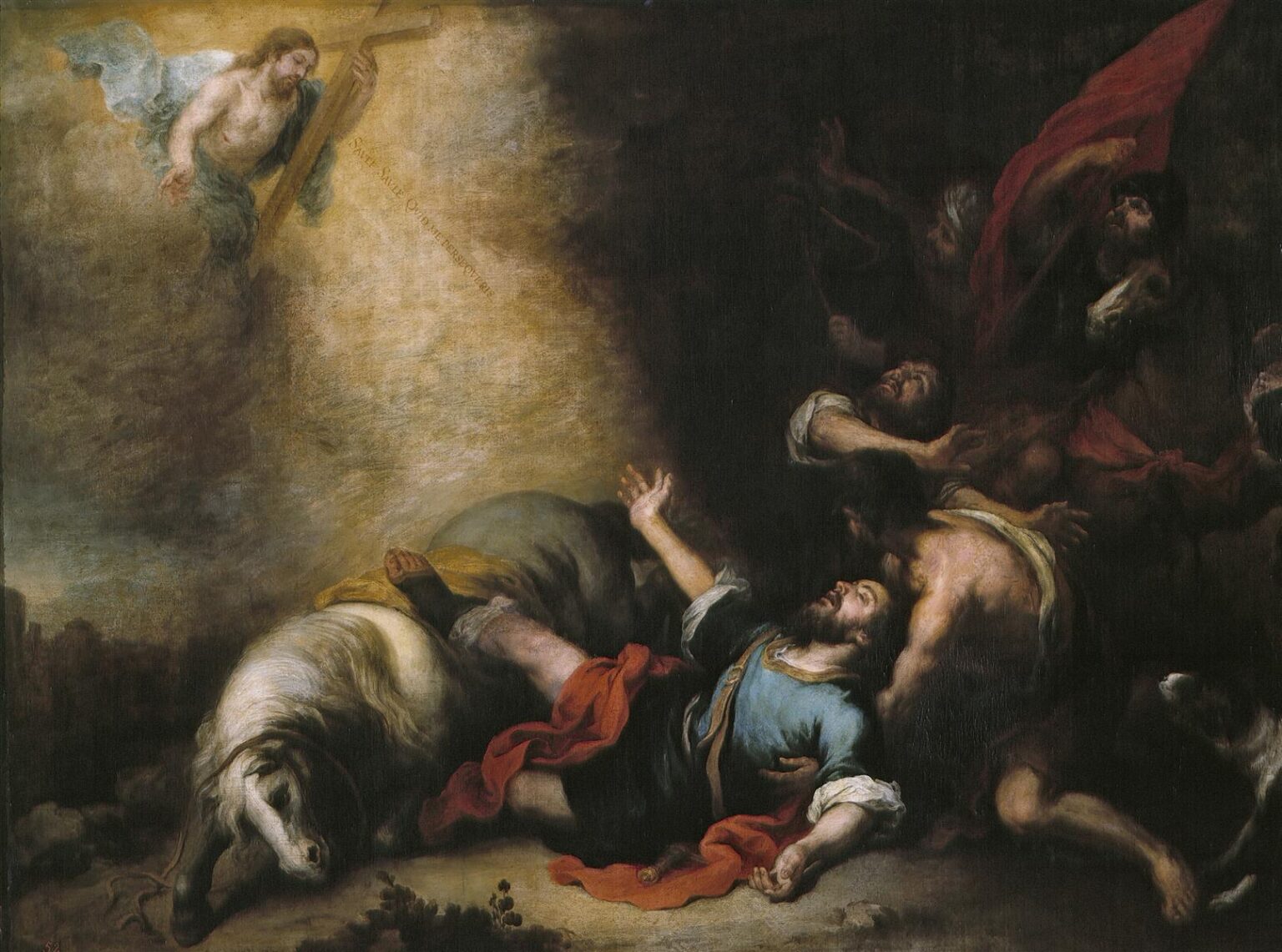
At first glance, the painting is dominated by a sweeping diagonal that runs from the luminous figure of Christ in the upper left down to the fallen body of Saint Paul in the lower center. The composition divides the canvas into two contrasting zones. On the left, a radiant, cloud filled space opens up, bathed in warm light. On the right, darkness engulfs a cluster of terrified soldiers and startled animals. At the center of this clash between light and dark lies Paul, stretched backward on the ground with arms spread wide in astonishment.
The eye is immediately drawn to Paul’s outstretched figure. His blue tunic and red cloak stand out against the more muted tones of the surrounding earth. His horse has collapsed beside him, its white body forming a curved mass that echoes the shape of the cloud above. Behind Paul, companions stumble and shield their faces from the blinding revelation. Above, Christ appears with a cross, leaning forward as if descending toward the stunned persecutor.
This dynamic arrangement creates a strong sense of movement, as though the viewer has arrived at the very instant when heaven interrupts the journey. Everything appears to tumble or spill along the diagonal of grace that cuts across the scene. Murillo’s composition thus embodies the suddenness and force of conversion.
The Figure of Saint Paul
Saint Paul is the emotional and narrative center of the painting. Murillo portrays him not as a distant biblical figure but as a robust, recognizable man of his own time. He wears a short blue tunic tied with a belt, a dark cloak, and a vivid red mantle that spills across the ground. His beard and hair are dark, and his face is rich with surprise and dawning recognition.
Paul’s pose is a powerful expression of shock and surrender. His body is twisted, one leg trapped beneath the fallen horse, the other flung out. One arm reaches upward toward the light, fingers spread in astonishment, while the other lies open at his side. His head leans back onto the supportive arm of a companion who tries to lift him. This posture suggests that his old identity as Saul, the persecutor, has been knocked down, while the new Paul is just beginning to rise in response to the divine call.
Murillo’s treatment of Paul’s face is particularly eloquent. The apostle’s mouth is slightly open, as if uttering a cry or a question. His eyes, though physically overwhelmed by the brightness, seem spiritually awakened. The artist captures the paradox of the story: Paul is blinded in order that his inner sight may be restored. By rendering this moment of inward transformation through the body’s shock and disarray, Murillo brings theology into the realm of lived experience.
Christ Appearing in Light
In the upper left corner, Christ appears within a glowing cloud, holding a large wooden cross. Unlike the triumphant judge of Last Judgment scenes, he is presented with a gentle yet authoritative gesture. His torso is bare, revealing the wound in his side, while a light drapery and wings or swirling cloud forms support him. His posture leans forward, body inclined toward Paul below, emphasizing the personal nature of the encounter.
The light surrounding Christ is soft yet intense, dissolving the edges of his figure into the surrounding cloud. Murillo avoids sharp outlines, instead using a vaporous handling that suggests a vision rather than a physical presence. This heavenly space is markedly different from the earthy terrain where Paul lies. It feels weightless, infused with a luminous haze that contrasts with the solid, darker forms below.
Between Christ and Paul, a subtle golden beam of light connects heaven and earth. Within this beam, faint Latin words can be seen, referencing Christ’s question to Saul. Although barely legible to the casual viewer, the inscription integrates the spoken word into the visual narrative. The message literally descends from Christ’s mouth to the man on the ground. Murillo thus translates the biblical dialogue into a visual path of communication that underlines the immediacy of divine address.
The Horse and the Earthly Setting
The horse, dramatically collapsed on the left side of the composition, plays a crucial role in visualizing the suddenness of the event. Its white body lies across the ground with legs folded awkwardly beneath it, head lowered and eyes closed or half closed. The animal’s fall mirrors Paul’s fall, reinforcing the sense that a powerful external force has intervened in the normal course of the journey.
Murillo paints the horse with a tender realism. The silky mane, rounded muscles, and heavy mass evoke both strength and vulnerability. The reins lie slack on the ground, further suggesting that human control has been abruptly disrupted. The animal becomes a symbol of worldly power and pride brought low before the divine. In many depictions of this subject, the horse threatens to trample Paul; here, however, its body almost seems to shield him, creating a sheltering curve between him and the earth.
The surrounding landscape is minimal but effective. Dark ground and indistinct rocks stretch into a shadowy distance, giving the impression of a road traversing a desolate region. Murillo does not clutter the scene with architectural detail, choosing instead to focus on the dramatic encounter. The emptiness of the landscape accentuates the isolation of Paul’s experience. Even though companions surround him, the primary dialogue is between him and the figure in the sky.
The Group of Companions
On the right side of the composition, a cluster of men reacts with alarm to the supernatural event. Some shield their faces, others raise their arms in defensive or supplicating gestures. One figure, half naked and muscular, kneels in profile, his body turning away from the light even as his arm supports Paul. Others appear partially hidden in shadow, their forms blending with red banners and swirling cloaks.
These figures add narrative depth and amplify the drama. They represent those who witness the event externally but do not yet fully understand it. Their gestures of fear and confusion contrast with Paul’s emerging openness. Murillo differentiates them through varied poses and expressions, yet he keeps them subordinate to the main diagonal of light and conversion. They are secondary echoes rather than independent focal points.
The presence of these companions also emphasizes that Paul’s conversion does not occur in private isolation. It happens on a public road, in the midst of a mission undertaken with zeal. Their startled reactions support the credibility of the vision within the narrative. In devotional terms, they may stand for viewers who initially experience the call of grace as something terrifying, before it resolves into understanding and faith.
Light, Shadow, and Spiritual Meaning
Murillo’s handling of chiaroscuro is central to the painting’s power. The canvas is sharply divided between the glowing left and the dark right. Yet the transition between the two is not abrupt. Instead, the radiance around Christ gradually dims as it moves across the scene, drifting like a cloud of light that finally meets the stormy darkness where Paul and his companions struggle.
This interplay of light and shadow is not merely decorative. It serves as a visual metaphor for the spiritual drama of conversion. The light signifies divine grace, truth, and revelation; the darkness represents ignorance, persecution, and the old life. Paul is literally caught in the middle of these zones. His body lies across the boundary, his head and chest illuminated while his legs remain in shadow. This positioning suggests that he is in the process of passing from one realm to another.
Murillo deepens this symbolism by using color temperature. The light area is warm, filled with golden and creamy tones, while the shadows are cooler and more brownish. This subtle contrast reinforces the sense that the light is life giving and the darkness heavy and suffocating. When Paul raises his hand toward the brightness, the gesture becomes an instinctive reaching for the new life being offered to him.
Baroque Drama and Murillo’s Personal Style
“The Conversion of Saint Paul” is a quintessential Baroque image, filled with motion, strong diagonals, and intense emotion. It shares concerns with other famous depictions of the subject, such as those by Caravaggio or Rubens, yet Murillo’s handling is distinct. Where Caravaggio emphasizes stark contrasts and almost sculptural clarity, Murillo prefers a softer, more atmospheric effect. His forms melt gently into the surrounding space, giving the narrative a dreamlike quality while still preserving its emotional impact.
Murillo’s color palette is rich but not strident. The red of Paul’s cloak, the blue of his tunic, and the white of the horse stand out against the dark browns and grays of the landscape. These colors guide the eye without overwhelming it. His brushwork is fluid, especially in the clouds and garments, where loose strokes suggest swirling energy. Faces and key anatomical details, by contrast, are modeled with greater precision.
Despite the dramatic subject, Murillo maintains his characteristic sense of compassion. There is no harshness in Christ’s expression, no gloating over the fallen persecutor. Instead, the entire scene is suffused with the idea that this violent interruption is ultimately an act of mercy. The Baroque love of spectacle is harnessed to a message of grace and transformation.
Theological and Devotional Implications
For seventeenth century viewers, the story of Paul’s conversion carried strong theological resonance. It illustrated the doctrine that salvation is a gift of grace, not the result of human merit. Saul was actively opposing Christ when he was called, yet he became one of the greatest apostles. Murillo’s painting translates this message into visual terms. Paul’s fall from the horse symbolizes the collapse of pride and self reliance, while his raised arm and open hand express receptivity to undeserved favor.
The painting also offered a model for personal conversion. Believers were encouraged to see themselves in Paul’s turmoil, recognizing that they too might be attached to their own destructive paths. The suddenness of the event did not imply that everyone must experience such a dramatic moment, but it did highlight the possibility that God’s call can interrupt life at any time. The image of Christ leaning from heaven toward a specific individual would have reassured viewers that divine attention is personal and intense.
Placed in a church or monastery, the painting could have functioned as a visual aid during sermons or as a focus for private meditation. Viewers might have prayed for their own deeper conversion, asking that the light of Christ would scatter the shadows in their hearts just as it does on the canvas.
Conclusion
Bartolome Esteban Murillo’s “The Conversion of Saint Paul,” painted in 1682, is a compelling fusion of narrative power, emotional depth, and spiritual symbolism. Through its sweeping diagonal composition, dramatic use of light and shadow, and expressive figures, the painting captures the shock and grace of a moment when a persecutor becomes an apostle. Paul’s twisted body, collapsed horse, and stunned companions all contribute to the sense of an ordinary journey violently interrupted by a higher call.
At the same time, Murillo’s gentle handling of Christ’s figure and his soft, atmospheric brushwork preserve a sense of compassion within the drama. The image is not merely about punishment or terror; it is about transformation and the possibility of new life. For viewers past and present, “The Conversion of Saint Paul” invites reflection on the ways in which unexpected encounters can change a life, and on the persistent initiative of divine grace that seeks out even those who resist it.
Through this painting, Murillo shows that the road to Damascus is not only an ancient pathway but also a timeless symbol of every human journey that shifts direction under the impact of truth. His canvas remains a powerful testament to the enduring human hope for change, forgiveness, and a new beginning.
