Image source: wikiart.org
Introduction
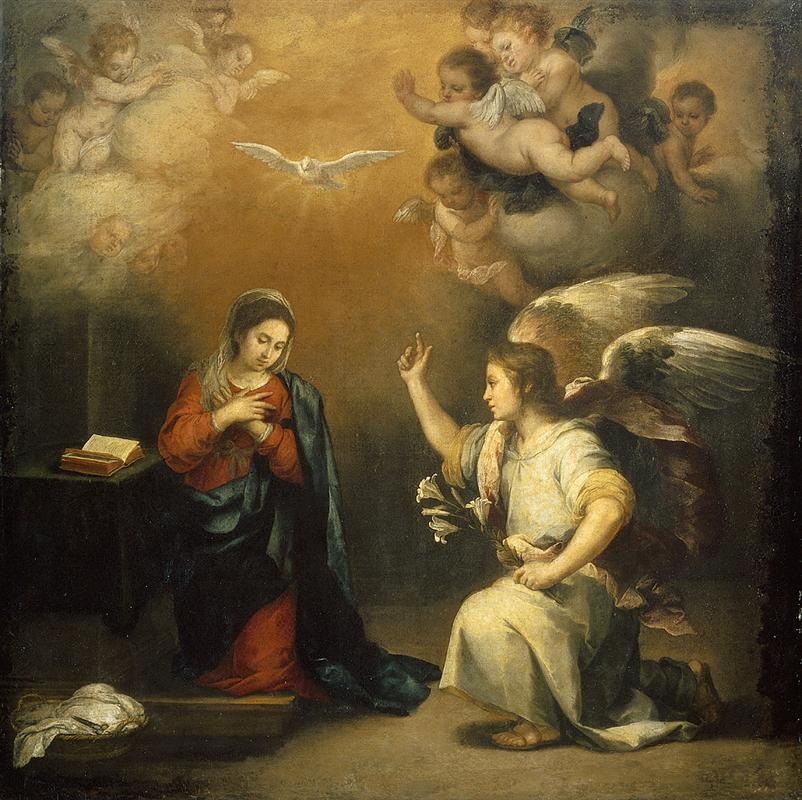
“The Annunciation” by Bartolomé Esteban Murillo, painted in 1680, presents one of the most intimate and gently luminous visions of the moment when the angel Gabriel announces to the Virgin Mary that she will bear the Son of God. Instead of the grand architectural settings favored by some Renaissance masters, Murillo chooses a quiet domestic space bathed in warm, golden light. Within this interior, heaven opens above, and angelic figures glide through clouds that seem to merge with the air of the room.
Murillo was one of the most beloved painters of seventeenth century Spain, famous for his tender depictions of religious themes. In this painting he blends theological symbolism with everyday humanity, transforming a cosmic event into something approachable and deeply moving. The viewer feels like a respectful witness to a private conversation between Mary and the angel, while also sensing the presence of the divine that suffuses every corner of the scene.
Biblical And Cultural Context
The Annunciation is described in the Gospel of Luke, where Gabriel visits Mary in Nazareth and greets her with the words, “Hail, full of grace.” This moment had enormous significance for Christian theology. It marks the beginning of the Incarnation, the instant when the divine plan for salvation becomes a concrete reality in human history. Artists of every era have returned to this subject, seeking to capture the mystery of a young woman quietly receiving an extraordinary message from God.
In seventeenth century Spain, religious painting was closely tied to devotional practice. The Council of Trent had stressed the role of sacred images as aids to contemplation. The faithful were encouraged to place themselves imaginatively inside biblical scenes, feeling the emotions of the figures and drawing moral inspiration from them. Murillo, working in Seville, became a master at creating such contemplative images. His soft colors, gentle facial expressions, and warm lighting resonated with a culture that valued both orthodoxy and deeply felt piety.
In “The Annunciation,” Murillo adheres to traditional iconography – Mary seated or kneeling in prayer, Gabriel bearing lilies, the Holy Spirit descending as a dove – yet he infuses these elements with freshness and emotional depth. The painting is designed to help viewers accompany Mary in her humble acceptance of God’s will.
Composition And Visual Staging
Murillo organizes the composition along a subtle diagonal that runs from the lower left, where Mary sits, to the upper right, where cherubs and clouds cluster. Gabriel occupies the middle ground on the right, kneeling with one knee on the floor and one foot ready to rise. This diagonal leads the eye upward from Mary’s quiet interior space to the luminous heavenly realm, visually expressing the connection between earth and heaven that the Annunciation creates.
The lower portion of the painting is grounded and domestic. A simple wooden table holds an open book, presumably a sacred text that Mary was reading when the angel arrived. A folded cloth rests on a low bench or chest near her feet, suggesting ordinary household activity paused by the arrival of the messenger. The floor seems solid, the space gently shadowed.
In contrast, the upper portion of the painting dissolves into golden clouds filled with cherubs. A dove, symbol of the Holy Spirit, glides through the center of the canvas, its wings spread wide as it descends toward Mary. The clouds swirl around this central axis of light, forming a celestial halo around the moment of announcement.
Murillo keeps the composition balanced. Mary and Gabriel form a triangular structure that anchors the scene, while the angels in the clouds create an echoing triangle above. The visual harmony of these shapes reinforces the spiritual harmony between God’s plan and Mary’s consent.
The Figure Of Mary
Mary sits on the left, slightly turned toward Gabriel. She wears her traditional colors: a deep red tunic that suggests love and sacrifice, and a rich dark blue mantle that envelops her and falls softly to the floor. Her head is bowed, eyes directed downward, hands crossed over her chest in a gesture of humility and inward contemplation. Murillo portrays her not as a distant queen but as a modest young woman caught between astonishment and serene acceptance.
Her face is calm, with a delicate blush in the cheeks and soft shadows around the eyes. The expression conveys modest surprise rather than fear. Murillo avoids dramatic gestures, preferring the quiet eloquence of slight movements and subtle features. Mary’s bowed head and closed lips suggest that she listens deeply, pondering in her heart the words she hears.
Her garments are rendered with soft folds and gentle highlights. The lap of her blue mantle gathers into rich curves that anchor her figure firmly in the room. Yet the light that touches the fabric hints at a spiritual radiance surrounding her. Mary is rooted in ordinary space, yet already enveloped by grace.
The Angel Gabriel As Messenger And Guide
On the right, the archangel Gabriel kneels in a posture that combines reverence and energetic movement. One knee is bent, the other leg extended behind, giving the impression that he has just descended and may rise again at any moment. His body leans slightly forward toward Mary, one hand resting on his chest while the other is raised, index finger pointing upward to God. This gesture both announces the divine origin of his message and guides Mary’s and the viewer’s attention to the heavenly realm above.
Gabriel’s robe is a pale, luminous cream. A soft, rose-colored sash crosses his chest and ties at his waist, adding a delicate note of color. Large, feathery wings extend behind him, painted with a mix of whites and muted browns that catch the warm light of the scene. The wings serve not only as a marker of his angelic nature but also as compositional elements that echo the sweeping arcs of the clouds above.
In his left hand Gabriel holds a bundle of white lilies. These flowers, long associated with the Annunciation, symbolize Mary’s purity and the new life that will blossom through her. Murillo paints them with careful precision, their white petals gleaming softly against the angel’s robe. The lilies visually link Gabriel’s message to Mary’s virtue, forming a bridge between the heavenly messenger and the humble recipient.
Gabriel’s face is youthful and serene, with an expression of gentle authority. He is neither stern nor frightening. Instead, he appears compassionate, eager to reassure Mary even as he delivers a startling message. This human warmth makes the scene emotionally accessible for viewers, who can imagine themselves in Mary’s place, guided by such a kindly messenger.
Light, Color, And Atmosphere
Light plays a crucial role in “The Annunciation.” Murillo suffuses the entire canvas with a warm, golden glow that seems to emanate from the presence of the Holy Spirit. The central area surrounding the dove is the brightest, with the golden sky there almost radiant. From this nucleus of light, illumination spreads outward, gently touching the faces of Mary and Gabriel and the pale bodies of the cherubs above.
This light is not harsh. Murillo’s technique involves soft transitions between light and shadow, giving forms a velvety softness. The shadows in the room are warm brown, never truly black, which maintains the overall atmosphere of comfort rather than fear. Even the darkest corners suggest a depth filled with quiet presence rather than emptiness.
Color harmonies reinforce the spiritual mood. The red of Mary’s dress and the deep blue of her mantle provide strong visual anchors, echoing traditional Marian colors. Gabriel’s cream robe and the white lilies introduce lighter notes that link to the brightness of the cherubs and the dove. The background glows with tones of amber, honey, and soft brown, creating a unified backdrop for the figures.
This palette, characteristic of Murillo’s mature style, combines earthly warmth with heavenly luminosity. The viewer senses that ordinary colors have been suffused with grace. The interplay of warm browns, golden light, and saturated garments creates an inviting visual space that encourages sustained contemplation.
Symbolism Of Objects And Gestures
Every element in the painting carries symbolic weight. The open book on the table to Mary’s left likely represents the Scriptures, perhaps the prophecies she was reading when Gabriel entered. It suggests Mary’s familiarity with God’s word and her life of prayerful meditation. The book also reminds viewers that the Annunciation fulfills promises made long before in the sacred text.
The white cloth on the bench near Mary hints at domestic life and service. It may recall the veil she was working on according to some traditions, or simply underline her role as a young woman engaged in ordinary household tasks. By including such humble objects, Murillo emphasizes that God’s call comes within the context of daily life.
Mary’s hand gesture – crossing her hands over her chest – expresses humility, obedience, and inner openness. It visually represents her words “Behold the handmaid of the Lord, be it done to me according to your word.” Gabriel’s raised hand points toward heaven, insisting that his message is not his own but comes from God. The lilies he holds, as noted, stand for purity and the blossoming of new life.
The dove at the center, descending with wings outstretched, represents the Holy Spirit overshadowing Mary. Its placement between the human figures and the angelic host highlights its role as a bridge between heaven and earth. The circular spread of its wings echoes the rounded forms of the clouds and cherub heads, suggesting that the Spirit animates the entire heavenly scene.
The Angelic Host And The Opening Of Heaven
Above Gabriel and Mary, the upper part of the canvas fills with cherubs gliding on clouds. Some lean over the edge of the cloud bank, gazing down at the event below. Others appear partially hidden in the vaporous forms, their faces emerging softly from the golden mist. Their presence signals that the Annunciation is not just a private conversation but an event that the whole of heaven witnesses with joy.
These cherubs embody exuberant innocence. Their small wings, rosy cheeks, and playful gestures create a contrast with the serious, contemplative mood of Mary. They suggest that, from the divine perspective, the Incarnation is an occasion of boundless celebration. Murillo balances this joy with the quiet reverence of the figures below, preserving the spiritual gravity of the scene.
The clouds themselves are painted with soft, swirling edges. They do not form a solid barrier between heaven and earth; rather, they dissolve gradually into the golden air. This creates the impression that heaven is opening within the very room where Mary sits. The boundary between the human and divine realms becomes porous, echoing the theological idea that, through the Incarnation, God enters intimately into human history.
Murillo’s Style And The Humanization Of The Sacred
“The Annunciation” shows Murillo at the height of his powers. His style is sometimes called gentle Baroque. He uses many features associated with Baroque art – dramatic light, dynamic diagonals, rich color – yet he tempers them with softness and emotional accessibility. There is motion in the swirling clouds and Gabriel’s kneeling pose, but it is not violent or overwhelming.
Murillo’s figures are distinctly human. Mary appears as a real young woman, not an unreachable icon. Gabriel, though winged and luminous, has the friendly face of a youth, free from stern majesty. This humanization of sacred figures made Murillo’s paintings beloved devotional images, because viewers could imagine a personal relationship with the characters.
His brushwork is smooth and blended, especially in the faces and hands. Fabrics are rendered with flowing strokes that suggest texture without becoming overly detailed. The overall effect avoids both hard realism and abstract vagueness. Instead, Murillo achieves a delicate balance where forms are convincing and yet bathed in a kind of spiritual haze.
Emotional And Devotional Impact
The emotional tone of “The Annunciation” is one of quiet awe. There is no panic, no dramatic surprise. Instead, Murillo presents a moment of reverent listening and gentle revelation. Mary’s humility and interiority invite viewers to imitate her response to God’s call: attentive, trusting, and open.
For believers, the painting serves as a visual prayer. One can follow Mary’s gaze, trace Gabriel’s gesture pointing to heaven, and rest in the calm light that surrounds the dove of the Holy Spirit. The painting encourages meditation on themes of trust, obedience, and the mystery of divine presence in ordinary life.
Even for those approaching the work from a purely artistic standpoint, the painting offers a compelling exploration of mood and atmosphere. The soft interplay of light and shadow, the warm color harmonies, and the gentle interactions between the figures create a sense of peace that transcends time and place.
Conclusion
Bartolomé Esteban Murillo’s “The Annunciation” from 1680 stands as a masterful fusion of theology, emotion, and painterly skill. In this canvas, the familiar biblical story unfolds in a modest interior that becomes a gateway to heaven. Mary’s humble posture, Gabriel’s reverent energy, the descending dove, and the chorus of cherubs all contribute to a harmonious vision of the moment when God’s word becomes flesh.
Murillo’s characteristic softness of color and form allows the scene to glow with quiet warmth. Rather than relying on theatrical drama, he guides the viewer into contemplative intimacy with the mystery of the Incarnation. The painting remains a powerful testament to his ability to humanize the sacred, presenting profound religious truths through the faces and gestures of approachable, tender figures.
Through its balanced composition, luminous atmosphere, and rich symbolism, “The Annunciation” continues to invite viewers to pause, reflect, and enter into the silent dialogue between heaven and earth that unfolds in the space between Mary and the angel.