Image source: wikiart.org
Introduction
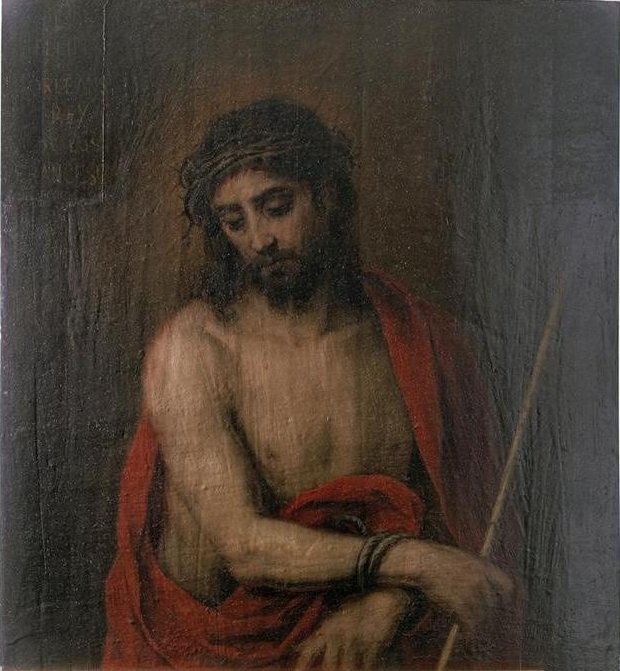
“Ecce Homo” by Bartolomé Esteban Murillo, painted in 1678, is a deeply moving meditation on the suffering of Christ. Rather than depicting a crowded narrative scene from the Passion, Murillo focuses entirely on the solitary figure of Jesus, crowned with thorns and draped in a red cloak, as he is presented to the crowd. The title comes from the Latin words spoken by Pontius Pilate, meaning “Behold the Man.” In this painting Murillo invites viewers to contemplate not the roar of the mob, but the quiet inner world of Christ at the moment of humiliation and pain.
The work belongs to Murillo’s mature period, when his style combined technical refinement with a gentle emotional tone that appealed strongly to Spanish devotional culture. Despite its apparent simplicity, “Ecce Homo” is loaded with symbolic and theological meaning. Through subtle gestures, controlled light, and a restrained palette, Murillo transforms a half length portrait into a powerful spiritual encounter.
Historical And Devotional Context
In seventeenth century Spain art played a crucial role in religious life. The Catholic Reformation stressed the importance of images that could move believers to compassion, repentance, and deeper faith. Subjects drawn from the Passion of Christ, in particular, were valued for their ability to inspire meditation on the sacrifice of the Savior. “Ecce Homo” images became especially popular, focusing on Christ mocked and crowned with thorns just before the Crucifixion.
Murillo, working in Seville, responded to this devotional climate with paintings that emphasized tenderness and empathy. Rather than emphasizing raw physical violence, he often highlighted the psychological dimension of suffering. His saints and biblical figures display relatable human emotions that invite viewers into intimate contemplation.
In “Ecce Homo” this approach is evident in the way Christ is isolated against a dark background, stripped of distracting accessories. The painting functions almost like an icon for private prayer. A seventeenth century viewer might have approached the work in silence, letting the gentle modeling of Christ’s features and the somber harmonies of color draw the heart into reflection on the Passion.
The Central Figure Of Christ
At the center of the painting stands the half length figure of Jesus, bare chested, wrapped in a red cloak that falls over his shoulders and around his waist. His head tilts downward and slightly to the side, eyes cast toward the ground rather than confronting the viewer directly. The expression is not one of dramatic agony but of quiet sorrow and resigned acceptance.
Murillo’s Christ appears very human. His beard and hair are rendered with soft touches, eyelashes visible against the lowered eyelid, and his lips parted slightly as if in silent prayer. The musculature of the torso is present but understated; this is not the idealized muscular hero of some Renaissance interpretations, but a real and vulnerable body subjected to humiliation. The crown of thorns sits heavily on his head, its prickly branches pressing into the flesh, yet no exaggerated blood flows. The emphasis remains on the inner spiritual suffering rather than the external wounds.
The pose is crucial to the painting’s emotional impact. Christ’s arms are crossed loosely, one hand gripping the reed scepter that mockingly stands in for a royal staff. The other hand rests gently on his forearm, a gesture that suggests both physical restraint and emotional containment. It is as if he holds himself together in the face of public scorn. This self embracing posture communicates resignation and self offering; Christ willingly accepts his fate for the sake of humanity.
Composition And Spatial Economy
Murillo adopts a very simple composition. Christ occupies the central vertical axis, filling most of the pictorial space. There is no crowd, no architectural setting, no visible Pilate. Only a small hint of inscription on the dark background suggests an official context. By eliminating external action, Murillo concentrates the viewer’s attention entirely on Christ’s inner drama.
The half length format brings the figure close to the spectator, establishing a sense of intimate encounter. Christ is not far away on a distant hill; he is right here, almost within arm’s reach. The horizon line is hidden, and the background is rendered as an undefined, shadowy space. This lack of spatial reference helps transform the scene from a historical moment into a timeless spiritual image.
Diagonal lines play a discreet role. The tilt of Christ’s head, the angle of his crossed arms, and the slant of the reed all move gently from upper left to lower right, creating a rhythm that leads the eye through the figure. However, these diagonals are restrained and quiet, avoiding the swirling energy of many Baroque compositions. The stillness of the arrangement reinforces the meditative tone.
Light And Shadow As Spiritual Language
Light in “Ecce Homo” falls softly from an upper left source, illuminating Christ’s torso, parts of his face, and the folds of the red cloak. Murillo uses chiaroscuro not for theatrical effect but for introspective mood. The background remains almost entirely in shadow, allowing the figure to emerge as if from darkness. This contrast between light and obscurity carries symbolic significance.
The illuminated flesh suggests the divine presence shining through Christ’s humanity. At the same time, the darkness behind him hints at the spiritual night of betrayal, injustice, and impending death. Christ appears as a solitary light within that darkness, the suffering yet steadfast redeemer. The subtle modeling of the light on his chest and shoulders brings warmth to the canvas, making the body tangible and real, while the shadows contour his form with gentle transitions.
Murillo avoids harsh edges between light and dark. Instead, he uses soft gradations that create a velvety atmosphere. This softness contributes to the sense of compassion and quiet grief, as if the light itself is gentle out of respect for Christ’s pain. The interplay of illumination and shadow thus becomes a visual metaphor for the coexistence of suffering and grace.
The Symbolism Of The Red Cloak And Reed
The red cloak draped over Christ’s shoulder is one of the most striking elements in the painting. In the biblical narrative, the soldiers clothed Jesus in a purple or scarlet robe as a mock royal garment, laughing at his claim to kingship. Murillo renders this garment in a deep, warm red that stands out against the brownish background. The color immediately calls to mind blood and sacrifice, foreshadowing the Crucifixion that will soon follow.
At the same time, red has long been associated with royalty and power. The cloak therefore embodies a painful paradox. It is both a symbol of humiliation and a hidden sign of Christ’s true kingship. Murillo allows the cloth to fall in heavy folds, suggesting its physical weight and the spiritual burden it represents.
The reed held in Christ’s hand functions as a parody of a royal scepter. Yet in Murillo’s treatment it becomes something more than a prop of mockery. Its slender vertical line echoes the vertical orientation of Christ’s body, creating a subtle visual link between his suffering humanity and the authority he quietly embodies. The reed is fragile, easily broken, yet it stands upright, mirroring Christ’s moral strength despite outward weakness.
Together, cloak and reed form a poignant commentary on the inversion of worldly and divine power. What is outwardly contemptible becomes, in the eyes of faith, the true sign of kingship and sacrificial love.
Murillo’s Painterly Handling
The surface of Murillo’s “Ecce Homo” reveals his mature technique. The paint is laid down in relatively thin, transparent layers that allow the underdrawing and earlier tones to softly influence the final image. This glazing approach produces a gentle luminosity, particularly noticeable in the flesh tones. Christ’s skin is built up from warm underlayers, with cooler highlights applied sparingly to suggest the play of light on living flesh.
The texture is smooth but not glassy. Minor brushstrokes remain visible, especially in the hair and beard, where small strokes indicate curls and strands. The crown of thorns is painted with delicate lines that imply sharpness without overpowering the figure. Murillo’s careful control ensures that no single detail distracts from the overall emotional impression.
Color harmony is understated and unified. Earthy browns and muted grays dominate the background and parts of the figure, while the red cloak introduces the strongest chromatic accent. The limited palette contributes to the solemn mood and reinforces the focus on Christ’s face and chest, where the light is most intense.
Psychological Depth And Emotional Resonance
One of Murillo’s great strengths lies in his capacity to convey complex emotions through subtle expressions. In “Ecce Homo” Christ’s downcast eyes and slightly furrowed brow communicate deep sorrow, yet there is no trace of bitterness or anger. The mouth is relaxed, neither grimacing nor smiling, suggesting a state of inner contemplation and acceptance.
This psychological restraint is crucial. Murillo does not present a dramatic outburst of pain. Instead, he gives us a moment of quiet, interior suffering. The viewer is invited to imagine Christ’s thoughts, perhaps prayer for those who persecute him or a silent offering of his fate to the Father. The scene becomes less about external violence and more about the voluntary nature of Christ’s sacrifice.
For devout viewers this emotional nuance would have been especially powerful. They could identify with Christ’s silent endurance in their own struggles, finding comfort in his willingness to accept suffering. At the same time, the painting might awaken feelings of remorse and compassion, encouraging contemplation of one’s part in the human sin that led to the Passion.
The Relationship Between Viewer And Image
Because the setting is minimal and Christ’s gaze is directed downward, the viewer occupies a unique position. We stand before the painting in a kind of reverent silence, much like the imagined crowd hearing Pilate’s words. Yet Murillo does not depict the crowd itself. The viewer effectively becomes the crowd, confronted with the battered yet dignified figure of Christ.
This arrangement creates a powerful moral and spiritual challenge. To behold the man is to face the consequences of human cruelty and injustice, but also to see the embodiment of self giving love. The lack of other figures removes any possibility of distancing ourselves. There is no Pilate or soldier to blame within the image; there is only Christ and the viewer.
The closeness of the half length figure accentuates this connection. Standing before the canvas, one feels almost as if one might reach out and touch the wounded shoulders or adjust the heavy cloak. Murillo harnesses the intimacy of portraiture in service of devotional contemplation.
Ecce Homo Within Murillo’s Broader Work
Murillo is often celebrated for his gentle Madonnas, playful street children, and luminous Immaculate Conceptions. Yet his depictions of Christ reveal another dimension of his talent. Works such as “Christ at the Column,” “The Good Shepherd,” and this “Ecce Homo” display a consistent sensitivity to the human side of the divine figure.
Compared to some of his grander multi figure compositions, “Ecce Homo” is strikingly modest in scale and ambition. However, this restraint allows Murillo to explore psychological depth and spiritual intimacy with great subtlety. The painting represents a mature synthesis of his skills as a portraitist, colorist, and storyteller.
Within the context of Spanish Baroque art, Murillo’s “Ecce Homo” stands apart from more dramatic interpretations by artists like Ribera or Zurbarán, which often emphasize harsh realism and intense physical suffering. Murillo, by contrast, softens the harshness without diminishing the gravity of the subject. His Christ is gentle, approachable, and profoundly compassionate. This humanized vision contributed to the enduring popularity of his devotional works in churches, monasteries, and private collections.
Continuing Relevance And Impact
Today “Ecce Homo” continues to speak to viewers regardless of their religious background. The painting’s emotional honesty and visual simplicity invite quiet reflection even in a museum setting. In a world saturated with noise and speed, Murillo’s Christ offers a moment of stillness, a chance to contemplate vulnerability, endurance, and self giving love.
The image also raises timeless questions about power and weakness, dignity and humiliation. The red cloak and reed suggest the way society can mock and distort the true nature of goodness, yet the calm strength of Christ’s posture hints that genuine authority is found not in domination but in patient suffering and fidelity to one’s mission.
For art historians, the painting provides a rich example of how Baroque artists could harness portrait like intimacy to serve spiritual aims. For believers, it remains a focus of prayer and devotion. For all viewers, it stands as a testament to Murillo’s ability to compress a vast theological narrative into a single, quietly eloquent figure.
Conclusion
Bartolomé Esteban Murillo’s “Ecce Homo” from 1678 is a masterpiece of concentrated emotion and spiritual depth. Through a simple half length composition, a restrained use of color, and delicate modeling of light and shadow, Murillo presents Christ at the moment of his humiliation as a figure of serene, suffering dignity. The downward gaze, the crossed arms, the crown of thorns, and the red cloak all work together to create an image that is both deeply human and profoundly sacred.
Rather than overwhelming the viewer with graphic violence or complex narrative detail, Murillo invites a quiet encounter. The painting functions as a visual doorway into meditation on the Passion, on the paradox of divine kingship clothed in mockery, and on the compassion of a Christ who accepts suffering for the sake of humanity. More than three centuries after its creation, “Ecce Homo” continues to captivate viewers with its intimate beauty and spiritual resonance, affirming Murillo’s place as one of the great masters of devotional painting in the Spanish Baroque.