Image source: wikiart.org
Introduction
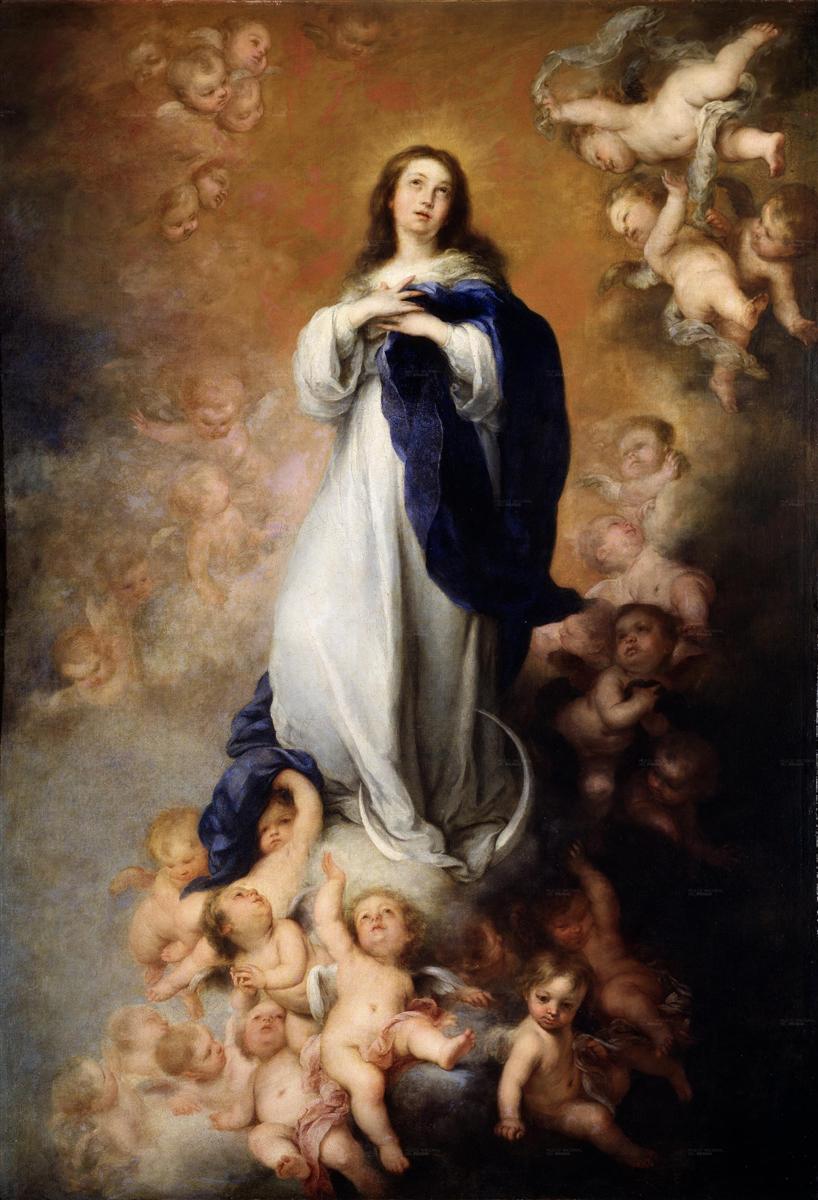
“The Aranjuez Immaculate Conception” by Bartolomé Esteban Murillo, painted in 1678, is one of the most radiant visual interpretations of the Virgin Mary in Spanish Baroque art. In this large canvas, Mary appears suspended in a glowing sky, wrapped in white and deep blue, surrounded by clouds of cherubs that swirl around her like living light. Murillo transforms a complex theological doctrine into a tender and accessible image, fusing mystical symbolism with human warmth.
This painting belongs to a group of Immaculate Conception scenes that Murillo produced throughout his career, yet the Aranjuez version stands out for its refinement, its subtle handling of color, and its carefully staged emotional atmosphere. Viewing the work feels like witnessing a vision gently materializing from a luminous mist. The viewer is invited not only to admire Mary as a heavenly queen, but also to approach her as a young woman whose expression reveals humility, awe, and quiet joy.
Historical And Religious Context
To understand “The Aranjuez Immaculate Conception,” it helps to recall the importance of the Immaculate Conception in seventeenth century Spain. The doctrine states that Mary was preserved from original sin from the very first moment of her existence. In Spain, devotion to this belief reached a fervent intensity. Religious orders, confraternities, and city councils promoted the Immaculate Conception as a national cause, and artists responded by creating countless images that celebrated Mary’s purity.
Murillo, working in Seville, became the most beloved painter of this subject. The Council of Trent had encouraged artworks that would instruct and move the faithful, and Murillo answered with images that were both theologically precise and emotionally engaging. The typical visual formula for the Immaculate Conception had already been shaped by Spanish artists and theologians, drawing on the description of the woman clothed with the sun in the Book of Revelation. She stands on a crescent moon, crowned with stars, attended by angels, and enveloped in light.
In “The Aranjuez Immaculate Conception,” Murillo embraces this standard iconography yet infuses it with his own characteristic softness and grace. The result is a work that would have satisfied doctrinal expectations while also stirring personal devotion. For a seventeenth century viewer, the painting communicated Spain’s pride in Mary as the purest of creatures and as a powerful intercessor for humanity.
The Vision Of Mary In The Aranjuez Immaculate Conception
At the center of the painting stands the Virgin Mary, a slender, youthful figure dressed in a flowing white gown and wrapped in a deep blue mantle. Her body gently twists in a graceful contrapposto, one foot placed upon the crescent moon that emerges from the clouds. Mary’s hands are folded over her chest, fingers interlaced in a gesture that expresses both humility and gratitude. Her head tilts slightly upward, and her eyes gaze toward an unseen light source, suggesting an intimate dialogue with God.
Murillo avoids the stern grandeur often associated with earlier Marian images. Instead, he presents Mary as approachable and tender, almost girlish, yet marked by a quiet nobility. There is a delicate blush in her cheeks, and her soft brown hair falls naturally over her shoulders. The features of her face are idealized but not remote, which makes it easy for viewers to imagine her as a living, feeling person.
The drapery plays a crucial role in defining her presence. The white robe symbolizes her purity and sinlessness, while the deep ultramarine mantle carries royal and celestial connotations. The mantle drapes around her figure, creating diagonal lines that animate her otherwise calm pose. Murillo arranges the folds so that the fabric seems to catch a gentle wind from the heavens, hinting that Mary is in motion, ascending or already suspended in the divine realm.
Composition And Spatial Drama
Although the painting appears serene, Murillo constructs a dynamic composition that guides the viewer’s eye in continuous motion. Mary forms the vertical axis of the scene, rising from the cluster of cherubs at the bottom to the glowing cloud at the top. Around this axis, the cherubs and angelic heads swirl in arcs and spirals, generating a sense of celestial movement.
Murillo balances this vertical ascent with lateral flows of figures. To the left, a cloud of barely defined cherubic heads dissolves into the golden mist. On the right, more fully modeled angels with fluttering draperies form a diagonal that sweeps upward, echoing the line of Mary’s mantle. The result is a visual rhythm that encloses Mary in a vortex of adoration. She is the still center of an otherwise swirling universe.
Spatially, the painting offers no earthly setting. There is no architectural frame, no horizon line, and no solid ground. Instead, the viewer confronts a vast expanse of sky, clouds, and light. This absence of earthly references underscores the supernatural nature of the scene. Yet Murillo softens the abstraction by giving every figure a tangible corporeal presence. The clouds support the cherubs like cushions of vapor, and Mary’s body casts gentle shadows on her garments. The sacred vision feels immediate and almost tangible, even as it transcends the physical world.
Light, Color, And Atmosphere
Light is central to the emotional impact of “The Aranjuez Immaculate Conception.” Murillo bathes the entire canvas in a warm golden glow, suggesting a light that emanates from within the clouds themselves. This luminous background gradually shifts from brighter tones near the upper center to deeper shadows near the right and lower edges. The effect resembles a sunrise in the heavens, with Mary as the figure who fully receives and reflects this divine illumination.
The color palette is carefully chosen. The golden browns and soft ochers of the sky contrast with the cool whites and blues of Mary’s garments. This cool-warm contrast makes her stand out while simultaneously harmonizing with the surrounding atmosphere. The cherubs display tender flesh tones that echo the warmth of the sky, creating visual continuity between the divine light and the human figures it touches.
Murillo’s handling of paint is smooth and delicate. Transitions between light and shadow are veiled and subtle, avoiding sharp contrasts. This gentle modeling gives the figures a velvety softness that became one of Murillo’s trademarks. It also enhances the sense of spiritual serenity. The light does not simply fall upon the figures from an external source; it seems to seep through them, turning their bodies into vessels of radiance.
The blue mantle deserves special attention. Its deep, saturated color anchors the composition and immediately draws the viewer’s eye. Highlights along the folds reveal soft reflections of the surrounding light, and areas of darker blue provide depth and gravity. Symbolically, the mantle is like the sky draped around Mary, while visually it serves as a strong counterpoint to the golden background.
The Angelic Host And The Language Of Devotion
Surrounding Mary is a multitude of cherubs and angels, each with its own pose and expression. At the very bottom, plump infant angels cluster among the clouds, reaching up toward Mary with outstretched arms. Some gaze upward in wonder, others play with pieces of her blue mantle, and one cherub looks out toward the viewer, inviting us into the celestial gathering. Their rosy skin and chubby limbs give the scene a playful intimacy, yet their gestures carry devotional meaning. They embody pure joy at Mary’s exaltation.
Higher up, angels with more developed bodies participate in the scene with graceful movements. On the right, a group of angels swoops in with billowing drapery, perhaps bringing crowns or symbolic objects that are partially lost in the mist. Their bodies twist and turn in complex poses that display Murillo’s understanding of anatomy and Baroque dynamism.
On the left side, ethereal angelic heads float in the golden clouds, like sparks of consciousness in the divine light. Murillo paints them with soft edges, almost merging with the atmosphere, which gives the impression that the entire sky is alive with spiritual presence.
These angels are more than decorative. They frame Mary as the central object of heavenly veneration and help viewers interpret the scene as a cosmic celebration of her purity. At the same time, their innocent faces and tender gestures make the supernatural realm feel affectionate and welcoming rather than austere or distant.
Symbolism Of The Crescent Moon And Heavenly Clouds
At Mary’s feet, a silvery crescent moon emerges from the dark clouds. This motif derives from the passage in the Book of Revelation describing a woman clothed with the sun, with the moon under her feet. In the context of the Immaculate Conception, the moon also symbolizes changeability and the sublunary world, which Mary transcends. By placing her feet upon the moon, Murillo signals her victory over sin and over the inconstancy of earthly existence.
The clouds that envelop the lower portion of the canvas have a dual function. Visually, they provide a soft platform on which the cherubs rest and through which Mary appears to rise. Symbolically, the clouds separate the celestial realm from the earthly one. The viewer stands below, while Mary and the angels inhabit a luminous zone that feels close yet inaccessible. The clouds thus become a poetic metaphor for the veil that divides human perception from divine reality.
Murillo differentiates between the upper and lower clouds through color and texture. The upper clouds are more golden and diffuse, filled with angelic heads. The lower clouds are cooler and darker, especially on the right, where a subtle shadow introduces depth. This gradient may suggest Mary’s movement from the darker world of sin toward the pure light of heaven, reinforcing the theme of immaculate purity.
Murillo’s Painterly Technique
Beyond iconography, “The Aranjuez Immaculate Conception” showcases Murillo’s technical mastery. His brushwork is controlled yet fluid, allowing him to capture both delicate details and broad atmospheric effects. The faces of Mary and the cherubs are carefully modeled, with smooth transitions and a luminous underpainting that seems to shine through the surface.
Murillo skillfully uses glazes to create depth in the colors. Thin layers of translucent pigment allow underlying tones to modify the final effect, especially in the blue mantle and in the golden sky. This glazing technique contributes to the painting’s characteristic softness and glow.
The artist also demonstrates a keen understanding of how to direct the viewer’s attention. The highest level of finish is concentrated on Mary’s face and hands, as well as on a few cherubs near the center. Peripheral areas, like the far clouds and distant angel heads, are more loosely painted. This creates a hierarchy of focus, leading the eye first to the central figure and then gradually outward into the surrounding vision.
In addition, Murillo subtly manipulates perspective and scale. The cherubs near the bottom are larger and more detailed, suggesting that they float closer to the viewer, while those higher up become smaller and more diffuse, enhancing the illusion of depth within the sky. The result is a painting that feels immersive, as if the viewer is gazing into a three dimensional space filled with light and movement.
Emotion, Contemplation, And The Viewer
One of the most remarkable aspects of “The Aranjuez Immaculate Conception” is its emotional tone. Despite the abundance of figures and movement, the overall mood is one of serene contemplation. Mary’s expression, calm and slightly introspective, sets the tone. She does not look directly at the viewer, but instead gazes upward, absorbed in her experience of divine grace. This indirect gaze invites viewers to adopt a similar attitude of interior reflection.
The cherubs provide a contrasting emotional register. Their delight and playfulness express a more spontaneous joy, which mirrors the celebratory aspect of the doctrine. Together, Mary’s quiet humility and the angels’ exuberant happiness create a balance between introspection and outward praise.
For a devout viewer in the seventeenth century, the painting would have functioned as a visual aid to prayer. The viewer could identify with the cherub reaching toward Mary, or feel comforted by the sea of angelic faces surrounding her. Today, even outside a strictly religious context, the painting still communicates feelings of wonder, tenderness, and uplift. Murillo’s ability to humanize the sacred allows modern viewers to connect with the work in personal ways.
The Painting Within Murillo’s Oeuvre
Murillo painted numerous versions of the Immaculate Conception for churches and private patrons. Over time, he refined a standard type of composition: Mary in white and blue, standing on the crescent moon, surrounded by a cloud of angels. The Aranjuez version belongs to his mature period, when his style had reached great sophistication and confidence.
Compared to some earlier Immaculate Conception paintings, the Aranjuez canvas feels more unified and atmospheric. In earlier works, the angels sometimes crowd the space more insistently, and the contrasts between light and shadow can be sharper. Here, Murillo prefers a more subtle orchestration. The transitions between zones of light are smoother, and the overall color harmony is more restrained.
This maturity also manifests in Mary’s characterization. She appears less like a rigid emblem and more like a living, breathing person. Her humanity remains central, even as she is glorified. This fusion of accessible humanity with lofty sanctity is one of Murillo’s greatest contributions to Spanish painting and helps explain his enduring popularity.
Legacy And Lasting Appeal
“The Aranjuez Immaculate Conception” participates in a long tradition of Marian images, yet it continues to feel fresh and emotionally resonant. Its appeal lies partly in Murillo’s ability to combine theological clarity with sensuous beauty. The painting does not merely illustrate a dogma; it creates an environment of light and tenderness that allows viewers to feel the emotional truth behind the doctrine of Mary’s purity.
The influence of Murillo’s Immaculate Conceptions extended well beyond his lifetime. Nineteenth century artists and patrons continued to admire and replicate his gentle Marian type, and reproductions of his works circulated widely in prints and devotional images. In churches and homes, Murillo’s Mary became a familiar presence, a visual shorthand for compassionate intercession and sinless beauty.
In art historical terms, the painting is also a prime example of Spanish Baroque sensibility. It combines dramatic composition and rich color with a distinctive softness that differentiates Murillo from more austere contemporaries. His approach helped define how later generations imagined sacred scenes, emphasizing warmth, intimacy, and emotional accessibility.
Even in a secular museum setting, “The Aranjuez Immaculate Conception” continues to draw viewers who may know little about the doctrine it represents. They are captivated by the luminous sky, the charming cherubs, and the serene figure of Mary gazing upward. The painting’s mastery of light and atmosphere, combined with its gentle humanity, allows it to transcend its historical origins and speak to a broad audience.
Conclusion
“The Aranjuez Immaculate Conception” by Bartolomé Esteban Murillo stands as a masterpiece of Spanish Baroque painting and as one of the most moving visual statements about the Virgin Mary. Through a finely tuned composition, luminous color, and tender characterization, Murillo translates a complex theological idea into an image of extraordinary clarity and emotional depth. Mary’s graceful figure, poised above the crescent moon and surrounded by clouds of adoring angels, becomes a symbol of both spiritual elevation and compassionate closeness.
The painting invites viewers into a world where the boundaries between heaven and earth soften, where golden light enfolds every figure, and where innocence and joy seem to animate the very air. Murillo achieves this effect not through violent drama but through a quiet, insistent radiance that gently engages the heart. As part of his broader series of Immaculate Conceptions, the Aranjuez canvas represents the culmination of his exploration of Marian themes and remains one of the most beloved images of the Virgin in Western art.