Image source: wikiart.org
Introduction to Children Eating a Pie by Bartolome Esteban Murillo
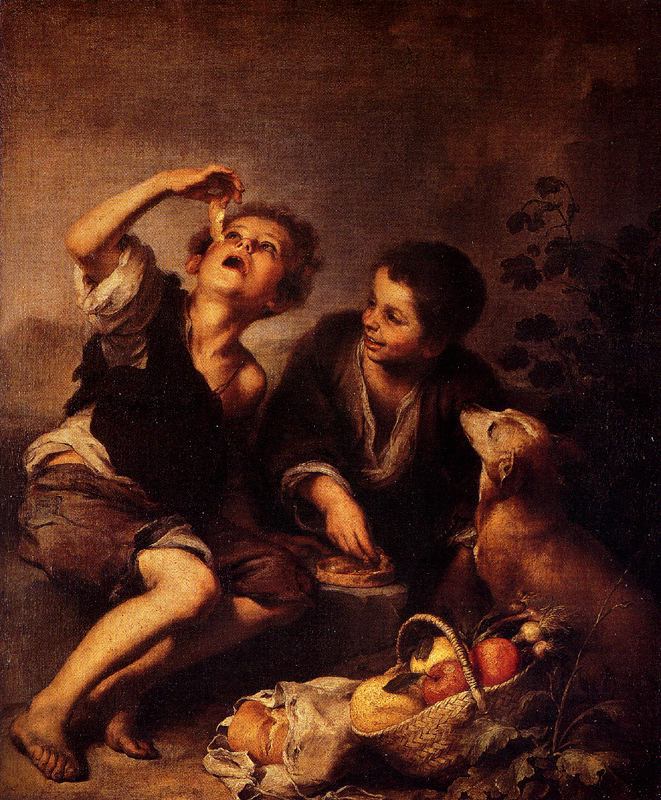
“Children Eating a Pie,” painted in 1675 by Bartolome Esteban Murillo, is one of the most charming and revealing images from the Spanish Baroque. Instead of saints, angels or noble patrons, Murillo gives his attention to two ragged street boys and a patient dog who share a simple meal. The scene is intimate and playful. One child throws his head back and lifts a slice of pie toward his mouth with theatrical enthusiasm. His companion watches with a broad smile, while the dog gazes upward, hoping for a crumb to fall.
This painting belongs to Murillo’s celebrated series of genre scenes that depict poor children of Seville at play, eating or resting. These works capture a world that was very real in seventeenth century Spain. The city was prosperous in trade, yet filled with orphans and beggars. Murillo’s talent lies in the way he transforms this harsh social reality into images filled with humor, warmth and humanity. “Children Eating a Pie” invites viewers to enjoy the boys’ delight while also reflecting on the fragility of their situation.
Historical Context and Murillo’s Street Children
By the 1670s Murillo was an established master in Seville, admired for large religious canvases and altarpieces. Yet during this same period he produced a series of smaller works showing street children in everyday activities. “Children Eating a Pie” is part of that group, which includes paintings like “Two Boys Eating Grapes and a Melon” and “The Young Beggar.”
Seville in Murillo’s lifetime suffered repeated outbreaks of plague, economic decline and social dislocation. Many children were left orphaned or driven to the streets. These young people would have been a common sight near markets and churches, where they begged for food or sold small items. Murillo’s genre paintings do not hide their poverty. Bare feet, torn clothing and simple food make it clear that these children live on the margins. At the same time, he refuses to portray them as merely pitiful. They laugh, joke, eat and invent games with the exuberance of youth.
Collectors, particularly foreign merchants and nobles, were fascinated by these images of lively Spanish street life. The paintings were acquired for private homes and palaces, where they offered a mix of exotic local color and sentimental charm. Through them, Murillo created one of the most enduring visual records of Seville’s children.
Composition and the Triangle of Companionship
The composition of “Children Eating a Pie” is both simple and subtle. The two boys and the dog form a loose triangle in the lower half of the canvas. This triangular arrangement provides stability while also drawing the viewer’s eye around the scene. The boy on the left leans back, his body angled diagonally as he stretches upward to eat. The boy on the right leans slightly forward, turning his head toward his friend. The dog sits at the base, looking up with bright attention.
Murillo places the group slightly off center, leaving a modest amount of open space above them. This space is filled with a soft, neutral background that suggests an outdoor setting without specific details. It might be a yard, a roadside or a corner of the city. The lack of architecture keeps the focus on the figures themselves.
In the foreground, a woven basket spills fruit and bread onto a cloth. The curve of the basket handle echoes the curve of the boy’s raised arm. The placement of the still life at the lower edge of the painting invites the viewer to imagine kneeling or sitting beside the children, sharing their humble feast. The overall effect is informal and approachable, as if the scene were captured spontaneously.
Light, Shadow and Color
Murillo’s use of light and color gives this modest subject great visual richness. The light appears to fall from the left, illuminating the faces and bare limbs of the children. Their skin glows with warm tones of peach and rose, contrasting with the darker browns and grays of their rough clothing. The boy who lifts the pie is especially highlighted. His upturned face and throat catch the strongest light, making his exuberant gesture the focal point of the painting.
The background remains in soft shadow, ranging from warm browns to muted grays. This gentle darkness pushes the figures forward and unifies the composition. Murillo’s color palette is dominated by earth tones, but he enlivens it with touches of red and yellow in the fruit and with subtle greens in the foliage to the right. These colors prevent the painting from feeling dull and suggest the warmth of the Spanish climate.
Chiaroscuro, the contrast between light and shadow, is present but not harsh. Murillo’s shadows are soft and enveloping rather than stark. They create a cozy atmosphere, as if the children were gathered in a sheltered corner away from the glare of the street. This tender lighting contributes to the painting’s mood of quiet happiness.
Character and Expression of the Two Boys
The individuality of the two boys is central to the charm of the painting. Murillo does not present them as generic types but as distinct personalities caught in a moment of interaction.
The boy on the left is impulsive and carefree. His clothing hangs loosely from his thin frame. One shoulder is bare, the fabric of his shirt slipping down as he lifts his arm. His knees are bent, his feet firmly planted on the ground. His head is thrown back, eyes half closed, mouth open in anticipation as he lowers the slice of pie. Everything about his posture suggests eagerness and delight. He is entirely absorbed in the simple pleasure of eating.
The boy on the right appears more reflective and amused. He sits closer to the viewer, leaning on one arm while the other hand holds or cuts into the pie. His gaze is fixed on his companion, and a half smile flickers across his face. He seems to enjoy the spectacle of his friend’s dramatic gesture, perhaps teasing him or sharing an unspoken joke. His expression conveys affection and playful complicity.
Together, the boys embody different aspects of childhood. One is spontaneous and physical, the other observant and social. Murillo captures this dynamic with extraordinary subtlety in the tilt of heads, the direction of eyes and the relaxed positioning of limbs. The relationship between them feels natural and believable.
The Faithful Dog and the Shared Meal
The dog at the right side of the painting is more than a decorative addition. Sitting attentively with ears alerted, it looks up at the boy who is about to eat, following the movement of the food. The animal’s posture mirrors the expectation and hunger present in the children, yet it also introduces another layer of companionship.
Dogs were common in Murillo’s street scenes. They symbolized loyalty and also echoed the precarious survival of the poor who lived day to day. Here the dog shares in the boys’ world, hoping to share their meal. The triangle formed by two children and dog suggests a tiny community bound by hunger, friendship and mutual dependence.
The food itself is modest yet plentiful for the moment. The pie, likely filled with fruit or simple ingredients, occupies the center of the interaction. The overflowing basket with fruit and bread indicates that the children have, at least temporarily, access to an abundance that contrasts with their tattered appearance. It may suggest a successful day of begging or work, or a stroke of luck. Murillo uses these details to underline the joy of having enough to eat, a joy that many viewers of the time would have understood.
Poverty, Innocence and Social Commentary
Although the painting radiates warmth and humor, it also carries a gentle social critique. The children’s clothing is clearly patched and torn. Knees are bare, shirts are ripped, and feet are unshod. Such details reveal that they live in poverty, likely without stable homes or families. Yet Murillo does not dwell on misery. Instead, he shows how these children manage to find pleasure in a simple meal.
This approach reflects the complex attitudes toward poverty in seventeenth century Spain. On one hand, charity and almsgiving were central Christian duties. On the other hand, beggars were often seen as a social nuisance. By humanizing street children and showing their capacity for joy, Murillo encourages viewers to see them not as problems but as persons worthy of sympathy and care.
There may also be an implicit moral lesson. The boys are poor, but they share their food and delight in each other’s company. Their lack of possessions contrasts with the richness of their immediate experience. Viewers, including wealthy patrons, might be reminded that happiness does not depend entirely on material wealth. The painting suggests that generosity, friendship and gratitude for simple gifts are forms of wealth available to all.
Symbolic Resonances of Food and Fruit
Beyond social commentary, “Children Eating a Pie” can be read on a symbolic level. Food has long carried spiritual meanings in Christian art. Bread and fruit often recall themes of nourishment, abundance and sometimes excess. Here, the pie and fruit basket may stand for the pleasures of the senses and the sweetness of life.
At the same time, there is a hint of the fleeting nature of such pleasures. The pie slice held high will soon disappear. The fruit in the basket will ripen and decay. The children’s happiness is therefore momentary. This sense of transience may reflect the broader Baroque concern with the passage of time and the vulnerability of human life.
However, Murillo does not emphasize warning or moral severity. The painting does not condemn the boys for enjoying their food. Rather, it quietly acknowledges that all earthly joys are temporary and therefore precious. In this way, the painting balances a celebration of physical pleasure with a contemplative awareness of its limits.
Murillo’s Technique and Handling of Paint
Technically, “Children Eating a Pie” demonstrates Murillo’s mature skill. His brushwork is varied and expressive. In areas of skin, he uses smooth transitions and delicate glazes to create a soft, lifelike glow. In fabrics and hair, the strokes become more visible, suggesting texture and movement. The still life elements in the foreground, such as the basket and fruit, are painted with confident touches that capture their shapes and colors without overworking detail.
Murillo’s mastery of tonal balance is evident in the way he harmonizes the warm hues of flesh, bread and fruit with the cooler, neutral tones of clothing and background. The painting feels unified, with no element jarring or out of place. The subtle gradations of light create depth, allowing the figures to emerge gently from the surrounding space.
Another notable aspect is the naturalistic depiction of anatomy. The children’s limbs show the slight awkwardness of growing bodies. The boy who stretches his arm upward displays the tension of tendons and muscles. These realistic details ground the painting firmly in lived experience, even while the overall scene carries lyrical charm.
Place of the Painting within Murillo’s Oeuvre
“Children Eating a Pie” occupies an important place in Murillo’s broader body of work. While he achieved fame for religious images of the Immaculate Conception, the Holy Family and numerous saints, his genre paintings of children have had a special appeal for later generations. They reveal a side of Spanish Baroque art that is intimate, secular and focused on everyday life.
Within this group, “Children Eating a Pie” stands out for its sense of narrative and interaction. Some of Murillo’s other works show single beggar boys, contemplative and solitary. Here, the presence of a companion and a dog turns the painting into a miniature story about sharing and companionship. It shows that Murillo was not only a skilled portraitist and religious painter but also a keen observer of human relationships.
Art historians have pointed out that these scenes of poor children, while sympathetic, were made for middle class and aristocratic collectors rather than for the children themselves. They allowed viewers to experience a sentimental connection to the lower classes while maintaining a comfortable distance. Even so, the sincerity of Murillo’s empathy continues to shine through. The boys in “Children Eating a Pie” feel alive and relatable, not staged props.
Emotional Impact and Lasting Popularity
The enduring popularity of “Children Eating a Pie” rests on its emotional accessibility. The subject is easy to understand and immediately engaging. Many viewers, regardless of era, can remember moments of intense enjoyment over a simple treat, especially in childhood. The painting taps into these memories, triggering both nostalgia and empathy.
The humor of the boy’s exaggerated pose and the dog’s hopeful gaze brings a smile, yet the tattered clothing and bare feet prevent the scene from slipping into trivial sweetness. There is always a quiet awareness of hardship behind the laughter. This balance between joy and fragility is one of Murillo’s great achievements. It allows the painting to be both delightful and profound.
For contemporary audiences, the work can also prompt reflection on present day issues of child poverty, hunger and social inequality. Murillo’s seventeenth century vision reminds us that behind every statistic about needy children there are real individuals with personalities, friendships and everyday pleasures.
Conclusion
“Children Eating a Pie” by Bartolome Esteban Murillo is far more than a charming glimpse of two street boys enjoying a meal. Through careful composition, warm lighting and sensitive characterization, Murillo creates a scene that is at once intimate, humorous and deeply human. The painting captures the universal experience of pleasure in simple things while also acknowledging the reality of poverty and the fleeting nature of material comfort.
The two boys, the faithful dog and the basket of food together form a small world of shared happiness and mutual dependence. Murillo invites the viewer to sit with them, to appreciate their joy and to recognize the dignity of lives lived on the margins. In doing so, he expands the scope of Baroque painting beyond grand religious and courtly themes, demonstrating that everyday childhood can be as worthy of artistic attention as the loftiest subjects.
More than three centuries after its creation, “Children Eating a Pie” continues to speak with warmth and clarity. It reminds us that art can preserve not only the faces of the powerful but also the laughter of anonymous children, and through that laughter, it can still move hearts today.