Image source: wikiart.org
A Heavenly Encounter: Introducing “St. Augustine with the Virgin and Child”
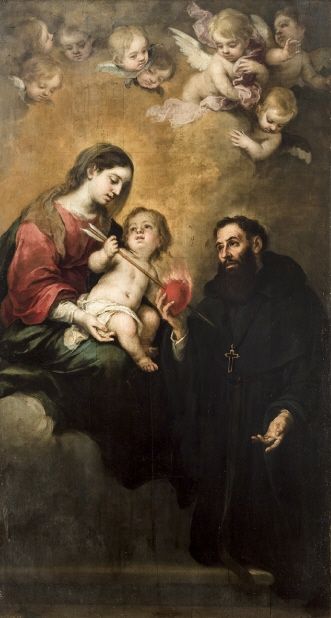
“St. Augustine with the Virgin and Child,” painted by Bartolomé Esteban Murillo around 1670, is a rich example of Spanish Baroque devotion. In this tall vertical canvas, the viewer witnesses a mystical encounter between the great Church Father Augustine and the Virgin Mary holding the Christ Child, all framed within an atmosphere of glowing light and swirling angels. Murillo, one of Seville’s most beloved painters, specialized in works that combined theological clarity with emotional warmth. Here he presents a dramatic yet intimate vision of a saint whose heart and mind are completely captured by divine love.
The painting belongs to a tradition of visionary images in which saints receive spiritual favors from heaven. Yet Murillo’s approach is uniquely tender. Rather than emphasizing fear or awe, he focuses on the gentle bond between the Virgin, the Child, and Augustine. The scene feels like a conversation suspended between earth and heaven, a sacred exchange that invites the viewer to draw near.
Composition and First Impressions
The composition is divided into two main zones that interact fluidly. On the left, seated on clouds, the Virgin and Child form a luminous, triangular group. On the right, Saint Augustine stands or kneels in his dark monastic habit, his gaze lifted upward toward the apparition before him. Above, a cluster of cherubic angels floats in the golden sky, filling the upper third of the canvas and completing the vertical ascent from earth to heaven.
Murillo uses the tall format to emphasize the idea of spiritual elevation. Augustine occupies the lower right, firmly grounded yet clearly drawn upward. The Virgin, placed just above his level, appears as a bridge between the earthly saint and the heavenly realm. The angels at the top complete the journey of the eye, guiding it into the glowing light that suggests the presence of God.
The overall impression is one of balance between movement and stillness. Augustine’s gestures are animated his hand extends outward, his other hand clutches his chest, and his face is alive with emotion. Yet the Virgin is serene and stable, her body forming a calm pivot around which the entire scene turns. The Christ Child, seated on her lap, leans toward Augustine in a gesture of active grace. Nothing feels accidental all lines and glances draw the viewer into this intimate axis of love.
The Virgin and Child as Source of Grace
Murillo presents the Virgin Mary as a young, gentle mother. Her head tilts toward the Child and slightly downward toward Augustine, creating a diagonal of compassion. She is richly robed in deep red and blue, traditional colors that signify love, humanity, and heavenly glory. Yet Murillo softens these hues with his characteristic warm light, so the fabrics glow rather than shout.
Mary’s expression is tender but serious. She is not merely an onlooker she participates in the act of grace that unfolds. Her arms support the Christ Child as he leans forward, and the careful way she holds him suggests both maternal protection and a willingness to offer him to the world. This dual role of mother and mediatrix was central to Catholic devotion in seventeenth century Spain, and Murillo visualizes it through posture and gaze rather than overt symbolism.
The Christ Child is the most dynamic figure in the upper group. His body twists slightly, his chubby limbs in mid movement as he reaches out toward Augustine. In his hand he holds a flaming heart or directs Augustine toward the heart presented to him. This heart symbolizes divine love, the burning charity that consumed Augustine’s life after his conversion. The Child’s gesture encapsulates the entire theology of the scene: Christ himself offers his heart to the saint, who receives it with awe and gratitude.
St Augustine and the Drama of the Heart
On the right stands Saint Augustine, Bishop of Hippo and one of the great doctors of the Church. Murillo depicts him in the dark habit of an Augustinian monk, emphasizing humility and poverty rather than the ornate episcopal vestments that could have been used. Around his neck hangs a simple cross, further underlining his identity as a follower of Christ rather than a worldly dignitary.
Augustine’s face is one of the most compelling features of the painting. Murillo portrays him as a bearded man of middle age, with furrowed brow and deeply reflective eyes. This is the philosopher and theologian who wrestled with questions of truth and desire. Yet in this moment of vision, his expression is softened by wonder. He looks up toward the Virgin and Child with a mixture of love, astonishment, and humility.
In one hand Augustine holds a red flaming heart or receives it directly from the Christ Child. In devotional iconography, Augustine is often shown holding a heart pierced or inflamed, representing his famous line, “Our hearts are restless until they rest in you.” Murillo takes this symbol literally. The heart is not only Augustine’s but also Christ’s, glowing with supernatural fire. This shared heart suggests the union of wills that defines sanctity. Augustine does not merely admire Christ he receives Christ’s own love into his being.
His other hand is extended outward in a gesture of openness. The palm faces upward, ready to receive or to give. This detail conveys the idea that Augustine’s theological work and pastoral service flowed from the grace he received. The saint is both contemplative and active, rooted in a mystical experience that fuels his mission.
Angels and the Theater of Heaven
Above the central figures, Murillo fills the sky with a lively assembly of cherubs. These young angels, with their plump faces and delicate wings, are a hallmark of Murillo’s style. They are not distant, solemn creatures but playful and affectionate witnesses. Some look down at the vision, others glance toward the viewer or interact with each other. Their rosy flesh and swirling movement animate the composition and underscore the joy of heaven at the transformation of a human heart.
The angels also serve a symbolic role. A few of them hold ecclesiastical objects traditionally associated with Augustine: a bishop’s mitre and a crozier or staff. These items affirm his office and authority within the Church, yet they are carried by angels rather than worn by the saint himself. This subtle choice reinforces the idea that earthly honors are secondary compared to the inner union of love symbolized by the flaming heart. Augustine’s greatness lies less in his status and more in his burning devotion to God.
The cloud on which the Virgin and Child sit extends into the space occupied by the angels, uniting the groups into a continuous heavenly environment. Soft, billowing shapes create a sense of depth and movement. They also form a kind of stage on which the drama of grace is played out. Yet the theater is not closed off. The bottom edge of the cloud almost brushes Augustine’s head, suggesting that heaven bends down to touch him.
Light, Color, and Murillo’s Baroque Sensibility
Murillo’s handling of light gives the painting its distinctive spiritual atmosphere. A warm golden glow suffuses the upper part of the canvas, emanating from the area around the Virgin and Child and gradually fading toward the edges. This radiance bathes the angels and drifts downward toward Augustine, symbolizing the flow of grace from heaven to earth.
The contrast between light and shadow is pronounced yet gentle. Augustine’s dark habit anchors the lower part of the painting, forming a mass of deep browns and blacks that set off the luminous flesh tones above. The Virgin’s garments occupy a middle range of intensity, their saturated reds and blues catching the light on folds and edges. The Christ Child’s skin and the glowing heart are among the brightest points, drawing immediate attention.
Murillo avoids harsh outlines, preferring soft transitions and subtly blended contours. This painterly approach suits the subject, as it visually reinforces the idea of a spiritual reality that surpasses rigid definitions. The figures seem to emerge from the surrounding atmosphere rather than being sharply detached from it. This fusion of form and light is typical of the Baroque style, but Murillo tempers its drama with an overriding sense of gentle harmony.
Color plays its own symbolic role. The red of the Virgin’s mantle echoes the red of the flaming heart, linking maternal love with divine charity. The blue cloak suggests her purity and heavenly role. Augustine’s dark habit underscores humility, while the creamy flesh tones of the Child and the cherubs radiate innocence and divine life. Taken together, these colors create a rich yet balanced palette that reinforces the painting’s theological narrative.
Gesture, Expression, and Emotional Connection
One of Murillo’s greatest strengths lies in his ability to convey complex emotions through gesture and expression. In this painting every glance and movement contributes to a network of relationships. The Virgin’s downward gaze and slight inclination form a line of empathy from heaven to Augustine. The Child’s forward lean and extended arm form a second line of active grace. Augustine’s upturned eyes and open hands complete the circuit, returning love and gratitude to the source.
The cherubs participate with more playful but still meaningful gestures. Some look admiringly at the Virgin and Child, others seem to point or present the bishop’s symbols, while a few simply float in contented observation. Their presence softens the solemnity of the scene and communicates a sense of joy. This combination of reverence and tenderness is a hallmark of Murillo’s religious imagery.
For the viewer, these interacting gestures create a strong emotional pull. It becomes easy to identify with Augustine, whose posture of openness mirrors the spiritual attitude encouraged in the painting’s audience. The composition does not isolate the saint as a distant hero. Instead it invites viewers to imagine themselves standing beside him, receiving the same gift of divine love.
Theology of the Burning Heart
Beyond its visual beauty, “St. Augustine with the Virgin and Child” is deeply rooted in theological symbolism. The central motif of the burning heart encapsulates Augustine’s spiritual journey from restless seeker to passionate lover of God. In his writings he described the interior struggle between worldly desires and the call of truth. Murillo condenses this complex narrative into a simple, unforgettable image: the saint, clad in humble black, holding a heart of vivid red that blazes with divine fire.
This heart can be read in several ways. It is Augustine’s own heart, purified and inflamed by grace. It is the Sacred Heart of Jesus, source of mercy for all believers. It is also the shared love that unites Christ and the saint, a love transmitted through the intercession of the Virgin Mary. The fact that the Child is the one who offers or touches the heart underscores that grace originates in Christ himself, even when mediated by Mary or the Church.
Such imagery resonated strongly in seventeenth century Spain, where Catholic mysticism placed great emphasis on the affective dimension of faith. Believers were encouraged to cultivate a personal, loving relationship with Christ rather than a purely intellectual assent. Murillo’s painting supports this spirituality by presenting Augustine not primarily as a scholar but as a man whose heart has been transformed.
Murillo in Seville and the Counter Reformation Context
To understand why a work like this was valued, it helps to situate Murillo within his historical context. Seville in the seventeenth century was a major center of Catholic reform and missionary zeal. Religious orders, confraternities, and charitable institutions commissioned artworks that would inspire devotion and teach correct doctrine. Murillo emerged as the leading painter of this environment, admired for his ability to make sacred themes emotionally accessible to a wide audience.
“St. Augustine with the Virgin and Child” belongs to this wider program. The painting not only honors a great saint but also promotes a specific model of Christian life. Augustine appears as a man who has surrendered his intellect and ambitions to the love of God. His example would have been held up to clergy and laity alike as a pattern of conversion and faithful service. The painting thus functions as a visual sermon that complements the pulpit and the written word.
At the same time, Murillo’s distinctive style, with its soft edges and radiant light, gave Spanish Baroque art a character different from the darker intensity found in some of his contemporaries. His religious scenes often carry a sweetness and humanity that made them beloved long after the original devotional context changed.
A Devotional Image for Public and Private Contemplation
Although likely intended for a church or religious house, this painting also works as an object of personal meditation. The viewer can linger over Augustine’s expressive face, the gentle inclination of the Virgin, or the glowing heart until the narrative becomes an interior reflection. The absence of complex architectural settings or crowded secondary figures keeps the focus on this central spiritual exchange.
In a public setting, the painting would have reinforced the identity and mission of Augustinian communities. It visually celebrated their founder and reminded them of the burning love that should animate their daily lives. For lay worshippers, it provided a saint to imitate and a heavenly family to approach in prayer.
Murillo’s ability to combine doctrinal richness with emotional immediacy explains why his works were cherished not only in Spain but eventually throughout Europe and the Americas. Even today, viewers who may not share the original religious beliefs often respond to the painting’s beauty and the sincerity of its feeling.
Continuing Relevance and Modern Viewership
Modern audiences encounter “St. Augustine with the Virgin and Child” in museums or reproductions rather than in the liturgical spaces for which it was made. Yet the painting still speaks powerfully about human longing and fulfillment. The restless heart of Augustine, searching for meaning, is a condition many can recognize. The image of that heart finally set ablaze by a love that comes from beyond the self offers a timeless reflection on what people ultimately seek.
From an art historical perspective, the painting exemplifies Murillo’s mature style: glowing color, gentle modeling, graceful composition, and a focus on tender human interaction. It also illustrates the way Baroque art could translate complex theological concepts into accessible visual narratives. Observing the work closely reveals how every detail contributes to the overall message, from the diagonal rhythm of the figures to the subtle interplay of light and shadow.
In a world often dominated by speed and distraction, the painting invites a slower, more contemplative gaze. To stand before it is to be drawn into Augustine’s moment of encounter, to feel something of his astonishment as divine love descends into ordinary human experience.
