Image source: wikiart.org
Introduction
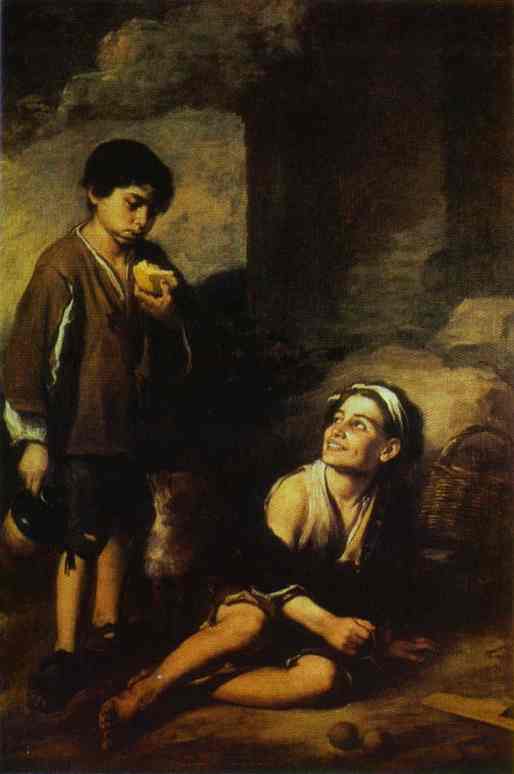
“Two Peasant Boys” by Bartolome Esteban Murillo, painted around 1670, is a quiet yet powerful scene of childhood on the margins of society. At first glance it seems simple: two boys in worn clothing share a modest moment around a piece of fruit. Yet the longer you look the more complex the painting becomes. Murillo transforms a fragment of street life into a touching meditation on poverty, friendship and human dignity.
The canvas shows a seated boy in the foreground, relaxed on the ground with bare, dusty legs stretched out toward us. He smiles upward at a second boy who stands to the left, holding a piece of fruit close to his chest. Behind them a dog slips into the shadows and a basket rests near a rough wall. The background is dark and undefined, so that the figures emerge from a soft gloom into a warm golden light. Murillo uses this light to reveal both the hard facts of their poverty and the softness of their bond.
This painting belongs to Murillo’s series of genre scenes of street children in Seville. These works were highly admired by foreign collectors and helped carry his reputation across Europe. In “Two Peasant Boys” he balances an almost documentary realism with tenderness and idealization, inviting viewers to feel empathy rather than pity. The result is one of the most human images of childhood produced in seventeenth century Spain.
Murillo in Seventeenth Century Seville
To understand the emotional charge of “Two Peasant Boys” it helps to place Murillo in his historical setting. Seville in the mid seventeenth century was a city of extremes. Once a thriving port that controlled the trade with the Americas, it had become a place of epidemics, economic decline and stark social contrasts. Many children were orphaned or forced to live on the streets.
Murillo was best known in his own time for religious paintings that adorned churches and convents across Seville. He painted tender Madonnas, visions of saints and miracles suffused with warm light. Yet in parallel he turned his attention to the poor who crowded the streets outside these sacred spaces. Instead of depicting them as anonymous beggars, he gave them individual faces, often with a surprising sense of humor and charm.
“Two Peasant Boys” grows out of this double artistic identity. The calm lighting and gentle expressions recall the mood of his religious scenes, where grace is quietly present in everyday reality. At the same time the subject matter is secular and humble. It is as if Murillo has brought the compassion of his sacred art into the world of ordinary children.
First Impressions and Narrative
When you first look at the painting your eye is drawn to the seated boy on the right. He occupies the brightest area of the canvas and his smile opens the emotional tone of the scene. His body is turned slightly away from us, yet his face tilts upward so that we fully see his expression. He appears to be mid conversation, or perhaps mid joke, sharing a moment with his friend.
The standing boy at the left is quieter and more introspective. He looks down at the fruit in his hand rather than directly at the other boy. His body is elongated and his shadowy face is partially obscured by the fall of his hair. This contrast sets up a subtle narrative. The seated boy radiates spontaneous joy, while the standing boy seems more cautious, perhaps more aware of hunger or responsibility.
Between them lies a small still life of rough objects: the basket, pieces of fruit, the dog and some indistinct items at their feet. Nothing is luxurious. Everything hints at scarcity and labor. Yet the painting is not tragic. Murillo freezes a shared pause in the daily struggle, a small pocket of pleasure and companionship that exists in spite of hardship.
The relationship between the two boys remains open to interpretation. They could be brothers, friends or simply companions thrown together by street life. What matters is the way Murillo conveys their connection through glances and gestures rather than overt action.
Composition and Use of Space
The composition is deceptively simple. The two figures form a loose diagonal that runs from the head of the standing boy down through the smiling face and body of the seated boy to his bare feet at the bottom right corner. This diagonal creates a gentle movement that guides the viewer’s gaze. It also introduces a subtle instability that echoes the precariousness of their lives.
Murillo balances this diagonal with vertical and horizontal elements. The standing boy’s body acts as a vertical pillar that anchors the left side of the canvas. Behind the seated boy, the baskets and vague architectural forms create a low horizontal mass. These structures prevent the composition from feeling overly tilted and give the scene a sense of grounded stability.
The background is largely undefined. Smoke or clouds of dust rise behind the figures and dissolve into darkness. This lack of detail focuses attention firmly on the boys and removes any distraction that might pin them to a specific street or neighborhood. They come to stand as representative figures for many poor children in Seville rather than portraits of identified individuals.
The space they occupy feels shallow but not cramped. The boys are close enough to the picture plane that we sense we could step into their world. At the same time, the dark recess behind them suggests a depth of unseen streets and alleys. Murillo thus places the viewer at the threshold between the immediate scene and the larger urban environment that produced it.
Light, Shadow and Murillo’s Palette
One of the most striking aspects of “Two Peasant Boys” is Murillo’s treatment of light. The figures emerge from a warm, focused illumination that falls from the left and slightly above. The light touches the boys’ faces, limbs and clothing, then fades gently into shadow. It also grazes the textured surfaces of the basket and the rough ground.
This lighting recalls the influence of earlier Spanish masters who were themselves indebted to Caravaggio, yet Murillo softens the stark contrasts typical of pure tenebrism. Instead of harsh edges between light and dark he uses gradual transitions. Shadows remain warm rather than cold. The result is a luminous atmosphere that feels almost caressing.
The color palette is dominated by browns, ochres and muted greens. These earth tones reinforce the humble nature of the scene and echo the color of soil and dust. The boys’ clothing is in shades of brown and dull red, frayed at the edges. Their skin carries a warm, sun touched tone, suggesting outdoor life.
Within this subdued palette Murillo introduces subtle accents. The fruit held by the standing boy glows with a rich yellow that draws attention to it as an important motif. The white cloth around the seated boy’s shoulders and head catches the light and frames his face, heightening his expression. These luminous touches prevent the painting from sinking into gloom and infuse it with quiet vitality.
The Expressive Power of the Figures
Murillo’s sensitivity to human expression is central to the emotional impact of “Two Peasant Boys.” The seated boy’s face is open and animated. His eyes are bright, his lips parted in a smile that feels genuine and unsentimental. There is mischief in his gaze, but also trust. He appears to delight in the presence of his companion, or perhaps in the rare treat of fruit.
His body language reinforces this impression. He sits in a relaxed, almost careless pose, legs extended, one arm supporting him on the ground while the other hand lightly holds an object near his lap. His bare feet and visible knees emphasize his youth and vulnerability. Yet he does not appear ashamed. He occupies his space confidently, even in poverty.
By contrast the standing boy seems more withdrawn. His head is tilted downward, his eyes mostly directed toward the fruit he holds. The shadows across his face hide some of his expression, which makes him feel more introspective. He may be weighing whether to share the fruit, guarding it carefully or contemplating how precious it is.
The contrast between their expressions hints at different psychological responses to hardship. One child meets the world with extroverted cheer despite everything. The other internalizes his worries, more aware of scarcity and perhaps more cautious by nature. Murillo avoids caricature and presents both as deeply human.
Symbolism of Food, Clothing and Setting
Although “Two Peasant Boys” is rooted in observation, it also carries symbolic layers. Food plays a central role. The fruit the standing boy holds, along with the scattered pieces on the ground, stands for sustenance and survival. In a city where hunger was common, such simple food takes on the weight of a treasure.
The seated boy looks not at the fruit but at his companion, suggesting that human connection can be as important as material nourishment. The painting therefore hints at the tension between self preservation and generosity. The viewer is left to imagine whether the fruit will be shared, hoarded or traded.
The clothing of the boys is worn and patched. Torn hems, bare legs and simple shirts speak of poverty, yet Murillo paints the fabric with care. Folds and textures catch the light, giving the garments a quiet dignity. He avoids sensationalizing misery. Instead he communicates that even in rags these children possess an intrinsic worth.
The setting, though vague, contributes to the meaning. Rough masonry, baskets and the presence of a dog suggest a back alley or courtyard used for work and storage. It is a space on the edge of domestic life, not quite inside a home yet not entirely public. This liminal zone mirrors the social position of the boys, who exist at the boundary between the structured world of families and the precarious world of the street.
Childhood, Poverty and Dignity
One of the most moving aspects of the painting is how it portrays childhood under the weight of poverty without stripping it of joy. The boys are clearly poor. Their clothing, bare feet and surroundings all bear witness to that reality. Yet Murillo refuses to turn them into symbols of despair. Instead he shows them as children first, with all the resilience and capacity for happiness that childhood carries.
The seated boy’s smile is not the forced grin of a staged portrait. It feels spontaneous, born from an in the moment joke or gesture. The dog that slips into the composition hints at companionship beyond human friendship. The fruit, though scarce, is also a source of pleasure. All of these details affirm that even in hard conditions children find ways to play, laugh and bond.
At the same time Murillo does not ignore the harsher side of their situation. The standing boy’s guarded posture, the darkness surrounding them and the sense of emptiness in the background all suggest vulnerability. These children are exposed to the elements and to the uncertainties of daily survival. The painting invites viewers to feel concern as well as affection.
Murillo’s genius lies in his ability to hold both truths at once. Poverty here is neither romanticized nor dehumanized. Instead he communicates that dignity persists in circumstances where social systems have failed. The boys possess a quiet nobility that does not come from wealth or status but from their humanity.
Brushwork and Painterly Technique
Looking closely at the surface of “Two Peasant Boys” reveals Murillo’s skill with paint. The faces and hands are rendered with relatively smooth, blended strokes. This careful modeling helps convey delicate expressions and subtle shifts of light over skin. The viewer can sense the softness of youthful cheeks and the slight roughness of work worn hands.
In contrast the background and secondary elements are painted more freely. The clouds of smoke or dust, the wall behind them and the ground at their feet dissolve into broad, loose brushstrokes. Murillo does not waste effort on describing every brick or pebble. Instead he uses suggestive marks that allow the viewer’s eye to complete the scene.
The clothing falls somewhere between these two approaches. Folds of fabric are indicated with sweeping strokes and decisive accents of light. Edges of torn cloth are hinted at rather than meticulously outlined. This balance between precision and looseness keeps the painting lively. It communicates movement and texture instead of static detail.
Murillo’s handling of paint also serves the overall mood. The soft blending in the faces contributes to their tenderness. The rougher strokes in the background evoke an atmosphere of dust and age, as if the boys occupy a world that is crumbling yet still warm. Everything works together to create a unified emotional tone.
Legacy and Influence
Murillo’s images of poor children, including “Two Peasant Boys,” were not mere curiosities in his time. They became highly sought after by collectors, particularly outside Spain. Foreign visitors to Seville admired these works for their mixture of realism and sentiment. They carried them back to their own countries, where they influenced later genre painting.
In the centuries that followed, artists across Europe revisited themes of street children and rural poverty. Murillo’s example showed that such subjects could be moving rather than merely picturesque. His compassionate gaze set a precedent for later painters who sought to portray the lower classes with respect.
Today “Two Peasant Boys” continues to speak to contemporary viewers. Modern audiences may read it in the light of social history, seeing it as a document of child poverty in early modern Spain. Others may respond more generally to its humanity, recognizing in the boys’ expressions a timeless mixture of vulnerability and resilience.
The painting also serves as a reminder of the role art can play in shaping empathy. By presenting marginalized individuals as worthy of contemplation and affection, Murillo encourages viewers to think differently about those who live on the edges of society.
Conclusion
“Two Peasant Boys” is far more than a charming scene of rustic childhood. It is a carefully constructed work that brings together narrative, composition, light and human psychology to create a profound statement about dignity amid hardship. Murillo’s luminous palette, soft transitions of light and sensitive handling of expression give the painting a warmth that draws us close.
The contrast between the exuberant seated boy and the thoughtful standing one invites reflection on different ways children cope with poverty. The simple objects around them fruit, baskets, a dog and rough masonry act as quiet symbols of scarcity and companionship. Through all of this Murillo avoids both sentimental exaggeration and cold realism. Instead he chooses a middle path based on empathy.
Seen today, the painting continues to feel intimate and immediate. The boys stand at a distance of centuries, yet their shared moment of companionship is instantly recognizable. Murillo has given them a kind of immortality, ensuring that their brief pause in a dusty corner of Seville lives on in the minds of viewers. In doing so he reminds us that every human life, no matter how humble, is worthy of attention and care.