Image source: wikiart.org
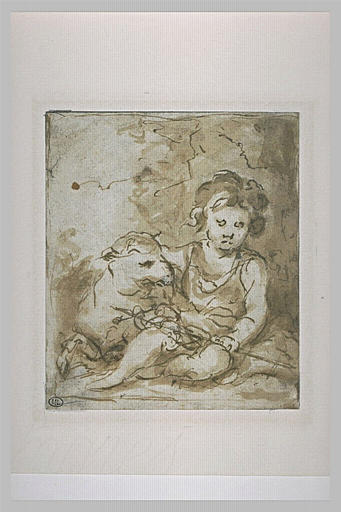
St. John the Baptist with a Lamb by Bartolome Esteban Murillo
“St. John the Baptist with a Lamb” by Bartolome Esteban Murillo, painted around 1670, is a quiet, intimate vision of one of Christianity’s most recognizable saints. Unlike the grand altarpieces and glowing canvases that often come to mind when we think of Murillo, this work is a small, monochrome drawing in brown ink wash. Yet in this modest format the Spanish Baroque master condenses his gift for tenderness, storytelling, and spiritual suggestion into a remarkably simple scene.
The composition presents a young boy seated on the ground, gently holding a lamb that nestles at his side. The child is St. John the Baptist, shown long before his adult mission of preaching repentance in the wilderness. Murillo strips away theatrical drama and instead concentrates on the symbolic friendship between boy and animal. The result is a work that feels both devout and deeply human, offering a quiet meditation on innocence, sacrifice, and destiny.
For viewers and art lovers interested in Murillo’s religious imagery, this drawing provides a valuable glimpse into his working process and his ability to create emotional impact with just a few strokes of brush and pen.
The subject: a child saint and the Lamb of God
St. John the Baptist is one of Murillo’s favorite subjects. In large altarpieces he often appears as a rugged young man, clothed in camel hair and pointing toward Christ. Here, however, John is still a child. Barefoot and simply dressed, he sits on a rocky patch of ground, one arm wrapped around a lamb whose head rests calmly in his lap.
The lamb acts as the key symbol for understanding the image. In Christian iconography it stands for Christ as the “Agnus Dei,” the sacrificial Lamb of God. By associating the child John with the animal, Murillo foreshadows the moment in the Gospel when John will point to Jesus and proclaim, “Behold the Lamb of God.” The drawing therefore links childhood innocence with future sacrifice and redemption.
At the same time, the companionship between boy and lamb reads as genuinely affectionate. The saint does not merely display the animal for symbolic purposes; he cradles it, his body slightly curved toward it. Murillo thus fuses doctrinal meaning with an everyday feeling of care that any viewer can recognize, even without a theological background.
Composition and focal points
Murillo organizes the drawing around a tight, pyramidal grouping of figures. The boy’s body creates a diagonal that runs from the lower left corner up toward his head, while the lamb’s rounded back and muzzle extend along a complementary diagonal. Together they form a compact unit that stands out clearly against the pale, loosely brushed background.
The saint’s face becomes the natural focal point. Murillo turns it slightly toward the viewer yet allows the gaze to drift downward, as if the boy is lost in thought rather than posing. The softness of his expression invites us to linger; there is no dramatic gesture, only a quiet awareness. The lamb’s calm eye echoes this mood, reinforcing the sense of gentle contemplation.
Around this central group Murillo leaves ample empty space. The background is suggested only with a few washes and rough indications of rock or earth. This deliberate sparseness pushes our attention back to the figures and gives the scene a contemplative, almost timeless quality. The drawing feels like a vision that has emerged briefly from the blank page.
Line, wash, and the beauty of economy
One of the most striking aspects of “St. John the Baptist with a Lamb” is how much Murillo achieves with very little. The medium appears to be pen or brush with brown ink and a light wash, possibly heightened with touches of opaque white. Rather than building up dense layers, he relies on quick, confident strokes and thin veils of tone.
The contours of the boy’s arms, legs, and face are drawn with a firm but flexible line. In places, such as the curls of his hair or the wool of the lamb, the line becomes sketchier and more energetic, giving a sense of texture without obsessing over detail. A few darker accents under the chin, around the eyes, and in the folds of the clothing are enough to model the forms and anchor them in space.
The wash provides the subtle gradations of light and shadow that bring the figures to life. Murillo floats translucent brown over the background and the shaded side of the bodies, leaving the paper bare in the highlights. This technique allows the light to feel natural and diffused, as if softly falling from above. Because the palette is limited, tonal contrast rather than color carries the emotional weight of the scene.
For anyone interested in Baroque drawing practice, this work functions almost like a masterclass in economy. Murillo suggests volume, texture, and atmosphere with remarkable efficiency. It is easy to imagine him using this type of study as a preparatory step for a larger oil painting, yet the drawing stands perfectly well on its own as a finished devotional image.
Emotion, gesture, and the spirituality of tenderness
Murillo’s reputation in Spanish Baroque art rests largely on his ability to depict gentle, approachable religious figures. In “St. John the Baptist with a Lamb,” that quality appears in concentrated form. Nothing in the drawing feels harsh or theatrical. The saint’s slight tilt of the head, the relaxed posture of the lamb, and the casual crossing of the boy’s feet all contribute to a mood of softness.
The gesture of John’s hands is especially meaningful. One hand seems to steady the lamb, while the other loosely holds a slender staff or reed—a traditional attribute of the Baptist, often topped with a small cross. Even drawn with minimal detail, this reed points us toward John’s future role as prophet and herald of Christ. The combination of protective embrace and symbolic staff turns the child into both shepherd and herald, a figure who cares for the lamb yet also announces its sacrificial destiny.
Instead of radiating ecstatic piety, the saint looks introspective and almost shy. Murillo avoids a pronounced halo or other overt signs of sanctity, relying instead on the inner feeling conveyed by the face and posture. This understated approach makes the spiritual message more accessible: holiness is shown as quiet compassion rather than distant majesty.
Murillo’s vision of youth and innocence
Throughout his career Murillo painted and drew children—street urchins, angelic putti, and youthful saints alike. He had a particular gift for capturing their combination of vulnerability and liveliness. In this drawing, John’s slightly oversized head, short limbs, and uncertain gaze remind us that he is still very young. Yet his calm demeanor and thoughtful expression suggest an awareness beyond his years.
By presenting the Baptist as a child, Murillo invites viewers to consider spiritual vocation as something that begins in the heart long before adult responsibilities. The saint’s closeness to animals and to nature aligns him with innocence and simplicity, qualities that the Counter-Reformation Church often encouraged believers to imitate. The drawing thus functions not only as an illustration of a biblical figure but also as a gentle moral example.
The choice of a small, intimate format reinforces this message. Unlike a grand altarpiece intended for a public chapel, this sheet would likely have been viewed at close range, perhaps in a private collection. Its scale encourages personal contemplation, almost like holding a prayer card or devotional print in the hands.
Spatial setting and implied landscape
Although the background of “St. John the Baptist with a Lamb” is barely indicated, Murillo hints at a wider environment. Behind the child we see irregular patches of wash and a few lines that suggest rock formations or a rough hillside. The ground under his feet is uneven, with a sense of outdoor space rather than an interior.
This subtle landscape context connects the scene to John’s later life in the wilderness. Even in childhood we find him outside the orderly world of cities and houses, already associated with the natural environment where he will one day preach. Murillo does not need to articulate every tree or stone; a few well-placed shadows are enough for the viewer to imagine the dry hills of Judea.
The openness of the setting also allows the composition to breathe. The surrounding emptiness, lightly washed with tone, frames the intimate moment between boy and lamb as if it were taking place in a vast, quiet world. That sense of space deepens the contemplative mood and prevents the drawing from feeling cramped despite its small size.
Comparing this work to Murillo’s painted St. Johns
Murillo returned to the young John the Baptist many times in oil. In those canvases the saint often appears more robust and theatrically lit, sometimes pointing toward the heavens or holding a banderole inscribed with “Ecce Agnus Dei.” Rich, warm colors and glowing flesh tones give those paintings an unmistakably Baroque splendor.
By contrast, this monochrome drawing reveals a more intimate side of the artist’s imagination. Here John is less a heroic prophet and more a contemplative child. There is no strong spotlight, no dramatic gesture toward the viewer. Instead Murillo relies on soft tonal transitions and modest body language to convey the saint’s inner life.
Seeing the drawing in relation to the paintings highlights Murillo’s versatility. He could adapt the same subject to different formats and audiences, ranging from grand public altarpieces to delicate works suited for private devotion. For modern viewers, the drawing is particularly interesting because it may preserve ideas that were later transformed, elaborated, or simplified when he worked on larger commissions.
Devotion, drawing, and the seventeenth-century viewer
In seventeenth-century Spain, drawings like “St. John the Baptist with a Lamb” had multiple possible functions. They served as preparatory studies, collecting motifs and poses for future paintings. They also sometimes circulated among connoisseurs and patrons as valuable works in their own right. The small scale and fragile medium made them especially suited to personal, domestic spaces.
For a devout viewer of Murillo’s time, this sheet could have offered a focus for prayer or reflection. The child saint, seated quietly with his lamb, would encourage meditations on humility, innocence, and the mystery of Christ’s sacrifice. The modest materials—ink and wash on paper—align with themes of simplicity and poverty, echoing the values promoted by many religious orders of the period.
At the same time, the drawing would showcase Murillo’s technical skill to collectors. His ability to create volume, emotion, and atmosphere with such limited means would have been admired by fellow artists and patrons alike.
Why “St. John the Baptist with a Lamb” still matters today
For contemporary viewers, “St. John the Baptist with a Lamb” remains compelling for several reasons. First, it offers a more relaxed, humanized image of a saint who is often depicted in stern, fiery terms. Here John is approachable, almost like a child we might meet in everyday life, yet quietly marked by his future calling.
Second, the drawing demonstrates how powerful simplicity can be. In an age saturated with color and digital effects, Murillo’s restricted palette and economical line work feel refreshing. The lack of visual noise allows us to focus on the emotional core of the image: a child and an animal sharing a moment of trust.
Third, the drawing enriches our understanding of Murillo’s wider body of work. Many visitors encounter him through his famous canvases of the Immaculate Conception or street children in Seville. This sheet adds another facet—a glimpse into the artist’s private, exploratory side, where he tested compositions and moods with quick, sensitive strokes.
Finally, the scene’s themes are timeless. The bond between human and animal, the vulnerability of childhood, and the quiet acceptance of future hardship all speak across religious and cultural boundaries. Whether one approaches the drawing from a spiritual, historical, or purely artistic perspective, it offers layers of meaning to contemplate.
Conclusion: a quiet masterpiece in miniature
“St. John the Baptist with a Lamb” may be small in scale, but it encapsulates many of the qualities that make Bartolome Esteban Murillo one of the great masters of the Spanish Baroque. With nothing more than ink, wash, and paper, he creates a scene of remarkable tenderness and depth. The child saint, gently cradling the lamb that foretells Christ’s sacrifice, embodies both innocence and destiny. The limited palette and simplified setting focus our attention on expression and gesture, allowing a profound sense of calm and devotion to emerge.
For anyone exploring Murillo’s art, this drawing is worth lingering over. It shows how a modest devotional image can carry as much emotional resonance as a large altarpiece, and how an artist steeped in Baroque drama can also excel in quiet, meditative modes. In its understated way, “St. John the Baptist with a Lamb” stands as a testament to the enduring power of drawing and to Murillo’s unique ability to translate faith into human warmth.
